This February, Paris hosts Animals in the City, an urban ecology conference that brings architecture, art, and posthuman theory into sharp dialogue. Taking place at the Fondation Cartier pour l’art contemporain, the event explores how cities might evolve when animals are no longer seen as outsiders, but as active agents within urban life.
Urban ecology conference at Fondation Cartier
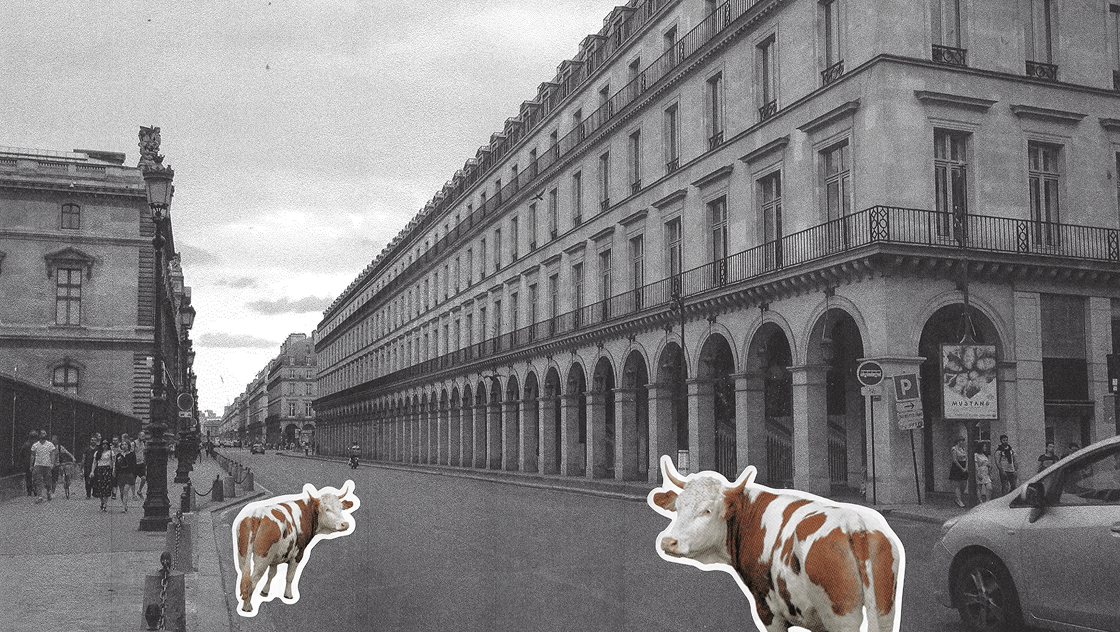
Held on Wednesday, 4 February 2026, at 18:00, the conference unfolds at Studio Marie-Claude Beaud, Fondation Cartier, Paris. Borrowing its title from a visionary concept developed by Andrea Branzi and Stefano Boeri, Animals in the City revisits a radical urban plan that imagined releasing thousands of animals—sacred cows and monkeys—into the parks and boulevards of Paris.
Far from provocation alone, the conference examines the porous boundary between city and nature at the intersection of arts, design, technology, and ecology, questioning how urban planning can foster new forms of multispecies coexistence.
Stefano Boeri and the postnatural city
Among the key participants is Stefano Boeri, architect and urban planner, and president of Triennale Milano. His long-standing research into biodiversity and metropolitan systems underpins the conference’s central theme: rethinking the city as a living ecosystem rather than a purely human construct.
Bas Smets on architecture and living systems
Architect and landscape designer Bas Smets presents Toward a New Alliance Between Architecture and Nature, drawing on recent projects including Building Biospheres in Venice and LUMA Parc des Ateliers in Arles. Smets proposes architecture as a “habitable milieu,” where built environments and living systems co-produce atmospheres capable of sustaining plant, animal, and human life.
Animals in the City: exhibition at Galerie Valois
Extending the conference into the public realm, the exhibition Animals in the City is on view until February 28th, 2026, at Galerie Valois, presented by the Fondation Cartier in partnership with RATP. This project features a series of collages created between 2008 and 2023, reimagining Paris through unexpected animal presences woven into its iconic architecture.
The project traces three stages of reflection on urban life, proposing a form of “cosmic hospitality” that invites biodiversity into the heart of the city. Both playful and critical, the exhibition offers a visual counterpart to the conference—one that reframes the metropolis as a shared territory for human and non-human life alike.
We invite you to read our interview with Béatrice Grenier, Director of Strategic Projects and International Programs at the Fondation Cartier pour l’art contemporain, who considers the museum as both a physical and conceptual space. She discusses her early influences, the role of architecture, and how curatorial vision can shape cultural futures.
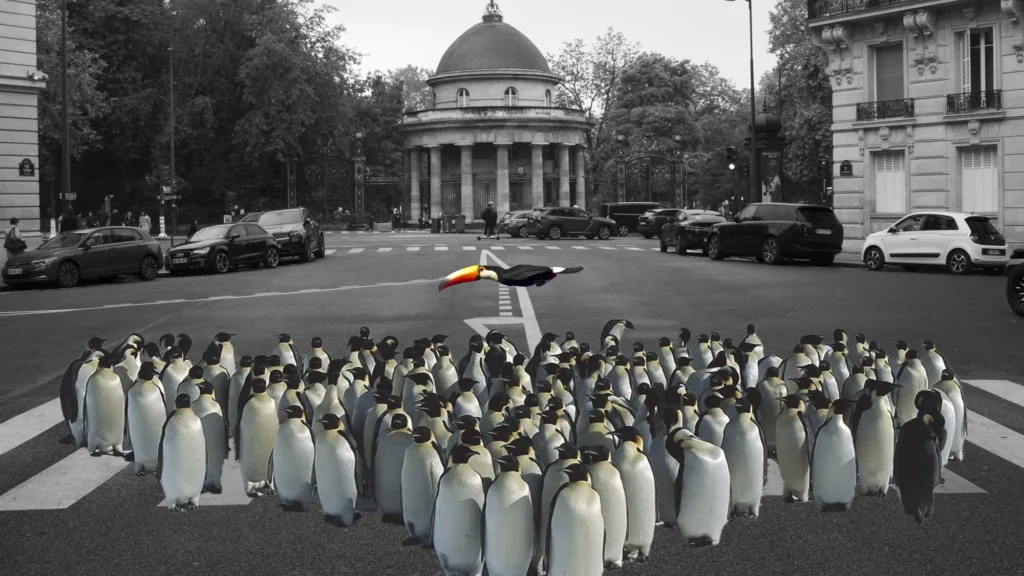
Animal City, 2023
Courtesy of ADAGP, Paris, 2025 © LEONE LOCATELLI ET BERNARDO MIGONE