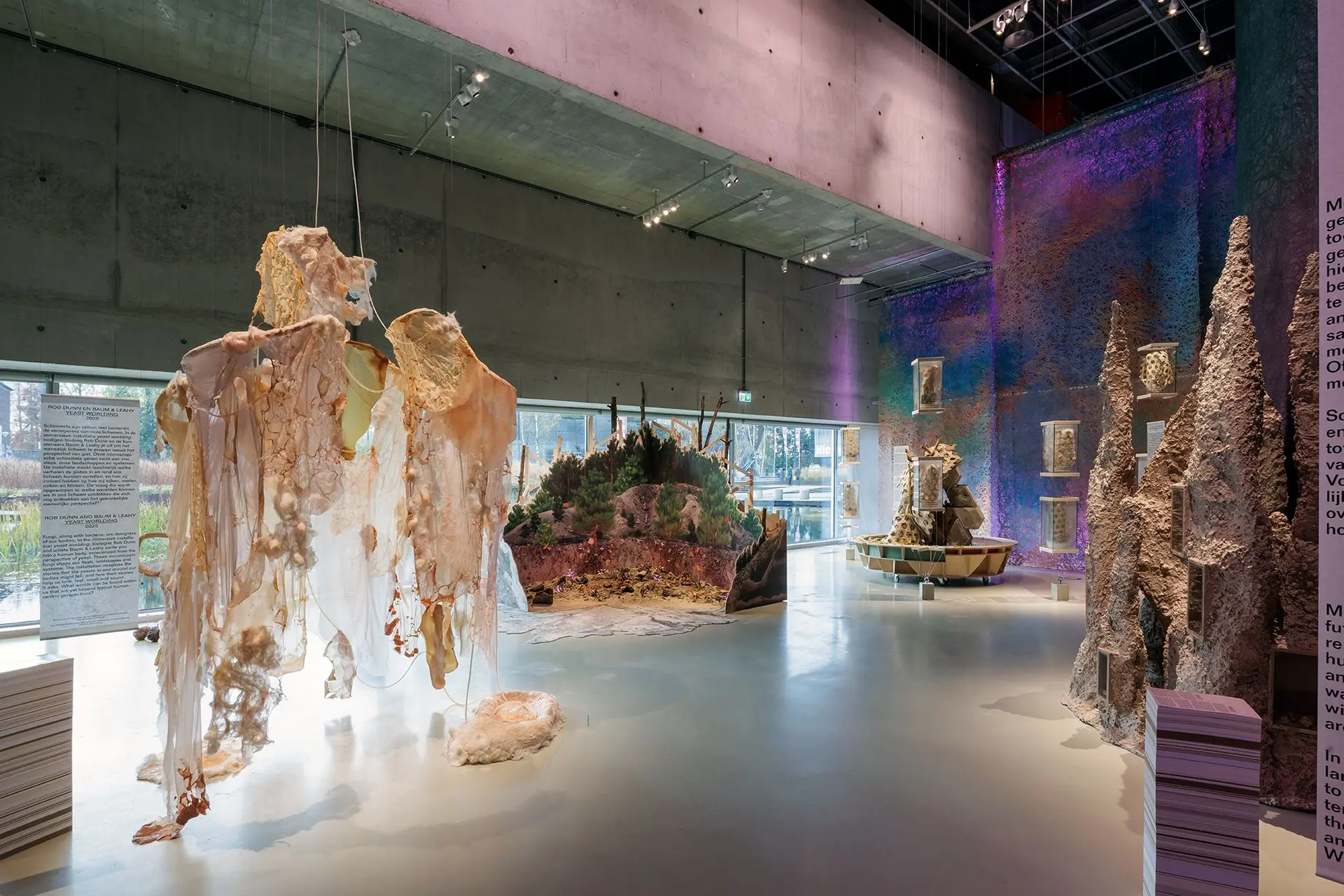
On view from November 21st, 2025 to August 9th, 2026, FUNGI: Anarchist Designers is a thought-provoking design exhibition that radically reconsiders humanity’s relationship with nature. Rejecting the familiar language of sustainable design, the exhibition positions fungi as autonomous agents and unexpected collaborators, opening a bold conversation around post-human design and shared ecological futures.
A design exhibition beyond human control
Curated by anthropologist Anna Tsing and designer Feifei Zhou (terriStories), the exhibition departs from conventional narratives that frame fungi as merely useful materials. Instead, it presents moulds and mushrooms as unruly, living forces that flourish in complex, multi-species systems—often in environments shaped by colonialism, industrialisation, and capitalism.
Rather than showcasing polished mycelium objects or eco-friendly design solutions, the exhibition challenges the ideology of endless growth and human mastery. Fungi appear here as co-designers: uncontrollable, adaptive, and capable of dismantling systems built on exploitation.
Sustainable design reconsidered through anti-design
Labelled by its curators as an exploration of “anti-design,” the exhibition critically reframes sustainable design itself. Fungi are shown not as neutral resources, but as organisms that expose the fragility of human-made systems. Their presence questions whether sustainability can exist without addressing deeper ecological and political entanglements.
Works throughout the exhibition reveal how fungi operate across vastly different scales—from household appliances and hospital environments to plantations, forests, and the human body—highlighting their role as both disruptors and connectors within global ecosystems.
Inside the exhibition: three narrative spaces
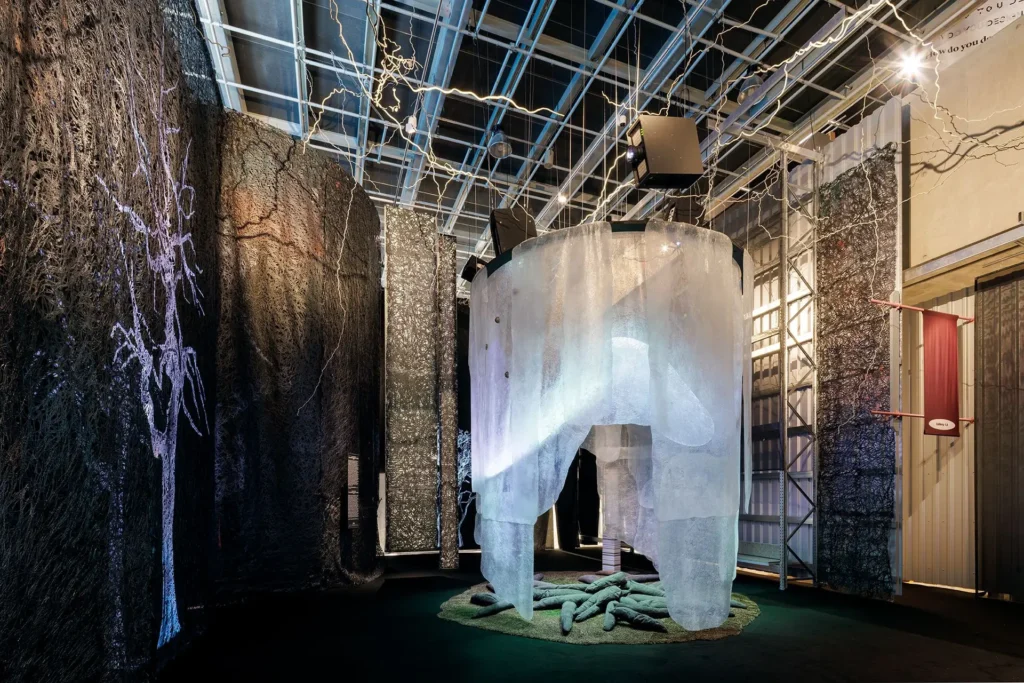
The exhibition unfolds across three distinct rooms, each designed by Feifei Zhou to represent a different role fungi play in the world. Together, they guide visitors through a gradual shift in perception, from human-centred thinking to a more entangled, post-human awareness.
One section examines how fungi thrive within industrial ruins. A standout installation traces the spread of coffee rust across Latin America, demonstrating how monoculture farming unintentionally enables fungal outbreaks that can destabilise entire economic systems.
Another space explores fungi’s role in environmental circulation, including an installation investigating radioactive fungi in post-Chernobyl landscapes. By following the movement of contaminated truffles through wild boars and ecosystems, the work reveals how fungi perpetuate invisible cycles beyond human control.
A new way of thinking design
FUNGI: Anarchist Designers ultimately proposes fungi as teachers rather than tools. By foregrounding their capacity to resist control, adapt to ruin, and form unlikely alliances, the exhibition invites visitors to rethink design as a collaborative, unstable, and deeply ecological practice—one that extends well beyond the human.

FUNGI: Anarchist Designers
Photography by AAD HOOGENDOORN