vulnerability hangover Thomas Houseago

Vulnerability hangover: rebuilding the self through sculpture

In the deliberate paintings of Francis Bacon and his predecessor Vincent van Gogh, it can feel as if the act of creativity was as much cathartic as it was cataphoric—the brushstrokes and brilliant colours touching while appearing to tear the canvas open like a wound. Their respective portraits and landscapes conjure a sense of foreboding that laces the works with an aesthetic acid. Even Van Gogh’s sunflowers appear charged with a greater intensity. Writing to his brother Theo while suffering from self-doubt, he confessed with characteristic candour: “What would life be if we hadn’t courage to attempt anything?” The light that filled his room, his kitchen, and the corridors of his house became a source of inexhaustible inspiration—something capable of eclipsing darkness and death. Yet those same energies, both decent and devastating, proved essential to the paintings we now recognise as among the most visionary in modern art: forces able to hold the world together even as they threatened to pull it apart. As Van Gogh insisted elsewhere, “though I am often in the depths of misery, there is still calmness inside me.”

That extraordinary tension—between sorrow and salvation, ruin and originality—fuels the work of the British-born, Los Angeles-based artist Thomas Houseago. For more than three decades he has pursued a practice that buries its demons whilst dancing with them in daylight. Working with materials such as clay, plaster, rebar, bronze and raw pigment, Houseago constructs skeletal frameworks for his monumental figures—forms that appear ancient and authoritarian, as though emerging from the canvases of Picasso rather than from the conventions of sculpture. They carry the weight of the human body, but also its fractures: masks that stare into space, torsos held together by visible seams, surfaces that seem less finished than fought for. Autobiographical or aggressors, they appear like spirits made flesh, haunting his works.

Houseago’s new exhibition Journey at Xavier Hufkens arrives after a period of prolonged personal rehabilitation for the artist. In many ways the exhibition continues a process that began with Recovery Works (3 September – 10 October 2020), Houseago’s previous presentation with the Belgian gallerist. Six years on, the title suggests movement, though not only in a physical sense. Rather, it evokes an internal journey—through uncertainty and the sensations of rebuilding oneself. If the new works appear both monumental and more measured, they carry within them Houseago’s enduring interest in scale and a persistent anxiety that fluctuates between feeling something and fighting against it. Seen together, the sculptures read as evidence of an artist confronting his own incarnations to reveal his fears, manifest as recurring emblems of deep-rooted expression.

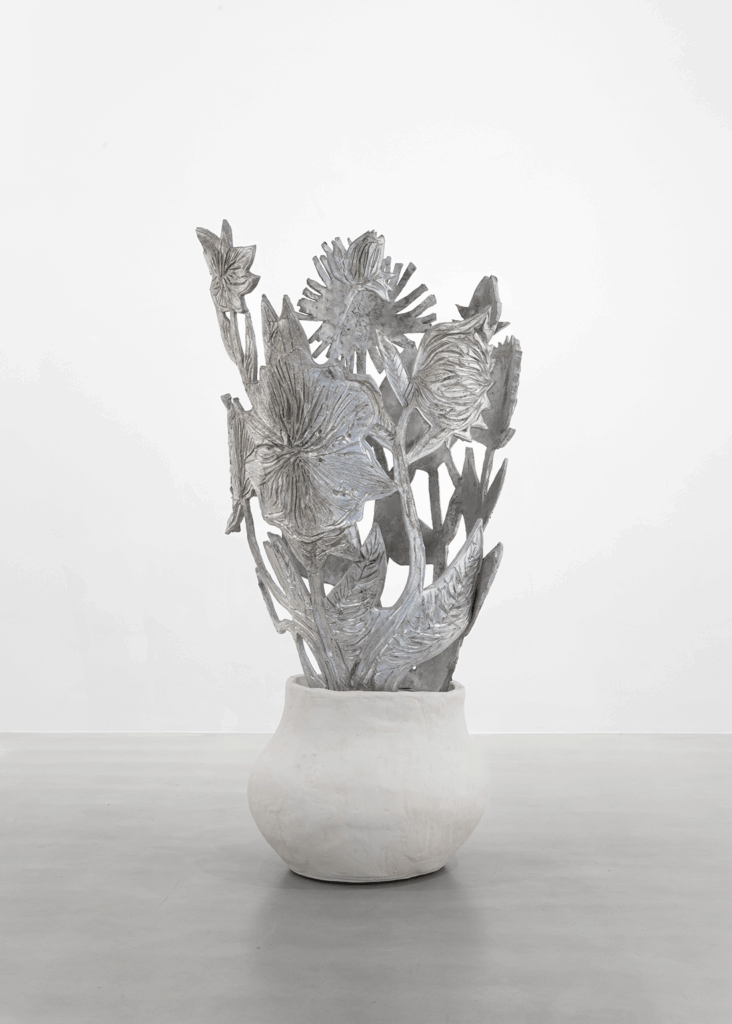
In conversation, Houseago reflects on a journey—as Van Gogh before him—of seeing and explaining everything with such intensity that it bleeds from his heart and hands into these contoured forms: the standing or striding figure, the body as both subject and structure, the Minotaur, the moulding labyrinth, and the twisted flowers. For all their brutal honesty, Houseago’s works still carry an impossible beauty.

Yet any sense of triumph in returning from the darkness remains complicated. As Houseago explains, relief is often followed by what he calls a “vulnerability hangover”—the emotional aftermath that lingers after moments of profound exposure. “It’s that feeling,” Houseago says, “when you’ve opened yourself completely—in the work, in life—and afterwards you’re left with the echo of it.” Like a long shadow tracing the artist’s return to sculpture, that defencelessness persists within the works themselves: figures that appear wounded yet resilient, their surfaces bearing the visible traces of their making. If Journey suggests movement, it is not a passage away from failure but deeper into it—an acceptance that creation itself often begins where certainty ends, and that the artist sometimes has to persist in the wake of such exposure. Impassioned, Thomas Houseago reflects on his passage back into sculpture—and on the forces that have fashioned his art.

Rajesh Punj: Striding Man—can we open with him?

Thomas Houseago: That sculpture really begins at the beginning, because I had stopped sculpting. After my breakdown I didn’t want to be a sculptor anymore—I didn’t want to make art at all. I stopped for years. There was a moment when you were meant to interview me when the works were at the Royal Academy.
vulnerability hangover
Thomas Houseago
vulnerability hangover
Thomas Houseago
vulnerability hangover
Thomas Houseago
vulnerability hangover
Thomas Houseago
vulnerability hangover
Thomas Houseago
vulnerability hangover
Thomas Houseago
vulnerability hangover
Thomas Houseago

Rajesh Punj: Yes.

TH: Everything collapsed around that time. The Royal Academy was a very hostile experience for me—much worse than I expected. I thought I had prepared myself for the worst, but it was worse than that. Part of it was also where I was mentally at the time. I was very triggered. I’m from the north of England, and in the 1970s and ’80s that meant something very different from what people imagine now. Today there’s this idea that the North is cool, but the reality was often very hard. That sense of hardness stays with you on a cellular level. It creates a feeling of betrayal that’s difficult to shake off.

My breakdown was tied to many things—including confronting the whole Jimmy Savile scandal that I had lived through growing up. It took forty-eight years for that to fully move through my system. Then there was the death of my father and other personal losses. It all accumulated. At that time, I was starting to completely unravel.

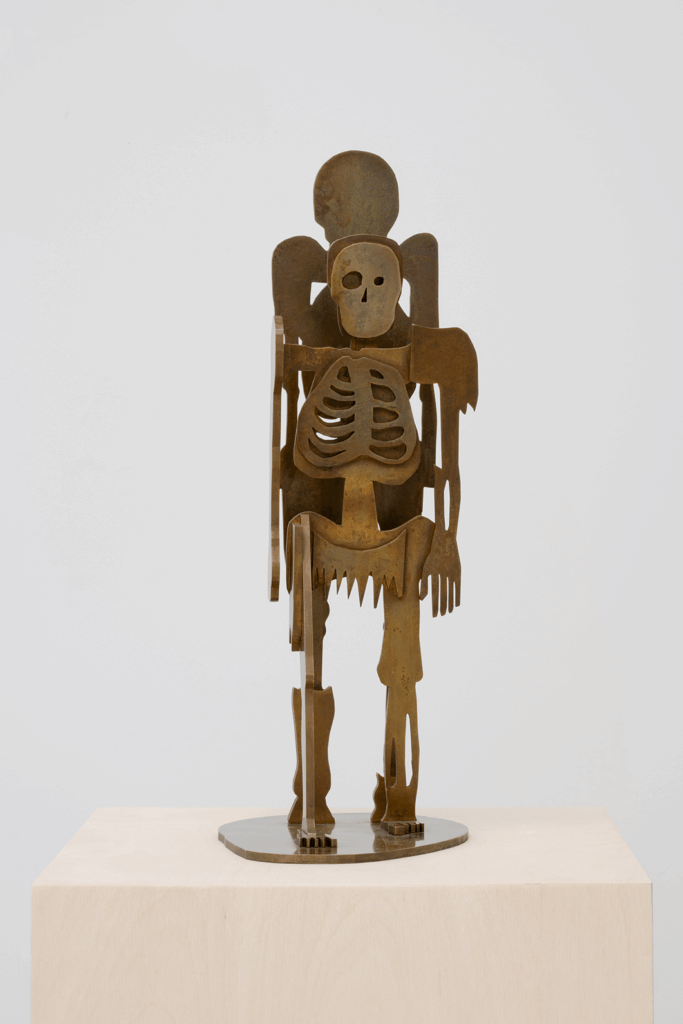
The sculpture you’re referring to is connected to the man who treated me during that period. He was a mental-health professional, but his approach was very radical. It wasn’t just about locking you in a room and medicating you. Of course, there were medical elements, but he also believed deeply in dignity—that you have a right to remain yourself even when you’re ill. He used to say: there are beautiful things inside you that you’re throwing away with the pain. His goal was not simply to stabilise me, but to help me reconnect with what I was capable of. Gradually, he guided me back toward sculpture. It was very strange and frightening at first—almost surreal to begin again after so long. That piece was the first sculpture I started working on again. Then, unexpectedly, he died at the age of forty-eight. Thankfully he had helped me enough by that point that, in some strange way, I was able to survive losing him. He always insisted that his patients should never feel dependent on him. He would say: my job is that one day you’ll know you can live without me. I used to joke with him, “Yes, but you’re not going anywhere, right?” In hindsight it almost felt as if he knew.

He was a very spiritual person, although he didn’t look like what people imagine when they think of that. Often the most extraordinary people appear very ordinary. When the sculpture arrived here, after being on my ranch in Malibu for so long, it suddenly looked completely different. At the ranch it sits outside among trees, birds, snakes—everything is very raw and open. But when I saw it here in the gallery space, Paul immediately said: “This sculpture is different here.” The shadows change it, the room changes it. I suddenly started seeing things in the work that I hadn’t noticed before. In a way it’s the most mysterious sculpture in the show. There’s also a film where you see me working on it. At one point I cut across the face of the sculpture, and the filmmaker Andrew Dominik stopped the shoot because he thought I was about to destroy the piece. The sculpture has carried this strange, almost mystical energy from the beginning. After Danny Smith died, I felt something very unusual emotionally—as if he had somehow become part of the work. Danny represented unconditional love for me. He taught me what that meant. That’s why when you pointed out the heart in the sculpture, it shocked me a little. Because in some strange way it feels as if he’s still present there.

RP: When I think of your work, the artists that immediately come to mind are Van Gogh and Francis Bacon, and the Van Gogh and Britain exhibition at Tate Britain in 2019, where they were shown together. Of the three Van Gogh-inspired Bacon works of the Dutch painter having painted himself into a landscape—specifically The Painter on the Road to Tarascon (1888), which Bacon called “a phantom on the road”—what did you make of them, and of Bacon’s interpretation of those works?

TH: I was in London at the time and saw those three paintings at the exhibition—three of my absolute favourite Francis Bacon works. Seeing them together at the end of the show was overwhelming. I went with a friend, he was crying; the exhibition was bringing up all sorts of emotions for him—the mother, the child, the angels he said he saw in the clouds. He was having his own kind of psychedelic experience. I suppose I was having mine too. Then we reached those three paintings, and you could have made an entire exhibition on Bacon’s paintings based on Van Gogh on the Road to Tarascon. They’re that powerful. Afterwards I went back and looked again at the sculpture Giant Striding Figure (2025), and suddenly I thought: that’s Van Gogh on the road to Tarascon.

If you look closely, the figure almost seems to be carrying something—and in the Van Gogh painting he’s carrying his paintings. Since then, we’ve all been slightly obsessed with that image. Even the shadow of the sculpture resembles the Van Gogh figure. I’m still trying to understand that piece. I only arrived here two days ago and seeing it in this space is completely different from seeing it in Los Angeles.

RP: The light here must change it. The space as well.

TH: Yes, completely. The light in Los Angeles is dominating. I work outside, usually in the mornings before it gets too hot. But then there’s a moment when the sun becomes so intense that you almost can’t see anything. The shadows become incredibly sharp. That’s why the film industry loves Los Angeles—those dramatic contrasts are perfect for cinema. But for sculpture it can be disorienting. Everything turns into a silhouette. You lose the subtlety of the form. I like that disorientation sometimes, but that sculpture stayed with me for a long time. Other works came and went, but that one remained. It felt personal. When Danny died, I had a choice. I could stop working entirely—just walk away—or I could try to stay connected to him somehow. Not in a mystical sense necessarily, but through memory, through the way he had shaped me. When I meditated on it, the feeling I had was that he would never want me to stop. I held on to that sculpture for a long time. I kept saying it wasn’t finished. I didn’t send it to New York or anywhere else. Then Xavier Hufkens saw it.

I’ve known Xavier for almost thirty years. Our relationship is almost familial at this point—not just a professional gallery relationship. Thirty years is longer than I’ve known almost anyone, apart from my sister. Family is complicated for me. When you come out of severe trauma and abuse, your idea of family becomes very fractured. Only recently—largely because of Danny—have I begun to reconnect with those relationships and find a way toward forgiveness. But that sculpture carries a lot of that emotional weight. I should also say that I didn’t curate the exhibition myself. Paul Kahil and Anne Haack, who work closely with me, Simon Devolder—who works with Xavier and is a brilliant curator—and Xavier himself organised the show. I stepped back intentionally, because I knew the exhibition would be emotionally intense for me. It’s the first major show I’ve done since my breakdown, and in a way, everything is in it.

RP: That must be overwhelming. When I look at the work—especially the standing figure in the first room—there’s a sense of energy, even aggression in the way the form is built.

TH: Yes. Violence is an important part of the conversation. I grew up with violence. My body was damaged by violence when I was very young. That kind of experience changes everything—it affects not only the body but the soul, your very sense of origin. As I grew up in Leeds, that violence continued in different forms. At some point it becomes internalised. Without support structures or protection, you absorb it and carry it inside you. When I eventually entered the art world, I realised that I couldn’t relate to a purely cerebral form of art—the idea that the artist stands outside the world and analyses it calmly. My experience was different. Violence had already entered my system. When I discovered artists whose work carried that intensity—Chris Burden, Joseph Beuys, artists who placed the body and risk at the centre of the work—it resonated deeply with me. For me sculpture had to contain that energy.

I am asked sometimes why my work feels violent. But when I look at the world around us — the images we see every day—my work feels almost restrained in comparison. Artists like Goya understood this. When I look at the Black Paintings, I’m not disturbed—I’m reassured. Someone witnessed the horrors of their time and said: this exists. Art can be a form of witness. For me, the violence in the sculpture is personal. It comes from lived experience, but it is also an attempt to wake people up—to confront the realities we often prefer not to see.

vulnerability hangover
Thomas Houseago
vulnerability hangover
Thomas Houseago

RP: Even in the techniques you use there seems to be a tension between control and release. When I think about your sculptures historically, it feels as though they are made very rapidly—almost in bursts of energy.

TH: Sometimes, yes. But my process is quite strange. I work constantly—seven days a week. It’s almost obsessive. Since my recovery I’ve become even more focused and productive. But the rhythm of making isn’t linear. I might work very intensely on a sculpture for three straight weeks and then not touch it again for months. That doesn’t mean it’s finished—it simply means the work continues in another way. Often, I’ll draw on the sculpture during that time. You may have noticed that some of the surfaces contain drawings. So, for a month I might only draw on the piece. Then I return to it physically and work intensely again. After that there might be another quiet period—perhaps I only make a few cuts with a chainsaw, very lightly, just thinking about the structure. Those small interventions can sometimes be more important than the big ones. It’s like a dance. That’s why I work on many pieces simultaneously. The eggs are next to the figures, drawings next to the sculptures, paintings nearby. Everything exists together in the studio, which can be quite disorienting for people who visit. Sometimes I paint landscapes or nature as well. That originally began as part of my therapy, but it has grown into something I genuinely love doing. It’s very grounding. My studio isn’t really the modernist idea of a studio—a place of linear progress. It’s more like a living environment. In some ways it’s closer to a treatment space than a traditional workshop.

RP: And the work is extremely physical as well. That physicality seems to carry a certain violence.

TH: But sculpture itself is violent. It goes against everything in our society. Every object around us has a function—a chair, a table, a cup. But a sculpture has no practical use. It exists purely as presence. In a world where everything is defined by utility and economic value, simply placing a useless object into the world can feel like a violent act. People assume that artists wake up every morning excited to make another sculpture. In reality it’s often the opposite. You wake up thinking: why am I doing this? It’s exhausting. It’s dangerous. It takes too much time. When I was raising my children as a single parent, I often questioned whether I should continue making work at all. You constantly hear the voices of the world asking: why is it so big? How will it ship? Who is it for? The pressure is always to make less—or to stop entirely.

RP: When you face that kind of pressure, do you ever think of artists like Van Gogh—working alone, carrying his canvases through the rain?

TH: Yes. That’s a great question. When I first became successful, I briefly believed that I had somehow become part of the system—that I finally belonged somewhere. But that illusion lasts maybe six months. Then you realise that artists are still fundamentally outside the system. You’re constantly under pressure, constantly alone. Someone said to me recently that my sculpture feels solitary. I hadn’t thought about that before, but it’s true. Especially since my recovery I’ve become very aware of the solitude involved in making work.

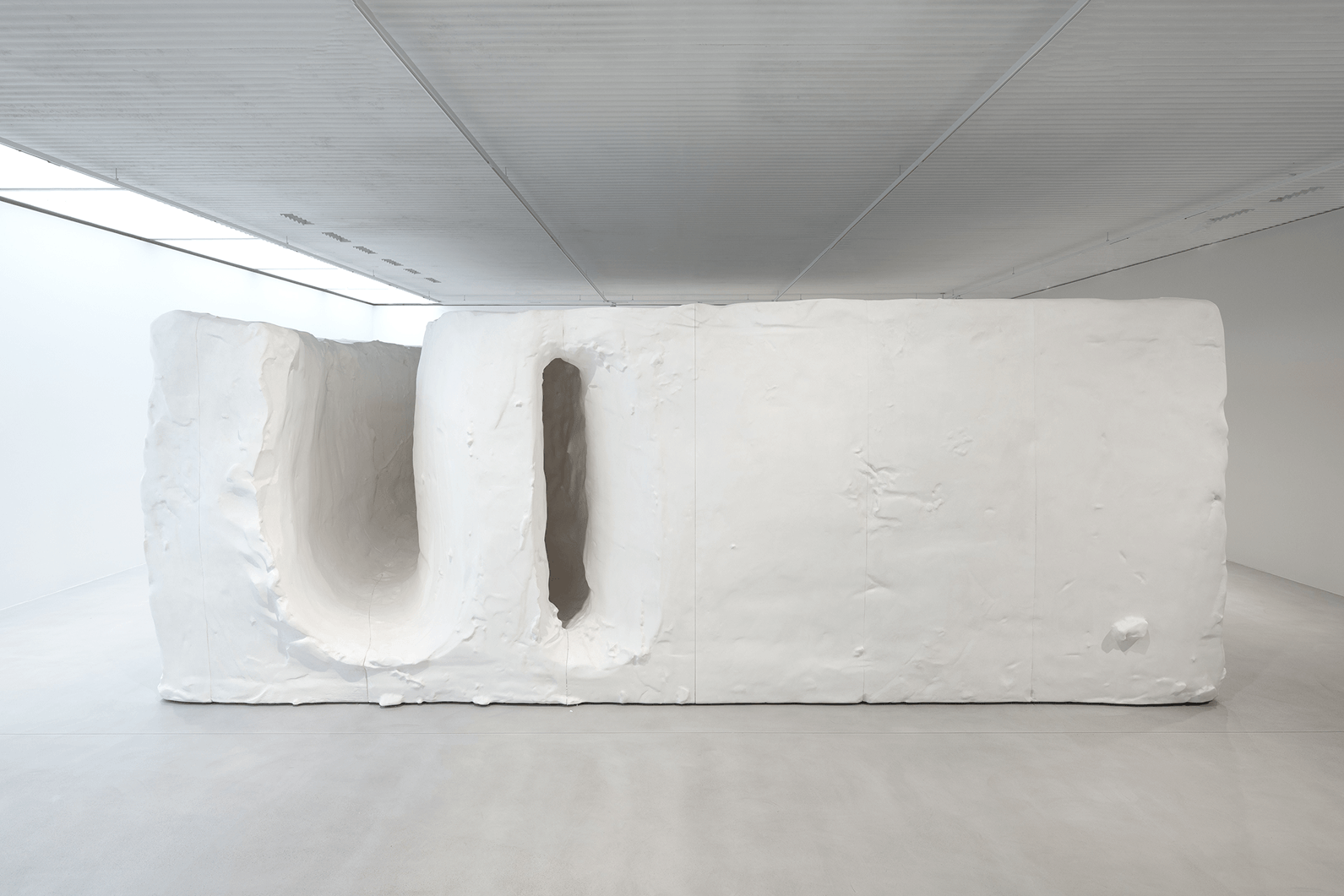
I’ve been working for nearly ten years on a huge project for the Los Angeles County Museum of Art. It’s a monumental sculpture—nearly two hundred feet long. The sculpture is called Beautiful Wall. I conceived it as a response to the rhetoric about building a wall on the US–Mexico border. Living in Los Angeles, where so many of my friends and collaborators are Mexican or immigrants, that rhetoric felt deeply offensive. So, I thought: if someone wants to build a wall, I’ll make a beautiful one—a wall that people can sit on, meet around, share shade beneath. But after years of work, you start to realise how political structures influence what can or cannot exist in public space. What I’ve learned is that the artist’s position is still very precarious. Even when the work exists—when the sculpture is physically there—you still have to fight for its presence. And in that sense, we may not be as far from Van Gogh’s time as we think. Artists are still working in a kind of avant-garde condition: often isolated, often misunderstood, and constantly negotiating the pressures of the world around them. In my first studio in Los Angeles there was this tiny door in the wall. I would sometimes hear music coming from the other side. One day, after drinking heavily—I was drinking a lot at the time—I decided to open it. On the other side of the door was Henry Taylor, sitting in a small room with this enormous can of warm beer he had bought in bulk from Costco. That was the first time we met. We started talking about music from the north of England—the Stone Roses, the Smiths.

It’s funny because the Smiths are huge in Los Angeles, especially within the Chicano community. Mexican gang culture in LA has this deep connection to their music—that melancholy, that yearning. I once asked Danny, who works with me, why that is, and he said it’s the sadness, the longing in the music. People recognise themselves in it. That moment with Henry was the beginning of many things.

It was also how I became connected to what eventually became the Underground Museum scene in Los Angeles. I came up in LA largely around Black artists and musicians because that was simply my social and economic reality at the time. I was working construction jobs then. I hadn’t come through Yale or any formal route into the art world. I was literally stealing plaster and iron from building sites at night so I could make sculptures. From the very beginning there has always been a struggle. And to be honest, that struggle never really disappears. Even now I still feel I have to fight for the work. If artists pretend that isn’t true, they’re lying—not only to themselves but to other artists. Because if you really believe in your work, in your experience, and in your vision of the world, then you must defend it. When I went through my breakdown a few years ago, almost everyone stepped away. The art world largely moved on. Had I died during that time—and I was very close to dying—it would simply have become part of the mythology of the artist. But there were a few people who stayed. Xavier Hufkens was one of them. He told my studio director: tell Thomas I’m here—I’m not going anywhere. Just get better.

The people who helped me through that time were often musicians and actors. They work in a life-based culture. Their presence matters while they’re alive. Visual art is different. In many ways it functions as a kind of death culture. An artist’s value often increases only after they die. Even Picasso, at the end of his life, was deeply hurt by the rejection of his late paintings. I once spoke to Pierre Daix, who worked closely with him, and he told me that Picasso was devastated. He felt betrayed by critics who could not trust the direction he was taking. So, the struggle between artists and the world around them has always existed. What worries me today is the dominance of entertainment culture. Much of contemporary politics functions like entertainment—constant stimulation, constant drama. Social media works in the same way. But culture—real culture—does the opposite. It slows you down. It asks you to stop for a moment and actually look, to feel what is happening. That’s why it’s so important that museums and artists continue to exist. They create spaces where we can step outside that constant stream of stimulation. A big part of my practice now is connected to healing—my own healing and the healing of others. Many people reach out to me privately about their own struggles with trauma or depression. The work I went through in recovery changed my life. I try to share some of those ideas with people whenever I can.

vulnerability hangover
Thomas Houseago
vulnerability hangover
Thomas Houseago
vulnerability hangover
Thomas Houseago
vulnerability hangover
Thomas Houseago
vulnerability hangover
Thomas Houseago
vulnerability hangover
Thomas Houseago
vulnerability hangover
Thomas Houseago

RP: In this sculpture, the figure also appears genderless.

TH: Yes, that’s very intentional. During my recovery I began to understand that identity—including gender—is often more fluid than we assume. In the studio I don’t experience myself strictly as male or female. I feel more like an energy moving through the work. That’s why I use certain elements very deliberately. The penis appears in some works almost as a symbol of trauma or menace rather than power. In other works, sexuality appears through different forms—flowers, eggs, organic shapes. Trauma itself isn’t gendered. When people speak about these experiences honestly, the boundaries between male and female often dissolve. What remains is simply the human condition.

There’s a meditation practice I learned during treatment that I often think about. You begin by observing your thoughts. Then you ask yourself: who is observing these thoughts? At first you might say, “I am.” But then you realise you can also observe your body. You ask again: where am I, if I can observe both my thoughts and my body?

Gradually you arrive at a strange realisation—that the observer itself is something beyond those identities. When I experienced that for the first time, I felt almost completely without gender, simply as a form of energy or awareness. That experience has stayed with me. It influences how I think about sculpture—about the body, about identity, and about vulnerability. You can see it in the form here. The body is fleshy, vulnerable, particularly in the belly. The stomach is very important to me. It’s where we feel instinctively—what we call a gut feeling. In many ways the gut is our first brain. That’s why the belly and the navel appear so often in my work. They are places where emotion, intuition, and physical experience all meet.

RP: There was something I wanted to ask you upstairs, and it’s almost an intrinsic question for all the artists I speak to—but perhaps much more interesting with you: your concern for beauty.

TH: Yeah—truth is beauty, beauty truth. I’m a Keats guy, right? That’s all you really need to know. I’m a truth-and-beauty guy. But truth is often ugly. The question is what happens when you really look at it, when you investigate it, when you’re able to stand with it rather than being completely inside it. I mean, I can tell you that there is trench warfare happening not far from here, and men are dying—being turned into mincemeat. But I can stand with that knowledge rather than deny it. I can say: I see it. And by seeing it, even just on a cosmic level, I can say, “I’m so sorry this is happening.” I can send my heart out in a strange way. I don’t pretend it isn’t there, and I don’t distract myself by saying, “Oh look, there’s a new movie out.” Instead, I sit with it. And once you sit with it, you can also make the flowers—for example—with that knowledge. For this show we decided to try to be gentle. Not too raw. Miami was a bit too raw—even for me it was like, whoa. We were really freaking people out. So here the idea was: let it be a gift. Let there be tenderness in it. Let those two things—the violence and the gentleness—exist in a kind of dance. Each floor gives you a slightly different experience. If you’ve had enough of that darker intensity, you can come into a space where it’s just about the act of looking.

When you’re in treatment and you’re in a very dark place, they teach you something called radical acceptance. You say: okay, that’s happening, I understand that. But in my home, I’m going to have a plant that I love. For me it’s sage. Native sage. There are also these native flowers that grow up in Malibu—unbelievably beautiful. You just can’t believe they’re simply there in the landscape. So, when you’re dissociating or you feel like you’re losing control, you focus on the flower. You keep saying to yourself: that flower exists right now. I’m looking at it. Do I think it’s beautiful? At first something inside you says, this is stupid, beauty is meaningless. You hear that cynical voice. But slowly you say to that voice: “I hear you. I understand you. But right now, I’m looking at this flower.” And gradually you begin to disappear into it. They call it a practice of nowness—radical nowness.

RP: I think of Wim Wenders, and his recent cinematic interpretation of nowness.

TH: That flower opened last night. That one hasn’t opened yet. That one is fully open. It’s a very childlike exercise, but once you learn to do it, it’s extraordinary. Danny taught me that. I had to learn it later in life. At school nobody taught us that kind of thing. They just said, you can’t do maths, you’re stupid, go into remedial class and shut up, and I had to relearn how to see. Then you look at a jar and suddenly you think that’s a beautiful jar. The flower becomes a shape. The jar becomes a silhouette. These simple sensory things start building an experience. At first, I was just painting the flowers, painting the moon. There’s a book about that period—about the breakdown and the paintings published by Editions Dilecta called Vision Paintings. But then I began to think maybe I could pull those images out of the painting. I started working with wax, treating it like a painting at first, then bending it, pulling it. There’s a lot of that play in this show. These rooms contain most of my themes in some form. But it’s also playful, and it comes out of how I was living. I was very domestic for years. I didn’t really have a studio—I worked at home with my kids around. It became almost a pre-industrial system, like the loom workers in Yorkshire.

My kids would say, “It’s weird… but it’s great.”

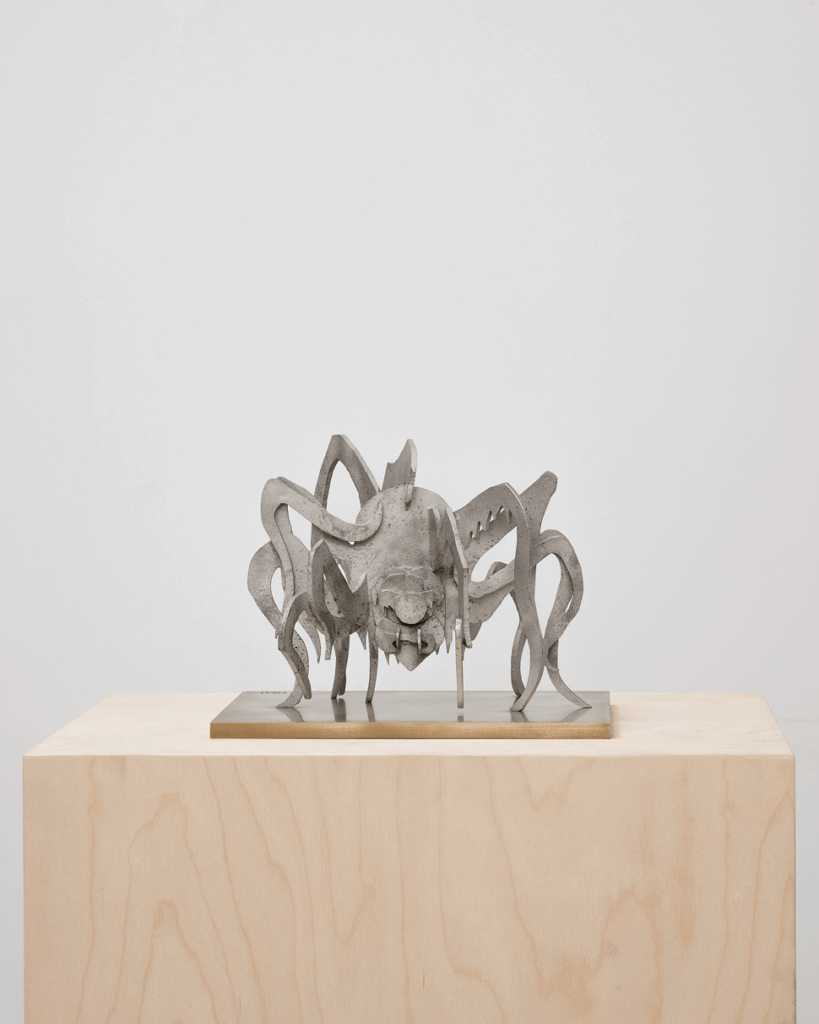
I worked on lots of little cardboard constructions with a glue gun, turning drawings into objects, playing with ideas. I’d see something on television, or remember a cartoon from years ago, and just morph it into something else. That’s very much what these works come out of. The Minotaur head, for example, began with a monitor in my studio in LA that I used to put things on—like a kind of Fellini prop. Then I visited the Picasso Museum in Málaga, where the director showed me something incredible: Fellini used to dream about Picasso. Whenever Federico Fellini had creative block, Picasso would appear in his dreams and give him ideas for films. Fellini even said, half-jokingly, Picasso was my producer. Those dreams eventually led him to make films like Satyricon. Picasso would say: go back to the Greeks. I started thinking about how artistic ideas travel through time—how they get passed on. It’s like an artistic family. I love reconnecting with that lineage. In this imaginative world nobody can tell you no. I can look at the Minotaur and say, “I’m going to make one of those—because I’m a sculptor.” Of course, in reality it’s hard work. The thing is heavy. You put it on your head, and you realise very quickly that myth is one thing and sculpture is another.

So, we work in a very luddite way. We use waste molds. That means you break the mold to reveal the cast—like an archaeologist uncovering bones. But if something goes wrong, that’s it. The piece is gone. There’s something about that natural order that I like. If you truly love the piece, the cast usually works. If you didn’t care enough, somehow you screw it up. And that’s just part of the process.


Words: RAJESH PUNJ

Images courtesy of THOMAS HOUSEAGO and XAVIER HUFKENS, Brussels  

Photography by THOMAS MERLE

ISSUE 8

Be the first to get the new issue