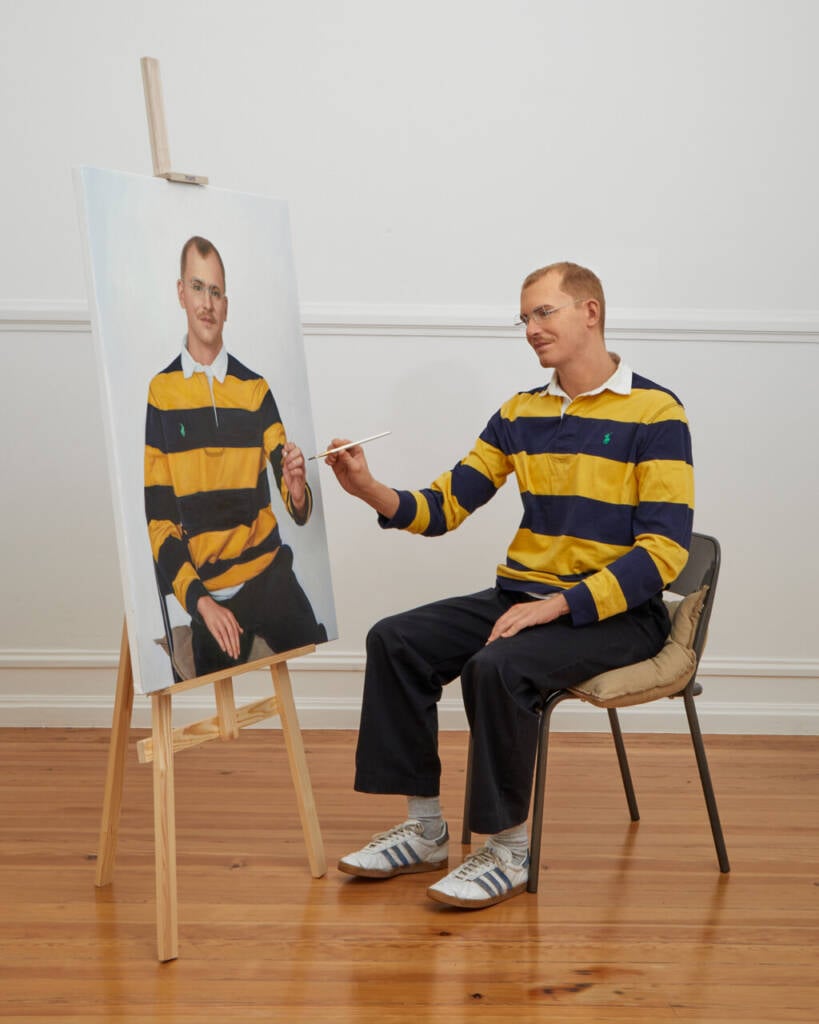
Self-Portrait, 2024
Oil on canvas, easel, chair, silicon, hair and textile; 178 x 100 x 152 cm
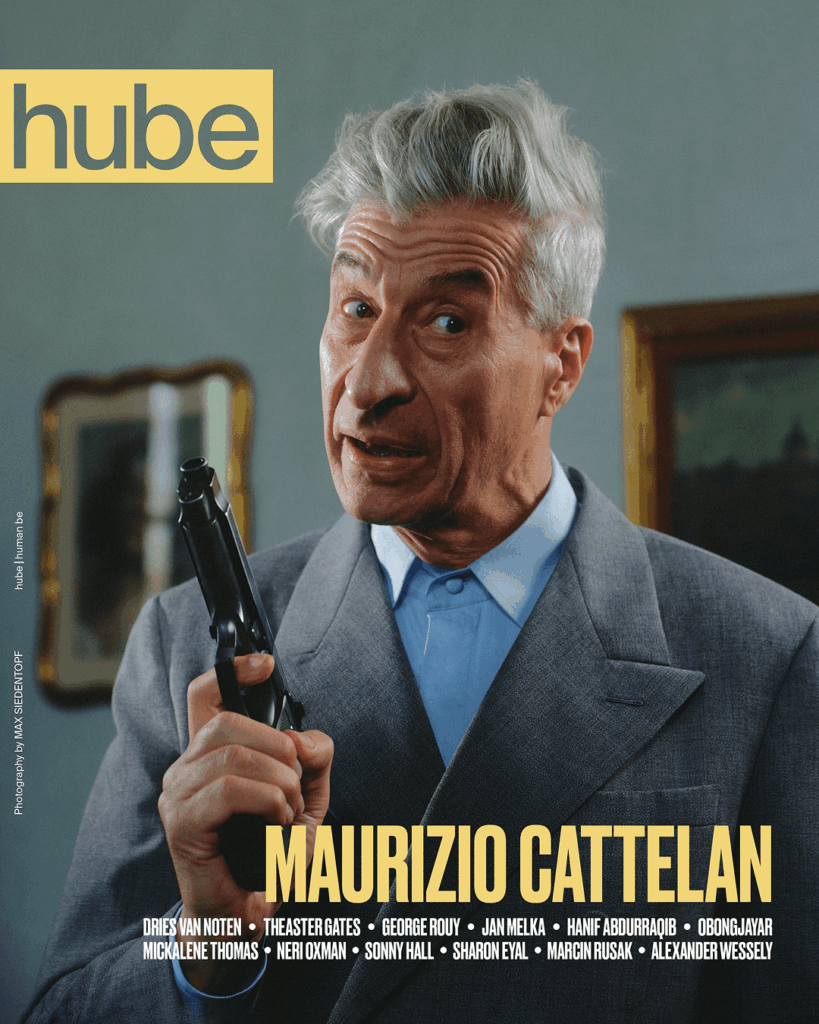
MAURIZIO CATTELAN
Photography by MAX SIEDENTOPF
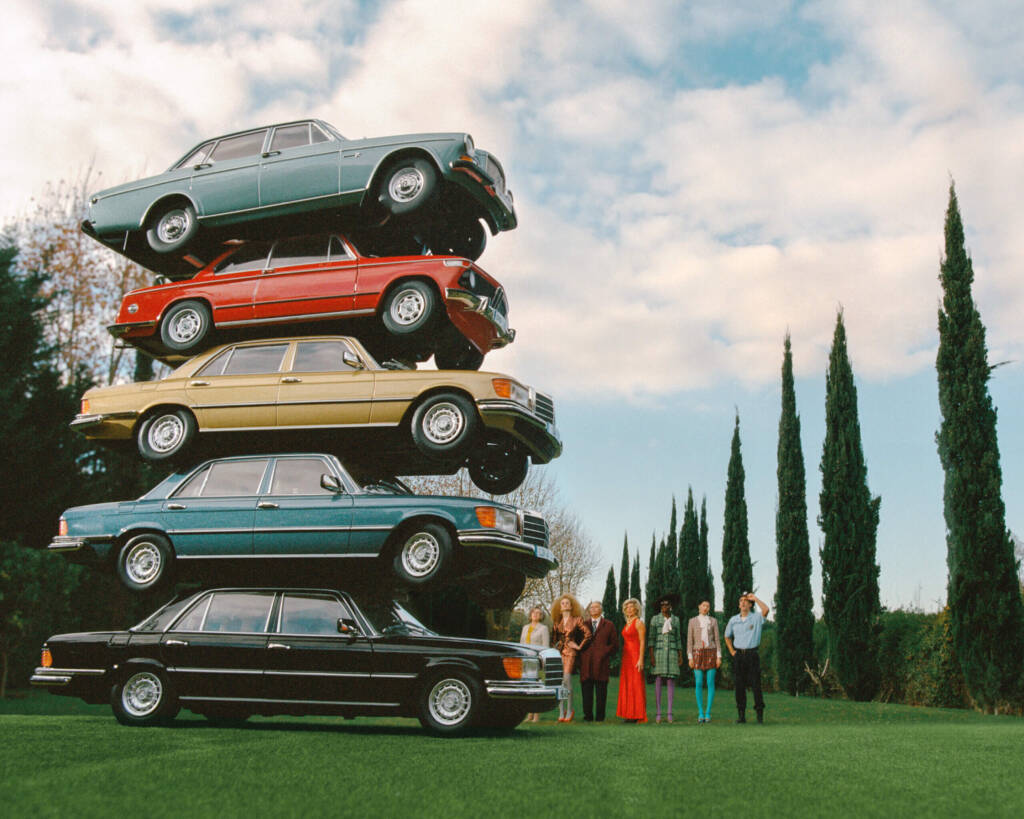
This Isn’t Where I Parked My Car
Max Siedentopf is an artist, photographer, and creative director whose work balances mischievous playfulness with quiet rigor. Moving effortlessly between sculpture, film, fashion, and the printed page, he has a rare gift for spotting the absurd in the everyday and elevating it without ever over-explaining. His approach is direct, intuitive, and unpretentious—an instinctive response to the world rather than a calculated position within it.
For hube’s upcoming Spring/Summer 2026 issue, we invited Max to shoot our cover story with Maurizio Cattelan. The pairing felt natural: both share a deep love of play, surprise, and subtle disruption. The resulting images—sharp, humorous, and tinged with mortality—capture a spirit of irreverent intelligence that defines both artists.
In this conversation with hube’s editor-in-chief, Siedentopf reflects on the instincts that guide his practice, the quiet disruptions he discovers in everyday life, and the ways he allows different strands of his work to collide.
Sasha Kovaleva: Let me start by saying—this is by no means flattery—but you are one of the most humble, thoughtful, and open to compromise photographers and art directors I’ve had the chance to work with so far. At first, I thought it was simply your personality that we should thank, but then I learned that you were a professional swimmer as a child. And I thought, of course—that must have shaped your character profoundly as well. I’m a runner myself, and some of my favorite words are “routine” and “discipline.” They help me stay grounded and mentally balanced. Do you find that the lessons from your swimming days still ripple through the way you work and live?
Max Siedentopf: Yes, absolutely, on a daily basis. During my teenage years, I was training around six hours a day and waking up at 4 a.m. every morning. It was incredibly demanding and required a lot of personal sacrifice, but I’m very grateful for that period. The work ethic it instilled in me is something I still carry with me today.
In many ways, sports and art sit on opposite ends of a spectrum. Art is deeply subjective—there’s no single right answer—whereas in sports, everything is measurable and brutally clear. You either touch the wall first or you don’t. Growing up in that environment shapes your mindset early: you learn to push yourself to the absolute limit, because effort and results are directly connected.
At the same time, there’s something almost meditative about it. I spent thousands of hours staring at the bottom of a pool, only to move from point A back to point A, repeating the same motion over and over again. That kind of repetition teaches patience, focus, and resilience.
Even though my work now lives in a much more subjective world, I still approach it with the same mindset—showing up every day, putting in the hours, and trusting that consistency will eventually lead somewhere—even if it’s back to point A.
SK: Growing up in Namibia must have been a unique experience. How did that environment shape your perspective on the world, and in what ways do those early years still influence who you are today?
MS: Growing up in Namibia was incredibly formative. It’s the second least densely populated country in the world, so you’re surrounded by vast amounts of space and nature, with very little external noise or distraction. In many ways, that creates a kind of quiet freedom.
As a child, a lot was left up to you. There wasn’t constant stimulation or endless options for entertainment—you had to invent things, find ways to occupy yourself, and learn to sit with stillness. Looking back, I think that was incredibly valuable. There’s something important about that kind of boredom. Boredom is where things begin—where your mind starts to wander.
This Isn’t Where I Parked My Car

This Isn’t Where I Parked My Car

This Isn’t Where I Parked My Car
SK: Tell us about your current exhibition in Seoul, Seriously NOT Serious, currently on view at GROUNDSEESAW. What can visitors expect to see, and is there a particular story or feeling you hope they take away?
MS: This exhibition will be the first time I’m bringing together a wide range of my work—sculpture, photography, film, fashion projects, and new pieces—into one space. In the past, I tended to keep these different worlds quite separate, almost as if they might contaminate one another. With this show, I wanted to let them coexist freely and see what happens when those boundaries dissolve.
A lot of the work is rooted in everyday life—ordinary objects, familiar situations, and the small absurdities we often overlook. I’m interested in slightly shifting those perspectives, just enough to make people pause. I’m less interested in delivering a fixed message than in creating a small disruption. If visitors leave seeing their surroundings with fresher eyes, or questioning—even briefly—why things are the way they are, then that’s already a success. And I think that early experience—being comfortable with space, with quiet, with not having everything immediately available—still influences how I think and work today.
SK: We just collaborated on a cover story with Maurizio Cattelan. When he confirmed the feature, I immediately thought you would be the perfect person to engage with him—he needed someone who loves to play as much as he does. Do you remember the first time you encountered his art? What was your impression, and how did you respond to his sometimes uncomfortably honest approach?
MS: The first time I encountered his work, it felt a bit like a child stumbling upon a trace of a long-lost father who had once stepped out to buy a pack of cigarettes and never came back. There was something strangely familiar in it, slightly uncomfortable, but deeply compelling.
SK: Speaking of dream projects, who else would you be excited to collaborate with?
MS: My daughter. Right now, she’s still a baby, but I know those will be the best collaborations.
SK: I’m curious to hear about your visual references and inspirations. Are there certain artists, movements, or works that consistently guide your eye and shape the way you approach a project?
MS: I’m very inspired by what you might call amateur culture—people who don’t necessarily consider themselves artists or creatives, but who, on their own terms, find inventive solutions to everyday problems.
There’s something very pure about that kind of creativity. It’s not burdened by references, trends, or the pressure to be “good.” It’s direct, intuitive, and often surprisingly original. I find that much more exciting than anything overly polished or overly considered.
SK: A crucial part of your work involves exploring and reinterpreting aesthetic forms. How do you perceive your relationship with the artistic traditions of the past?
MS: I try not to overthink it too much. Of course, I’m aware of artistic traditions and what came before me, but I don’t feel a strong need to position my work directly in relation to them. If you think about that too much, it can become quite limiting. Instead, I’m more interested in responding to what feels immediate and intuitive. Inevitably, everything you’ve seen and experienced feeds into your work in some way, but I prefer that to happen subconsciously rather than as a deliberate reference.

Photography by MAX SIEDENTOPF

Photography by MAX SIEDENTOPF

Photography by MAX SIEDENTOPF


More Is More, 2025

More Is More, 2025

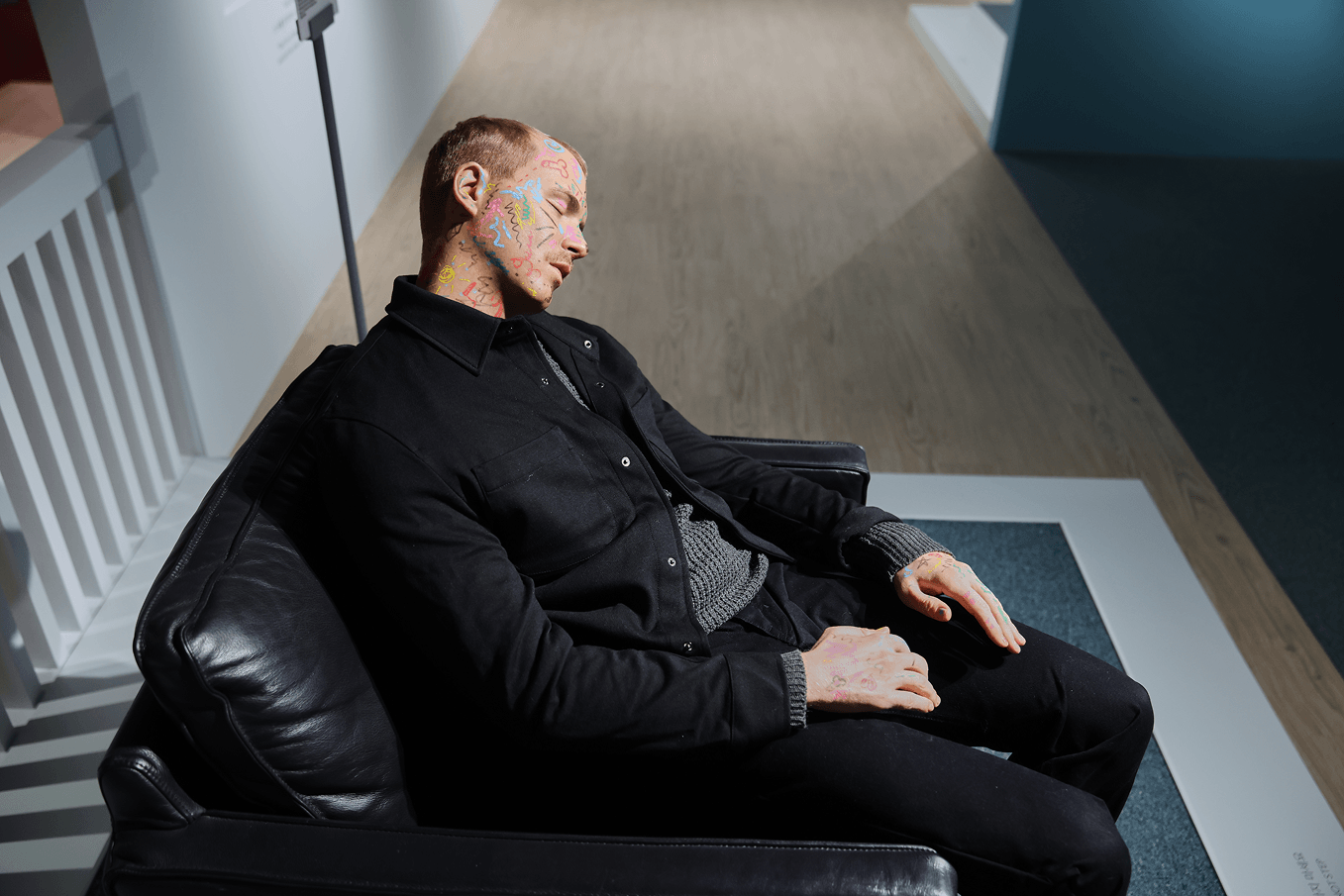
Zeitgeist, 2024
Silicone, resin, hair, fabric and paint; 108 x 55 x 30cm

Democracy, 2024
Silicone, resin, hair, fabric and aluminium; 210 x 160 x 65cm

Photography by MAX SIEDENTOPF
SK: You’ve lived in so many different places, and now you’re based in Lisbon with your family. How did you end up here, and what drew you to this city? Lisbon has incredible history, culture, and cuisine—but some might say it lacks a certain modern energy. Do you feel the same, or do you see it differently? What is it about living here that excites or inspires you most?
MS: In many ways, Lisbon reminds me of where I grew up. The weather, the slow pace of life, and the general sense of neighborly warmth you feel in the streets.
I think the idea that Lisbon lacks a certain modern energy is debatable. If anything, it’s one of the fastest-transforming cities in Europe right now. But interestingly, it’s exactly that balance that drew me here—the combination of change and calm.
Because of my work, I travel a lot and constantly move between very intense, fast-paced cities. Coming back to Lisbon always feels like a reset. I like having that bit of distance and being able to tap into those high-energy environments when I need them, but not being fully consumed by them. At the same time, I’m much more interested in being close to nature, having space, and being able to step away.
SK: Tell me about your magazine Ordinary. How did the idea first come to you, and how did the process of bringing it to life evolve—knowing that independent publishing can be incredibly demanding? Was there a particular issue or story that stands out as especially memorable for you?
MS: Each issue of Ordinary revolved around a single, very ordinary household object—something like a sponge, a piece of plastic cutlery, or a rubbish bag. That object was also physically attached to the cover of the magazine, and then sent out to artists around the world with a simple invitation: make it extraordinary.
I was really curious to see how far you could push something so mundane—objects we interact with every day but barely ever notice. It became a kind of global experiment in perspective. The same starting point, but completely different outcomes depending on who you gave it to.
The first issue will probably always remain my favorite. At that point, everything was still completely open—there were no expectations, no formula, just curiosity and excitement. As the magazine grew, things naturally became more structured and defined, which is good in some ways, but you also lose a bit of that initial naivety. I think that naivety—that sense of not quite knowing what will happen—is often where the most interesting things begin.
SK: With AI and emerging technologies transforming every creative field, one day humans may lose the ability to distinguish between reality and illusion. Does this present more opportunities or dangers?
MS: Images have always been manipulated; narratives have always been constructed. The difference now is that AI makes this incredibly easy and accessible to anyone. Naturally, that opens the door to misuse. It can be used in deceptive or harmful ways, and I think it will increasingly require individuals to question what they’re actually looking at, rather than taking things at face value. But for me, the more interesting danger lies elsewhere. It’s not just about misinformation—it’s about creative complacency. The risk is that people become lazy or overly dependent, and start outsourcing the thinking itself.
SK: How would you describe the future in three words?
MS: Bigger, better, faster.

Only Human

Only Human

Only Human


Tooth Fairy’s Payday, 2024
Silicon, hair, textile and string; 126 x 40 x 32 cm


Trust, 2024
Plinth, silicon, hair and textile; 214 x 50 x 170 cm


