Leonardo Drew Pace Prints paper sculpture
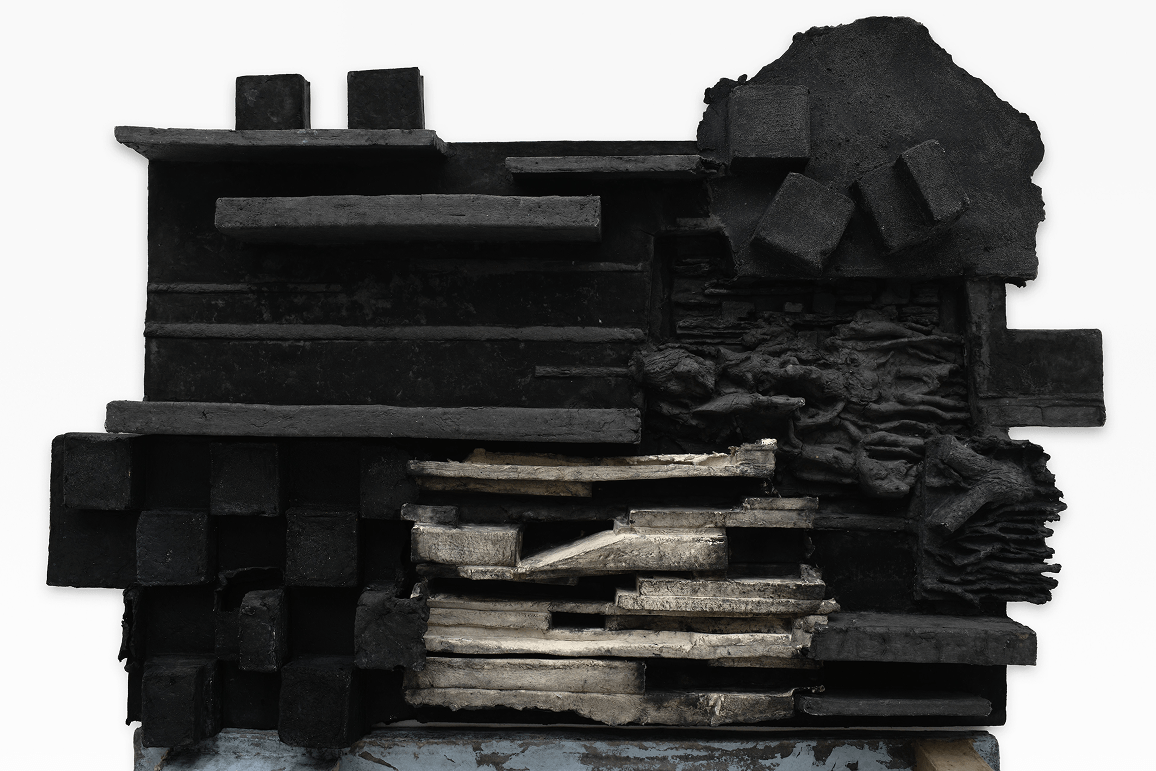
LEONARDO DREW, '98P,' 2025

Leonardo Drew: The Alchemy of Ruin

Leonardo Drew
Pace Prints
paper sculpture
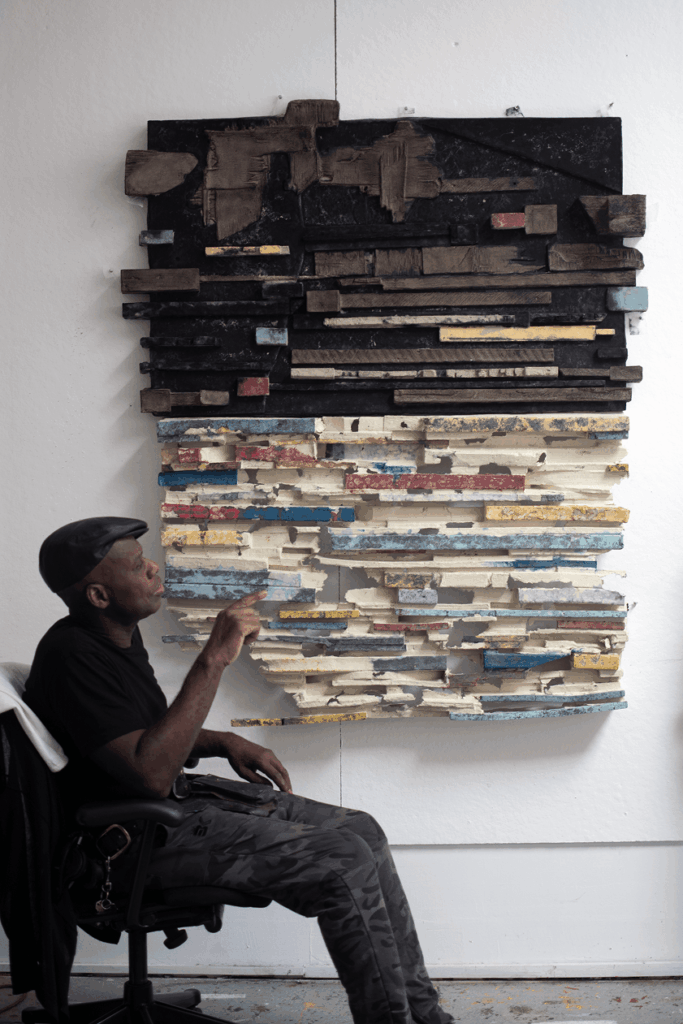
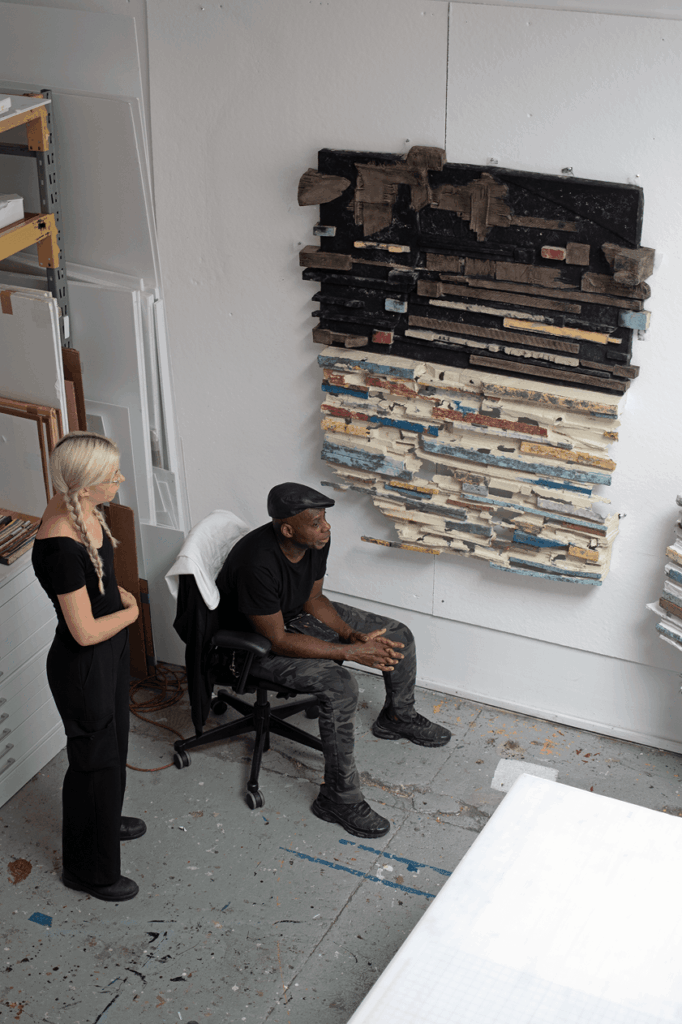
LEONARDO DREW working at PACE PAPER in Gowanus, Brooklyn
Photography courtesy of PACE PRINTS
Leonardo Drew
Pace Prints
paper sculpture
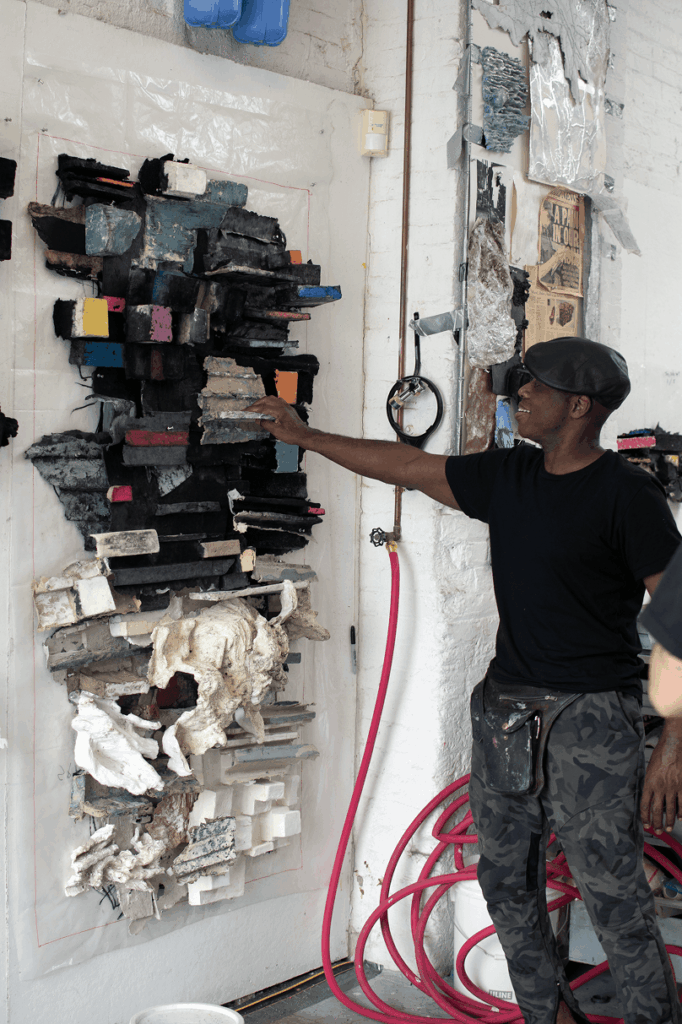
LEONARDO DREW working at PACE PAPER in Gowanus, Brooklyn
Photography courtesy of PACE PRINTS
Leonardo Drew
Pace Prints
paper sculpture
LEONARDO DREW working at PACE PAPER in Gowanus, Brooklyn
Photography courtesy of PACE PRINTS

Before ruin became a corrosive condition of the present, it was already being rehearsed in the fragmented languages of modern art. Visible in the densely covered surfaces of American Jackson Pollock’s work, the painting was no longer confrontational, but laid flat on to the studio floor, exposed to the energies and elements of the artist—broken into impulsive gestures that fall like bodies on top of one another, as an accumulation of grievances suffocating the surface of space, and reality out of reach. Whilst for his contemporary, Robert Rauschenberg, the canvas itself gave way to the world, absorbing its rubble and ruin, as fragments of newspapers, fabric, debris and the readymade—were applied onto a surface that was at once honest and undone. In both, their materials ceased to sit quietly; instead, appearing entirely fractured, bruised, broken into new incarnations of meaning. It is within this lineage of breakdown and recomposition that Leonardo Drew can be situated, extending their radical treatment of matter into a more explicitly sculptural and regenerative terrain.

Images of wreckage and ruin have, as French conceptualist Christian Boltanski predicted, come to surpass idyllic landscapes and lifestyle magazines as the dominant visual register of modernity—cities reduced to rubble, architectures split open, and histories erased in real time. Yet for Drew, the energies of damage and destruction are inseparable from those of creation; they are necessary conditions through which the world might be seen anew. Ruin, once the distant subject of painting, now occupies the present as an unflinching force. It is no longer a metaphor alone, but condition—for vast swathes of displaced lives. And yet, as Russian anarchist and philosopher Mikhail Bakunin argued, the urge to destroy is also a creative urge, and as the English writer Graham Greene observed, destruction itself may be understood as a form of creation. Read together, these propositions are less a romantic call to arms than an invitation to think through our opposing values—suggesting that within the act of undoing lies a latent, if uneasy, potential for renewal. Within this climate of violence, the question persists: what remains possible after the break? What forms of making can emerge from a world so visibly unmade?

In Drew’s work, ruin is rarely an end point; it is a condition of possibility. Across two concurrent exhibitions—Alchemy at the Bruce Museum (28 November 2025 – 10 May 2026) and a solo exhibition project at Pace Prints (19 March – 25 April 2026)—he turns to paper not as a passive support, but as a site of transformation. Here, material is broken down, layered, and reconstituted into something that resembles both landscape and residue. Paper becomes both medium and environment—torn apart, remade, and, in its reincarnation, made to speak again.

In the artist’s hands, paper refuses its historical role as a surface of inscription. It is not the bearer of image, but its very condition—fibrous, unstable, susceptible to time and touch. Cast, torn, soaked, ripped and reassembled, it undergoes a series of controlled degradations that mirror processes of erosion and entropy in the natural world. Yet this is not destruction for its own sake. What emerges is a form of material thinking: an insistence that undoing can be generative, that collapse might contain within it the logic of something new. Drew’s works do not depict ruin; they enact it, allowing the viewer to encounter matter in the midst of its own becoming.

The Bruce Museum’s exhibition title, Alchemy, is instructive. Historically tied to the transmutation of base materials into gold, alchemy was never simply proto-science, but a philosophy of transformation—of believing that matter could exceed its given state. Drew’s practice extends this lineage into the present. His paper works are not elevated through illusion or representation, but through process: the repetitive, almost ritualistic handling of material that collapses distinctions between making and unmaking. The studio becomes less a site of production than one of conversion, where discarded or degraded substances are granted a second ontology. At Pace Prints, this logic finds a particularly charged articulation. Printmaking, traditionally associated with reproduction and multiplicity, is here rethought as a medium of resistance. Drew approaches the print not as a fixed matrix, but as an unstable field—subject to pressure, abrasion, and interruption. The resulting works resist clarity and resolution; they appear worn and weathered, as though excavated rather than produced. Ink behaves less as a vehicle of image than as residue—a trace of contact between surface and force. In this way, the print aligns with the sculptural, sharing in the same vocabulary of fracture and reassembly that defines his broader practice.

What binds these exhibitions is a sustained commitment to regeneration. Drew does not seek to restore objects to a prior state of wholeness, nor to aestheticise their damage. Instead, he inhabits the space between ruin and repair, where material is neither fully lost nor fully recovered. It is here, in this unstable interval—so resonant with the present—that his work finds its force. Wreckage is not merely salvaged; it is reimagined, its histories compressed and rearticulated through touch, pressure, and time. And in an age marked by fracture, Drew’s work proposes neither consolation nor escape, but a more demanding proposition: that even within cycles of violence and erasure, matter—and perhaps meaning—can be made again.

Rajesh Punj: We spoke previously about your work at the Yorkshire Sculpture Park—a body of work that felt highly physical, expansive, almost architectural. What strikes me now, looking at the works on paper in the exhibitions at the Bruce Museum and Pace Prints, is a shift in scale and intimacy. The works appear more fragile, more contained. How do you understand the relationship between those two modes of working—the monumental and the intimate?

Leonardo Drew: I think if you were to see them in person, you’d realise they’re still very physical. They’re really sculptures on paper—that’s probably the best way to describe them. The prints also move into that territory. There’s a physicality that remains, even at a smaller scale. What happens is that the framing puts them into a context that makes them more legible—it cleans them up, in a way—but at the same time it gives them a kind of legitimacy, a sense of presence as something real.

RP: It’s interesting you mention framing, because your work often resists containment—it spills, expands, almost exceeds its own edges. How do you reconcile that tension between containment and overflow?

LD: I think of it almost like looking at a Jackson Pollock. There’s always a border, but the work feels like it’s defying it. That tension is important. There’s something additive about the frame—it doesn’t just contain; it can extend the work conceptually. But it’s a tightrope. There are moments when it works, and moments when it doesn’t. And practically speaking, people are more comfortable with works on paper being framed—it protects them. So, you’re negotiating between that expectation and what the work itself wants to do.
RP: That negotiation seems central—not just materially, but also in terms of how the work is completed. To what extent do you see the viewer as part of that process?

LD: Completely. I don’t think of the work as finished without the viewer. There has to be a kind of synergy—a relationship between what I make and how it’s received. I don’t try to control that or push against it. I allow it. The viewer is complicit in completing the work. I don’t work in a vacuum.

RP: And how does that extend into the space of exhibition—the distance between works, their placement, the surrounding architecture? How do you think about that field in relation to each individual piece?

LD: You learn that early on, especially working at scale. When you’re making work outdoors—say, in New York—and you’ve got the skyline, the Empire State Building, the Flatiron, all of that becomes part of the work whether you like it or not. So, you learn to negotiate your surroundings. They become additive—they help realise the work within that space. When you bring that down to works on paper, it’s the same thinking, just condensed. The works still command their surroundings. You must understand proportion—how something sits, how it breathes within a space. But I don’t consciously calculate it. It’s something that comes from doing this all my life—drawing, painting, sculpting. It becomes instinctive. You’re not switching between disciplines; you’re just working.

RP: So, it’s less a method than a kind of embodied knowledge—almost like balance?

LD: Exactly—balance, awareness, coordination. Like dancing. You need to know where your body is, where everything else is, so you’re not colliding with it. It’s about creating a rhythm that works with the environment rather than against it.

RP: And when we think about paper itself—it’s traditionally understood as fragile, ephemeral, almost secondary to painting or sculpture. Yet in your work, it becomes something far more forceful. How do you approach that transformation?

LD: When Pace Prints approached me—this is about fifteen years ago now—they recognised that I could bring something different to printmaking. What I do sits against the history of printmaking. I’m interested in pushing it—giving it a physical presence. Traditionally, prints sit lower in the hierarchy—you can buy a print for less than a painting or a sculpture. But for me, that’s not really the point. The question is: how do you make something that carries the same weight, the same physical and emotional presence, regardless of the medium?

RP: It’s interesting—when you speak about these works, they seem to sit somewhere between categories. They’re not quite prints, not quite sculptures, but something in between. Do you think you’re redefining what we understand as printmaking?

LD: That’s something people say after the fact. You get master printmakers, real specialists, looking at these works and asking: are these prints? And I understand that. What’s happened is that something has been added to the language. But that wasn’t my intention going in. I came into printmaking, saw what I had to work with, and approached it the way I approach everything—through balance, through process. You bring your own thinking into a medium, and that inevitably changes it. Only later do you realise that something has shifted.

RP: So, it’s less about redefining the medium, and more about inhabiting it differently?

LD: Exactly. You fall into the situation. You respond to what’s there. And when you look at the history of printmaking—artists like Louise Nevelson or others who came from sculpture—you realise that there’s always been this push to bring more weight, more presence into the medium. What I’ve done sits on top of that. It’s additive, but it’s also built on what came before. I only fully understood that when I saw collections like Jordan Schnitzer’s—when you see the history laid out physically, you begin to understand where your work sits within it.

RP: And yet, when we think of someone like Robert Rauschenberg, the use of materials often remains identifiable—there’s a recognisable object, a referent. Your materials seem to operate differently.

LD: I don’t use found objects in that way. I’m not presenting something you can immediately identify. What I’m doing is working material until it echoes something that feels familiar—something shaped by time, by weather, by exposure. That’s my way of painting, in a sense. I’m introducing a kind of ageing process, a transformation. So, when you look at the work, you feel like you recognise it—but you can’t quite place it. It’s not something you’ve lived with directly, but it resonates.

RP: That tension between recognition and abstraction feels central—this sense that the work is both known and unknowable at the same time.

LD: That’s key. That’s where the mystery is. If the viewer can fully identify something, it closes the work down. But if there’s just enough familiarity, it creates an entry point. That’s where the viewer begins to navigate the terrain. And once I understood that it became part of how I build the work—how I extend it, how I develop my voice.

Leonardo Drew
Pace Prints
paper sculpture
LEONARDO DREW
122P, 2025. Pigmented and cast handmade paper; 74 3/8 x 39 1/2 x 8 1/2 inches. 
© LEONARDO DREW. Photography courtesy of PACE PRINTS
Leonardo Drew
Pace Prints
paper sculpture
LEONARDO DREW
105P, 2025
Leonardo Drew
Pace Prints
paper sculpture
Courtesy of LEONARDO DREW
Leonardo Drew
Pace Prints
paper sculpture
LEONARDO DREW
123P, 2025. Pigmented and cast handmade paper; 168 1/4 x 15 3/4 x 5 1/2 inches.
© LEONARDO DREW. Photography courtesy of PACE PRINTS
Leonardo Drew
Pace Prints
paper sculpture
LEONARDO DREW working at PACE PAPER in Gowanus, Brooklyn
Photography courtesy of PACE PRINTS
Leonardo Drew
Pace Prints
paper sculpture
LEONARDO DREW
98P, 2025
Leonardo Drew
Pace Prints
paper sculpture
LEONARDO DREW
98P, 2025

RP: There’s also something profound in your process—the way you begin with material that is broken down, almost destroyed, and then move toward reconstruction. Especially now, in the context we’re living in, that movement from wreckage to regeneration feels incredibly charged.

LD: That’s always been at the core of what I do. It’s about the cyclical nature of life—life, death, regeneration. And it’s important to understand that this isn’t just an artistic philosophy, it’s a life philosophy. If you recognise that cycle, you move through the world differently. There’s a kind of alignment that happens. But if you resist it, if you push against it, you tend to stumble—you collide with things. There are forces that are larger than us, and part of the work is about understanding that—finding your place within that order.

RP: So, it’s less about control, and more about attunement?

LD: Exactly. A kind of awareness—of where you are, of what surrounds you, of what’s already in motion.

RP: And in relation to the two exhibitions—the Bruce Museum and Pace Prints—how do they differ? Are we seeing two distinct bodies of work, or variations within the same language?

LD: Once you find your voice, that’s it. You build on it, you expand it, but it remains consistent. No matter the material, no matter the scale—it’s always going to be you. That’s what people call a signature. If you look at my work overtime, even when the materials change, you can still recognise it. That’s the realisation—that you’re present in the work, and that what you’re offering is singular.

RP: And looking forward—particularly with these works on paper—do you feel you’re moving in new directions?

LD: Yes. I think one of the last holdouts for me has been drawing. And now I’m starting to find a way into that—what I would call sculpted drawings. They’re fluid, they’re linear—line becomes central. It’s about movement, about continuity. If you imagine something like a sculptural Jackson Pollock, that might come close. The line, the gesture, the flow—they’re all part of how the work is moving forward. And that was a surprise to me, because I started out as a painter. But the work keeps evolving—it keeps finding new forms.

RP: It sounds as though you’re returning, in some way, to the origins of your practice—drawing, painting—after years of working through abstraction and material.

LD: Yes. Early on, I had to almost tie my hands—to move fully into abstraction, I had to let go of certain things. Drawing, painting—those were my foundations. And now, at this point in my life—I’ll be 65 next month—I find myself coming back to those beginnings. Not in a nostalgic way, but as a continuation. It feels like I’ve lived long enough to begin to see the full arc of it.

RP: And when you speak of drawing now, it seems you’re challenging the very definition of it. Is drawing, for you, becoming a more physical act?

LD: Absolutely. What I’m working on now, I would describe as sculpted drawings. If you imagine a line—a drawn line—but instead of graphite or ink, that line is built up out of material, then the material is the line. That’s where it gets interesting. The challenge is to follow that logic through—to make it hold together, to make it make sense. I’m still pushing it, still trying to see what’s on the other side of that.

RP: So, the work reveals itself in the process—rather than being fully conceived beforehand?

LD: Exactly. You make something, and only afterwards do you realise what just happened. Then you understand that you need to follow that discovery—to take advantage of it.

RP: And does that naturally lead to an expansion in scale? If the line becomes material, does it inevitably grow—becoming something spatial, almost architectural?

LD: It can. But scale is always about proportion. Even within drawing, you have thick lines, thin lines—you’re constantly pushing and pulling. For me, that comes through material. I have a huge vocabulary of materials, and that allows me to adjust, to respond. That’s where the future lies—in building enough of these works to really solidify that direction.

RP: And in the studio, are these materials predetermined, or are they drawn from previous works—reused, reworked?

LD: Both. There’s no secrecy in the studio. Works exist in different states—some unfinished, some dismantled, some waiting. And if you’re not precious about them, you can take them apart, reintroduce them, make them part of something new. That’s where things become super-additive. Of course, there are moments when I build new material, but even that comes from what I already know—from the language I’ve developed.

Leonardo Drew
Pace Prints
paper sculpture
LEONARDO DREW
124P, 2025. Pigmented and cast handmade paper Pigmented and cast handmade paper with calcium carbonate and black magnum; 44 x 68 1/4 x 7 1/8 inches. 
© LEONARDO DREW. Photography courtesy of PACE PRINTS
Leonardo Drew
Pace Prints
paper sculpture
LEONARDO DREW
124P, 2025. Pigmented and cast handmade paper Pigmented and cast handmade paper with calcium carbonate and black magnum; 44 x 68 1/4 x 7 1/8 inches. © LEONARDO DREW. Photography courtesy of PACE PRINTS

RP: Are there materials or visual systems you return to repeatedly?

LD: New materials often come from old ones—they’re extensions, offshoots. For example, in earlier works—like what you saw at Yorkshire—I was working with broken ply, blackened surfaces. Then colour entered. And that colour came from Persian rugs. That gave me a palette, a structure to work from. You study those compositions, understand their dynamics—and then you introduce chaos into them. But that only becomes clear afterwards. The process of discovery itself—that’s the difficult part. That’s where the struggle is.

RP: The labour of it?

LD: Exactly. You forget the pain once you’ve made the discovery—but in the moment, it’s intense. It’s peaks and valleys. You reach a point where you have to go back into the lab—back into the alchemy. I’m in that place right now. I can see the direction, but I’m not fully there yet. And when I share it with people I trust, they’ll say: this is something you need to pursue—with urgency.

RP: And physically, the work is incredibly demanding. The processes of breaking down and rebuilding, of balancing and composing—how does that register in your body now?

LD: It’s very real. I had a total knee replacement last November. Both of my wrists have undergone partial fusion—years of physical work take their toll. Things break down. That’s just a fact. Now there’s a maintenance aspect to it. You adjust. You find new ways of working. But the physicality doesn’t go away—it’s still there, it’s still central.

RP: The body, in a way, undergoes the same cycle as the work—breakdown, repair, adaptation.

LD: It’s the same cycle. Life, death, regeneration—it’s not just in the work, it’s in everything.

RP: You speak often about the act of breaking down material and rebuilding it—of destruction and creation as inseparable. In the world we’re living in now, where destruction feels so present, do you see your work as responding to that condition?

LD: I think there’s always a moment where we have to look at ourselves—really look—and try to understand what’s happening around us. We’re not separate from it. We’re complicit. Pointing fingers doesn’t solve anything. The question is: how do we begin to understand why we repeat these patterns, and how do we break that cycle? Because no matter how advanced we become—technologically, socially—this tendency toward destruction keeps reappearing. It’s part of us. We must confront it, both individually and collectively. Take a longer, more honest view of who we are.

RP: And where does the artist sit within that?

LD: The studio can be a kind of sanctuary—but it shouldn’t be an escape. Artists, writers, musicians—we’re often trying to process what’s happening, to find some kind of remedy, even if it’s not explicit. In a way, we become interpreters—sometimes even soothsayers. And historically, those are the people who are often targeted first. The intelligentsia, the ones trying to push things forward—they’re the ones that get attacked. Because creativity disrupts control.

RP: And the act of making is also an act of resistance?

LD: Yes—but more than that, it’s about clarity. Clarity is the real gift. Not just making things, but seeing clearly—understanding what’s in front of you, what’s beneath it. If we all had that, if we could all see through the noise, through the illusions—we wouldn’t be in the position we’re in. But that’s the challenge. That self-destructive tendency—it’s part of us. And we have to find a way to move through it.

RP: You describe that cycle—destruction and creation—not just as artistic, but as something much larger.

LD: It is larger. It’s cosmic. If you look at history—deep time—the dinosaurs were here far longer than we’ve been. And they disappeared. There’s always a point where something ends. There’s a kind of clock. And we’re not outside of it. The difference is that we now have the capacity to accelerate that ending ourselves. You can see it in everything—technology, weapons, even the systems we build. We’re constantly creating potential exits. And I don’t necessarily see that as negative. It’s part of a larger process.

RP: That’s a difficult idea—that destruction might be embedded in a larger order.

LD: It is difficult. But I don’t think it should produce fear. It’s humbling. It removes ego. It places us within something much bigger than ourselves. The challenge is not to deny it—but to understand it, to move through it with awareness.

Leonardo Drew
Pace Prints
paper sculpture
LEONARDO DREW working at PACE PAPER in Gowanus, Brooklyn
Photography courtesy of PACE PRINTS
Leonardo Drew
Pace Prints
paper sculpture
Courtesy of LEONARDO DREW
Leonardo Drew
Pace Prints
paper sculpture
Installation image, Leonardo Drew, PACE PRINTS, 2026
Photography by Garrett Carroll
Photography courtesy of PACE PRINTS
Leonardo Drew
Pace Prints
paper sculpture
Installation image, Leonardo Drew, PACE PRINTS, 2026
Photography by Garrett Carroll
Photography courtesy of PACE PRINTS
Leonardo Drew
Pace Prints
paper sculpture
Installation image, Leonardo Drew, PACE PRINTS, 2026
Photography by Garrett Carroll
Photography courtesy of PACE PRINTS
Leonardo Drew
Pace Prints
paper sculpture
LEONARDO DREW working at PACE PAPER in Gowanus, Brooklyn
Photography courtesy of PACE PRINTS

Words: RAJESH PUNJ

ISSUE 8

issue no8

Be the first to get the new issue