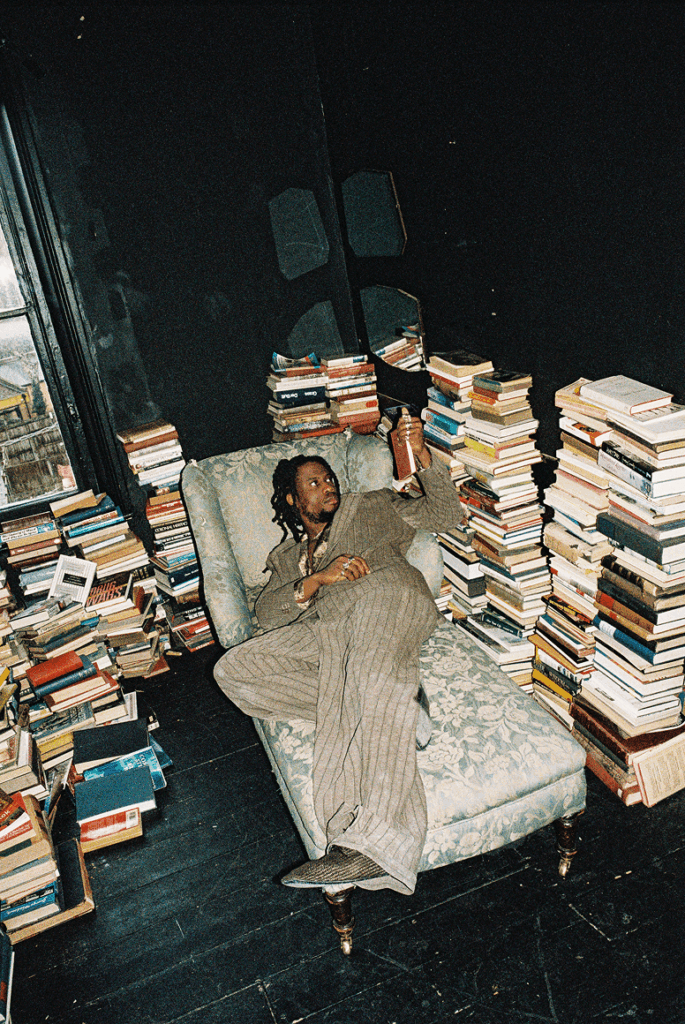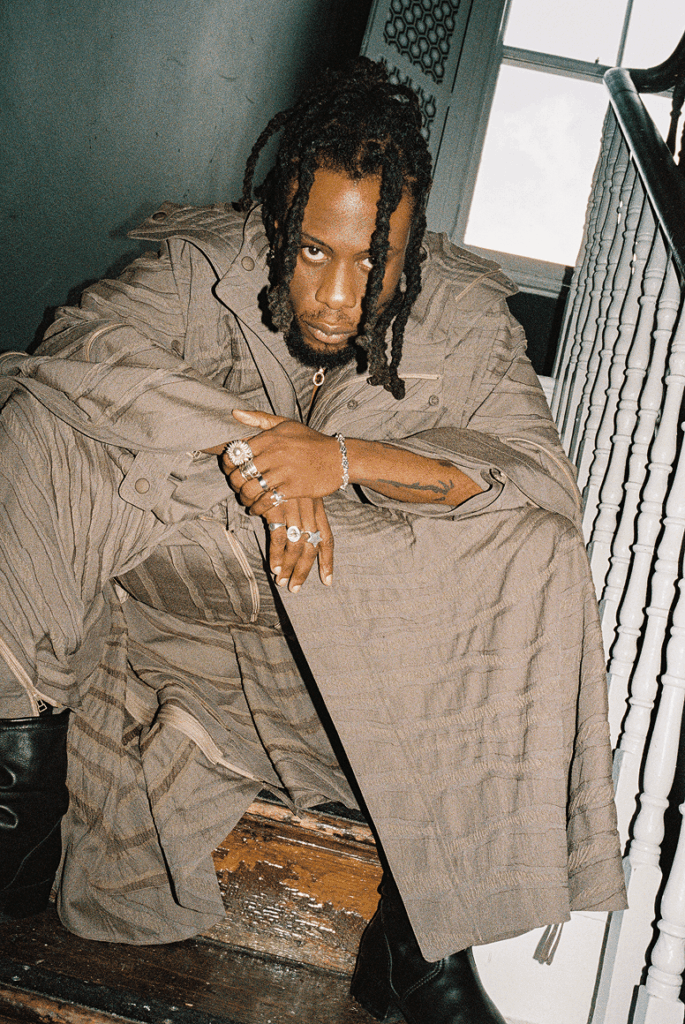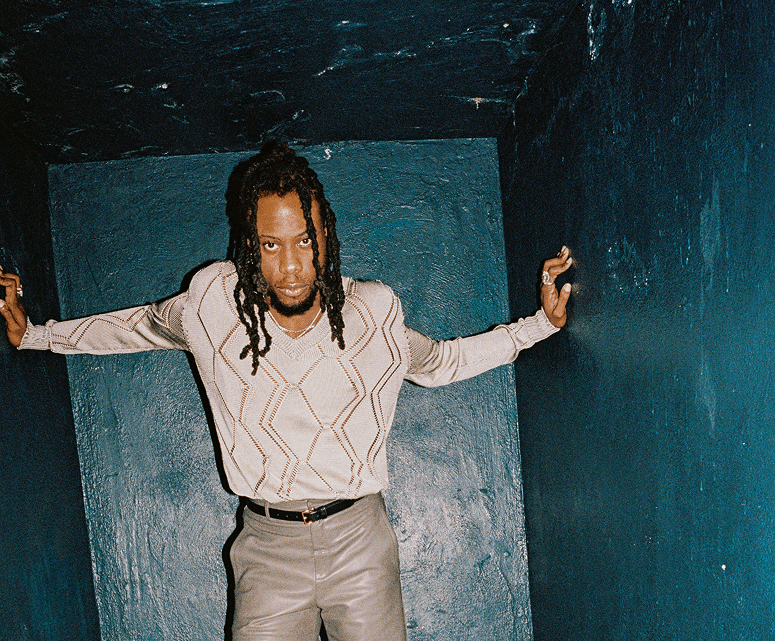
Listening to Obongjayar feels like a bolt from the blue. His voice: elastic in its register. His sound, a cosmic mix where afrobeat meets baile funk and gospel, where rap collides with experimental electronics and Nigerian folk. Speaking to him is striking in a different way—the London-based artist delivers ruminations with energy and without filter. “Identity is something you discover by creating,” he tells hube. “Creating is a journey of discovery.” And what a journey it’s been. Obongjayar grew up in Calabar, a port city in southeast Nigeria, before moving to the UK as a teenager. His early work was heavily influenced by American rap, a musical accent that he dropped when he realised that someone else’s voice would never be able to tell his stories. Since then, he has delivered two critically acclaimed albums, collaborated with the likes of Danny Brown and Lil Simz, and achieved Platinum for adore u with Fred again. For Obongjayar, his singular sound comes from a simple idea: “The whole world is in chaos, but there is also beauty,” he says. “It’s about trying to be the voice of beauty, however far that voice reaches.”
hube: You have described your early music as a kind of “terrible American rap,” linking it to a creative identity crisis that many experience when trying to find their voice. Is identity something you discover, or something you create?
Obongjayar: Identity is something that you discover by creating. Creating is a journey of discovery in a sense. The more you discover yourself, your roots, and what you align yourself with, the more you start to create this identity. What was true for me was growing into the knowledge of what I was comfortable with and who I was, but that took a long time—it took a process of discovery to get to that point. So, I think you both discover and create identity. I don’t think it’s one or the other.
h: Many forms of art are shaped or restricted by society’s moral and ethical limits. Music seems to be the freest form of creativity, do you agree?
O: I don’t agree, man. I don’t think music is the freest form. All forms of art are the freest form if they’re true to the perspective of the artist. Every human has a perspective that’s unique to them, and an artist is someone who can pluck an idea or perspective from the universe or whatever the fuck—the great beyond—and then bring it into fruition. Artists of all forms do that: poets, stand-up comedians, writers, directors.
I believe art is the ability to open a portal to a new way of seeing. If your voice is unique enough and opens a new source of beauty, you’ve done your job. So, I wouldn’t say any specific form of art is the freest. I went to art school and studied graphic design, so to me, functional art is the highest form because it expresses what it needs to express in a way that isn’t aligned with the status quo.