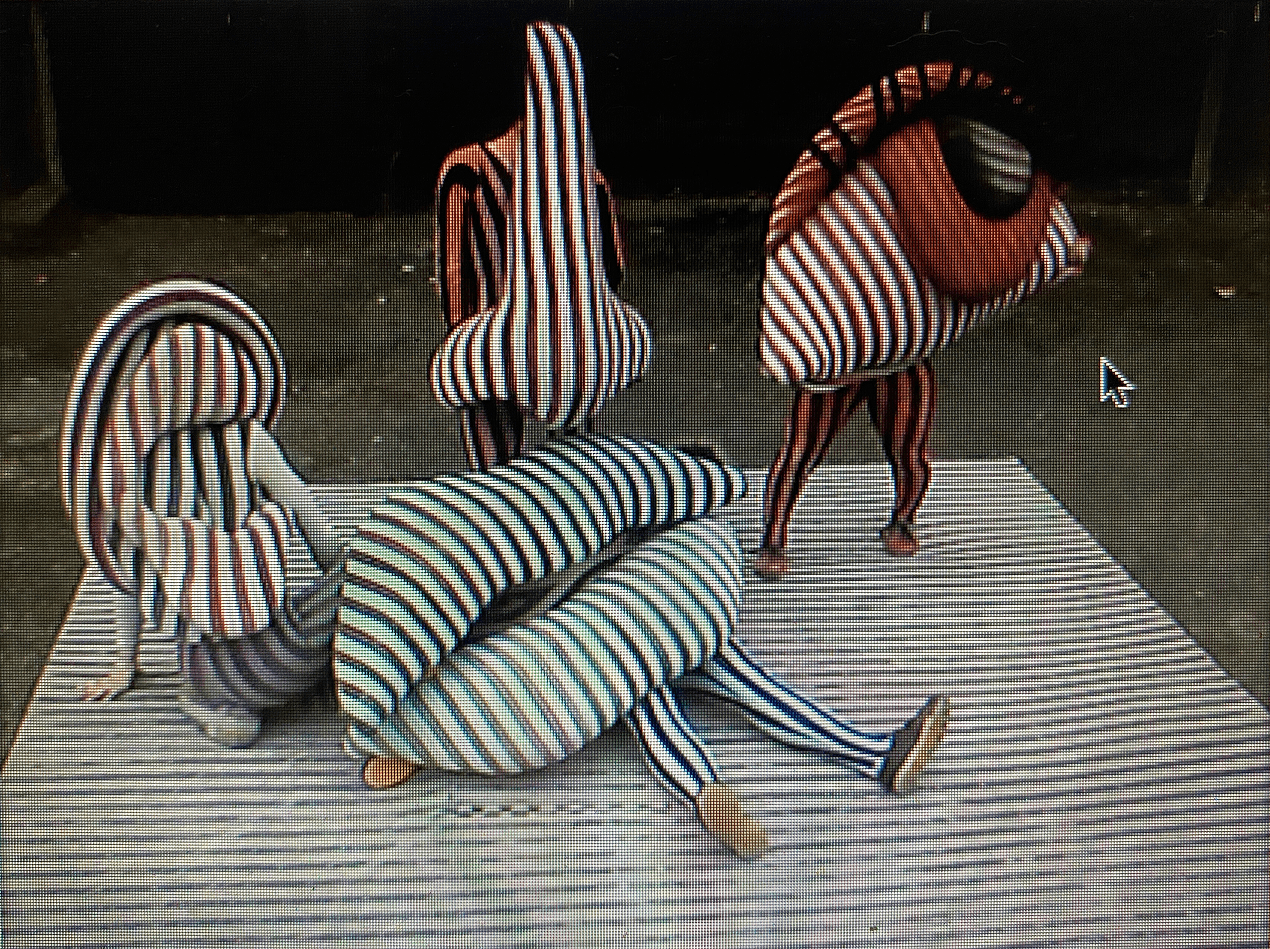
Shona Heath is an Oscar-winning multidisciplinary designer whose work in set and production design has graced films and publications across fashion, art, and cinema. Imaginative and expansive, her sets—spanning a wide variety of genres and visual styles—have established her as one of the most in-demand creatives in today’s media landscape.
While she may be less familiar to some audiences by name, her work is almost certainly widely recognised: campaigns for luxury houses including Prada, Alexander McQueen, Louis Vuitton, and Hermès; editorial work for publications such as Vogue and DUST; and, most notably, her Academy Award-winning Poor Things set design that helped shape the surreal aesthetic of the Yorgos Lanthimos film.
Her remarkable ability to transform any space—whether a bare studio or an outdoor landscape—into a fully realised world of its own is underscored by a consistent emotional and visual tension: tenderness intertwined with grit. The result is a form of storytelling that feels both enticing and uneasy, leaving viewers unable to look away.
In this conversation, Heath reflects on her creative journey, taking risks, embracing authenticity, and choosing the references that informed the production design for Poor Things.
hube: Your work often sits between reality and fantasy—how do you find the balance between the two?
Shona Heath: Every idea of fantasy starts as a response to reality, so the balance is always there in some way. Some kind of comparison to the known or the grounded often helps fantasy really shine. I find this balancing act quite fun. While I’m designing or making, reality and unreality reveal themselves when and if they’re needed. If I had to put it into percentages… It is 70 percent vague reality (or some kind of materiality) and 30 percent intense fantasy.
h: Looking back, was there a specific moment or decision that led you into this field, or did it emerge more gradually through different interests coming together?
SH: I was working as a costume designer for an artistic duo, where my work was really shaped by their aesthetic, and I felt my own voice growing stronger. As I grew impatient, an opportunity with my friend came up, and I decided to make a paper set for a photoshoot. My mum used to make beautiful paper sculptures as decorations from a book (I still have it), and I just assumed I could do the same. I think watching her do so many different crafts so well made me grow up believing it was basically a birthright!
In reality, it’s more of a slapdash approach that lets you move forward a bit faster. That’s why I love working at the scale of sets—they are human-sized and not fiddly. Ironically, I also get to work with and make miniatures, which I love, but they bring me closest to violence—your hands are just too big, and every sneeze or wobble is catastrophic.
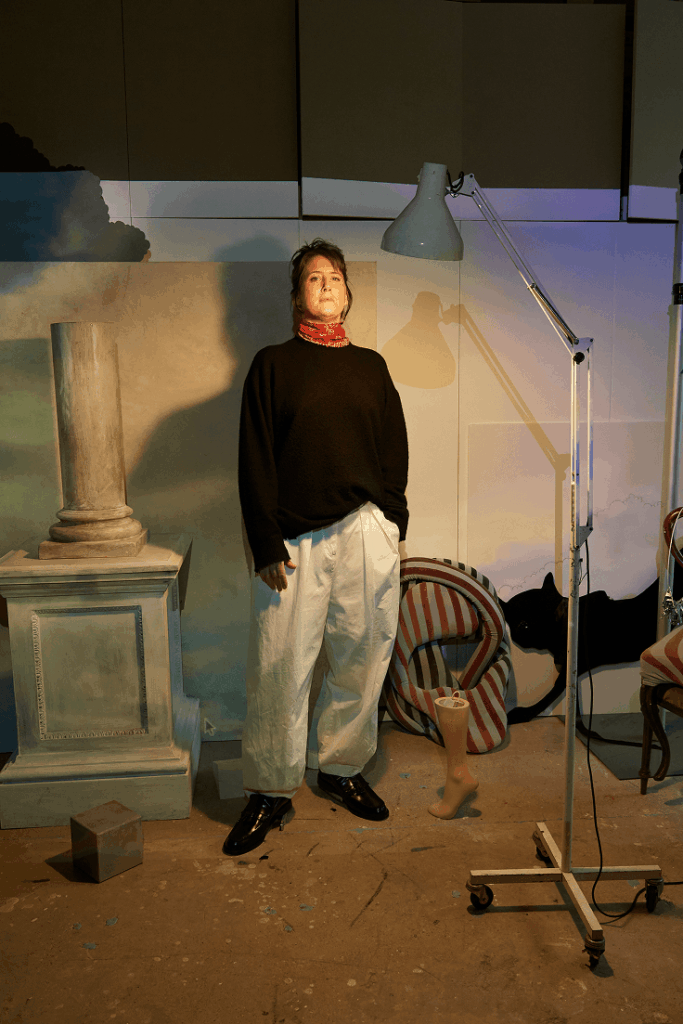
Photography by TIM GUTT
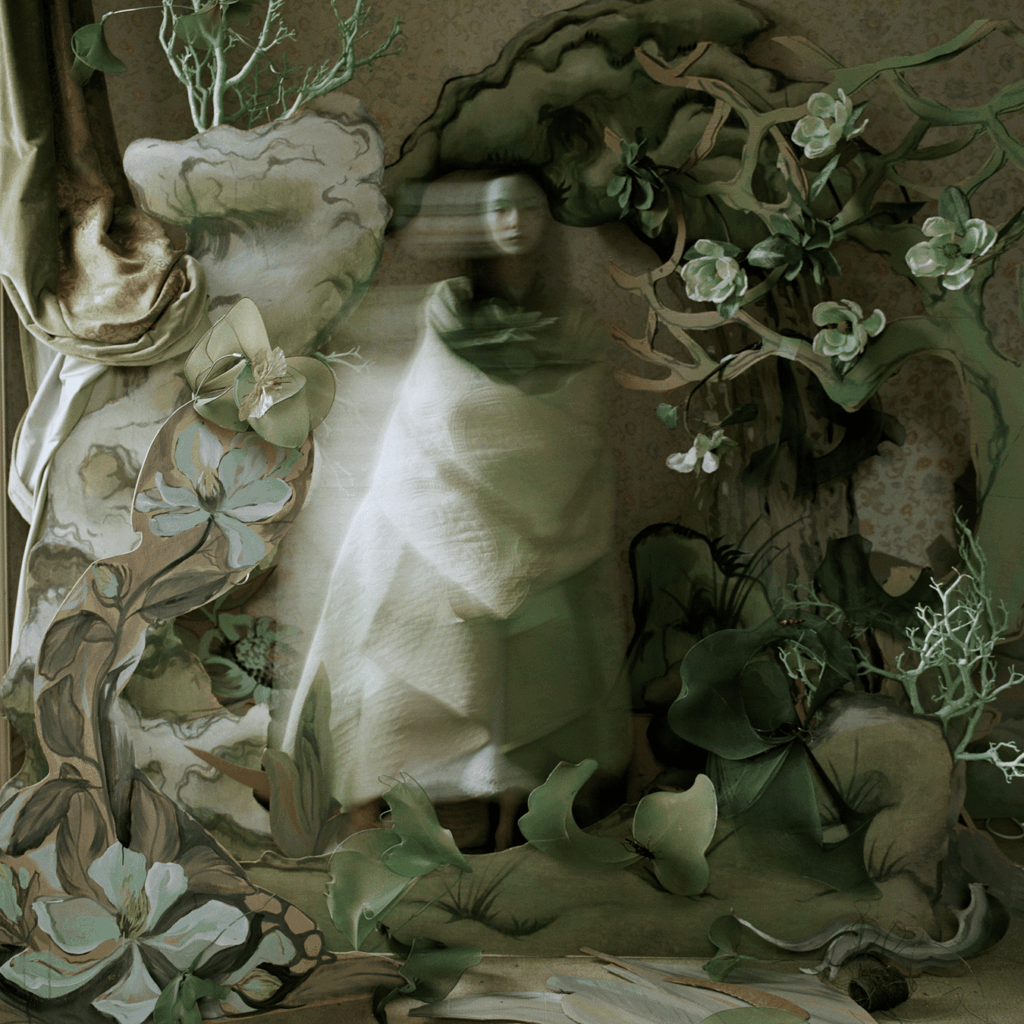
Photography by TIM WALKER
Set Design by SHONA HEATH
The Still Life of a Peach, 2023
Photography by TIM GUTT
Creative Direction by SHONA HEATH

The Garden of Earthly Delights
Photography by TIM WALKER
Set Design by SHONA HEATH

Photography by TIM WALKER
Set Design by SHONA HEATH
h: What aspects of contemporary culture feel most visually or conceptually exciting to you right now?
SH: I’m really more of an outputter than an inputter of culture. This always makes me feel like a bit of a fraud, but it’s the truth. I want to make contemporary culture, not consume it. I have constantly been drawn to nature, hardware shops, and random surplus tat. I get ideas from wandering city streets, pound shops across the world, reading, words, and just thinking.
I love the permanent collections in museums most of all (which I suppose are contemporary, as they are always there). That way I don’t feel I’m being told, “At this moment, you should be interested in looking at this”. I am generally very obedient, but not if I feel coerced into being told how and what to look at. “You must see this show” fills me with dread. Generic modern architecture around us is really fast becoming the perfect gallery to show off just how mind-blowingly amazing historic buildings and their crafts are.
h: Do you think your visual instincts are more shaped by art, fashion, cinema, or something outside those fields entirely?
SH: My instincts follow a fashion-like rhythm—something that changes with the zeitgeist or as a response to a saturation of something; you take the other path, switch it up, move on, which I suppose is fashion. But photography and paintings have the biggest pull for me. The thoughts I’m having also relate to what I choose to see—so if a colour, for example, matches my mood or state of mind, I’m drawn to it.
h: While working on Poor Things, what key ideas, references, or experiments helped shape the distinct visual world of the film?
SH: Poor Things really came from Bella, the main character, and the possibilities of how she thought. Therefore, what she saw and how she saw it could be a unique experience (like everyone’s), but she had the added curveball of a real-time baby brain. The excuse to put all of the visual things I love in there with some relevance was present: an irreverence of strict logic, a kind of physical and mental collage, a layering of everything architectural, nature, colour, and wonder. Francis Bacon, Hieronymus Bosch, John Singer Sargent, John Soane, Victorian surrealism—an endless list.
h: Is there something you feel is consistently misunderstood about your work?
SH: I don’t read critique—it completely floors me—so I don’t know… but I suspect it’s to do with cheesecakes and fairytales.

Photography by SHONA HEATH, 2021

Photography by SHONA HEATH, 2021

Photography by SHONA HEATH, 2021
h: What is the biggest risk you’ve taken together with Tim Walker?
SH: An unscheduled flight in a really sketchy, homemade microlight plane in Bristol, flown by homemade scrumpy cider and a wish and a prayer—amazing sunset, though. He is pretty fearless. I am not.
h: Have you ever felt that an idea was too excessive, too strange, or too unresolved?
SH: Yes, and that’s why they should absolutely be executed at once. You could probably say that about Poor Things. “Too something” is often why it works.
h: What does “authenticity” mean within a practice that is so deeply rooted in artifice?
SH: I think the authenticity comes from the intent and the source—from nurturing personal creative ideas into their manifested form. The end result is in fact no more artificial than a painting. A painting is purely to be enjoyed and looked at. So is a set. It’s just often bigger and looks like it might or should serve some kind of practical purpose.
I struggle with the fact that sets are destroyed, which is why I think people categorise them as artificial—as they have no future once they have served their purpose of film, photo, theatre, or party… I would absolutely love this not to be the case. Maybe I could start a set graveyard somewhere on the top of a landfill; you could wander from room to room—that would really be immersive.
h: What has been the most disillusioning aspect of working within the fashion and image-making industry?
SH: That I see its value disappearing slightly. The increasing number of photographs in the world—because it’s become like the common pencil, a note-taking device (I love pencils, by the way)—means the industry’s investment, both personally and financially, in each image is less. It is ultimately swiped right. To make sets, it takes brilliant people, power, materials, and money, but I totally foresee a return to the magic of photography on film stock. The obsession with the “immersive” experience is baffling. I think it is giving too much on a plate to the viewer. It stops them from having to wander in their own minds. I still don’t really know what it means, I just nod. It is just never going to be immersive enough if you say it is.
h: If you could invite any three people to dinner—living or dead, with no constraints—who would you choose?
SH: Bob Mortimer x3.

CATE BLANCHETT
Photography by JACK DAVISON, styled by REBECCA PERLMUTAR, set design by SHONA HEATH

Poor Things, Chapter Heading Concept Art, 2021

Photography by JACK DAVISON
Set Design by SHONA HEATH

Photography by JACK DAVISON
Set Design by SHONA HEATH

Photography by TIM GUTT
Creative Direction by SHONA HEATH
Words: ISABELLA MICELI
