The Sculpture
Over 100 people are standing in a large, rectangular, exhibition hall. Tall white walls lead up to a large skylight in the roof, which lets through blotchy hues of blue and turquoise. Wood-framed doorways lead into dark side rooms. The hall is also flooded. To avoid stepping in water, people make their way along an angular wooden gangway that lines the walls and meets in the centre of the room, where it forms a small wooden island. In the middle of this island are two rectangular frames—one taller than the other—which hold up stainless steel tubes, a row of nozzles jutting up from both of them. More tubes can be seen lining the gangway, hidden underneath the planks just above the water.
Suddenly, a deafening hiss. Somewhere, a motor powers a pump that accelerates a mass of purified water through the tubes. At a pressure of over 1,000 pound-force per square inch (about 10 times the pressure of a regular foot pump), the water is forced through nozzles with a 0.15 mm aperture. A thin needle tip in the aperture splits the stream into droplets of 17-microns in diameter (about twice the length of a red blood cell). But as soon as they explode into the air, freedom. Wisps of droplets come together to form a thick white fog in the centre of the room. It curls and flows, rises and falls, traversing the space with a serenity that belies the violence from which it was birthed. As the fog moves it encounters things: people, walls, doorways. It drifts past surfaces, curls around obstacles, and immerse human bodies. The visitors are engulfed by the mist and welcome it, wafting their hands around, feeling the water on their skin. Those who stand in it for long enough emerge with beads of moisture clinging to their hair. The cloud slowly makes its way towards the room’s far exit, getting fainter as it goes.
The hissing has stopped now. Slowly the room becomes fully visible again: bare white walls, angular wooden gangways, rows of stainless steel tubes. It seems as if nothing has changed. But as the spectators saunter into the adjoining rooms, they murmur excitedly. For a precious few minutes they were embraced by a man-made fog. Some may have marvelled at the sight of a cloud indoors, others at the engineering prowess behind it. Whatever the response, the industrial-looking array of tubes and nozzles helped create a fleeting experience of wonder for the spectator: an artwork built on decades of scientific and technical knowledge, which uses fog as its medium.
The Artist
The installation is called Munich Fog (Wave), #10865/I (2022), and was designed by the Japanese artist Fujiko Nakaya. Born in Sapporo in 1933, she began her formal artistic training in the United States and Europe during the 1950s. Early on in her career she studied compositions of organic objects and processes, such as cell divisions, plant roots, and metabolism. During the mid-1960s she came into contact with a group of artists and engineers based in New York, who would later become known as the semi-anarchic collective Experiments in Art and Technology (E.A.T.). Nakaya quickly became a core member of the collective, and would play a prominent role in one of E.A.T.’s most important projects: the Pepsi Pavilion created for the Osaka World Fair in 1970 .
Called on by her E.A.T. colleague Billy Klüver to drape the Pavilion in artificial fog, she spent a year carrying out research and development. She studied possibilities using chemical fog, steam, and dry ice, but settled on water for three reasons: its ability to make air currents visible but objects behind it invisible; its soft and cool touch to the skin; and its vulnerability to atmospheric conditions (it could disappear, rather than persist in the environment). Her research was carried out in collaboration with Thomas Mee, an atmospheric physicist and founder of Mee Industries, an engineering company. With a background in developing fog-making technologies (although with an eye towards agricultural applications), Mee and his company helped Nakaya design a system of 2,520 nozzles, which could spray over 40 tonnes of water per hour. The system worked so well that when it was turned on for the first time, at only half capacity, the resulting fog was so thick the local fire department rushed to the scene.
The Pepsi Pavilion installation arguably defined the rest of Nakaya’s career. While she produced numerous artworks in other mediums, including a number of experimental video works during the 1970s and 1980s, the hallmark of her artistic practice remained her fog sculptures.
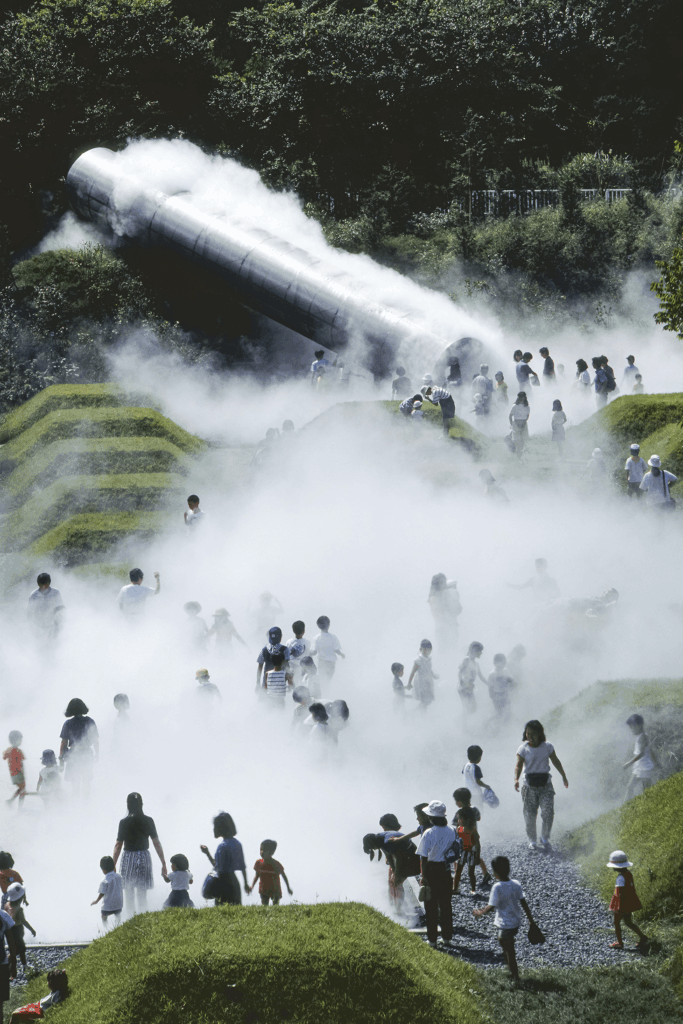
Her installation, Island Eye Island Ear (1974), was made in collaboration with the American composer David Tudor and French artist Jaqueline Matisse. In her second fog project, her ‘canvas’ was expanded from a single building to a small Swedish island. Over the following decades, further installations would be presented in Australia, the United States, Japan, France, Wales, Spain, Latvia, Norway, and most recently in Germany. Many of her fog projects were carried out in collaboration with other artists, including dancers, videographers, and light artists, making them profoundly multifaceted experiences.
What doesusing fog as a medium actually mean?
Nakaya wants the experience of a fog sculpture to be a dialogue with nature and with oneself: “What it reveals to us is the relationship between artificial and natural, things and being, tangible and abstract, worldly and sublime, etc.” She explains that her motivation for creating fog sculptures comes not from the traditional objectification of nature as something beautiful, but from the desire to facilitate a relationship between a person and their environment, believing that when someone interacts with a sculpture she has made, this interaction is reflected in how they relate to nature. This motivation is related to a core concept in the field of media ecology, namely that media themselves—not just their content—play an important role in affecting human responses, values, and understandings. The fog in Nakaya’s installations doesn’t expose a message—it is the message. She thereby hopes that people experience nature in an embodied way, gaining an “instinctive wisdom” to want to protect it (as opposed to just being told to do so).
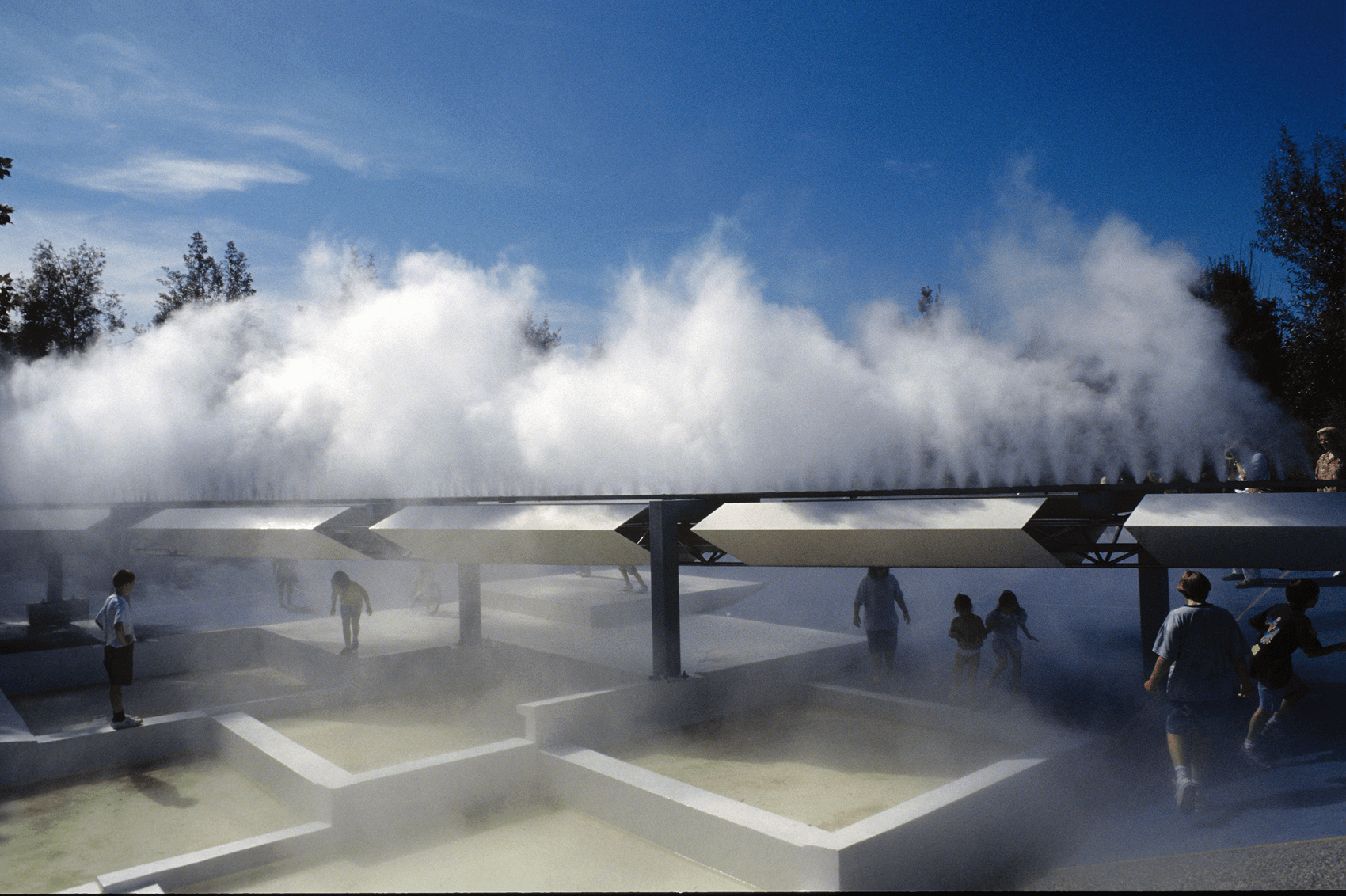
Nakaya’s fog sculpture is both natural and artificial. Its wispiness and shapelessness hide a highly technical nature. Each installation is a machine made out of motors, pumps, tubing, valves, nozzles, and monitoring equipment, that is kept operational by technicians. This apparatus has remained largely the same for the past half century, yet before the first visitor ever touches a droplet, each unique sculpture goes through extensive research and development. Nakaya first gathers data on local humidity, wind speed, wind direction, and temperature. The importance of this data is reflected in the titles of her works, which bear the identifying number of the weather station from which she gathered it (in the Munich case it was station #10865, located near Olympic Park). A study of the local topography is also important for figuring out how she wants the fog to move. Armed with this knowledge, she carries out tests in simulated environments: previously in wind tunnels, and more recently using 3D software. These tests help her define the technological parameters of the installation: how many nozzles to include, what power the pump should be set at, and the on-off programming of the fog. It is an art to make something so meticulously calculated and designed to seem so ‘natural’. If we consider an artwork to be the product of an artist’s craftsmanship, who actually crafts the fog sculpture? Nakaya’s preparations are key in shaping how it will look and behave, but it is ultimately an interactiveartefact: set in motion by plumbing, yes, but animated by visitors and the air. Observing a fog sculpture, one will find the occasional head or arm appear in the mist, before disappearing again. Human bodies raise the ambient temperature, increasing the rate of dissipation (Nakaya jokingly refers to them as “kilojoules”). Similarly, the fog constantly responds to meteorological and topographical conditions, with every change of wind, temperature, or pressure causing it to morph into a different shape. In a sense, it is not the artist doing the sculpting, but the wind itself. Recognising this, she has used the term “negative sculpture” to underline the way she relinquishes artistic control to the atmosphere. As the curator and art critic Anne-Marie Duguet notes: “she builds the experiential generator, and then lets nature do the rest.”