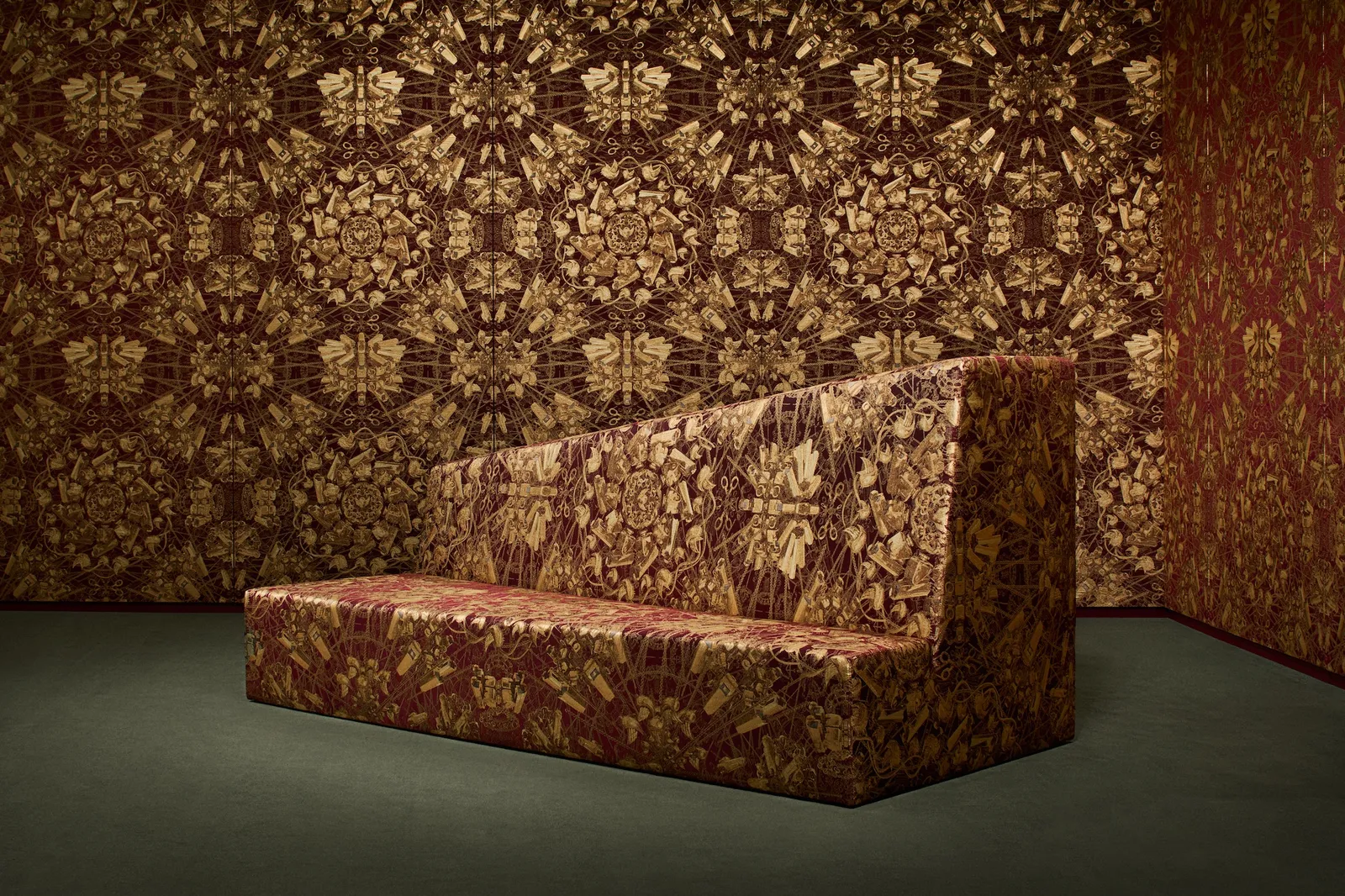
During Milan Design Week, Ai Weiwei unveiled About Silk, a site-specific installation developed with Rubelli—his first sustained engagement with the medium. Saturated in red, gold, and orange lampas, the space unfolds as a dense, tactile field where silk carries the weight of memory and political expression.
Symbols in silk: a visual language of resistance
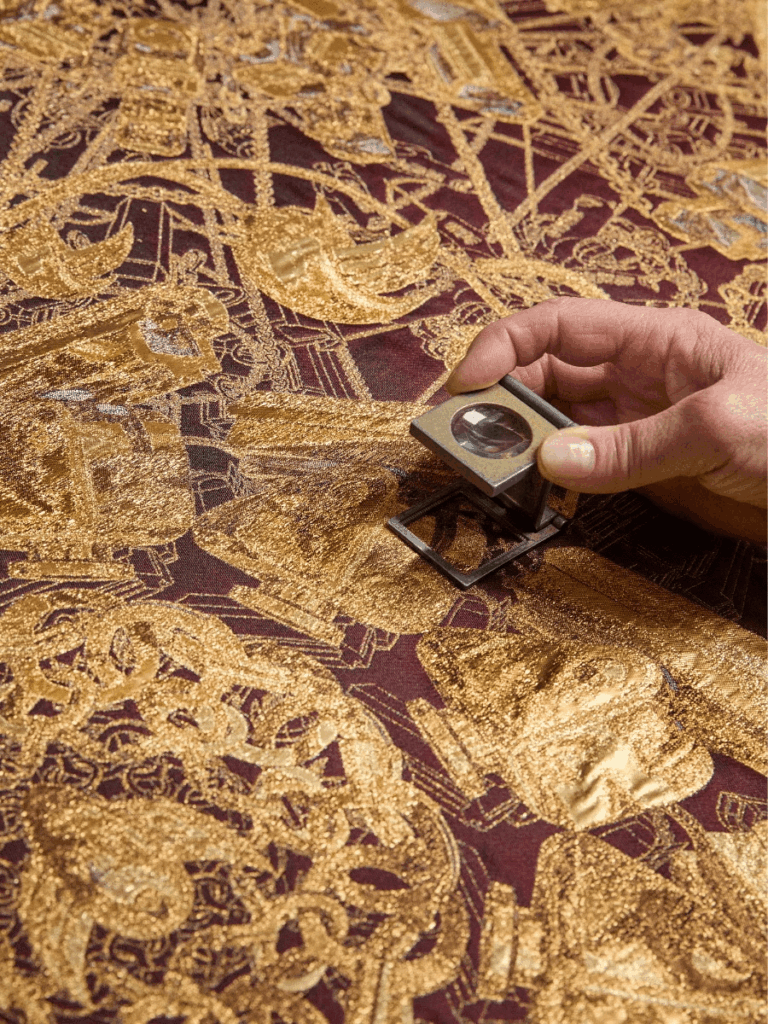
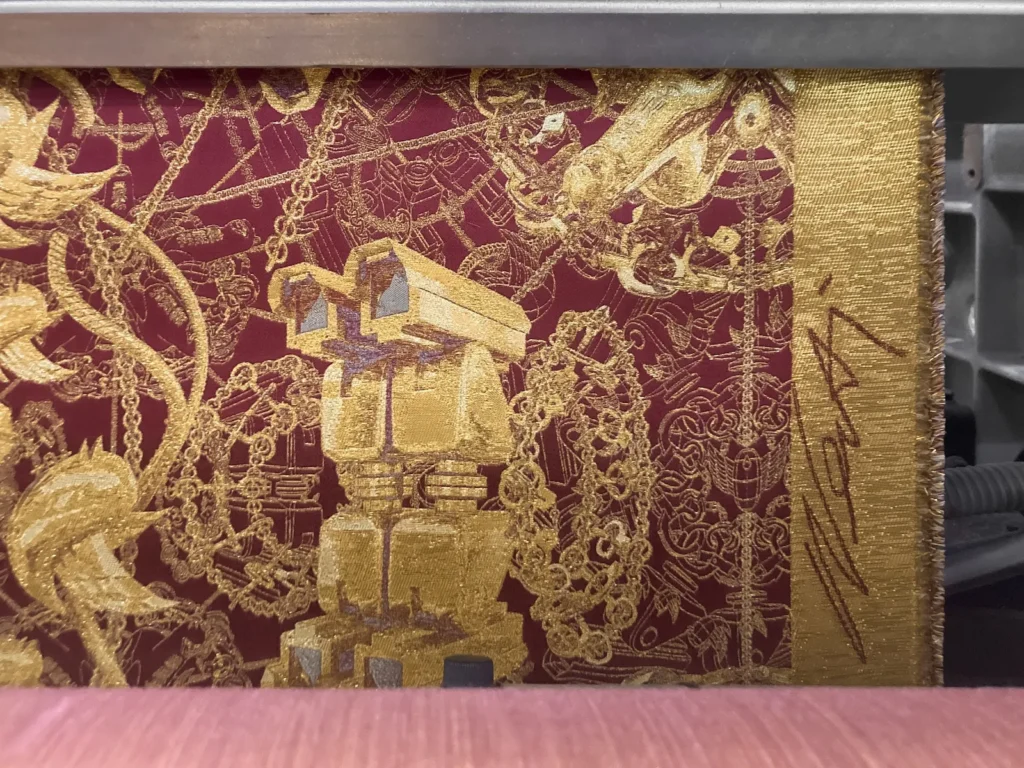
Woven with motifs drawn from The Animal that Looks like a Llama but is Actually an Alpaca, the textiles form a coded visual language: surveillance cameras glint in metallic thread, chains and handcuffs acquire a sculptural softness, and the Twitter bird flickers between promise and ambiguity. The alpaca—long a discreet emblem of dissent—threads through the installation as a quiet sign of resistance.
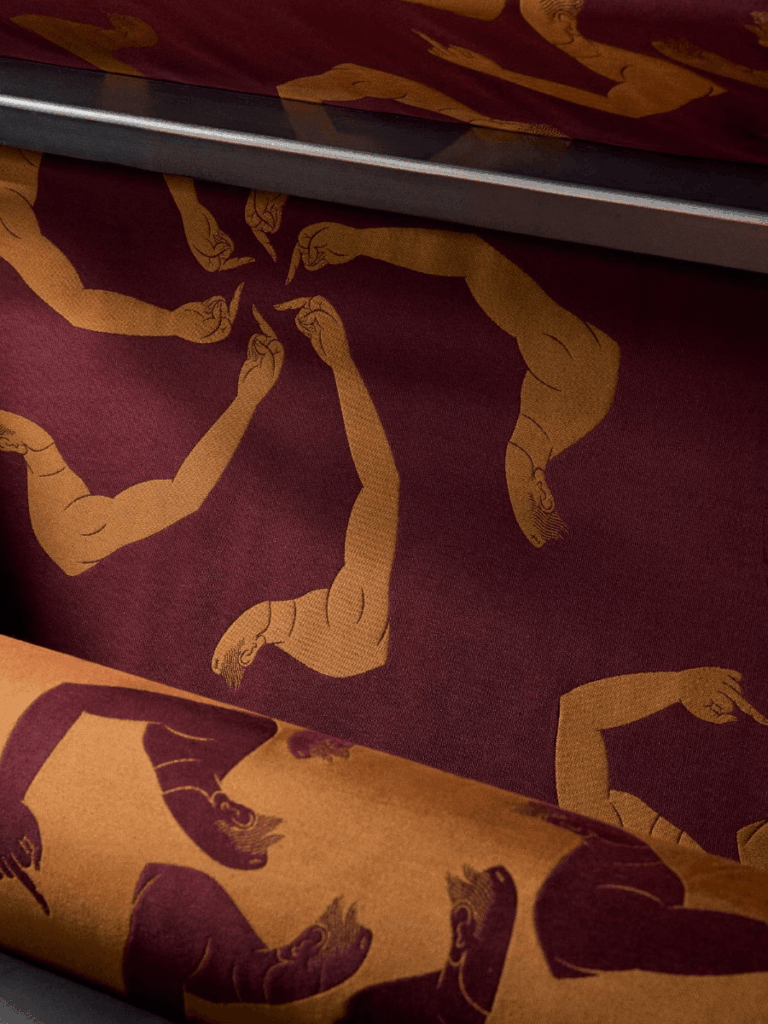
At the centre, a geometric sofa designed by the artist disturbs scale and perception, its surface dissolving the boundary between object and image. Nearby, Finger appears in double-faced silk and linen, its inverted colours sharpening the gesture’s defiance.
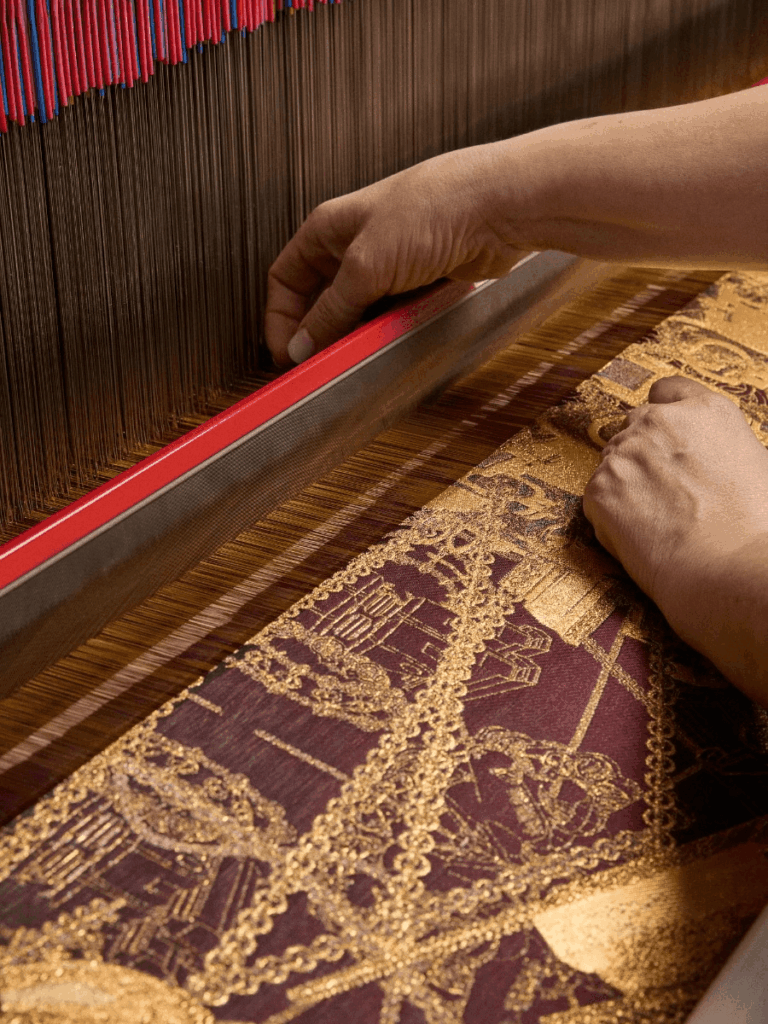
Archival materials, presented in cases by Formafantasma, extend the narrative, placing Chinese artefacts in dialogue with Venetian weaving traditions and tracing centuries of exchange between East and West. A film by Felipe Sanguinetti follows the making of the work from Cambridge to Como, revealing a process grounded in material knowledge and sustained experimentation.
Here, silk sheds its decorative role and speaks with clarity—carrying histories of power, resistance, and cultural memory in every thread. Don’t miss the About Silk installation at the Rubelli showroom, which is on display until May 15th, 2026.
Through radical gestures and charged materials, Ai Weiwei continues to challenge our perception of the world. Read our interview with the artist to explore the creation of meaning, symbolic objects, and the interplay between presence and absence.


Photography by CLAUDIA ZALLA
Courtesy of RUBELLI