At the recent Paris Fashion Week, Matières Fécales, presented its Fall-Winter 2026/2027 collection aptly called The One Percent. Bryan Johnson, the American tech multimillionaire, who is known for his extreme biohacking treatments and pursuit of immortality, walked the show. Inevitably, a news-making appearance, opening up once again this wider conversation around the topic of longevity and the quest for eternal youth.
In the same week, the exhibition Chiaroscuro opened at the Bourse de Commerce. If the conversations around longevity promise the possibility of extending life indefinitely, the exhibition turns our attention in the opposite direction. Instead of youth and preservation, it confronts viewers with images of decay, fragility, and the inevitability of death.
While fashion has always flirted with eternal beauty and enduring relevance, the new exhibition shows us its opposite: death and decay. A topic that is almost taboo, as the world prefers the narrative of optimism.
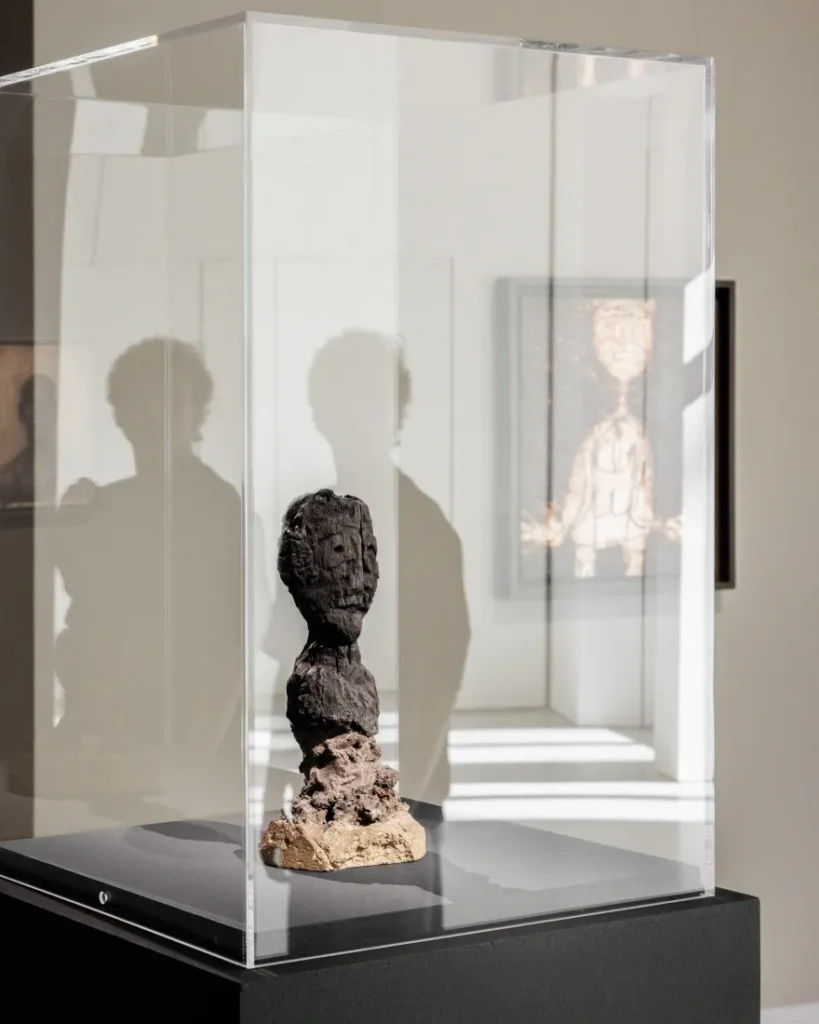
Clair-Obscur, a French term for chiaroscuro, translates to light and dark. Curated by Emma Lavigne, Director and Chief Curator of the Pinault Collection, it features around a hundred works, including images of skulls alongside sculptures that resemble parts of bodies such as limbs, skin, almost corpse-like forms, and the after-life. The show confronts mortality with almost an obvious, in-your-face directness.
It opens with works by German artist Sigmar Polke. His raster paintings are enlarged interpretations of found images, over which he painted. The notes highlight his “protean approach,” describing his studio as almost a laboratory for experimentation.
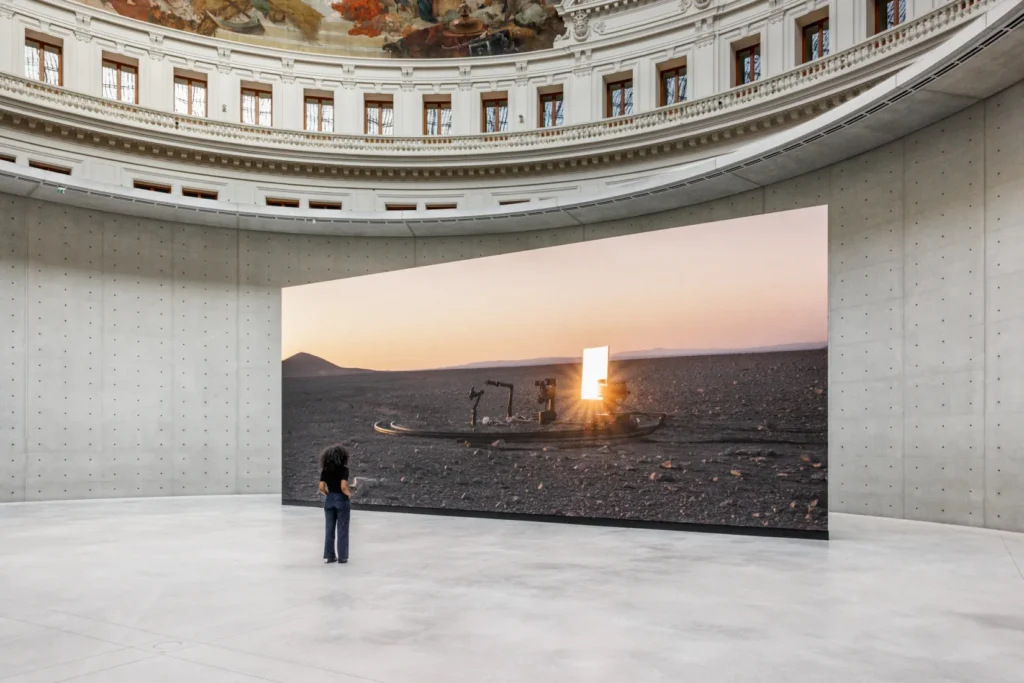
At the center of the exhibition, and perhaps its most striking moment, is Camata (2024), the robotics-driven, self-directed piece by French contemporary artist Pierre Huyghe. The piece features a skull being autopsied by a slow-moving robotic arm in the dryness of the Atacama Desert. A mirror reflects the scene, as well as rays of the sun. Blue elements appear throughout the work, like an antidote, perhaps to the desert, perhaps even to the bones themselves.
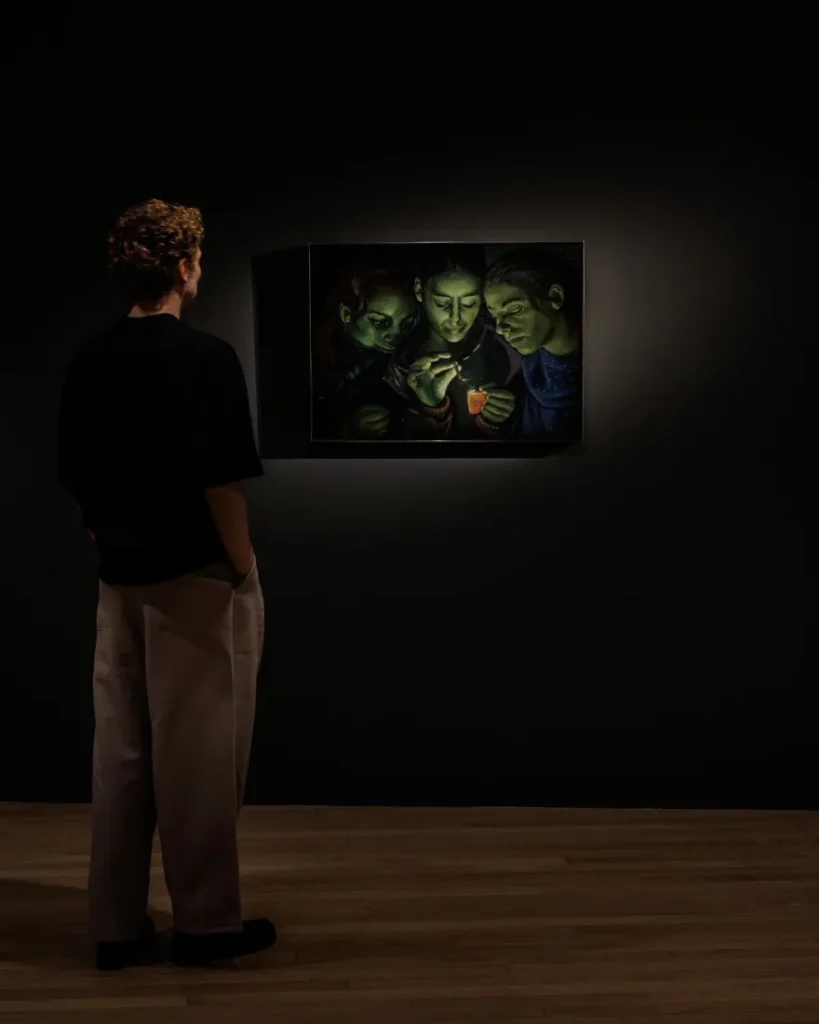
On the first-floor gallery, paintings by Romanian artist Victor Man glow in the dark with a hypnotizing green light. Each canvas depicts life with figures appearing in intimate, haunting scenes: a woman with a child suggesting new life, a small mouse beside a woman brushing her hair with her hands, animals shown across the compositions such as a horse and a snake in strange conversation, while a monkey sits on a bright red piece marked with crosses. Everything feels like a narrative of our everyday life, what happens between birth and death.
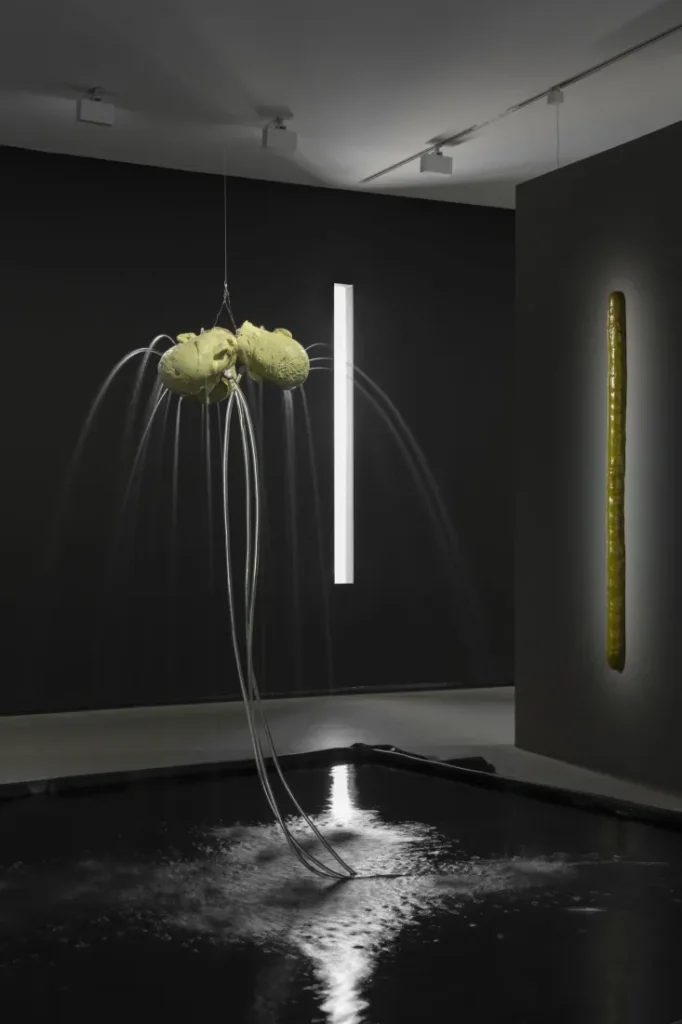
Another gallery titled Ombres/Shadows presents sculptures that represent the human body made from moulds of the artist’s own bodies or someone they know, which evokes their “pessimistic view of humanity tied to the trauma lived by the artists.” The gallery featured works by Alina Szapocznikow, Bruce Nauman, Dan Vo, and Robert Gober. In the middle stands a fountain with running water akin to a life source.
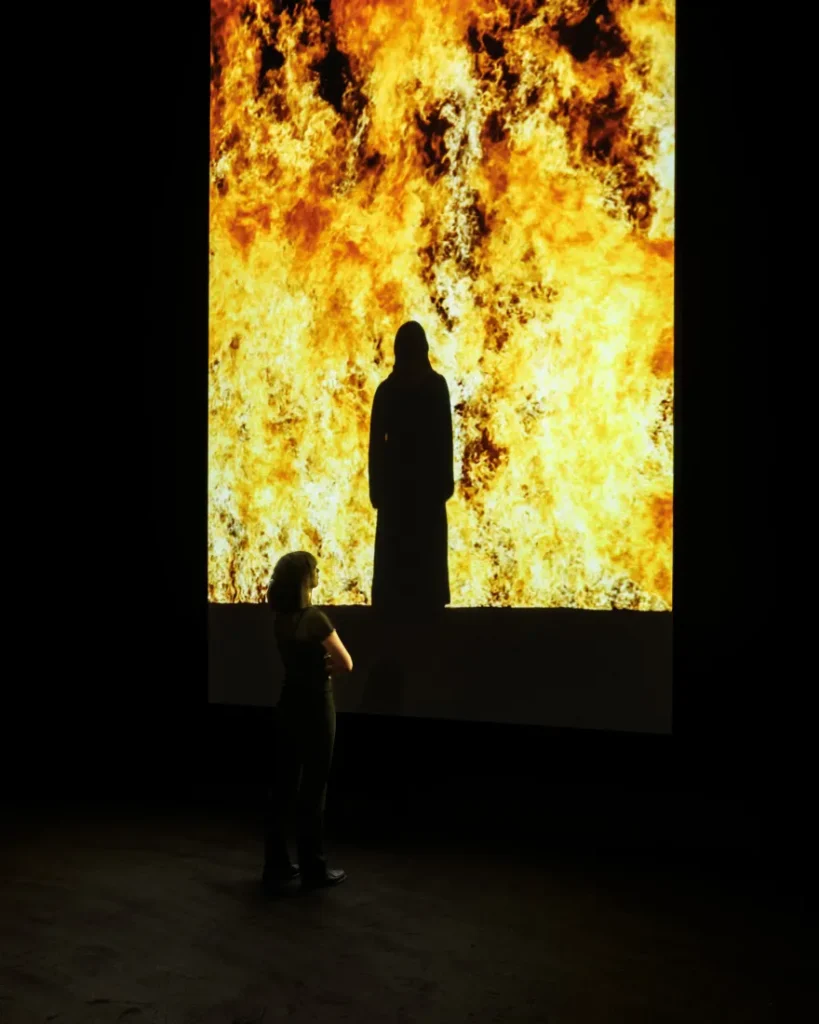
Two video installations nearby by Bill Viola become almost an instant favorite. Across his work, Passage Into Night (2005) is Fire Woman (2005), which features a scene of calm waters filling the screen that abruptly cuts to a figure standing before a raging fire that feels like burning hell.
Throughout the 24 display cases of the passageway, Laura Lamiel explores lived experiences and memory. Animal skulls appear again, reminding the viewer of the exhibition’s message on mortality.
The basement section is called Nocturnal. It features videos La Quinta del Sordo (2021) by Philippe Parreno alongside Saodat Ismailova’s To The Throat of the Sun (2026), a hallucinatory video that captures the very idea of chiaroscuro. It features scenes of nuclear explosions, where light appears not only as a flash of brightness, but also as a symbol of human brilliance and invention, set against its darker use as a tool of power and destruction, something that could bring about the end of the world.
Walking through Clair-Obscur, our thoughts inescapably turn to death, especially in the strange reality of the world we are living in now. Darkness is everywhere: wars, economic fragility, and everything else that reminds us how small we are, and how little control we have over our body, our time, and our life. Is this one of the causes of our ever-growing obsession with longevity and prolonging life? Is it a way to see light in a world that feels so dark? Maybe the promise of agelessness is the answer to a decaying world?
The exhibition is on view at Bourse de Commerce—Pinault Collection until August 24th, 2026.
Words: LIZ BAUTISTA
Photography by FLORENT MICHEL, courtesy of PINAULT COLLECTION