Beginning September 17th, 2026, Hauser & Wirth Hong Kong will stage Lucio Fontana: Spatialism. Pioneering the Contemporary, a major exhibition tracing the Argentine-Italian artist’s radical approach to painting, sculpture and space. Running through December 19th, it brings together seminal works from 1949 onwards, revealing how Spatialism opened the canvas to movement, light and infinite possibility.
Curated by Luca Massimo Barbero with the Fondazione Lucio Fontana, the exhibition concludes a trilogy devoted to Fontana, following presentations in Los Angeles in 2020 and New York in 2022–2023.
The Lucio Fontana’s exhibition begins with a hole in the canvas
The exhibition opens in 1949 with Fontana’s revolutionary Buchi (Holes), where piercing the canvas became an act of creation, opening the painted surface onto the space beyond. Early perforated papers, terracotta works and later pierced canvases trace his growing interest in breaking the boundary between painting and sculpture.
For Fontana, the canvas was an active field extending into space. Each hole introduced depth, shadow and movement, allowing the surrounding environment to become part of the work.
The tagli turn a gesture into a new spatial language
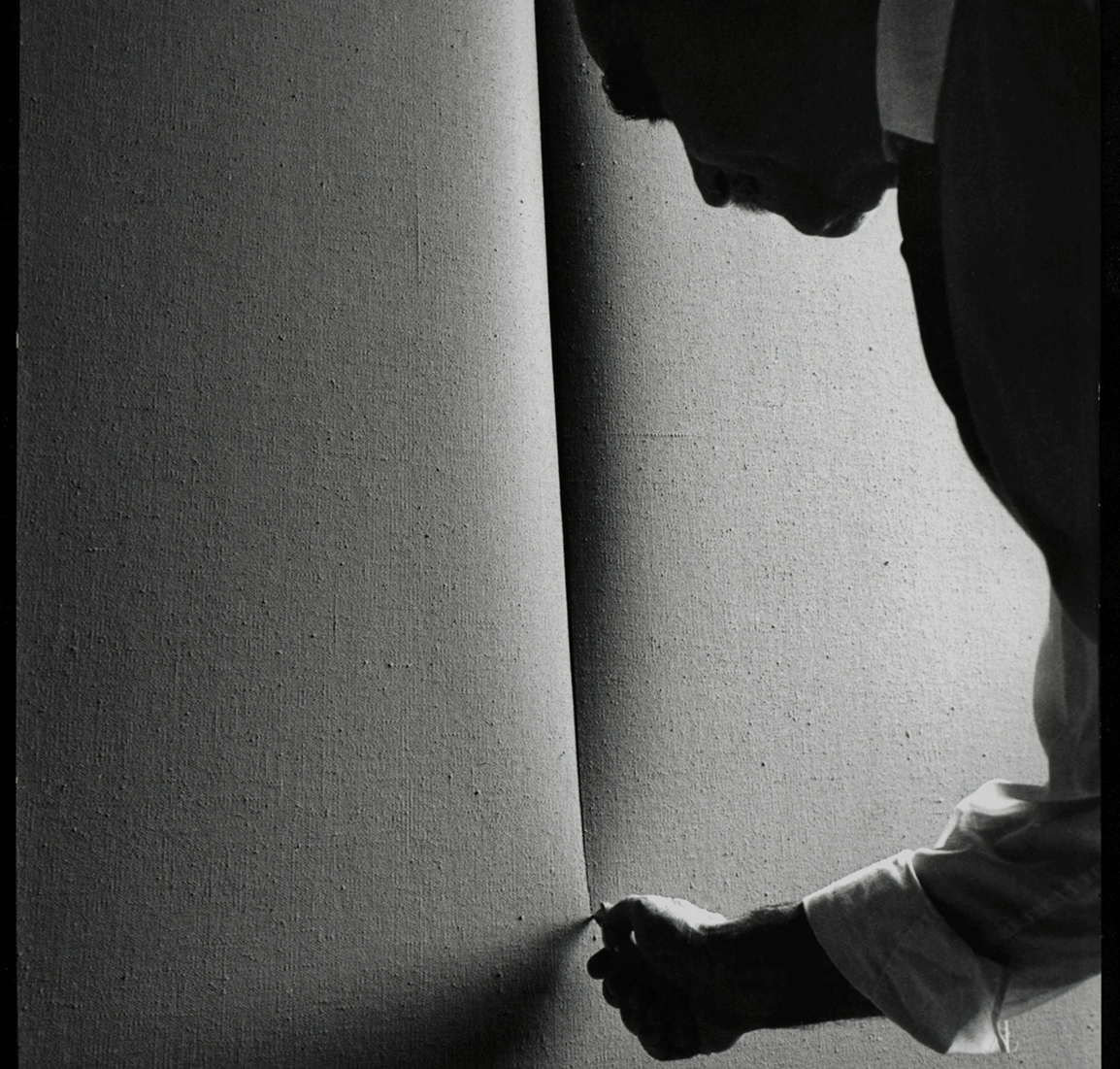
By the late 1950s, Fontana’s experiments led to the celebrated Concetti Spaziali, Attese (Spatial Concepts, Expectations), or Tagli (Cuts). A significant selection follows the evolution from early incisions to the precise slashes that became synonymous with his practice.
Narrow openings puncture monochromatic surfaces, bringing darkness and depth into the composition. Alongside the Tagli, Quanta (1959–1960) features shaped canvases that challenge the traditional rectangular format and anticipate the American shaped-canvas movement.
Spatialism turns light, matter and space into the artwork
Fontana’s Spatialism called for an art responsive to new ideas of space, movement and contemporary life. Works in white, black, gold and silver interact differently with their surroundings, while light moves across metallic surfaces and through the openings in the canvases. His radical treatment of surface and space helped pave the way for postwar practices that blurred the boundaries between painting, sculpture, installation and environment.
Fontana’s Nature series (1959–1960) brings Spatialism into three dimensions through rough bronze sculptures with organic, geodesic forms resembling planets or fragments of unknown matter. Their punctured surfaces and ambiguous shapes suggest distant worlds.
Where the Buchi and Tagli open the canvas towards infinite space, Nature gives that sense of the unknown a physical body, extending Fontana’s vision across painting, sculpture and the cosmos.
The Fondazione Lucio Fontana extends the artist’s legacy in Hong Kong
The exhibition coincides with a new monograph from Hauser & Wirth Publishers, the first widely available introduction to Fontana’s practice in Simplified Chinese. Edited by Luca Massimo Barbero, it traces his career from Argentina and Europe through Spatialism, Ambienti Spaziali (Spatial Environments) and his late slashed canvases.
The publication also features Fontana’s writings, including manifestos, interviews and articles from 1939–1967, translated into Simplified Chinese for the first time. It marks the third collaboration between Hauser & Wirth, the Fondazione Lucio Fontana and Barbero.
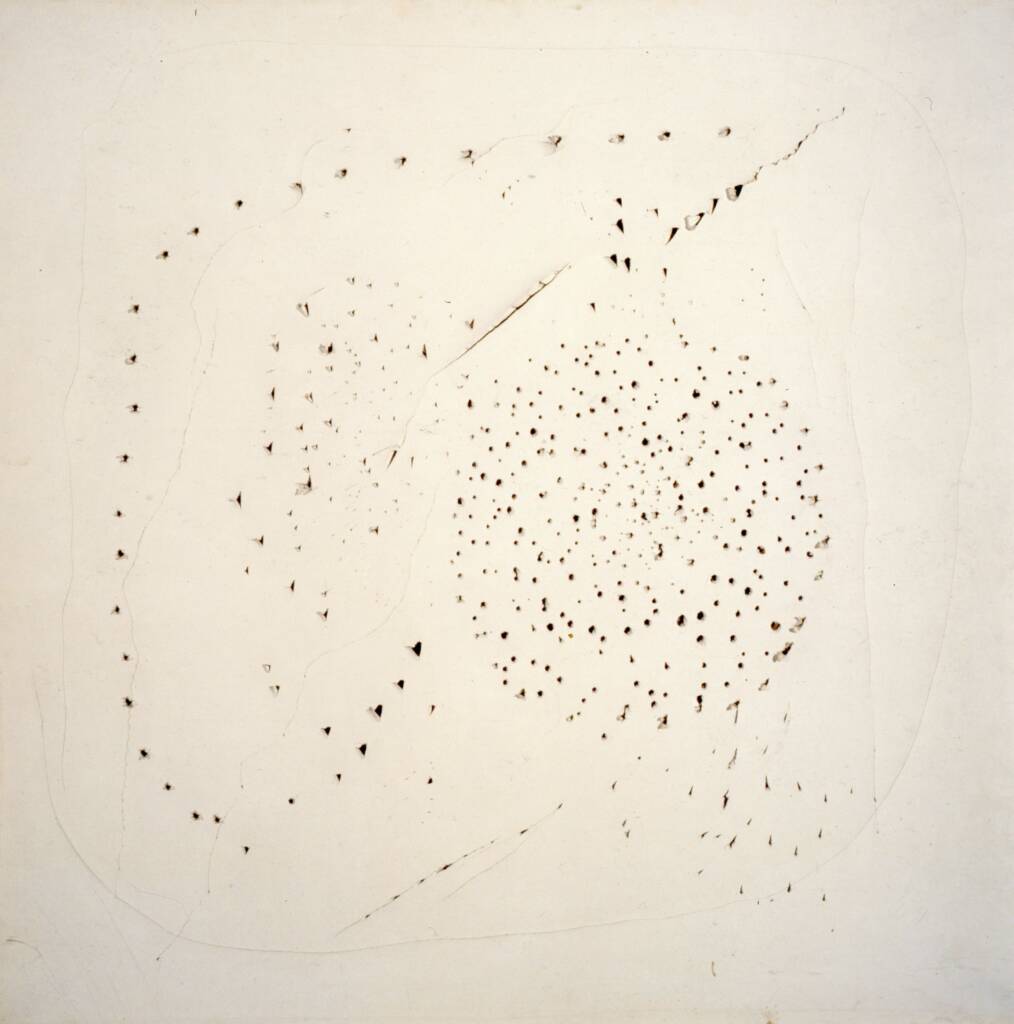
Concetto spaziale (Spatial Concept), 1949
© FONDAZIONE LUCIO FONTANA, Milano
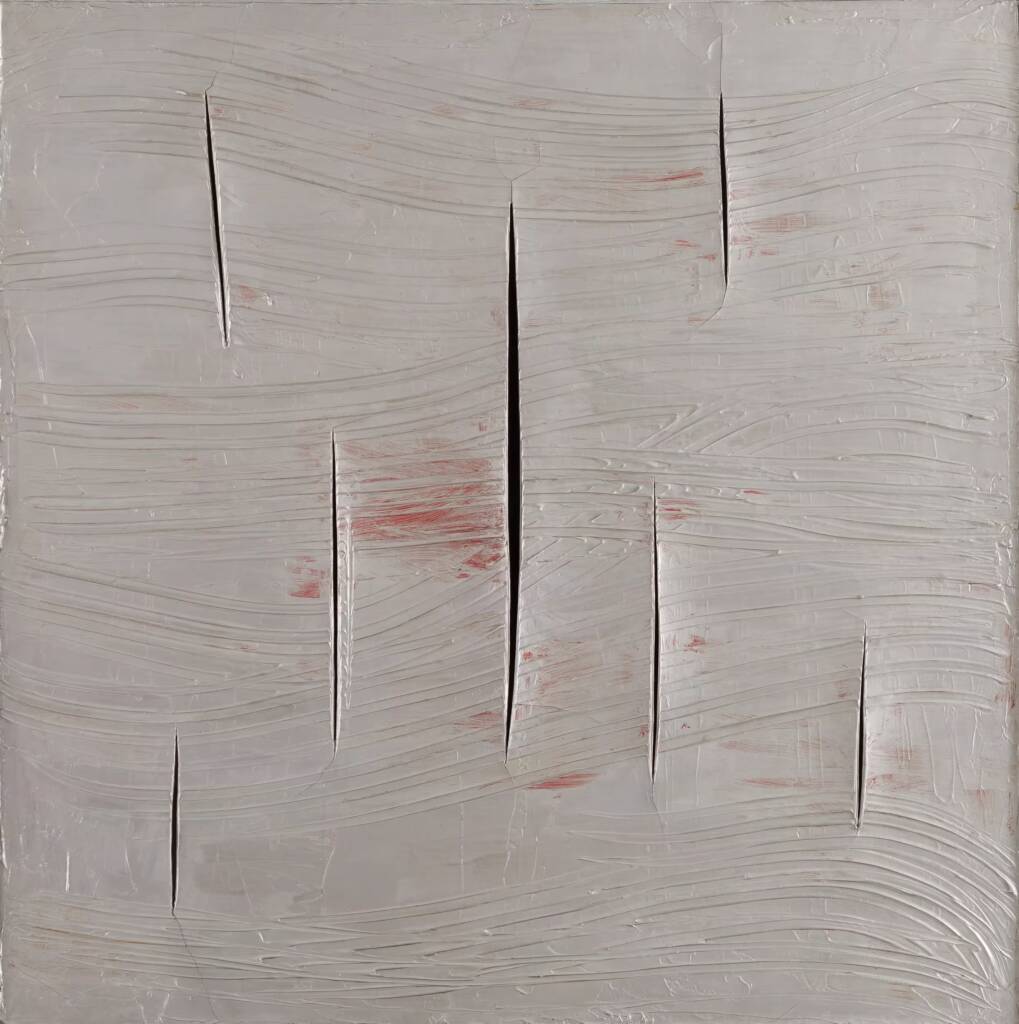
Concetto spaziale, Venice moon (Spatial Concept, Venice Moon), 1961
© FONDAZIONE LUCIO FONTANA, Milano