jerskin fendrix film scoring Poor Things film score

Jerskin Fendrix on Shropshire and other planets

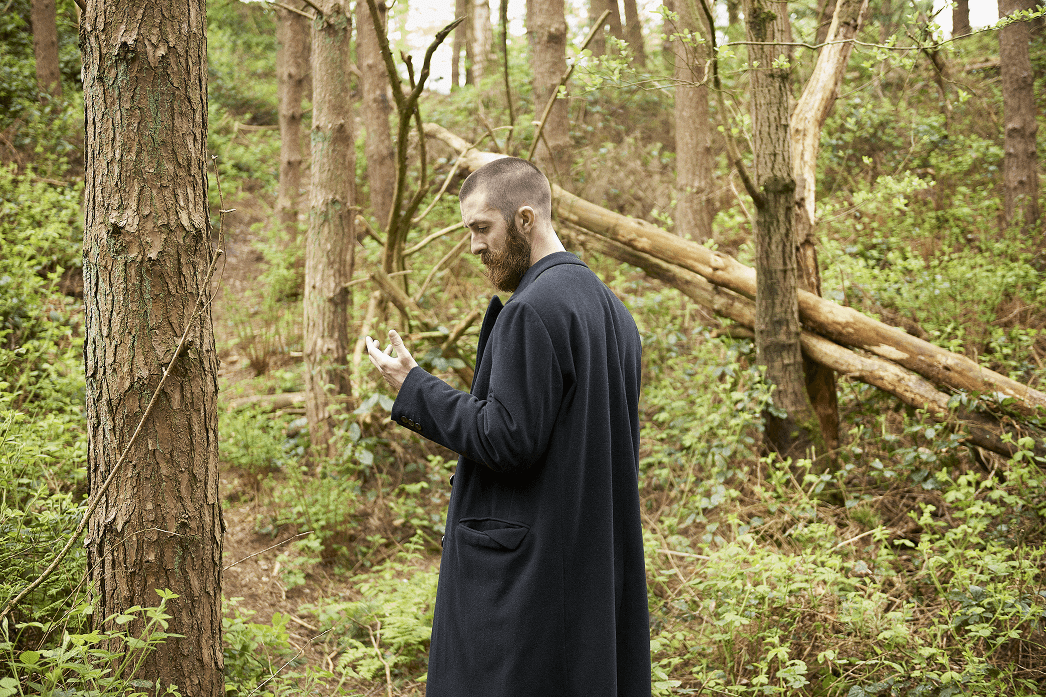
The way English music composer Jerskin Fendrix describes his childhood in Shropshire, one might assume he was describing a dream. With the idyllic countryside framing his imagination on all sides, it makes sense why Fendrix fell in with Yorgos Lanthimos, the director making other-worldly Hollywood films that could only be scored by someone who has truly lived it. After composing the Poor Things film score, Fendrix has grown more accustomed to working with large creative teams, although he already had experience with experimental opera at institutions such as London’s V&A Museum. Beyond prestigious museums and the Academy Awards, where his score for Poor Things earned a nomination, you can find Fendrix at London’s more eccentric music venues, experimenting with the presentation of his sound and observing how audiences respond. For him, seeing the narrative within his lyrics reach people is what keeps him making work.

In this interview with hube, Fendrix talks about the fantasy worlds that inspire him, a song named after an Adventure Time special about death, and why there is often a better way than the right way.

hube: Your stage name originated from a friend at school. How has its meaning evolved over time, and what does it represent for you today?

Jerskin Fendrix: The best things in my life have been given to me. I loved not having to choose a solo name that would have dated instantly for the same reason that I would never get a tattoo. Also, there is no hierarchy between my stage name and my birth name. No one gets to pretend to know me better or closer, which lets me be more honest in my songwriting. More welcoming. And for the record, my name has 0% to do with Jimi Hendrix.

h: Working on Poor Things brought you close to Yorgos Lanthimos. When approaching a large-scale project like that, how do you navigate the balance between your musical vision and the director’s cinematic world?

JF: Working as a small component in a large system is so beneficial, especially after years of being the captain of a solo project. It is a practice in artistic humility, empathy, and the sheer joy of knowing when to hold back in order for other artists to be seen. In reality, most of working with a team like that is keeping up; Yorgos, his actors, his writers and the other departments are so monumentally talented that the motivating factor is not wanting to be the loose screw. Imagine seeing the concept artwork for Poor Things! All I wanted to do was keep up.

h: Returning to work with Lanthimos on Bugonia, what aspects of the collaboration felt familiar, and where did you find yourself approaching the music in entirely new ways?

JF: I am getting better at knowing what Yorgos wants and how to competently furnish his work, though a bizarre mental stumbling block for Bugonia was knowing about reception. When I scored Poor Things and Kinds of Kindness, I didn’t know what the reception to my film work would look like. Now, I need to navigate that public pressure, and a bit of semi-successful ego suppression.
jerskin fendrix
film scoring
Poor Things film score
jerskin fendrix
film scoring
Poor Things film score
jerskin fendrix
film scoring
Poor Things film score
jerskin fendrix
film scoring
Poor Things film score

h: In translating abstract emotions or narratives into music, what are the biggest challenges, and how do you know when a piece feels complete?

JF: It’s very easy to do for autobiographical songwriting. Most of the time, I just focus on the concision of language, which I’m okay at. For songs that involve the feelings and experiences of other people or fictional characters, you have to be ruthlessly gentle and sensitive. It’s another great exercise in trying to quiet your ego. Writing music for Bella Baxter has made me into a more empathetic person. Without it, I don’t think I would have been able to write Once Upon A Time… In Shropshire with as much appreciation for my friends and family. I could not have written the song Mum & Dad without having worked on Poor Things.

h: Are there particular voices or genres you keep returning to for inspiration, and why?

JF: I return to certain artists, such as Joanna Newsom and Bob Dylan, to remind myself of the highest possible standard. My friend Jack Merrett, from the band Famous, and I made a pact some years ago to never write a meaningless lyric. He is an astonishing lyricist, and I owe him my standard of writing.

h: Song titles often serve as the first point of connection for listeners. How do you decide on them?

JF: Together Again is named after the Adventure Time special about death. It is so sad and so beautiful. A title that’s shared with another piece of work can illuminate where a song comes from. My songwriting can be a little difficult, so I try to search for anything to assist understanding. I used the same principle for the title Winterreise, but oftentimes, it’s just functional.

h: Your work spans solo projects, film scoring, and collaborations. How does your creative process adapt to these different contexts, and what do each of them teach you about sound?

JF: My approach is always surprisingly similar. The bottom line of my work is to communicate the correct feeling in the least conventionally correct way. Structurally, it’s just a series of very long jokes. My upbringing was The Simpsons and John Berryman, who taught me that the right way is the wrong way. There are always ways better than the right way.

h: Performing at venues like the Windmill in Brixton and Café OTO in Dalston seems intimate yet charged. How do these spaces influence the way music is presented and experienced live?

JF: I never went to gigs as a kid and I don’t take huge pleasure in performing live. My closest connection to any artist will always be listening to them on headphones in the back of a car. I see performance as part of my education, preparing music, and observing how it feels to present it to a critical audience. Places like The Windmill and Cafe OTO are unique and extraordinary in creating a space for artists to discover and improve their methods of making music. For the civilian public, I’m sure they are also wonderful places to see some really unexpected music. But, for me, they take on the roles of schools. Though, getting offstage after a good performance is one of the greatest experiences in the world.

h: Once Upon A Time… in Shropshire evokes the English countryside. Were there particular landscapes or memories that inspired the album? What feeling do you hope listeners carry away?

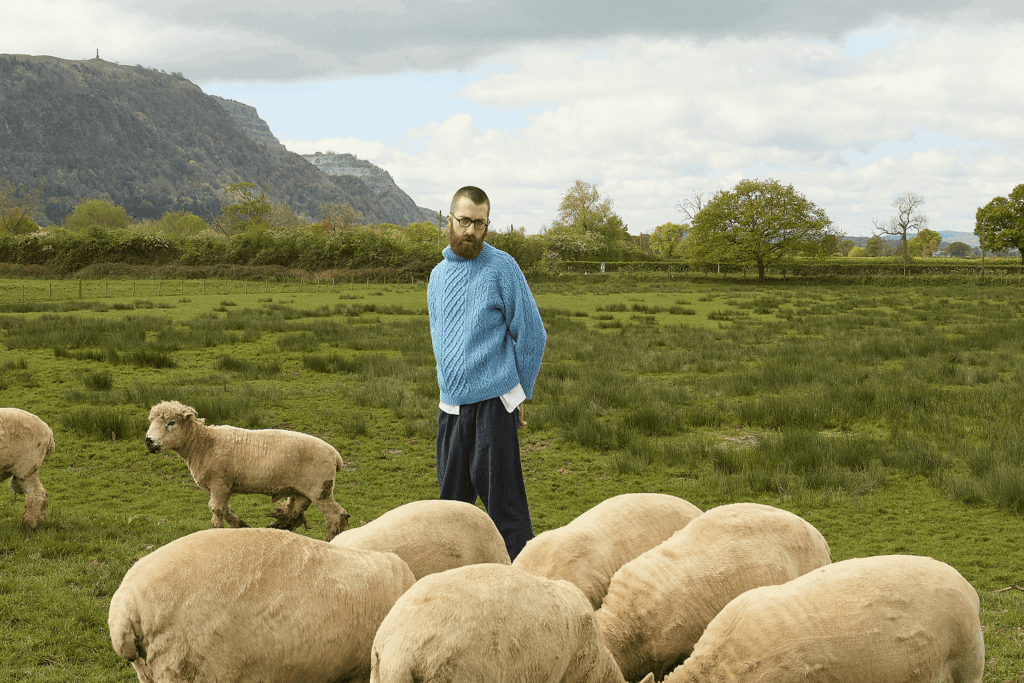
JF: I was lucky to grow up in a place of astonishing and unknown natural beauty. Since I was very young, I felt sensitive towards it. I was so constantly moved and emotional about how the rural landscape of Britain feels. To communicate it is very difficult, like taking a photo of the most beautiful sunset you’ve ever seen, then trying to show it to someone. It doesn’t translate. I’ve always liked Stephen King’s idea about writing being a form of telekinesis. It takes a lot of time to make an artwork effortlessly conjure a feeling, especially one as numinous as a natural landscape. Nigel Slater’s preface to The Kitchen Diaries, books like The Wind In The Willows, cartoons, and The Legend Of Zelda were all touch points for trying to find unexpected, little, understandable ways of making something so massive and ineffable a little more effable.

I grew up near the forest where Charles Darwin did his early worm experiments. My friend Beth lived in a jaw droppingly magical part of Wales. There, they had barbecues in abandoned quarries, these little country chapels that existed outside of time, and endless oceanic wheat fields that feel like another planet when you’re ten bottles of Stella deep, listening to Chance The Rapper on a Bluetooth speaker. These places make you weep when you’re by yourself, and weep even more when you are surrounded by the people you love. I always found summer in the countryside more depressing than winter. I can deal with darkness, but the length and majesty of each sunset when the days are so long makes every night feel like the end of the universe.

h: Looking ahead, how do you envision your practice evolving over the next year?

JF: I’m gonna get better.

jerskin fendrix
film scoring
Poor Things film score
jerskin fendrix
film scoring
Poor Things film score

Photography by TIM GUTT
Words: JULIA SILVERBERG

ISSUE 7

The new edition is here