
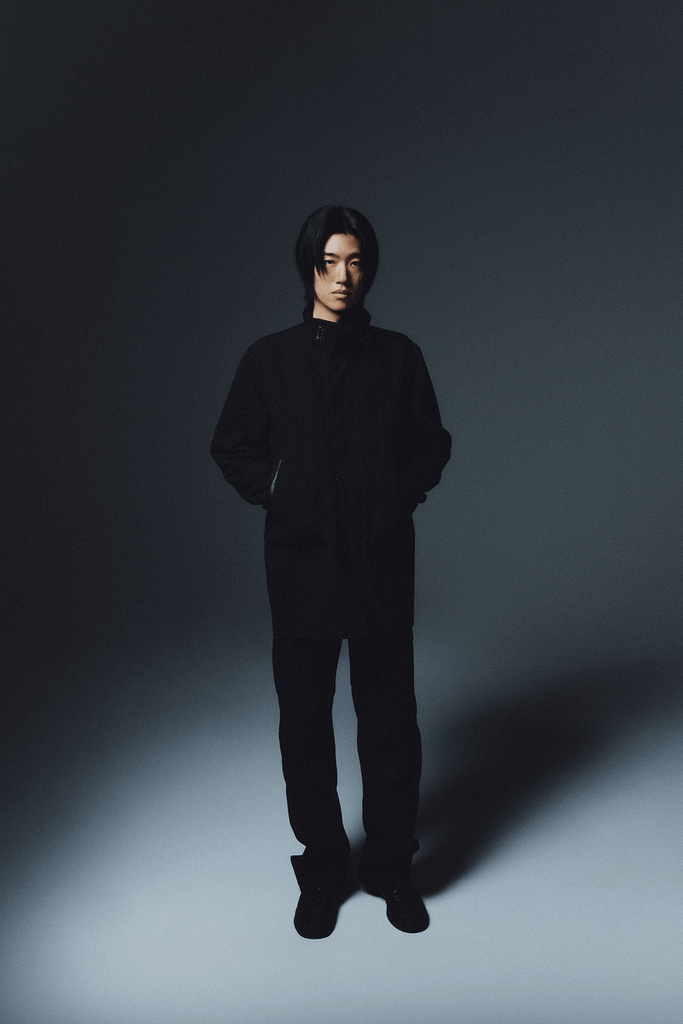


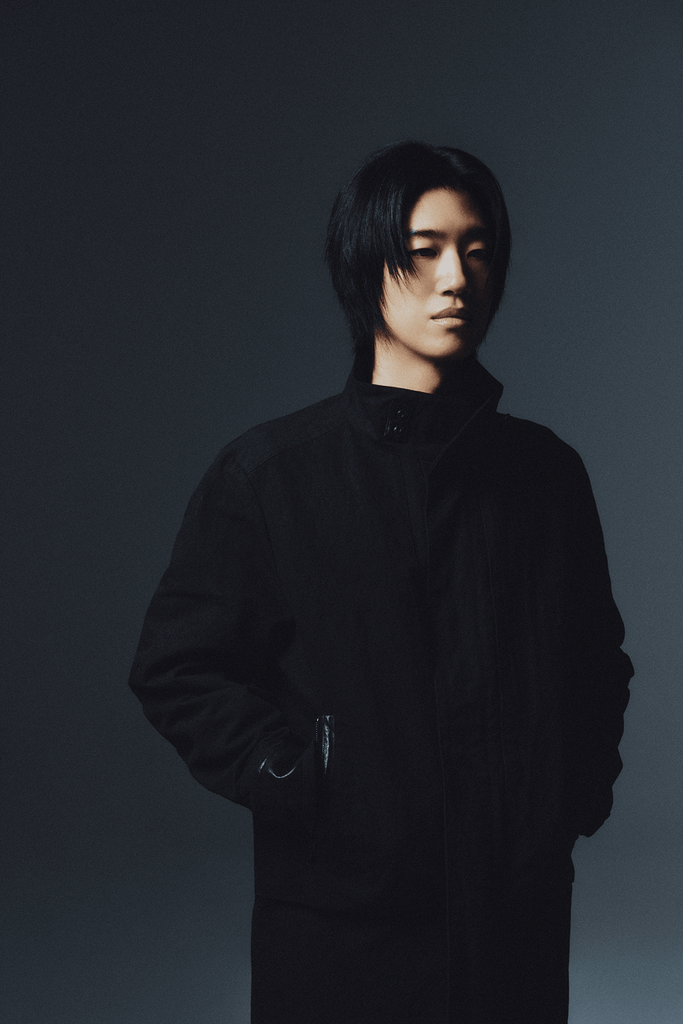
Lee Sang-yeop started SAN SAN GEAR in Seoul in 2019, after running two earlier Korean fashion brands built around the skateboarding scene. The new label takes the equipment logic of technical outdoor clothing—adjustable closures, a modular design in which parts detach and recombine, unusual synthetics—and puts it at the service of subcultures such as rave, cosmic horror, anime, and astronomy. The method is additive: pockets exaggerated, seams curved where they could just as easily go straight, a garment usually carrying more than it strictly needs. He calls the result functional maximalism.
SAN SAN GEAR operates as a loose group of designers, musicians, 3D artists, and gamers with an overlapping interest in the same subcultures. A release tends to arrive with a film, a figure, or a record attached, made by members of the group. The brand has worked with PUMA, ASICS, and Alpha Industries, produced an apparel line for League of Legends, built a season around the Korean rock band Silica Gel, and extended its SS23 collection into animation and figures with the artist KOESY. The collaborations go both ways: a collection turns up inside a music video, an artist’s animation turns up inside a collection. It now sells through more than fifty stockists, among them GR8 in Tokyo, Goodhood in London, and Extra Butter in New York.
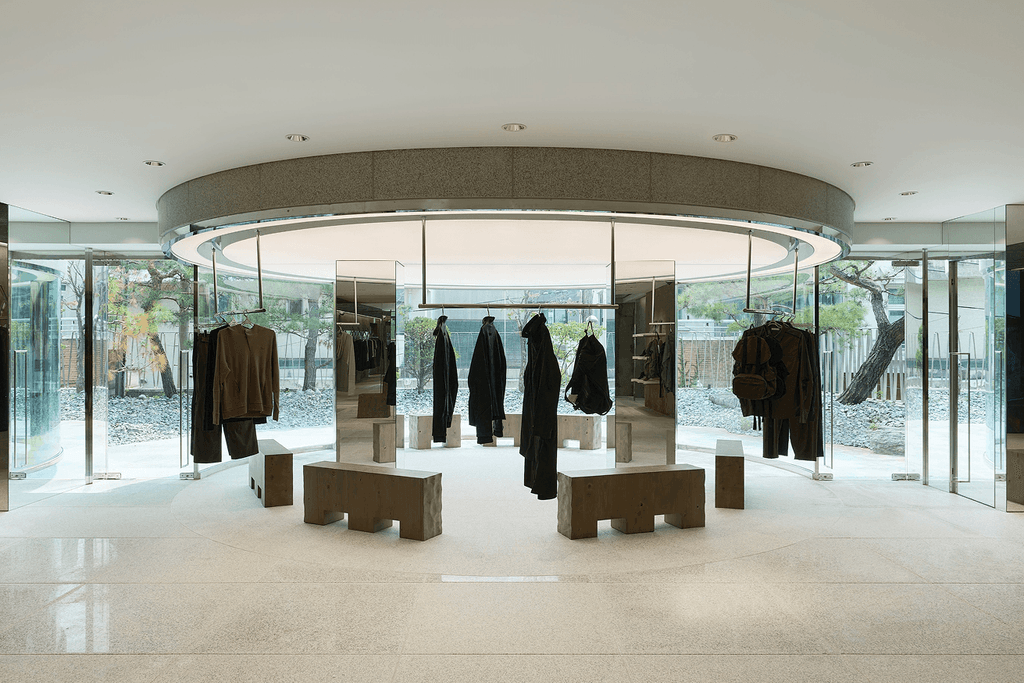
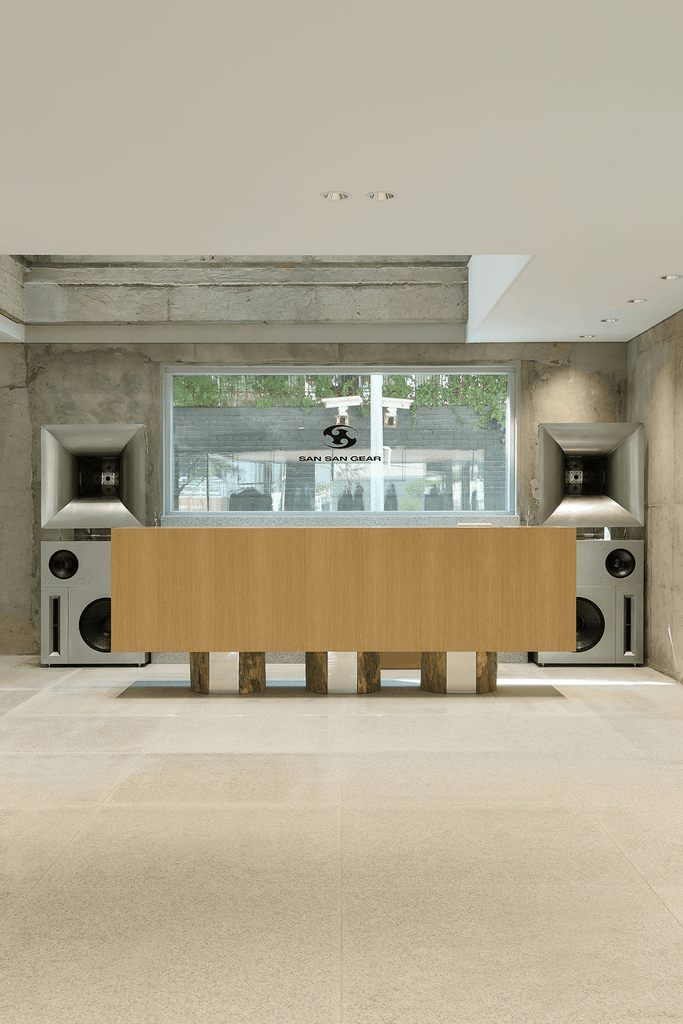
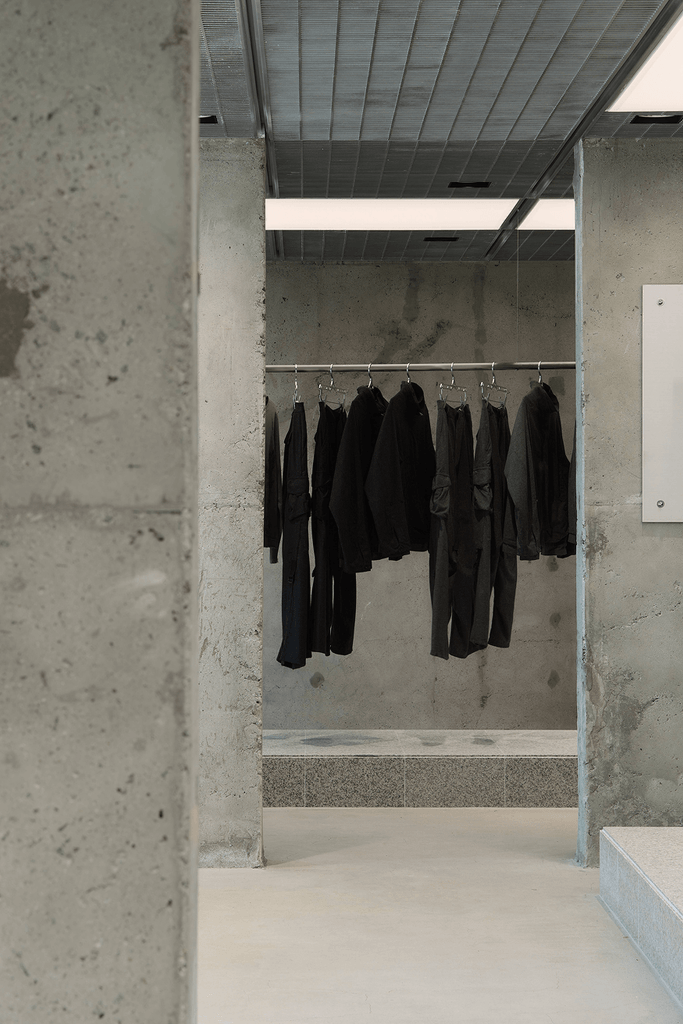
In August the brand opened its second Seoul flagship, in Hannam, inside a converted private house. The Tokyo studio DAIKEI MILLS took it on as their first project in Korea, working on a principle of minimal intervention, with furniture from SIIN SIIN on the ground floor and the Seoul-based Choi Sung-il above. The FW2026 collection, CABLE, followed days later across three drops, using cables as a metaphor for the tension between the individual’s desire for isolation in contemporary society and the unavoidable connections that bind us to the world around us. Multi-layered outerwear whose layers stay visible and are joined by cable-like details, structural knitwear, and modular bags that can be rebuilt for a different load. The palette stays low in saturation until an accent colour arrives and reads as a signal. Hube spoke to Lee Sang-yeop about cities, contradiction, and what he has stopped trying to define.
hube: Some brands communicate through statements, while others leave something unsaid. Was there an idea, attitude, or way of seeing the world that you wanted people to understand through the clothes and objects themselves, without ever having to explain it?
Lee Sang-yeop: Rather than saying that one style or culture is better than another, I think of SAN SAN GEAR as a brand that takes things already familiar to us, looks at them from a slightly different perspective, and twists or combines them in unexpected ways. Functional outdoor clothing can be worn through the language of streetwear, and interesting elements that once belonged to subcultures can take on completely different meanings in everyday life.
I want there to always be a certain contradiction within SAN SAN GEAR. The clothes are clearly functional, but they do not exist rigidly for function alone. They can feel futuristic while still carrying something familiar, worn-in, and human. Even in the design itself, we try not to become overly serious or heavy. The world constantly pressures us to define and prove things clearly, but I would like SAN SAN GEAR’s clothes to simply become a comfortable “background” for people quietly living their everyday lives within that complexity.
I do not want to force these ideas through grand slogans or explanations. If someone wears our clothes while walking through the city, or experiences a certain atmosphere through our editorials or spaces, and naturally thinks, “This brand seems to look at the world with a slightly different attitude,” that is enough for me.
h: Looking back, what did you understand about SAN SAN GEAR from the very beginning? And what did you once believe was essential, but later realised was no longer relevant? What does letting go make possible?
LSY: From the beginning, one thing was clear to me: it had to be a brand that spoke through my own perspective and language. Through previous failures, I learned the hard way that following someone else’s way of doing things can never last. Rather than simply chasing trends or applying fashionable graphics, we have always tried to build a reason why a garment needs to exist in the world, along with an attitude that belongs to us.
What I have gradually let go of, on the other hand, is the obsession with defining exactly what we are. In the beginning, I sometimes thought SAN SAN GEAR needed a clear genre through which it could be explained—whether technical, outdoor, or streetwear. Now I feel that refusing to define those boundaries too clearly is actually closer to the identity of SAN SAN GEAR.
When you let go of one thing, you create space for something else to enter. Once we emptied out the framework of genre, not only clothing but also music, space, art, and relationships with people could naturally become part of the brand. Now, rather than being defined as one particular thing, I find it much more important to remain open enough to absorb and breathe with anything.
h: Your experience has crossed different cultural environments, and the brand now speaks to people far beyond Korea. How much of SAN SAN GEAR comes from the place you started, and how much comes from everything you encountered after leaving it? Can a brand still have a clear cultural identity without being defined by geography?
LSY: The influence Seoul has had on SAN SAN GEAR remains as the fundamental foundation of the brand. Seoul is not simply trend-sensitive; it is such a fast and dense city that even trends can struggle to keep up with how quickly people’s interests change. Starting a brand in that kind of environment forced us to think more intensely about what our own standards should be—what should remain unmoved even within such rapid change. The speed and atmosphere I grew up seeing on the streets are already embedded in the clothes, even without consciously trying to put them there.
At the same time, as I developed the brand and continued experiencing other cities such as Tokyo and Paris, I realised that a sense of regional identity does not come from deliberately using obvious traditions or symbols. Even when looking at the same thing, the way I choose, edit, and distort it is already shaped by the environment and experiences of having grown up in Korea and Seoul. I think the results that come from bringing that embodied sensibility into dialogue with the global scene create the most natural balance between Korea and the wider world.
That is why I am cautious about deliberately packaging something as “Korean” or as having a “Seoul sensibility.” Rather than explaining where we come from, I think it is more important to show how growing up there shaped the way we look at the world.
h: When you enter a new city, what do you notice first: people, clothes, architecture, objects, signs, or something else?
LSY: Architecture, flashy signs, or the clothes displayed in stores are, to me, things that anyone can see if they spend a little time looking. What catches my attention first is how people actually use the space around them.
I notice the way someone carries a bag on the street, the posture they take while waiting for the subway, or the casual way they wear an old coat. Where people sit down to rest, which street corner they spend time on, what they wear, and which stores they enter without thinking—I feel that these everyday movements reveal the real atmosphere and attitude of a city.
When I visit a new city, I tend to pay more attention to things like convenience stores, subway stations, old shops, and billboards than to famous tourist destinations. They are so ordinary to the people who live there that they barely register as special. I think the true rhythm and honest character of a city reveal themselves much more clearly through these everyday gaps than through surfaces that have been deliberately curated.
h: SAN SAN GEAR’s new flagship in Hannam is housed in what was once a private residence. What interested you about turning a space that was designed for private life into a public one?
LSY: What interested me most was the tension created by placing a public function—a space open to an undefined number of people—inside the deeply private shell of a home that once contained someone’s personal life. Typical retail spaces are designed from the beginning to welcome large numbers of people, with high ceilings and open, box-like layouts. A house is the complete opposite. It is divided into rooms, living areas, stairs, and narrow corridors for people to live in, so its scale and rhythm are fundamentally different.
Of course, we stripped back and reorganised the space when turning it into a store, but the structure and layered feeling unique to a residence remain—something that could never come from a conventional commercial building. We placed our own circulation and new spatial scenes boldly over that private structure, allowing public functions to overlap with what was originally private.
When we design clothes, we also like creating tension between elements with different characteristics, such as function and form. I think allowing that same kind of duality and contradiction to appear naturally in the space feels very true to SAN SAN GEAR.

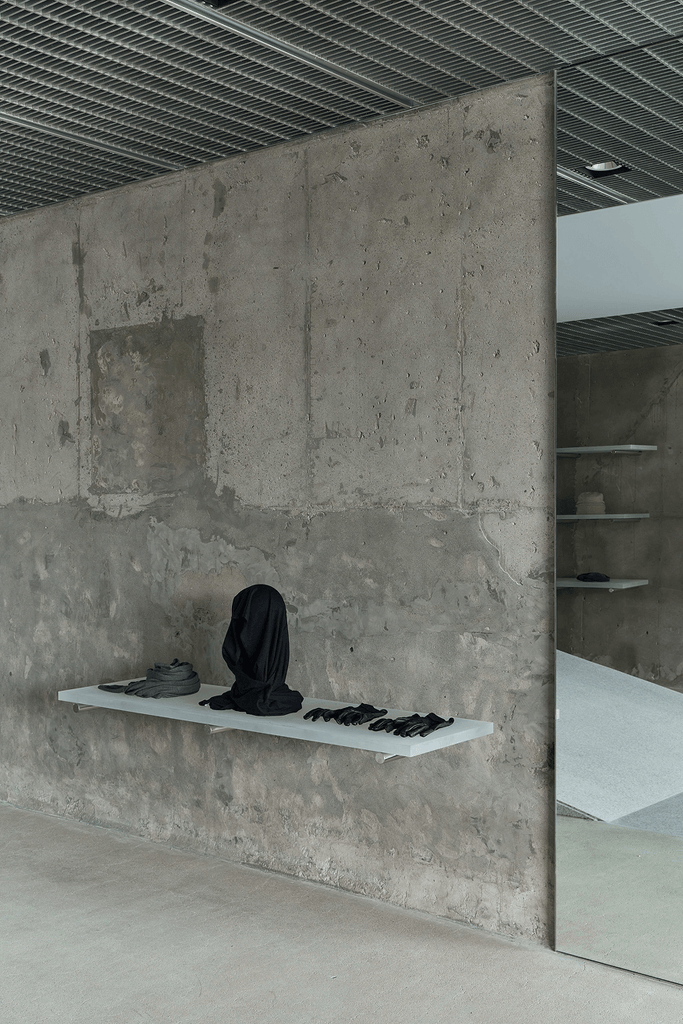
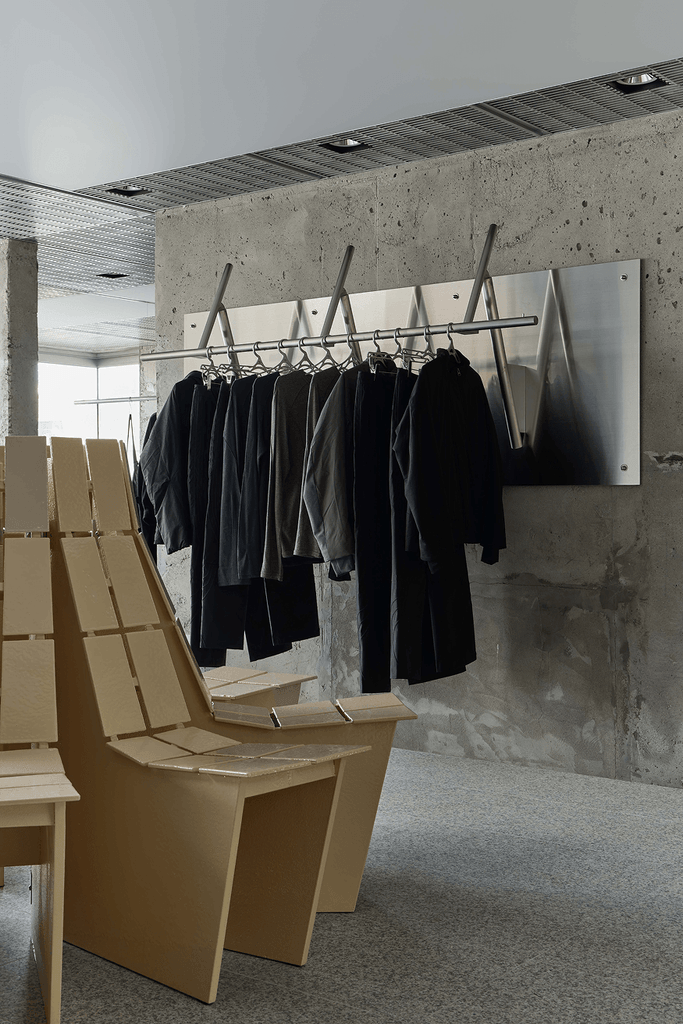
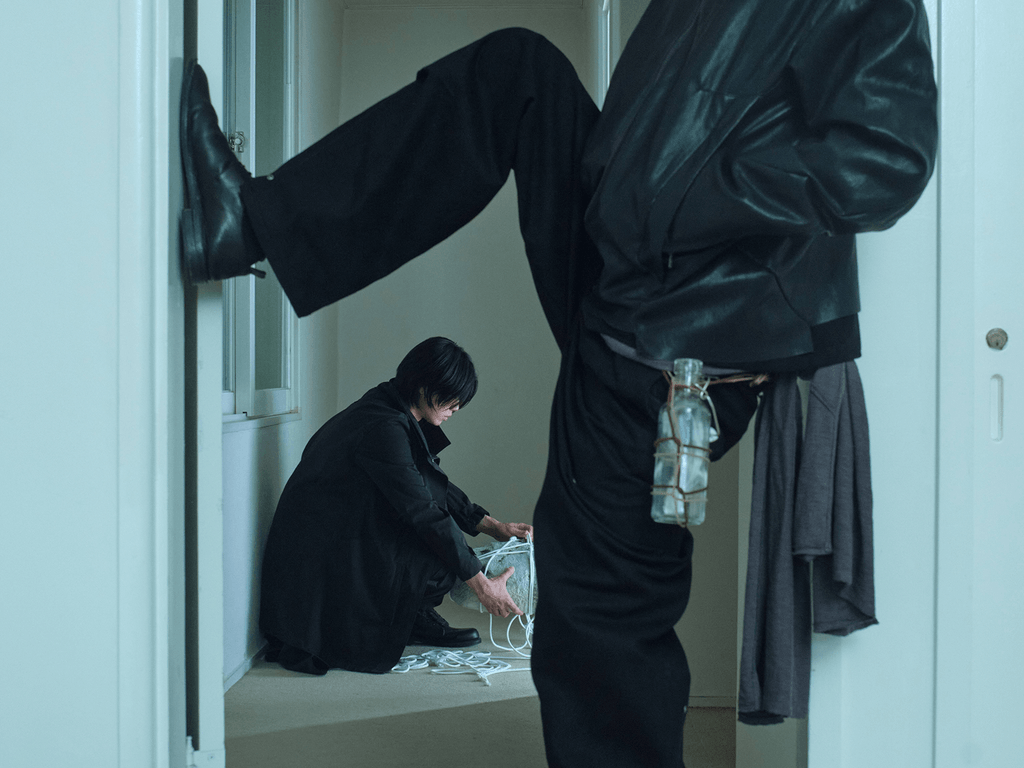
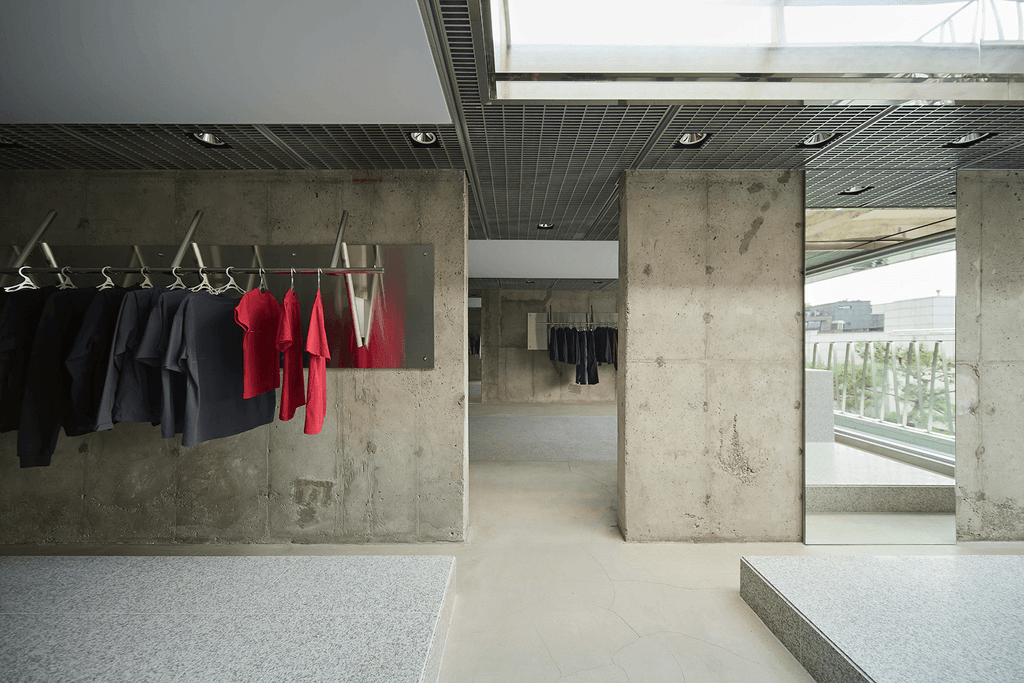
h: When someone walks into a SAN SAN GEAR store, what do you want them to understand through the space before they even see the products? What can a physical space give a brand that an image, website, or social media never can?
LSY: Online, a brand can show only the scenes it wants people to see. You can select the images, control the sequence, and create a completely curated experience. But in a physical space, everyone experiences things differently. The air, sound, and smell when you open the door, where you stop walking, what catches your eye first, and even who you happen to encounter there—a brand cannot fully control any of those things. I think those unpredictable experiences are incredibly important.
A physical space is where a brand directly meets people’s everyday lives. Sometimes the atmosphere someone felt there, or the people they encountered, can stay with them longer than the clothes themselves. That is why I want SAN SAN GEAR’s spaces to go beyond simply being showrooms for products.
When someone enters the store, I hope they can naturally sense what kind of clothes we make just through the atmosphere and attitude of the space. Beyond that, I would like it to become a place where exhibitions, music, events, and different kinds of people can come together and form their own relationships.
h: Who are the people whose work you return to repeatedly—not necessarily in fashion? And has anyone influenced SAN SAN GEAR without you consciously intending it?
LSY: Rather than repeatedly referring to the work of one particular person, I tend to move freely across different fields and look at whatever catches my attention. That includes not only fashion, but music, film, architecture, graphics, games, and even highly commercial images I happen to come across online. More than refined outcomes seen through a fashion perspective, I am drawn to the particular point of view or atmosphere contained within a work, regardless of its medium or field.
When I think about the things that influenced me without my intending it, I realise that what remains deepest are the things I absorbed almost unconsciously when I was younger—the music I listened to in school, the games I was obsessed with, old magazines, or raw scenes I encountered on the street. At the time, I never imagined those fragments would later connect to a brand.
But looking back, much of the visual sensibility I am drawn to now, and the slightly alien or cold atmosphere that runs through SAN SAN GEAR, seem to originate from feelings that became naturally embedded in me during that period. In the end, I think the strongest influences on a brand often come less from consciously searching for impressive references, and more from the unconscious experiences that have accumulated within you over time.
h: We live in a time when almost everything can be made more polished, more efficient, and more visually perfect. Is there a kind of beauty that gets lost in that process? What do you personally still look for that feels rare?
LSY: Today, almost anything can be packaged into something convincing very quickly, and data or immediate reactions let us see at once which approaches are efficient and safe. Because of that, anything even slightly inefficient, likely to fail, or difficult to explain clearly can easily be filtered out before it ever reaches the world.
I actually find myself more interested in things that feel slightly strange, or that make you wonder why someone would choose to make them that way. Even if they do not look perfectly polished, I am attracted to work where you can still feel the creator’s stubbornness and judgment in a raw form. When I look back at old magazines, films, or clothes, many of them seem technically rough or unresolved by today’s standards. Paradoxically, it is precisely that imperfection that gives them a unique vitality that would be almost impossible to reproduce now.
I think what is truly becoming rare today is not technical sophistication or perfection, but the “weight of judgment”: the subjective attitude of deciding what to keep, what to leave out, and sometimes where to deliberately go against what everyone else considers correct. When everyone is moving toward perfection, the awkward traces left behind are what I find beautiful precisely because they cannot be easily replicated.
h: Visibility can give a brand more freedom, but it can also create expectations. Has growing recognition ever made you question something that once came naturally to you? How do you protect the parts of SAN SAN GEAR that should remain personal, strange, or unresolved?
LSY: There are definitely moments when I find myself thinking about that. When the brand was smaller, if something felt exciting to us, we could act on it without hesitation. As the brand has grown, however, I naturally find myself first considering, “How will people react to this?” I do not necessarily think that is a bad thing. It is also a sign that the brand has grown and formed stronger relationships with many more people than before.
But if we begin responding only to those expectations, we eventually become trapped by the answers we created for ourselves, and the very reasons people originally found SAN SAN GEAR interesting can start to disappear. When we work, I try to preserve the attitude of not making everything easy or comfortable for people to understand. Sometimes we deliberately avoid repeating a formula that people especially loved in a previous season, or choose details that may initially feel slightly strange or unfamiliar.
I think that the moment everything becomes too perfectly explained, a brand actually loses some of its vitality. Rather than behaving like a model student who carefully meets every expectation, I believe SAN SAN GEAR needs to retain unexplained gaps and question marks that even we, as the people making it, have not fully resolved. That tension is what allows us to move into the next stage.
h: What is one mistake you made early in SAN SAN GEAR that ultimately taught you more than any success could have?
LSY: One of the biggest mistakes I made in the beginning was trying too quickly to define the answer to the question, “What kind of brand is SAN SAN GEAR?” I believed that giving the brand a clear definition and filling it densely with specific tastes and details would make it stronger. But once we actually made samples and wore them in everyday life, the clothes often felt excessive and exhausting, and we found ourselves repeating safe choices within a framework we had created ourselves.
What allowed us to move forward was breaking out of what we thought were the “boundaries of SAN SAN GEAR” in a way that still felt distinctly SAN SAN GEAR. Because of that, I now think of brand identity not as a fixed answer, but more like a filter. It is not a strict set of rules that narrows down what we are allowed to do, but a standard that helps us interpret completely different fields or unfamiliar elements entirely through SAN SAN GEAR’s own attitude.
h: Where do you want SAN SAN GEAR to be in five years—not in terms of size, but in terms of cultural presence? Is there a conversation, a community, or a way of thinking that you would like SAN SAN GEAR to become part of?
LSY: In five years, I hope SAN SAN GEAR is not remembered simply as a brand that makes good clothes. Clothing has always been our main focus, but ultimately, I think it is a medium that connects people and culture. I would like new relationships to continue forming around the brand—someone discovering a musician or artist for the first time through SAN SAN GEAR, or connecting with people from another city because of it.
I especially want SAN SAN GEAR to exist within conversations among people who do not simply follow given answers or efficiency, but who look at things from their own perspective and twist them, even in small ways. I would like the brand to become a platform where people and cultures that sit slightly outside the mainstream—people who embrace a certain strangeness or imperfection within their own fields—can meet a wider world.
For us, the idea of being “alternative” is not about opposing something. It is closer to showing that beyond the ways that already exist, another attitude or another approach is also possible.
In five years, I hope SAN SAN GEAR will still be a brand that continues to ask new questions rather than one that claims to hold the answers. If we can become a solid background for people developing their own standards and ways of seeing, while new cultures and movements naturally emerge around that, that would be the ideal place for SAN SAN GEAR to be.
Special thanks to RITUAL PROJECTS