In a pre-renovation 19th-century building in Vienna, the House of Navigating Angst confronts visitors with their dual position as observer and observed.
There is a desire to be seen, but also a discomfort in being watched and in watching others. This tension lies at the heart of House of Navigating Angst, an exhibition curated by Robert Punkenhofer and co-curated by Anne Zühlke. Here, angst becomes a lens through which to experience our present: an omnipresent feeling shaped by ecological, political, technological, and physical uncertainties. Featuring works by Kara Walker, Tony Oursler, Anthony Olubunmi Akinbola, and Miao Ying, among others, the exhibition explores the anxieties that permeate both our inner lives and the world around us.
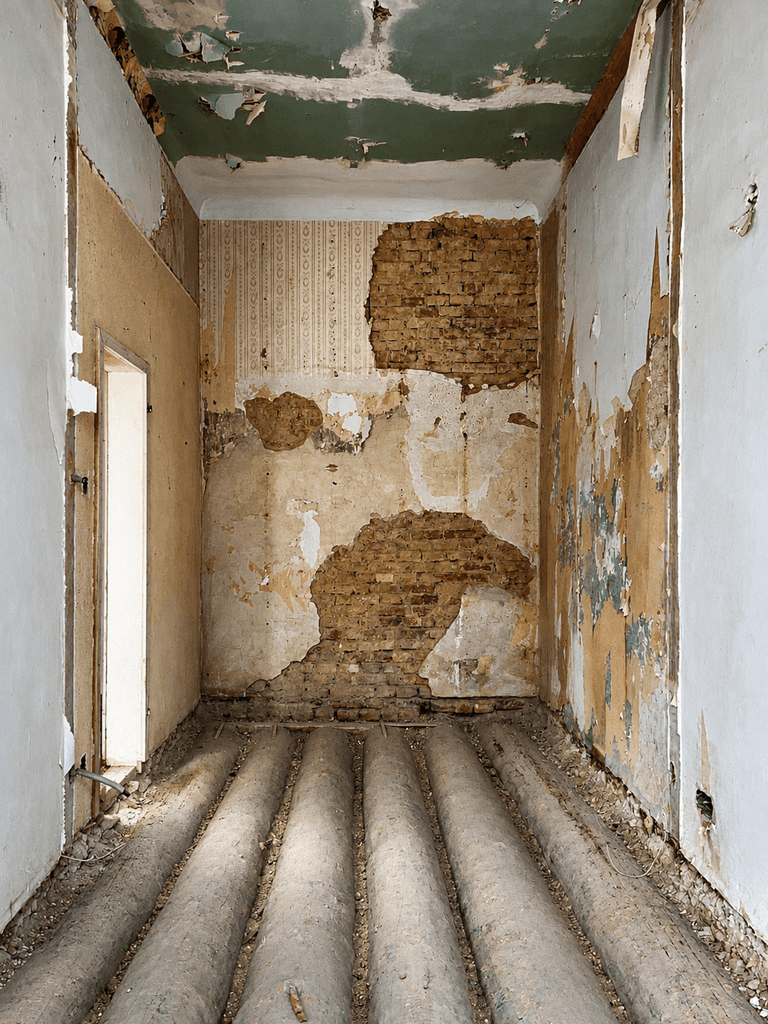
The exhibition unfolds in a late-19th-century building in Vienna’s 15th district, currently awaiting renovation. Stripped of its walls and flooring, the building exists in a state of transition, suspended between former lives and an uncertain future. From the basement and courtyard to the rooms throughout the house, its exposed surfaces and unfinished interiors evoke a particular vulnerability: that feeling of being laid bare, perhaps even being unwillingly seen. In this in-between state, the architecture itself becomes part of the exhibition, emphasising the unease of inhabiting spaces susceptible to the regimes, politics, and power of the gaze.
Photography by ESEL.AT – LORENZ SEIDLER
As curator Zühlke explains, “You become the voyeur of a life that happened there and this former life.” The apartment, once a private space inhabited by others, is now open to the gaze of the exhibition visitor. Its former occupants are absent, unable to explain or defend themselves against this intrusion. “They’re completely exposed. Their flat is exposed now as a piece of art to the audience, which is quite a violent gesture.”
The gaze is a recurring motif throughout the exhibition, beginning with Tony Oursler’s work, one of the first pieces visitors encounter. As Zühlke explains: “The gaze is, I think, a motive, it’s a subject that is really present within the exhibition, as you mentioned before, like Tony Oursler’s Spheres series (1996), featuring the digital videos Eye-scifi, Sakshi-eye, and Trash-eye, one of the first artworks you’re going to see.” Since the 1980s, Oursler’s work has frequently addressed alienation, perception, and the influence of media on contemporary society, exploring the relationship between technology, mass media, and human psychology. By projecting moving images, often distorted human faces, onto sculptural objects, he creates uncanny figures that appear to speak and interact with viewers.
The visitor, in turn, becomes something of a ghost moving through the apartment. As Zühlke puts it, “Your gaze actually becomes like a gesture of stalking.” Looking is more than just an innocent act, it also becomes an act of trespassing into someone else’s private world.
Residency artist Marco-Augusto Basso, who took part in a three-week artist residency in the Austrian capital for its Art Week, responds to this underlying violence through gestures that are themselves deliberately unsettling. In LONER (2026), a bedsheet is nailed to the wall with porcupine spikes, while a hole broken into the wall exposes the physical damage inflicted on the interior. These interventions disturb the domestic familiarity of the space, transforming the act of looking into an encounter with vulnerability, intrusion, and the violence of seeing.
The basement extends this sense of unease through sound, image, and overlapping narratives. Rather than creating a linear sequence between the video works, Zühlke wanted to produce a dense atmosphere in which different sounds coexist, sometimes interrupting or contradicting one another. Not all the videos are directly connected. Alina Kleitmann’s video, for instance, relates to her sculptures, while other works occupy their own distinct sections. Yet, without using headphones, the sounds inevitably spill into one another.
For the curator, this overlap became an integral part of the experience. “The idea of a basement as a metaphor for the unconscious, and like a place where a lot of stuff is going on at the same time. Stuff you cannot control and stuff that maybe is also mismatching,” she says.
The basement thus operates almost like an unconscious landscape, where unrelated images, voices, and political concerns surface simultaneously. Zühlke describes how, while watching Malin Kuht’s Blue Light Waves Goodbye (2024), which addresses blue LED technology and critiques technological development, visitors can hear Alina Kleytman’s video Are u Tired? (2026) asking, “Do you want to be drafted?” The two works are entirely separate, she explains, with no immediate conceptual relationship. Yet their sounds meet in the same space, bringing together questions of technological development, military conscription, and the geopolitical conditions that shape individual lives.
Rather than forcing these works into a single narrative, Zühlke allows their proximity to create unexpected associations. “It makes no sense to try to kind of put them into one group of works,” she says. Instead, the basement is conceived through its atmosphere and formal relationships, while each artwork is given the space to stand on its own.
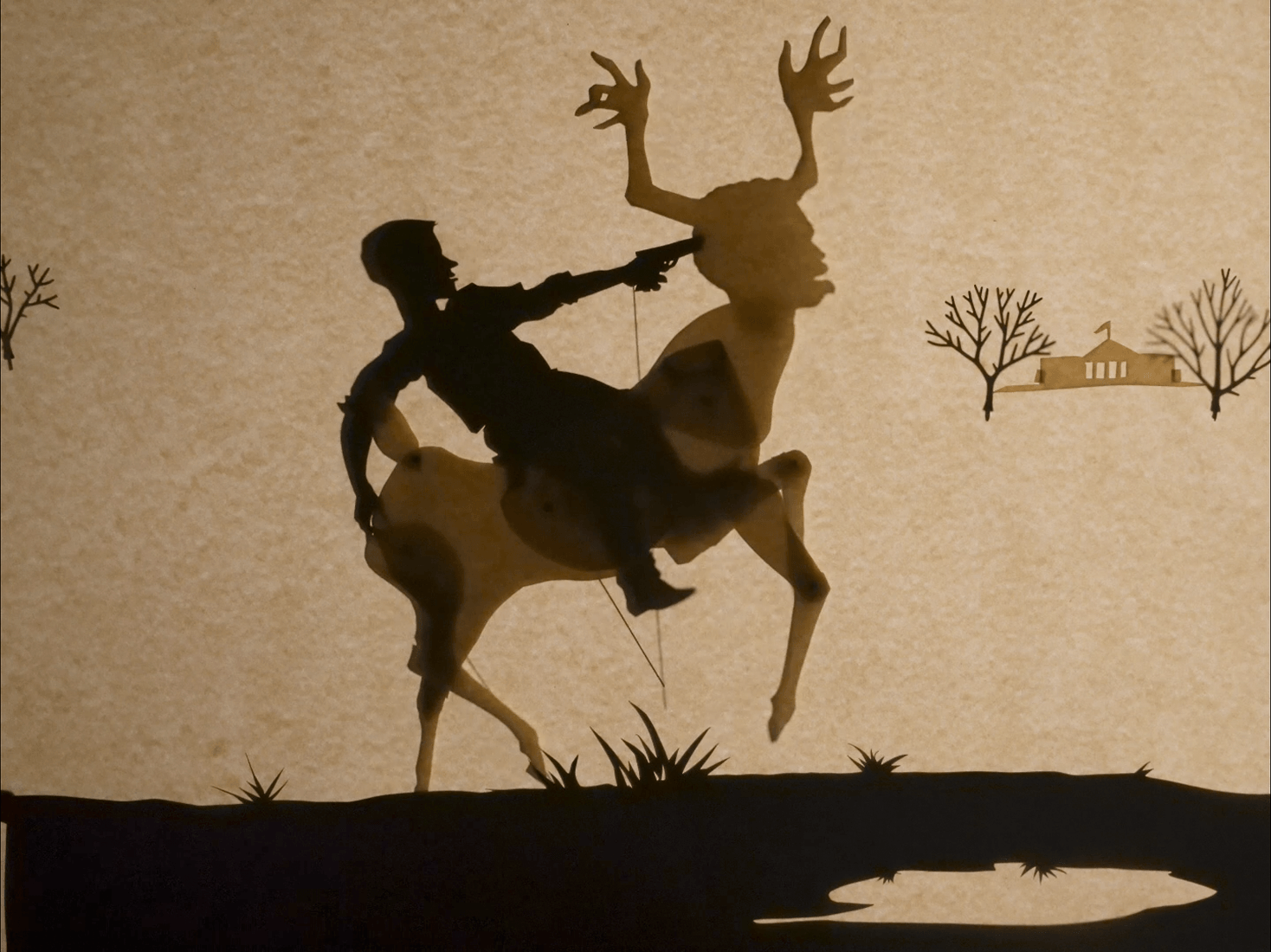
Visitors then pass through a graveyard-like atmosphere before reaching Kara Walker’s work. Although the two installations are not directly connected, their placement creates a passage through different histories and forms of ideological violence. Prince McVeigh and the Turner Blasphemies (2021) is Walker’s 12-minute stop-motion animation featuring cut-paper silhouettes that reenact several of the most gruesome and infamous acts of supremacist violence in America’s recent history, including the 1995 Oklahoma City bombing by Timothy McVeigh and the 1998 murder of James Byrd Jr. The work was inspired by the January 6, 2021, insurrection at the United States Capitol.
ART WEEK 2026
Photography by WOLFGANG THALER
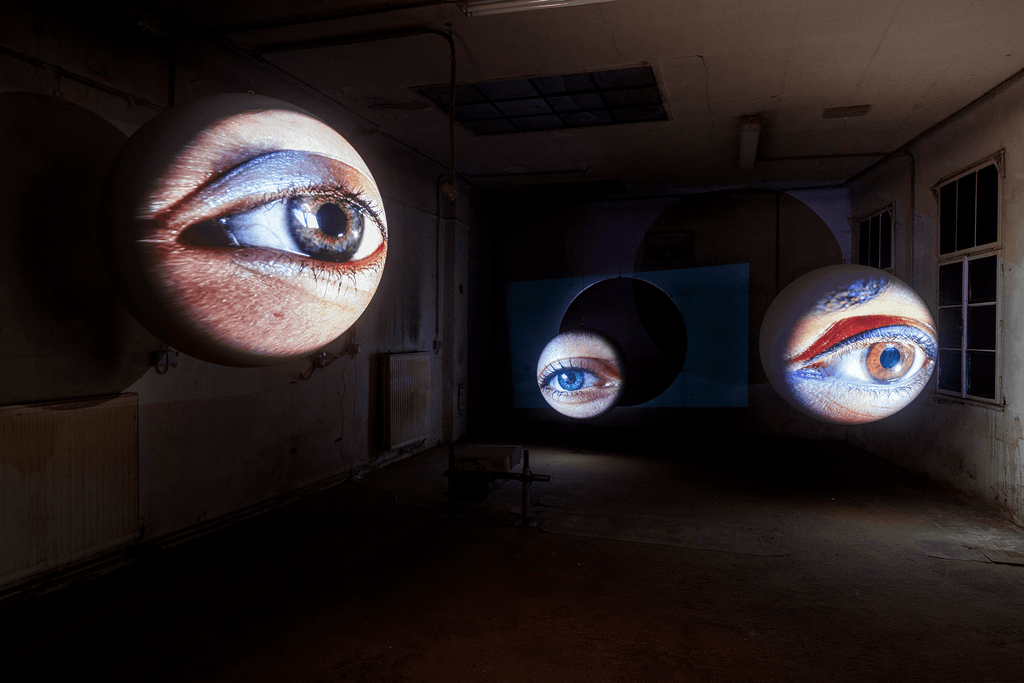
Eye-scifi, Sakshi-eye, Trash eye, Digital video, 1996. HOUSE OF
NAVIGATING ANGST © VIENNA ART WEEK 2026
Photography by WOLFGANG THALER
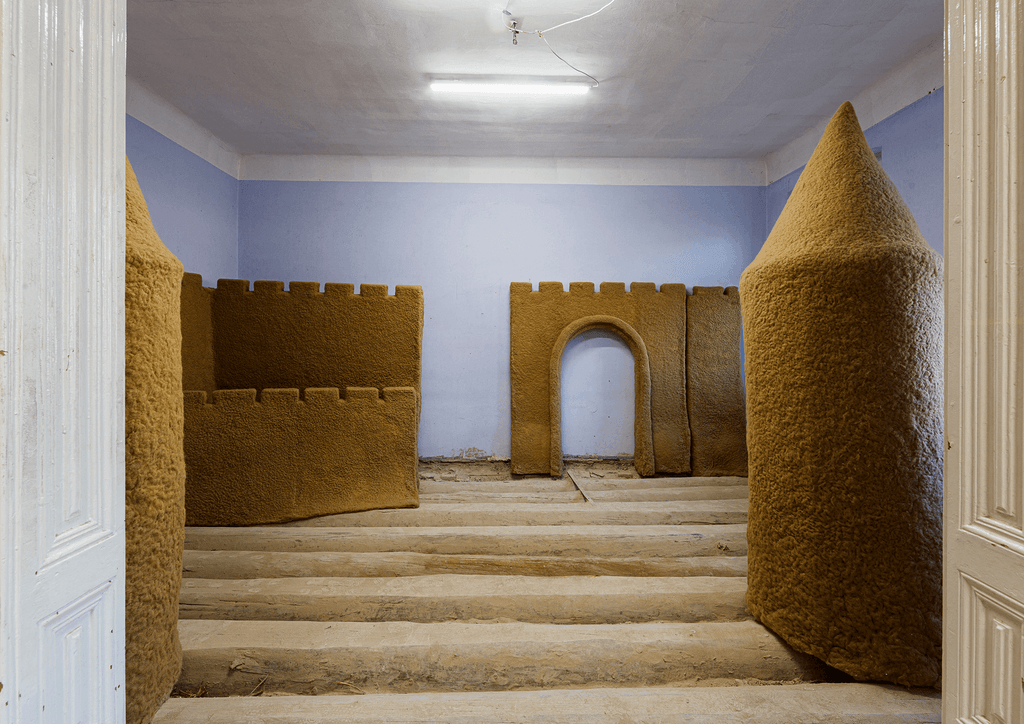
Sandburg, 2026. HOUSE OF NAVIGATING ANGST © VIENNA ART WEEK 2026
Photography by WOLFGANG THALER
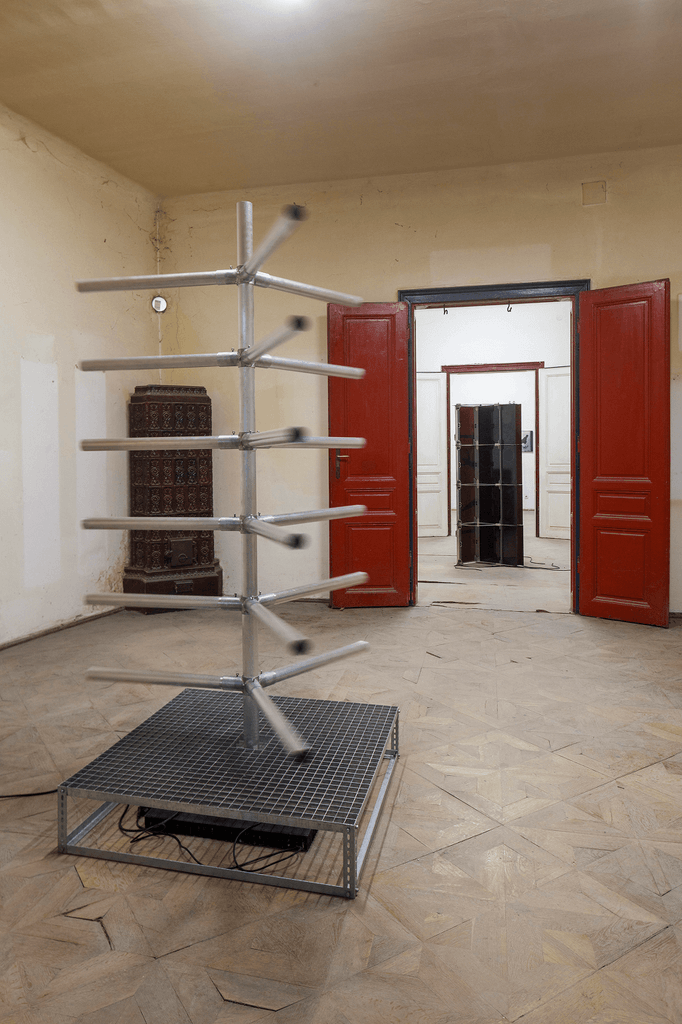
On the second floor, the relationship between the architecture and the artworks takes another turn with the inclusion of Clemens Tschurtschenthaler’s kinetic sculpture. Working at the intersection of sculpture and music, Tschurtschenthaler explores psychological and social dynamics through sound, repetition, and spatial movement. His installation creates a sense of disorientation, unsettling the visitor’s perception of direction and control. A movement forward can bring one back to the beginning; distinctions between inside and outside begin to dissolve.
In another room, Berlin-based artist Viktor Petrov presents two sculptures made from steel and found electric stovetops: Super Sexy Body Horror (2026), made of brushed stainless steel, rubber cord, and glass ceramic, and Spread the Words (2026), constructed from the same materials. Through these objects, Petrov turns his attention to the working body and the physical labour that often remains overlooked, particularly the everyday acts of cooking and care. His work explores how patriarchal and economic power manifests in architecture and ordinary objects, and how bodies adapt to, resist, or subvert these structures.
The two sculptures address the eroticisation and fetishisation of the working body, examining the contradictory process through which labour is elevated into an object of desire while simultaneously being systematically mutilated. At their core is an ambivalent relationship between utility and pleasure, between the “useful” and the “pleasurable”, as well as the social and political narratives that connect beauty, desire, and labour. By bringing these dynamics into view, Petrov exposes the power structures and contradictions embedded in the ways physical work and the bodies performing it are perceived and valued.
Sandcastle (2026), a mixed-media collaboration by Kiki Furlan and Can Denzer, takes the form of a large-scale spatial installation made from fragments of felted wool. Exhibited in one of the rooms of the third floor, and originally conceived as an oversized sandcastle built during a residency, the work is now presented in a deconstructed form, its elements dispersed throughout the room. Rather than displaying the castle as a complete object, the artists and curator have transformed it into an environment that visitors can physically enter and move through. The intention was to evoke something familiar yet elusive: childhood memories of building sandcastles at the beach, the heat, dust, and sunlight, and the imaginative impulse to construct something temporary.
Mind games and playfulness run throughout the house. Boundaries between reality and speculation are deliberately blurred in certain rooms, leaving visitors uncertain about what they are encountering. Some objects were intentionally placed so that it remains open whether they are artworks or simply part of the apartment. Zühlke explains that this ambiguity is a way of activating the visitor’s perception, interrupting the familiar relationship between artwork and audience. Rather than simply confronting an artwork, receiving its message, and leaving, visitors are invited to question what they see, exchange impressions, and share their experiences with one another.
This collective dimension is somehow essential to the exhibition. “Through going through the experience collectively, in my opinion, it just becomes an experience.” It is not enough to remain alone with an observation; the encounter gains meaning when it is articulated, discussed, and experienced together. The house thus becomes a space for conversation as much as contemplation, where discomfort encourages exchange and reflection. Perhaps this is where the exhibition ultimately returns to its central subject: the gaze, not only how we look at things and how we become visible to others, but, more importantly, how we see ourselves looking.
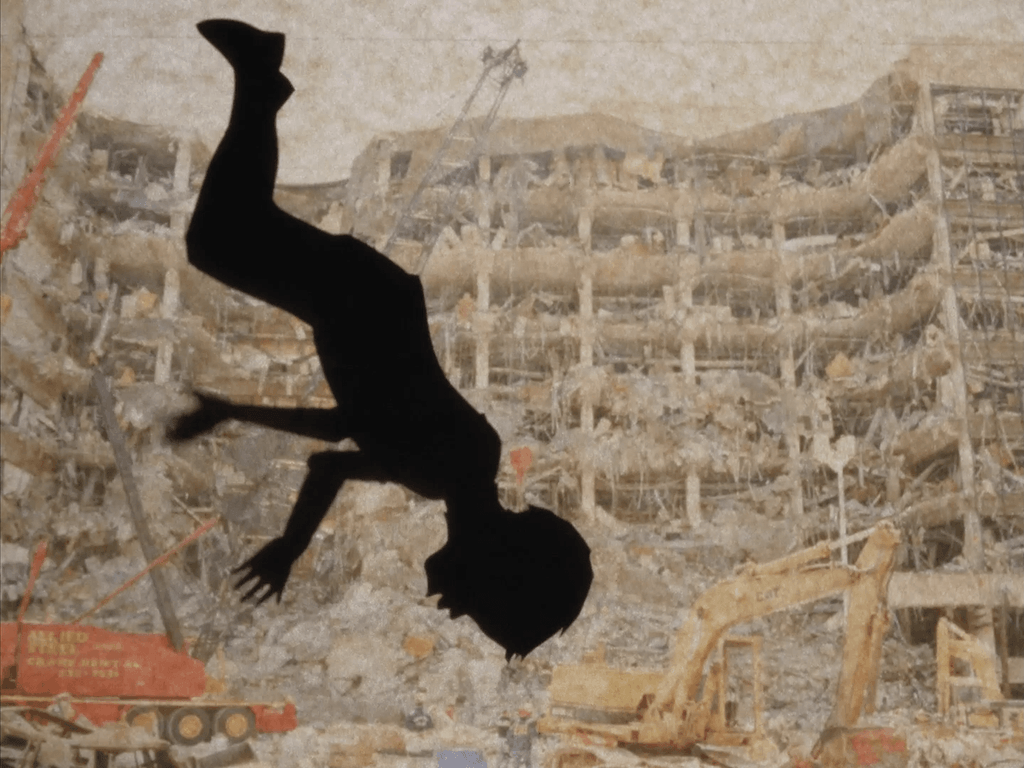
Prince McVeigh and the Turner Blasphemies, Digital-Video, 2021.
HOUSE OF NAVIGATING ANGST © VIENNA ART WEEK 2026
Photography by WOLFGANG THALER
Words: LIZ BAUTISTA