Tiffany Hsu tiffany hsu mytheresa fashion buyer modern luxury

Mytheresa’s Chief Buying & Group Fashion Venture Officer Tiffany Hsu: luxury is a feeling, not a label

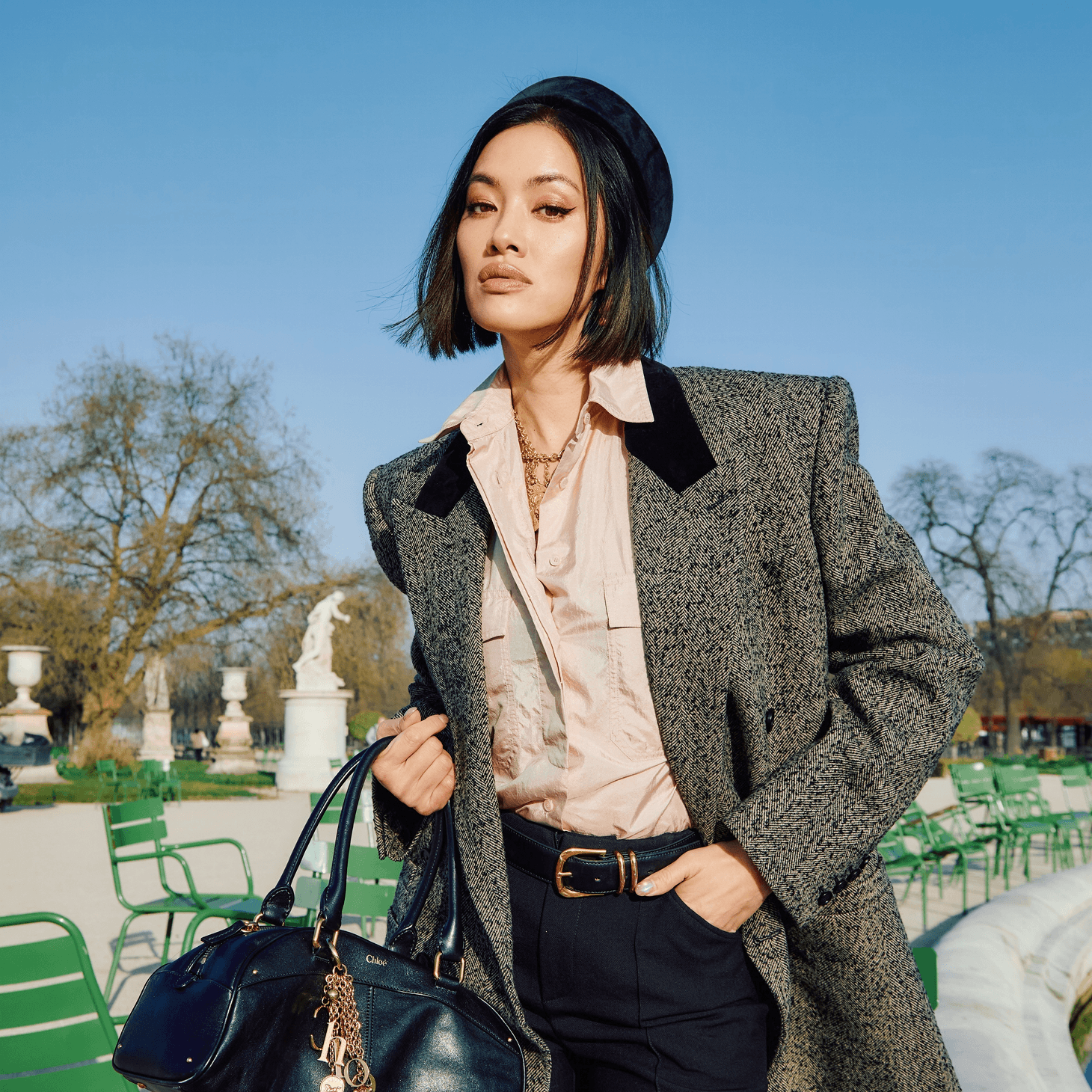
For Tiffany Hsu, buying has always been about more than selecting what goes into a store. A collection can be remarkable, but until it finds its way onto a shop floor or a homepage, it remains largely unseen. As Chief Buying and Group Fashion Venture Officer at Mytheresa, Hsu has spent nearly two decades thinking about what makes a brand worth discovering—and how an assortment can become a reflection of a particular way of seeing fashion and culture.

Raised in Taiwan and trained as a designer at Central Saint Martins, she entered the industry at a time when the physical store still played a defining role in how a brand presented itself. Her role today extends beyond fashion into design, travel, and hospitality, reflecting Mytheresa’s expanding understanding of contemporary luxury. In this conversation with hube’s editor-in-chief Sasha Kovaleva, Hsu opens up about fashion fatigue, information overload, and the growing difficulty of finding space for genuinely new ideas.

Sasha Kovaleva: Buying is often described as a commercial discipline, yet at its highest level it begins to resemble cultural editing. Was there a moment when you realised your role was no longer simply selecting products, but shaping the visual conversation people would have with fashion?

Tiffany Hsu: I’ve always known that, to be honest. If a department store or major retailer doesn’t stock a brand, customers simply don’t have access to it—and when they don’t have access, it never becomes a talking point and no one wears it. People in the fashion industry rarely discuss what buyers actually do, but we hold a great deal of power: if we don’t buy the product, it never reaches the consumer.

In my earlier years working for physical stores, the visual presentation was crucial. The space itself is shaped by the product you’ve chosen, so you’re constantly thinking about how it will look at different times of year, what will be on display, and which brands sit well together. That remains part of the responsibility of being a buyer.

For me and my team, it’s never only about commercial decisions. We think carefully about the assortment that best tells the story the creative director wants to tell, and about properly representing each brand’s DNA.

SK: Taste is often spoken of as something innate, but perhaps it is something learned. Who—or what—has shaped your own eye most profoundly?

TH: Growing up in London, without question. I trained as a fashion designer at Central Saint Martins, and that education shaped my taste, as did the people I’ve met along the way. My friends come from a wide mix of cultural backgrounds, and I’ve always been drawn to creatively minded people—whether through film, music, street culture or subculture.

I feel very fortunate that during those formative years, from my teens into my early twenties, I was in London: a genuine melting pot of culture and creativity. My school was equally creative, so everyone I encountered had a creative mind, coming from different corners of the arts. Ultimately, it’s the people around me—the ones I choose to keep close and the ones I’m naturally drawn to—that have shaped who I am and what I respond to, both culturally and creatively.
Tiffany Hsu
tiffany hsu mytheresa
fashion buyer
modern luxury
Tiffany Hsu
tiffany hsu mytheresa
fashion buyer
modern luxury
Tiffany Hsu
tiffany hsu mytheresa
fashion buyer
modern luxury
Tiffany Hsu
tiffany hsu mytheresa
fashion buyer
modern luxury

SK: Mytheresa has gradually evolved from a destination for luxury fashion into a broader cultural ecosystem—where fashion exists alongside design, travel, hospitality, and art. Was this evolution driven by changing consumer behaviour, or by a belief that luxury today is less about ownership than about a way of seeing the world?

TH: I don’t think this is really a change in consumer behaviour. It’s more our realisation that we’re engaging with our customers’ lifestyles rather than simply running a transactional process of stocking and selling. We’re here to inspire them and to stay relevant to their needs. That’s why so much of our communication is shaped around lifestyle and the social side of our clients’ lives.

SK: Luxury has become one of the most overused words of our time. When you strip away price and branding, what still has the power to feel genuinely luxurious to you?

TH: Craftsmanship, for sure. It needs to reflect the price tag. Customers are not stupid—you can’t just decide this is luxury and put a super high price tag on something. People react to that. When you touch something and immediately recognise the most beautiful leather or the most beautifully made garment, that’s where the real value shows. Scarcity matters too; anything less readily available feels more precious. It’s a fine balance.

You need all the elements in place to be considered truly luxury or ultra-luxury. You can’t simply claim the word. Some brands have made that mistake—calling themselves luxury while being distributed everywhere. Luxury is also built by association: which other brands you sit alongside, the environment and experience you offer, the visual language you communicate. All of that constructs the sense of luxury. It’s a feeling, not a label.

From the moment you walk into a store—or when you shop at Mytheresa and receive the service—the journey itself is part of the luxury. It isn’t only the product or the transaction.

SK: Every season, thousands of beautiful collections compete for attention. Beyond aesthetics, what makes a designer feel culturally necessary rather than simply visually appealing?

TH: That’s difficult, because it shifts all the time. Relevancy can be short-lived—what feels essential this season may not next season. The important thing is not trying to be culturally relevant to everyone, but knowing exactly who your customers are and how you’re presenting your vision to that focused audience. You simply cannot be culturally relevant to the entire world.

SK: Fashion weeks have transformed street style into a carefully choreographed spectacle, where being seen can sometimes feel as important as the clothes themselves. Has personal style become a performance shaped for the camera—or do you believe authenticity can still survive in such a highly mediated world?

TH: Authenticity is very important. Just because a street-style photographer has taken your picture doesn’t make you famous—not anymore. Street style has always existed, but what matters more now is personal style. When street style first emerged, social media wasn’t as dominant; the two grew up together. Street style helped create many of today’s influencers, but to keep an audience engaged, it’s no longer the only thing people look at.

If you have a strong personal style and presence on social media, you can build a following without ever attending a show or standing outside one. Outside the shows it’s chaotic—just because your picture wasn’t taken doesn’t mean you weren’t there or that you weren’t well dressed. Street style is only part of the picture, and I think people pay slightly less attention to it now. These days it’s even easy to fake: take a photo of yourself walking somewhere and post it. No one knows whether you were actually at the show.

SK: Buyers are often expected to predict trends, but trends usually appear only after deeper cultural shifts have already taken place. Which subtle cultural shifts—not necessarily within fashion itself—make you think the visual language of luxury is about to change?

TH: I don’t think the visual language of luxury will change. Cultural movements shape trends season by season—that’s the biggest change. What really affects the business is the economic climate. If people aren’t in a position to buy, it doesn’t matter how relevant the imagery is. The most basic foundation for luxury is whether people have the means. The economy is the biggest factor.

Everything else is micro. Brands can certainly shape trends—Chanel will influence the next few years, inspiring other houses, shoppers and the way people dress. Brands have real power there. But I don’t see that amounting to a massive cultural shift; it influences trends.

SK: If you could curate an exhibition rather than a collection—bringing together fashion, architecture, literature, music, and objects—what question would you want visitors to leave asking themselves?

TH: It would be interesting if people left thinking, “Why didn’t I think of that?” Any good exhibition should spark curiosity and contain an element of surprise. I want it to be a visual and sensual experience—sound, sensation, what you see—and I want to be surprised myself, to encounter something I haven’t seen before. Whatever I curated, I’d hope people would leave with that sense of discovery: “Why haven’t I experienced this before?”

SK: As someone deeply immersed in visual culture, how do you recharge your own creative and intellectual life? Are there particular artists, writers, places, or practices that consistently inspire or ground you?

TH: I don’t really get inspired very often anymore, because you get to see so much. After fashion week I often feel fashion fatigue, to be very honest—information overload. And because I have a child, I have a very limited amount of time to do other things—I like to go to gigs, and I love music.

The simplest ways to recharge right now are visiting an exhibition or watching a film I haven’t seen—something more arthouse than Hollywood. You still find inspiration there. Or I rewatch or relisten to things I loved ten or fifteen years ago. I used to keep a lot of magazines, and occasionally I look back through them. It’s interesting to rediscover what once moved me.

SK: You’ve spoken about the extra expectation on women in fashion—to be excellent at the job and also look effortless doing it. What’s the real cost of “effortless,” and do you ever want to visibly show the effort?

TH: The word “effortless” actually takes a lot of effort. If I were truly effortless, I’d look sloppy. What people mean is effortlessly chic. It doesn’t mean no effort at all—if I made none, I’d show up in pyjamas, hair unbrushed, no makeup. Effortless simply means striking the right balance in how much effort you show. It takes real work to look cool, relaxed and still polished.

There are times when it’s fine—and fun—to let the effort be seen. I always enjoy dressing up. What matters is the occasion. For a ball or a big party, you can go all out. For the office or a meeting, you turn it down a little. Constant high effort isn’t chic. You put the energy where it belongs, and you should still have fun being expressive and wearing things that make you happy at the right moment.

Tiffany Hsu
tiffany hsu mytheresa
fashion buyer
modern luxury
Tiffany Hsu
tiffany hsu mytheresa
fashion buyer
modern luxury
Tiffany Hsu
tiffany hsu mytheresa
fashion buyer
modern luxury

SK: What advice would you offer to young creatives or professionals aspiring to build meaningful careers that honour both ambition and personal fulfilment?

TH: This is hard—I wish I had that balance. I think following your heart is the most important thing. Don’t self-doubt, especially when you’re young. I had self-doubt when I was younger, so I took a different career path; this isn’t what I chose when I was young. I’d tell my younger self to persevere through the difficulties, stay true to your heart, and you’ll get there.

Having grit is very important too. A lot of young people today struggle to persevere when things get difficult—when something is hard, they decide not to overcome it. If you want to be better at whatever you do, you need to get past the hurdle, put in the time and the hardship. I feel that’s quite lacking sometimes in the younger generation; they’ll easily say, “This is too hard, so I’m just going to take a year out and travel and find myself.” But if you want to better yourself, whatever the hurdle is, you learn something from it. My advice would be to stay true to your heart, but also not be afraid of putting in the time and the hard work.

SK: What hopes do you hold for the future of fashion as a cultural force—its role in fostering connection, beauty, or thoughtful living in an increasingly fragmented world?

TH: In fashion, more beauty is always helpful. A lot of the bigger brands are always so worried about sales, about growth. Yes, you have to be commercially minded—but sometimes they also need to allow space for creativity. The rhythm of fashion is so fast that I don’t know when creative directors are given time to be creative, to come up with new ideas. They have to produce within such a short time frame that things become repetitive. When you’ve been in the business for twenty years and you see a new product every few months, new ideas are hard to come by. We’re always looking for something new.

I get bored easily. So more beautiful things can only help. But I also think fashion was heavily impacted by culture pre-social media, and with the impact of social media people have become maybe a little less original, because it’s so easy to see other people’s ideas. Back in the day it was very hard to see what anyone else was doing until they presented it—so you were creating your own idea, your own ideology of what’s beautiful. In that sense, you don’t see as many things with a surprising element these days.

Courtesy of TIFFANY HSU and MYTHERESA

ISSUE 8

issue no8

Discover the new issue — available now