R & Company Francesca DiMattio collectible design craft and design
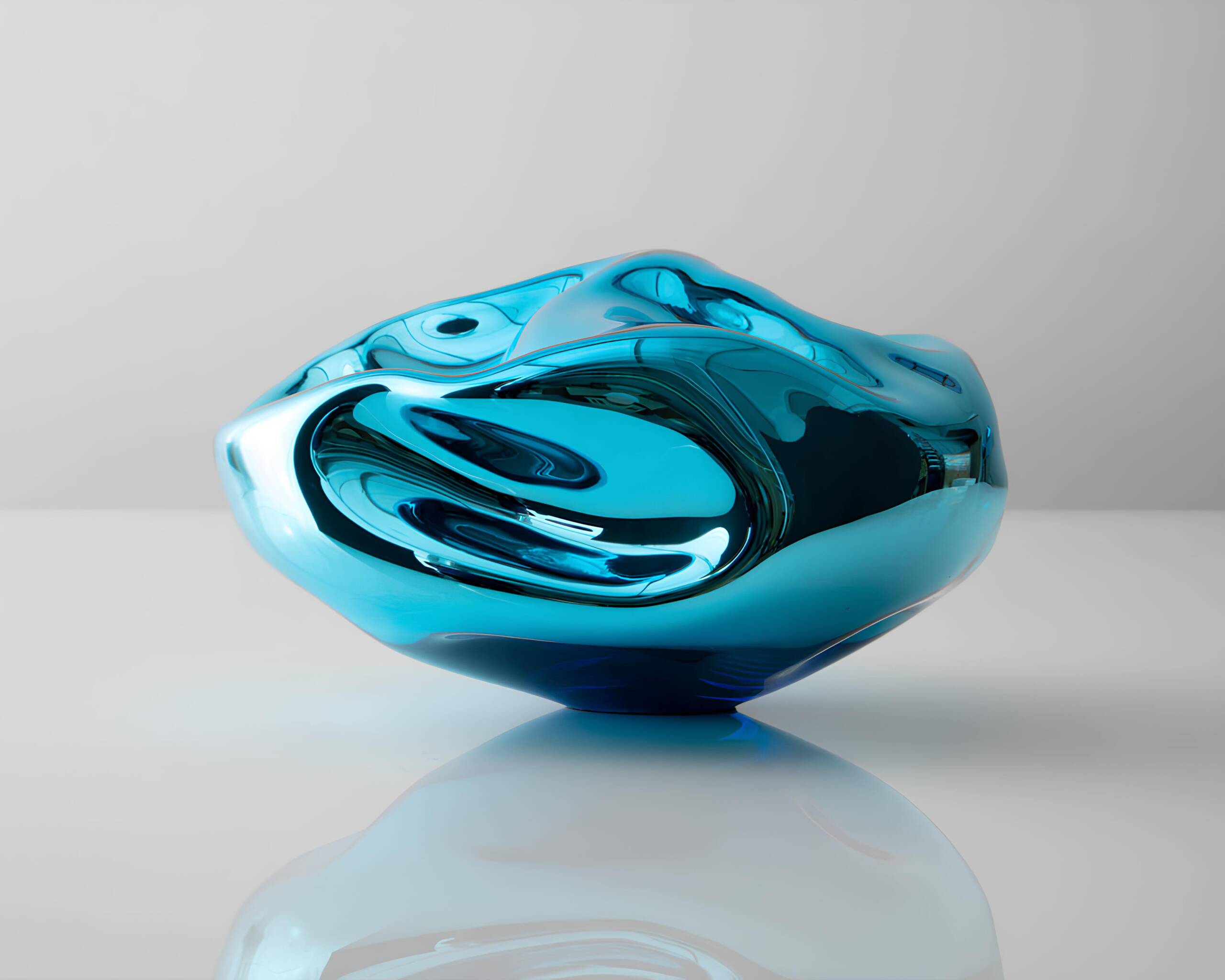
JEFF ZIMMERMAN, 'Crumpled Vessel,' 2021. Glass. 10" (H) x 16" (W) x 15.5" (D) 25.4cm (H) x 40.6cm (W) x 39.4cm (D). SG2356. Photography by JOE KRAMM

R & Company in Venice: in conversation with Zesty Meyers and Francesca DiMattio

The fourth Homo Faber Biennial opened on September 1st, 2026 at the Fondazione Giorgio Cini in Venice and runs to the end of the month. This edition is titled An Island of Light and has been shaped by Es Devlin as artistic director, with fifteen installations laid out across the island’s historic buildings and gardens. 500 artisans from over 70 countries have contributed, and roughly 700 objects are on view. The theme returns, again and again, to three things held together: a material, a source of light, and the hand that works them.

R & Company is taking part for the first time. The New York gallery has brought three American craft artists to Venice—Francesca DiMattio, Jeff Zimmerman, and Roberto Lugo—each working in a medium with a long decorative history and each treating that history as material rather than inheritance. For hube, Meyers and DiMattio spoke about what brought them to the island.

Zesty Meyers came to dealing from the workshop floor. He trained as a glassblower and worked professionally in glass before opening a gallery. He founded R & Company with Evan Snyderman in 1997, at a point when American museums were stepping back from craft and the word itself had become a liability. The gallery was built to close that gap: research first, then exhibitions, publications, and long-term representation, applied to design and craft with the apparatus a contemporary art gallery would give a painter.

While in Venice, Meyers is also taking part in the first Homo Faber Summit, a gathering of 150 invited makers, executives, and cultural directors held 16–18 September. He joins the closing panel, Investing in our Future Heritage, on the final day.

hube: R & Company has long championed work that lives between form and function. Looking back, what moments or artists first convinced you that collectible design could hold the same cultural weight as contemporary art?

Zesty Meyers: Before I had a gallery, I was a maker. I was a professional glassblower, and also ran a not-for-profit arts organisation, the B Team, that did installation and performance art with molten glass. Inherently, I’ve always known how to make things. I was exhibiting in galleries, some of the work was in museums, other kinds of exhibitions were happening. It was great.

R & Company comes out of my own practice and the B Team. We wanted to do something we found was lacking, that wasn’t there in the marketplace—or maybe there wasn’t even a marketplace. In the mid-to-late nineties in America, craft and design were dying. And yet on the secondary market, at Christie’s or Sotheby’s, things from the mid-twentieth century had started to sell for a lot of money. But I couldn’t learn more about most of those objects, because there were no books, no periodicals, no magazines writing about them. The two things didn’t make sense together. In the craft world, galleries were closing, museums weren’t really collecting anymore, and there was a small crop of artists who had made it and were eating up most of the market share.

So we simply started to look at designers who weren’t as famous as the superstars. In Finland, for example, everybody knows Alvar Aalto—but who was number two or three behind Alvar Aalto? There had to be other people. Why didn’t we know their names? Back in the nineties you couldn’t just find a book on Finnish design in America; that was exceptionally rare. So we started going to antiquarian bookshops to learn about what had happened in the world. And we were crazy enough that we would come up with these ideas, then fly to Helsinki and start walking around town, asking anyone who spoke English whether they knew anything about craft or design, because we couldn’t speak Finnish. Then we would find our way to an antiquarian bookshop and buy every book we could. Even though we couldn’t read Finnish, we could at least identify who had made the work, or get a better idea. That’s one of the ways we started to build the history.

It was never one artist who convinced us. It wasn’t one designer that was the interest. We could only do so much in a given week or month or year, and it’s still the same to this day. There are so many more people I would love to do projects with, work with, take on, build a career for. Our biggest enemy is time.

The difference in the contemporary fine art world was that if you became known there, you were included in museum shows, people were writing about you, and eventually you had a book. So we simply decided to take design and craft and elevate them the same way a fine art gallery would. We copied the model of how they run a stable of talent. We would put a credenza on a pedestal, and all of a sudden people would talk about it in a different way. They would ask questions like: why was this made? Why is this important? That’s how we started to change the way the market looked at things—or to create a market at all.
R & Company
Francesca DiMattio
collectible design
craft and design
FRANCESCA DIMATTIO
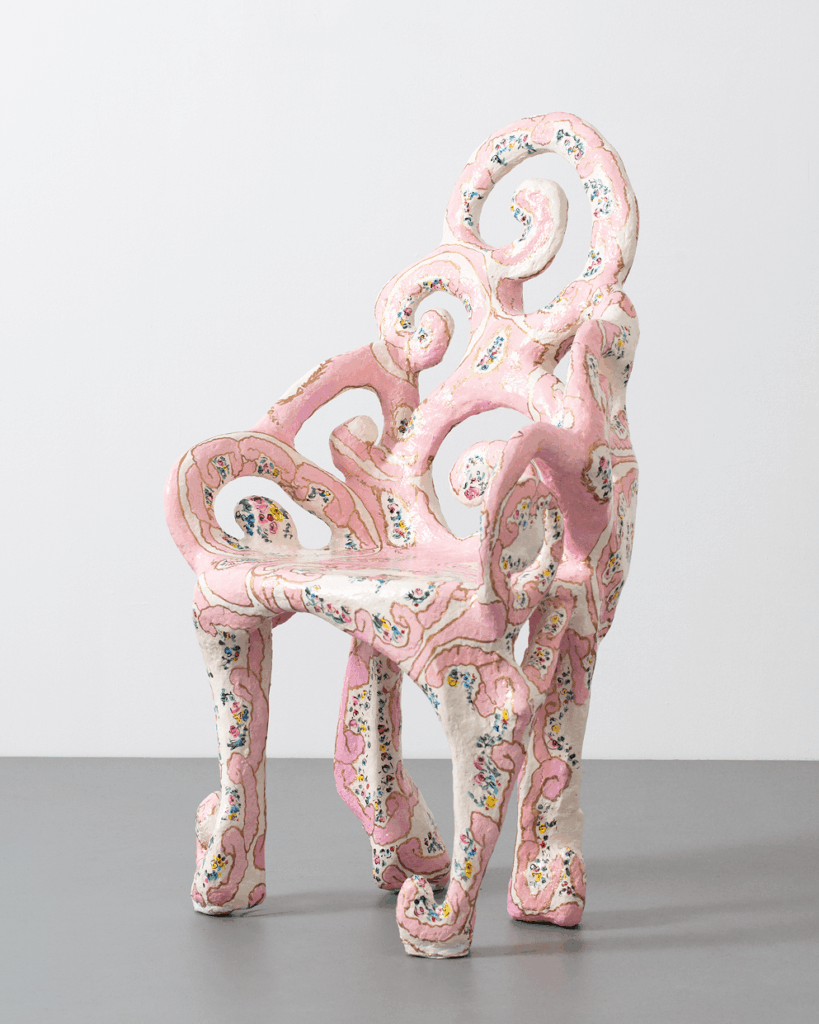
Pink Spiral Chair, 2025. Acrylic, paper pulp, wood, and resin. 41.5″ (H) x 24″ (W) x 18″ (D). / 105.4cm (H) x 61cm (W) x 45.7cm (D). CH1542
Photography by LOGAN JACKSON
R & Company
Francesca DiMattio
collectible design
craft and design
ZESTY MEYERS
Photography by LOGAN JACKSON

h: Homo Faber 2026 marks the gallery’s debut at this biennial. What drew you to participate, and why did this particular edition—under Es Devlin’s artistic direction and the theme An Island of Light—feel like the right moment?

ZM: I’m on what in America we’d call the committee; here they’re known as the Friends of Homo Faber. I try to help them find or get in contact with talent in America, so they can keep making better biennials. I joined just before the last one happened, so I didn’t have the time to come then. And they had only just included the first Americans, because they’re moving more throughout the world now, going to different continents to keep expanding what they do.

So they asked us to participate. Participation means being accepted by the curator, and that was the first thing—none of us knew what Es Devlin would want when they asked for submissions. Of course we didn’t. So we submitted a number of different things we thought could potentially work, and fortunately they picked three designers we represent, which is fantastic. That’s a really good thing.

But the reason I want to be a bigger part of this is that I want an organisation like this to become my United Nations. I want to be able to go to something like this and learn about craft and design from around the world, the things I cannot find myself. I could do some of it alone, but when I come here and see artists, designers and craftspeople from seventy countries at one time, in one arena, five hundred different makers, my eyes open in a very different way. It’s incredible. So why wouldn’t I want to keep learning, keep seeing, keep thinking? It’s not about liking everything. It teaches me how to think about what might be happening. What trends might be coming. What’s becoming interesting. How people are using materials differently to stimulate ideas.

h: The theme explores the fundamental relationship between light, materials, and the human hand. How do you see the practices of Francesca DiMattio, Jeff Zimmerman, and Roberto Lugo speaking to those ideas?

ZM: Inherently, most of the people we work with already carry the idea behind this iteration of Homo Faber, so I see it as a natural fit. These aren’t big reaches or asks. You can see it when you look at their work, how instantly it relates to this year’s theme.

h: Jeff Zimmerman trained in the classical Venetian approach to glass. Presenting his work in Venice itself carries a certain resonance. How do you hope audiences will experience the dialogue between his illuminated sculptures and the lagoon city’s own glass heritage?

ZM: Jeff is trained in the Venetian style of glassblowing; that’s the way he was taught. He’s an amazing glassblower who then breaks the rules to create his own pieces. Instead of trying to make a piece of glass pretty, or perfect, he looks at the anomalies, at the fact that nothing is perfect. He has the ability to push past technique and let the material control itself at times, while still staying in control of the whole piece and its parts.

His work goes deeper, into the molecular biology of cells, or the cosmos, and none of those things are perfect either. So when Jeff makes the work he makes, he can never repeat himself, because he isn’t trying to. He’s trying to make each piece unique for the viewer. He took the craftsman’s rules—learning how to respond to a material—and pushed them into concept and idea. That is exceptionally hard to do. Very few people can do it.

h: Francesca DiMattio’s towering ceramic hybrids and Roberto Lugo’s genre-mixing clay vessels both confront and expand the histories of decorative arts. What role do you think American voices like theirs can play in a biennial that brings together artisans from more than 70 countries?

ZM: We have a global world that’s amazing, and finding a way to be connected right now is how you find hope, strength, success, fellowship. We are contributing and they are contributing. They’re adding to the greater global community of people who work with their hands. It’s an amazing thing to see it start to happen on a global scale, and to be there at the beginning of it.

h: Looking at the three artists on view, each engages material in ways that feel both ancient and urgently contemporary. What qualities do you look for when deciding which makers to represent and champion over the long term?

ZM: As I said, we only have a limited amount of time, so that’s the first thing. And even though I’m one of the owners of the company and the gallery, I don’t bring people in individually. We always bring people in with the team’s support. If we succeed, we succeed as a team. If we fail, we fail as a team.

We have a very long list of people we’ve been looking at, wanting to work with, watching. It’s not about moving fast, it’s about trying to move right—finding what would fit into our platform that we don’t already have. That’s probably an approach most galleries do not take, particularly in the world of design and craft. But the amount of effort and time we put into somebody once we take them on is different from a lot of other places where people show their work. We take on representation and try to build into whatever that means, and each person needs something different from representation. Our goal is to help them become a better maker, or to have more time to make, so that we can do our job and find the right places to present the work to the people who want to collect it or exhibit it—and get their dreams to come true somewhere in the world.

h: Beyond the exhibition, you’ll take part in the inaugural Homo Faber Summit and the closing panel, titled “Investing in our Future Heritage.” What does that phrase mean to you at this moment?

ZM: It means everything. It’s hope. People need hope right now.

The world is a much better place than it used to be, for everybody, on every socioeconomic level, but we take it for granted. Makers, people who make things, are some of the most needed people on earth. Most makers who use their hands don’t make things that are perfect. They make things that are beautifully imperfect, and that creates a sensuality, a passion, a love. It works on our chemical make-up and makes us want to be around these kinds of objects. It makes us feel better.

So to be part of a summit where people from politics and from other great parts of craft and design come together—hopefully out of that we can build a campaign for why we help save people’s lives, or make a better future.

h: You’ve spoken of craft as a language that connects generations. What responsibility do galleries and cultural platforms have in ensuring that knowledge and skill are passed on rather than lost?

ZM: Galleries always have two choices, and you need both for a marketplace to exist. There are galleries that are only interested in making money, and there are galleries that are interested in making somebody’s future, and they invest for the long term. The game we play is the long game.

If galleries invest long-term, what we end up being able to do is influence and guide a generation, create a second generation, make sure other people can come up into a marketplace, and hopefully give rise to other people who want to become this kind of dealer. It also gets people writing articles about why this maker is interesting—giving the intellect, instead of just the idea of value.

Anybody who repeatedly makes things that grow a marketplace has something else going on besides people liking what they do. How do we project that? This is where we start writing books. This is where we try to get overview shows to happen, or get our artists into overview shows like Homo Faber and the Biennale. How do we get the world to start paying attention?

And the bigger question is: why shouldn’t we take it on? Why shouldn’t we try to be as big as we could be? Why shouldn’t we ask? Why should we be afraid of anything, if what we’re doing is pure and right for the wishes of the maker? Why aren’t we becoming the best version of that we can be?

h: R & Company has helped redefine how design is collected, exhibited, and studied. From your vantage point, where is the field of collectible design heading?

ZM: I think the trend for craft is going to be so insanely big over the next decade or two that I’ll have seen nothing like it in my lifetime. Whatever AI does for all of us—whether we like it or not, whether it’s good or bad, it doesn’t matter—as we go through a massive change in human evolution that none of us can control, we all go back to primal instincts, to using our hands.

So the bigger thing that’s going to happen is that the stuff surrounding us has to become more important, because we will also know how real it is, and how much feeling it gives us. I see a craft and design evolution over the next decade that becomes the whole package, that gets bigger and bigger and bigger, and challenges the idea of collectibility in a way I have never seen. It’s only the beginning of what we can actually accomplish, and of why this is so important to most of the earth. That’s the trend.

h: After the exhibition closes and the Summit ends, what do you hope visitors, fellow makers, and the wider public will carry away from R & Company’s presentation at Homo Faber 2026?

ZM: What I hope is that it gets people to take a chance on becoming themselves. I hope it finds us other people who want to collect, and who want to support the individuals we’re showing at the Biennale and at the Summit.

I’m looking forward to meeting a lot of people I’ve never met. I think that’s the biggest point: being connected globally with people who are all, locally, trying to do the same kind of thing. Collectively we need a bigger voice, and the Summit will provide that. If we have a bigger voice and our voice is unified, then we can do anything. We can become as big as any of us has ever dreamed, if not bigger. And as a group, it’s always easier than as an individual.

One of the three individuals in question is Francesca DiMattio. She was born in New York and grew up in a household where her mother made ceramics. She built her early reputation as a painter of large, crowded architectural compositions. Clay entered the work around 2010, at first as paintings about vessels and then as sculpture, and she learned the glaze chemistry, mould-making, and casting outside any formal ceramics training, in other people’s studios. The porcelain pieces that followed draw on Sèvres, Meissen, Wedgwood, Ming vases, Turkish tiles, and Islamic fritware, all of it modelled and glazed by hand so that no reference keeps the status it arrived with. Ornament—beading, knitting, flower arranging, the vocabulary of the domestic interior—spreads across her forms until it starts to work against them, and the resulting hybrids treat womanhood as a balance held under strain rather than a settled subject.

Her solo exhibitions were held at the Blaffer Art Museum in Houston, the Zabludowicz Collection in London, Salon 94 in New York, and many other institutions; her work was included in Ceramics in the Expanded Field at MASS MoCA, and is held by SFMOMA, the Bass Museum, and the Saatchi Gallery, among others. She has shown with R & Company since Objects: USA 2024, and the gallery gave her a dedicated presentation at Design Miami the following year. In Venice she is represented by Arabesque (2025), a piece in acrylic, paper pulp, wood, and resin that carries the rococo surface of her porcelain onto a form built to be sat in.

DiMattio spoke to us about how clay took over from painting, about the chair she made for Venice, and about what she wants beauty to do once the histories behind it have been pulled apart.

R & Company
Francesca DiMattio
collectible design
craft and design
ROBERTO LUGO
Stagecoach Mary, from the Hood Pattern Series, 2024. Glazed ceramic. 30.5″ (H) x 16″ (W) x 12″ (D) 77.5cm (H) x 40.6cm (W) x 30.5cm (D). SM9690
Photography by LOGAN JACKSON
R & Company
Francesca DiMattio
collectible design
craft and design
FRANCESCA DIMATTIO
Courtesy of the Artist

hube: Your practice draws on the history of craft and the decorative arts, re-evaluating their narratives through a feminist lens. How did ceramics become the central medium through which you explore these ideas?

Francesca DiMattio: I am drawn to elements in culture associated with the feminine that exist on the edges. Traditions or aesthetics that have been pushed aside. Traditionally decorative objects and materiality associated with domesticity have not been taken seriously. In my work I want to change how we meet these materials to expand how we think of what is feminine or girly. The work defies the expectation of sweetness; upending porcelain and floral prints to feel more viral than sweet; more primary than in service.

h: Many of your works confront classical forms—caryatids, Venuses, monumental vessels—and reclaim or unsettle their traditional meanings. What does it mean to you to liberate these figures from their historical roles?

FD: I always look at history to begin. I put historical references in conversation with other periods and cultures as well as everyday items to destabilize our fixed notions of importance and value. Having historical elements in dialogue with unlikely pairings helps to see both anew. I think instability is the goal.

h: Your work celebrates the decorative while simultaneously questioning the values and desires it has historically encoded. What role do you hope beauty plays in that critical conversation?

FD: Beauty, like humor, is a way into a piece. It’s a way to step in and stay longer with something. That being said, I feel like beauty has been a dirty word. It has the feeling of being simple but beauty can have rigor, complexity, strength and I hope to make works that declare that. There are so many realms to engage with that are in the category of the beautiful and it would be a shame to keep them quarantined and untouched.

h: In an era when so much cultural production is digital or mass-manufactured, what does the slow, physical labor of hand-building and glazing still offer—to you as a maker and to audiences?

FD: Much of my work is copying and pasting things together and it is my hands that are the glue and make it work. I am often putting things together that shouldn’t work and it is the sensitive process of making that recognizes and pulls out the formal connections between unlikely pairings. It is also my hands that unify the disparity of the references. Because of the layered process within ceramic production, I can compress opposing material treatment within one piece. Carefully hand-built forms can be stepped on and torn and then carefully glazed and gilded. I love that one piece can simultaneously be crude and careful, brash and polite.

h: Arabesque (2025) appears in the R & Company presentation. Can you tell us about the materials and process behind that piece, and how it fits into your broader exploration of form and instability?

FD: I was thinking about tableware in a home and wanted to expand how we see it. Dishes are decorative pieces of service that are a pretty accent in a room. What if the patterns of these porcelain dishes jumped off the small plates onto their surroundings? I make furniture, chandeliers, napkins and tile that behave more like graffiti than objects of service. For this chair I was thinking about spiral doodles found in a high school notebook. I always start with something not taken seriously and then try to find the complexity in it. I wanted to combine the girliness of the spiral shape with the girliness of this porcelain floral motif to make a chair that is wrapped and rebellious.

h: You’ve been working with R & Company for some time now. What has this relationship meant for the development and presentation of your work, especially in the context of a platform like Homo Faber?

FD: Over my career I have been driven to examine, explore and elevate the ideas and materiality of craft. R & Company has honored those traditions since it began, so it’s a good fit. It is an honor to be next to the incredible handmade objects at Homo Faber.

h: R & Company is making its debut at Homo Faber 2026 with you alongside Jeff Zimmerman and Roberto Lugo. What conversations or shared sensibilities do you feel among the three practices, especially around material, the hand, and cultural narrative?

FD: There are certainly a lot of threads in common between me and Roberto Lugo. We both look at the history of ceramics to discuss contemporary ideas.

h: The biennial brings together 500 artisans from over 70 countries. As an American artist whose work is deeply engaged with European and Asian ceramic traditions, how do you think about cultural roots in your practice?

FD: I think growing up in New York City as the child of two immigrants has defined my thinking and aesthetic. My parents immigrated quite young so they were neither from their places of origin nor fully American. I grew up with their invented idea of Europe. That was a very specific aesthetic and cerebral construct that I think became the scaffold for my work. New York City is a clashing tough environment where filth and beauty sit next to each other. That place of contrast is the starting point for every piece.

h: Presenting in Venice—a city saturated with its own ceramic, glass, and decorative traditions—carries particular resonance. What does it mean to you to place your hybrid, feminist reworkings of those histories in this context?

FD: It is a dream to show in Venice where ideas of excess, beauty and pretend have been honored. The dichotomy of its tradition of extraordinary beauty and its fragility with water rising is also extremely acute. I could never separate the expansive feeling of carnival from the precariousness of the place… I love this decadent precarious structure.

h: The theme of An Island of Light suggests both illumination and isolation, individual skill within a larger archipelago of craft. How does that metaphor resonate with the way you think about individual artistic voice within broader traditions?

FD: Craft is a form of time travel. I learn from those that came before me and while I work alone most of the time, I feel surrounded by the company of history and the many hands that paved the way before me. They say haptic sense is the strongest in terms of memory and I have always felt that. Making a certain movement with clay reminds me of how my grandma rolled out her pasta and whenever I use a knife with the blade towards my thumb as she did I can smell the smell of her fresh cut apples. I feel that kind of connection with craft techniques and the craftspeople that helped develop the techniques and I never feel lonely when alone.

h: Looking ahead, how do you see the relationship between contemporary ceramic sculpture and the larger worlds of design, fashion, and architecture continuing to evolve?

FD: I have always wanted to work between all those fields and I hope to make work that blurs the lines that separate them. When I began working with clay in 2010, it was extremely rare to see clay in contemporary art galleries. Fifteen years later, that’s no longer the case, which is all I would have wished for. I hope we continue in this direction judging work for its quality and not its material.

R & Company
Francesca DiMattio
collectible design
craft and design
JEFF ZIMMERMAN
Crumpled Vessel, 2021. Glass. 16″ (H) x 13.5″ (W) x 13.5″ (D) 40.6cm (H) x 34.3cm (W) x 34.3cm (D). SG2359
Photography by LOGAN JACKSON

ISSUE 8

issue no8

Discover the new issue — available now