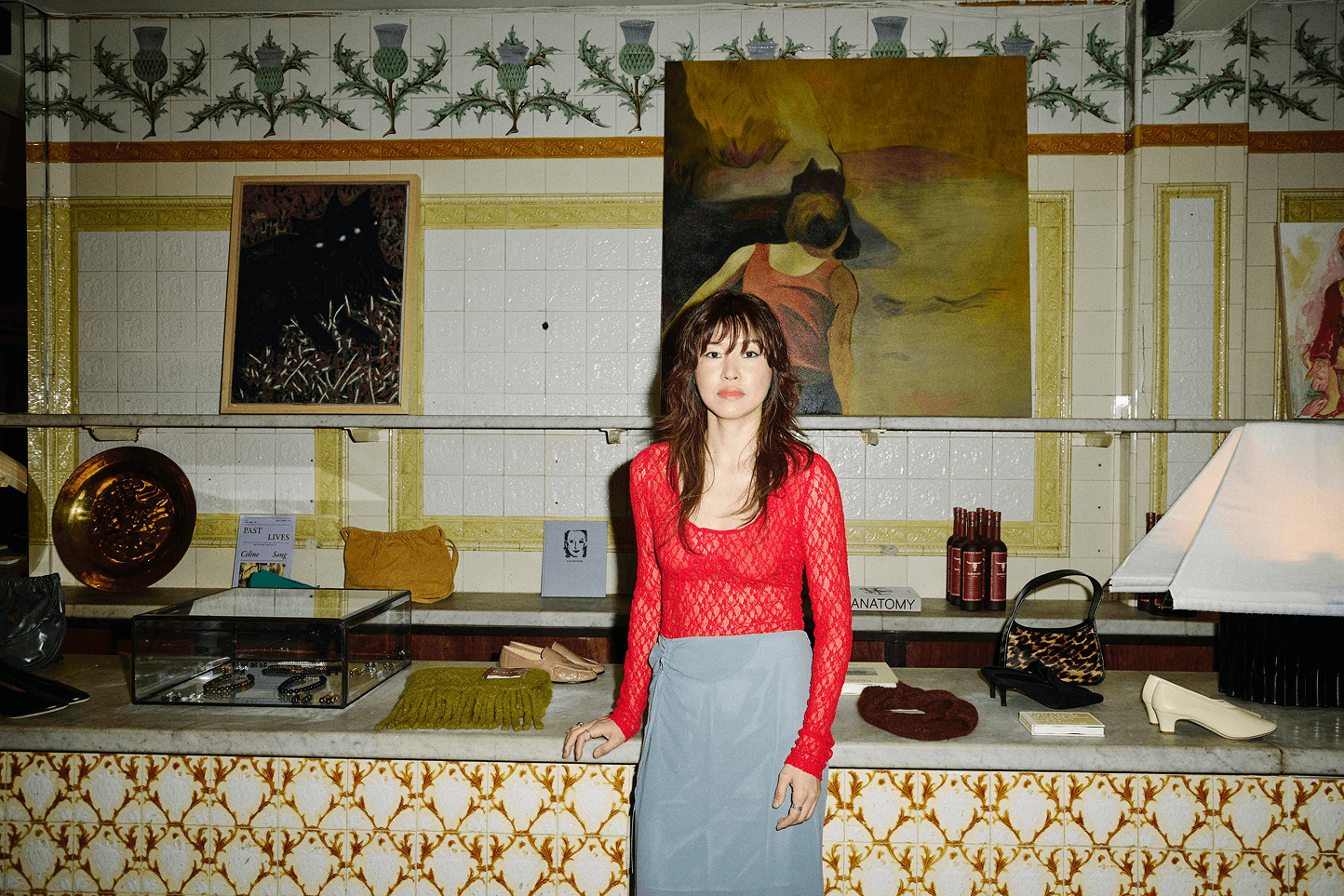
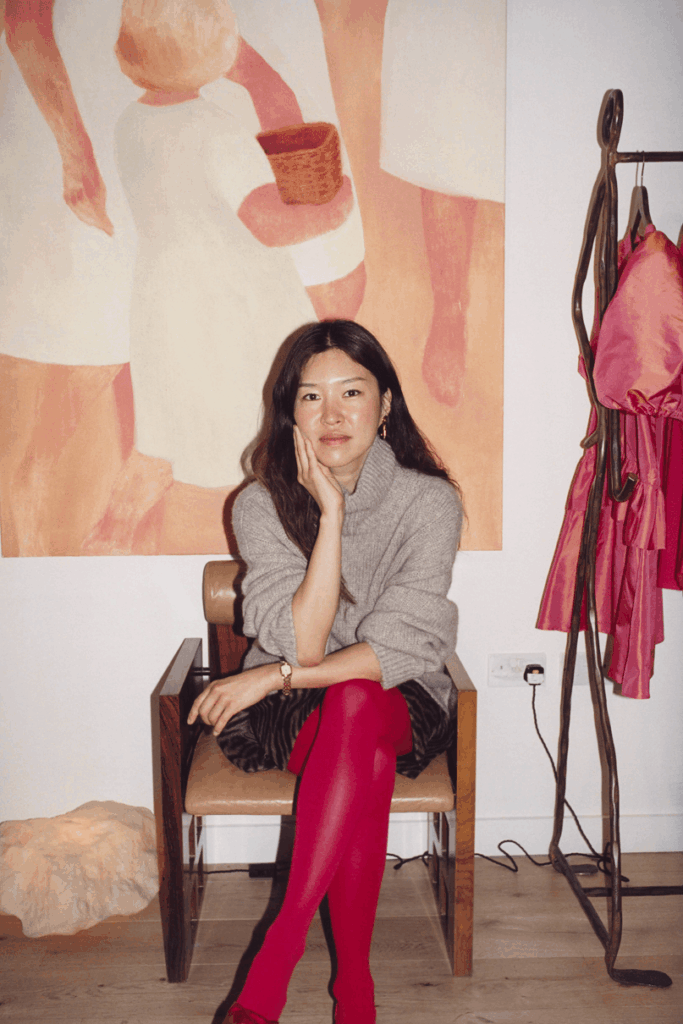
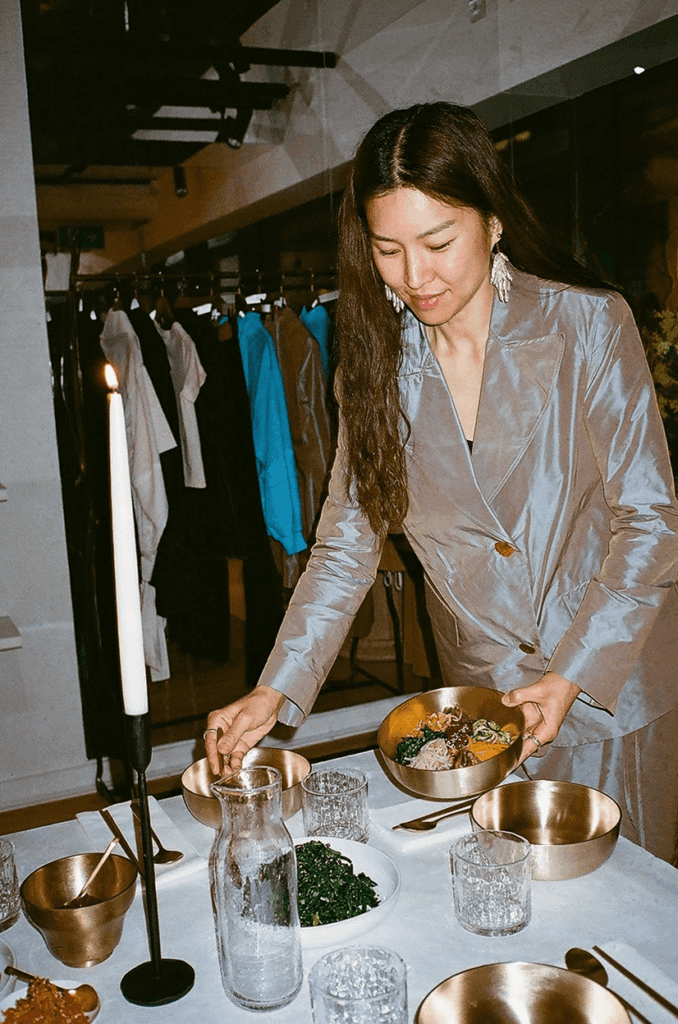

Rejina Pyo is a South Korean fashion designer whose work sits at the intersection of art, architecture, and contemporary womenswear. Born in Seoul and based in London since 2008, she completed her MA in Fashion at Central Saint Martins before establishing her eponymous label in 2014. Since then, the brand has gained international recognition for its sculptural silhouettes, refined tailoring, and quietly distinctive visual language.
Drawing on both Korean and Western cultural perspectives, Pyo approaches clothing as a form of structure—something that shapes the body while remaining grounded in the realities of everyday life. Her practice moves fluidly between artistic expression and practicality, exploring questions of identity, femininity, and the spaces we inhabit. At the same time, she has become increasingly engaged with questions of sustainability in design, seeking ways to build a slower, more thoughtful model of fashion that prioritises longevity, craftsmanship, and a genuine connection with the wearer.
In conversation with hube, Pyo reflects on the cultural dualities that inform her work, her interest in sculptural form, the evolving meaning of modern femininity, and the challenges of creating an independent fashion practice in an industry defined by speed and constant change.
hube: Though you received your higher education in London, you were born and raised in South Korea. How do these two cultural landscapes converge within your designs, and in what ways do you find yourself playing one against the other?
Rejina Pyo: At the beginning, it was difficult to navigate because the two cultures felt so opposed to one another. Over time, I realised how fortunate I am to have experienced both. It has probably become one of the things that makes my perspective unique as a designer and as an artist. I think it is always important to understand that there are many different cultural viewpoints beyond the one you grow up with. Having lived within both Korean and Western cultures gives me a broader lens through which I approach design.
h: What was your introduction to design, and what sustained your ambition as you began to pursue it as a career?
RP: Growing up in Seoul, the majority of fashion magazines available were from the other side of the world, so the perspective was very Western-centred, as that was what was being shared globally at the time. However, my surroundings were totally Korean, and so, without realising it, that culture and aesthetic had a very big impact on me and shaped who I am as a designer and artist. When I was studying my MA at Central Saint Martins, everything at London Fashion Week felt very maximalist. We did not have social media like now, so it often felt like there was only one way to succeed, which was to fit into the current moment. As a young designer brand, I chose to take a different approach. Introducing bags, shoes, and jewellery early on was a risk, as was opening a bricks-and-mortar store, but I felt it was important to show the whole world of the brand and connect directly with our community. Taking risks and staying true to yourself sustained the brand, and my ambition has always been to continue on that genuine path.
h: Your work often carries a strong sculptural quality. How do you think about form when you design, and which artists or designers have influenced your sense of structure and silhouette?
RP: I see garments as structures that house our bodies. I am interested in how clothing can shift proportions, create illusions, and change how we feel in our bodies. Architecture and space also fascinate me because they are the environments that surround us. I have a continuous curiosity about the relationship between ourselves, the body, and the spaces we inhabit. I practise art myself and have always had a strong interest in artists. I admire how Angela de la Cruz navigates between two-dimensional and three-dimensional space, and I am also inspired by the sculptures and spatial work of Phyllida Barlow and Rachel Whiteread.
h: You’ve explored womanhood and modern femininity throughout your career. How do you approach these ideas without falling into stereotypes—and how has your own understanding of femininity shifted over time?
RP: Authenticity is vital. I design for women from my genuine experience of going through womanhood myself. I do not speak for everyone else. I can only speak about my own experiences in the most honest way possible. My mum always spoke about inner beauty and confidence when I was growing up, and I still believe in that. When I was younger, I wanted to be equal to boys, but now it feels more about embracing femininity and recognising it as a strength. That acceptance is empowering, and being yourself is the most powerful thing.
h: Many brands talk about ‘the modern woman’, yet the term can feel overused. Do you ever feel the industry simplifies women too much?
RP: To be honest, I pay less and less attention to what other brands are doing. I think audiences today are very intelligent and can recognise when something is just marketing. There is already so much content and noise in the world, and because of that, emotional authenticity becomes even more important.


h: Is there a theme or concept you find yourself returning to repeatedly within your work? If so, why do you think it continues to resurface?
RP: Rather than repeating a specific theme, I think the core thread running through my work is an idea of effortless elegance combined with an artful playfulness.
h: Fashion can be both inspiring and exhausting. What continues to excite you about the industry—and what still challenges or frustrates you the most?
RP: Practising art allows me to step back and observe fashion from a wider perspective, and it really is a fascinating industry. The spectacle, the creativity, and the business side are all interesting to me. What excites me most today is that personal style feels more celebrated than ever. In the past, magazines and campaigns dictated clear seasonal trends, but now fashion feels much more diverse and fragmented. There are microtrends, or sometimes no single trend at all, because the landscape is so vast. What frustrates me most is throwaway fashion and the culture of disposability.
h: Sustainability has become a major talking point in fashion. Do you think the industry is genuinely changing, or has sustainability become another aesthetic language?
RP: At certain moments there has been genuine interest in change, but of course there are also examples of greenwashing. The most impactful changes would likely need to come from the largest players in the industry, although that can be complicated when businesses are tied to profits and shareholders.
h: Social media has transformed how collections are consumed—sometimes in seconds. Has this changed how you think about impact, detail, or storytelling on the runway?
RP: Yes, definitely. As soon as images are released, someone else can reproduce the idea in production faster than you can, and people are no longer willing to wait six months. That is partly why I stopped doing regular runway shows and began exploring other ways of connecting with people, such as exhibitions or creating meaningful physical retail spaces.
h: Your silhouettes often feel alive, as if they’re already in motion. Do you design with movement in mind, and how important is it for you to imagine how a garment lives on the body?
RP: Of course. I design with the real lives of women in mind, so how a garment moves and how it feels on the body is incredibly important.
h: Collaboration plays a big role in contemporary fashion. What makes a creative partnership truly work for you—and what parts of your vision are non-negotiable?
RP: Trust is essential. When a partner trusts your vision, the collaboration tends to produce the best outcome. Recently, I have been prioritising partnerships with people or organisations that share similar values, particularly around sustainability and quality.
h: Right now, what feels most urgent or exciting in your practice? Is there a direction you haven’t explored yet that keeps calling you forward?
RP: I am very interested in pushing textiles and sculptural form further. I am also excited about expanding lifestyle elements within the brand, such as furniture design, art exhibitions, and publishing projects connected to our stores. These cross-disciplinary collaborations feel very natural to me and are something I would love to explore more deeply.
Courtesy of REJINA PYO
Words: ISABELLA MICELI
