A rocket stands upright against the sky on the tarmac of the Musée de l’Air et de l’Espace, just beyond Gagosian in Le Bourget. It’s impossible not to notice the proximity. It feels less coincidental than intentional, especially to the gallery’s current exhibition, The Singular Experience featuring works by Walter De Maria. There’s something about that precise engineered presence of space travel that echoes De Maria’s own vertical ambitions. His practice which oscillates between mathematics, nature, and imagination, where a strict pragmatic system is always present, but so is a current of humor, and a sense of boyish wonder.
De Maria is perhaps best known for The Lightning Field (1977), a work that stages an encounter between earth and atmosphere in the vastness of the New Mexico desert. It continues to be a must-see piece of land art to this day, and has somewhat become a bucket list for many lovers of art. Often described as transformative, sublime, contemplative, it is a special experience, meant to slow you down. The reservation site went live February 2026 and was completely booked in an hour.

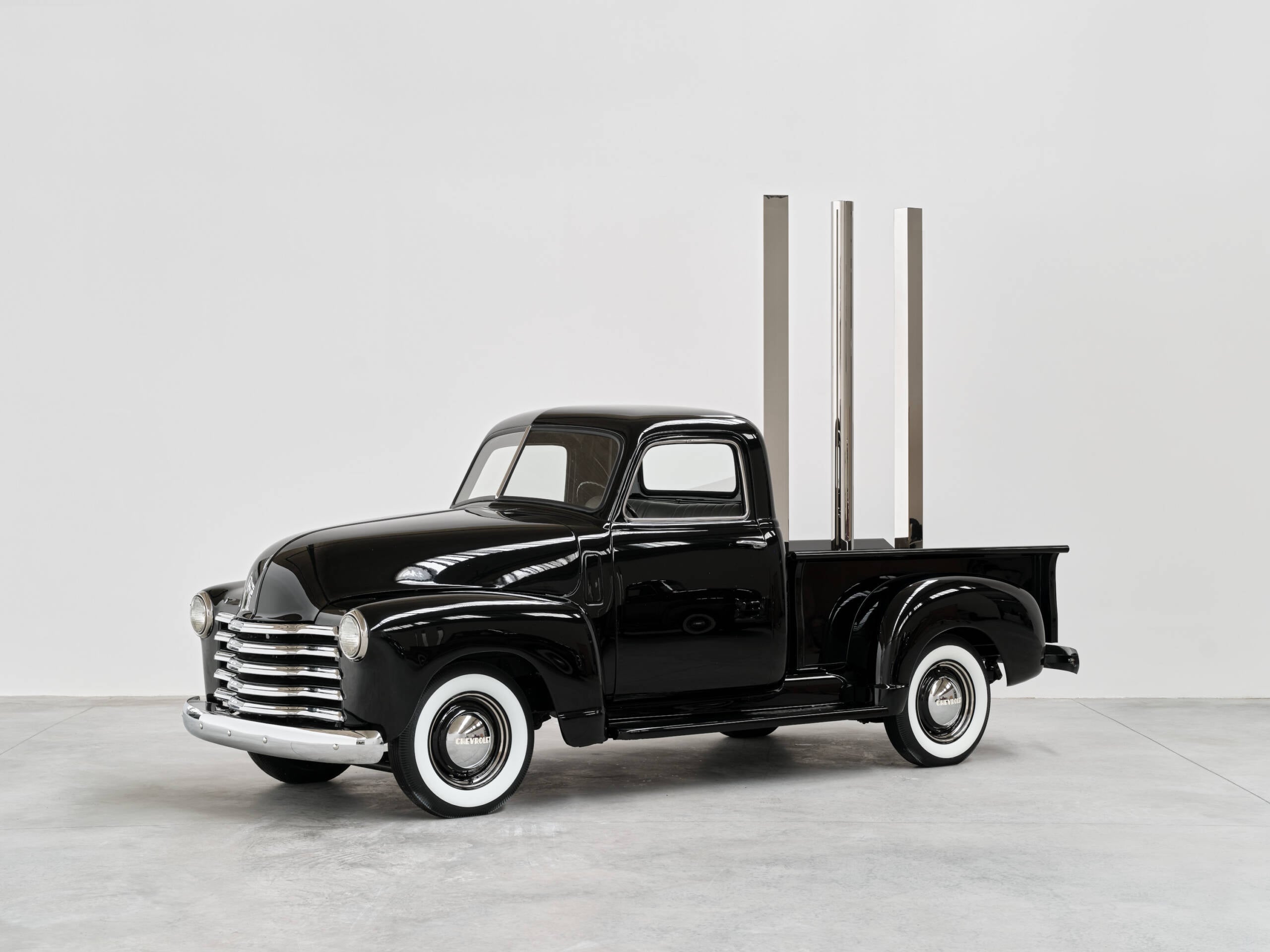
Truck Trilogy, 2011–2017, installation view at Dia Art Foundation, Beacon, New York, 2017–19
© 2025 ESTATE OF WALTER DE MARIA
Photography by ROB MCKEEVER. Courtesy of GAGOSIAN
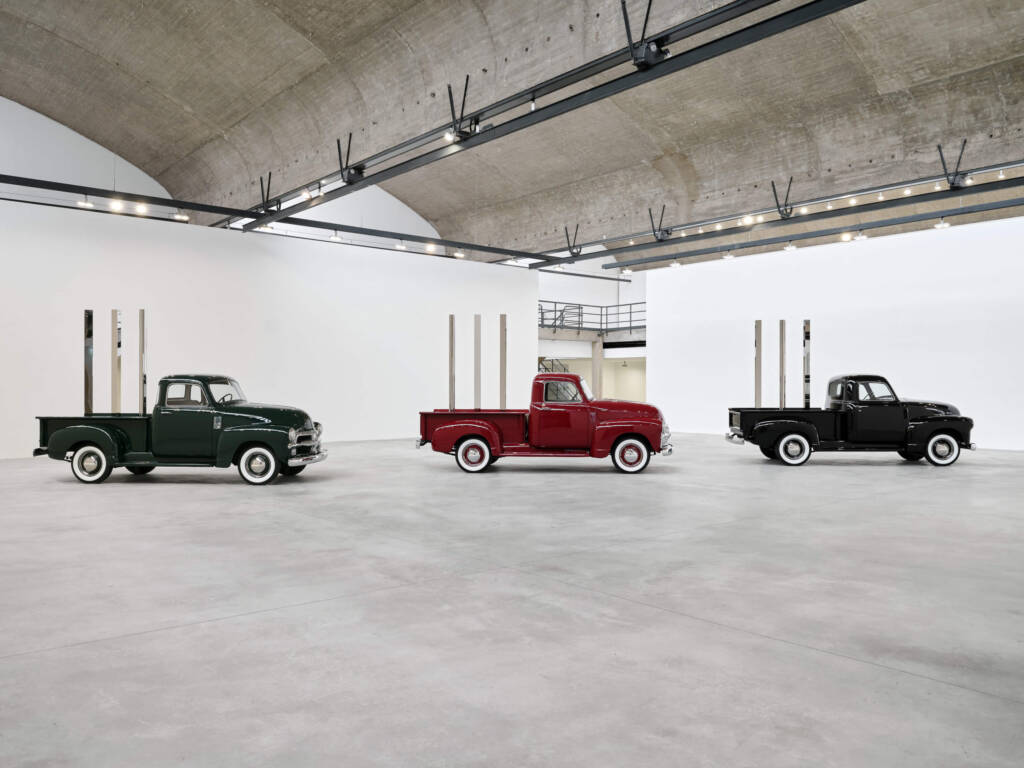
The Singular Experience, 2025, installation view
© 2025 ESTATE OF WALTER DE MARIA
Photography by THOMAS LANNES. Courtesy of GAGOSIAN
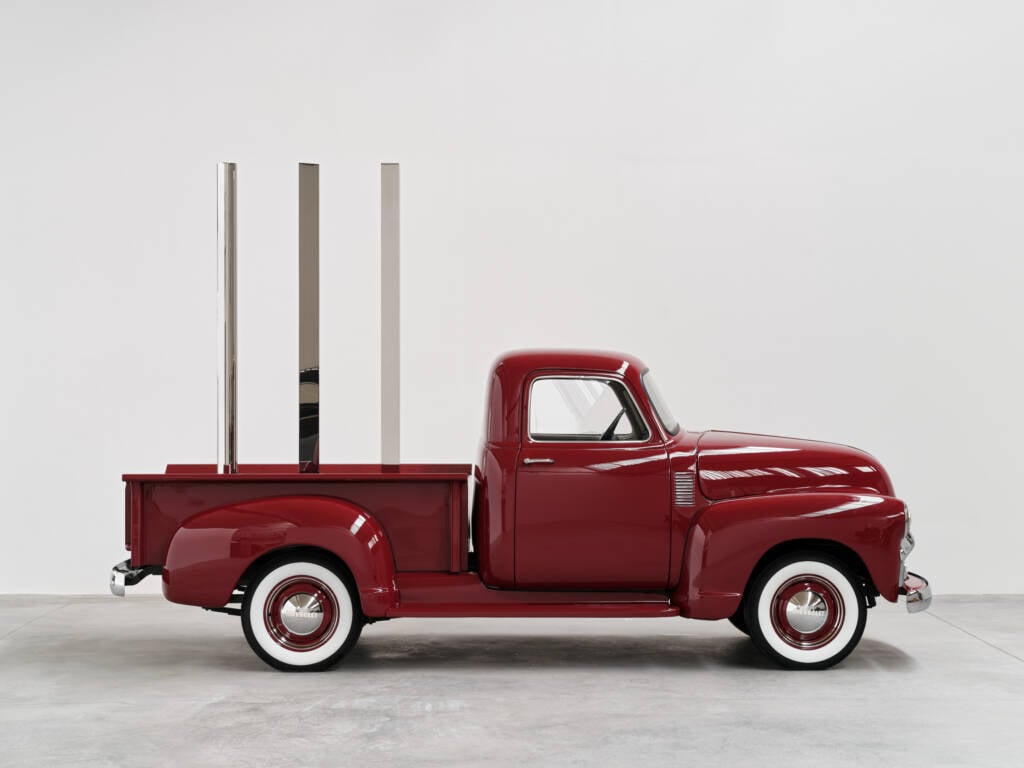
Red Truck / Square, Triangle, Circle, from Truck Trilogy, 2011–17
3 1950s Chevrolet half-ton pickup trucks, white oak, and stainless steel, in 3 parts,
each: 120 x 75 x 195 inches (304.8 x 190.5 x 495.3 cm), overall dimensions variable
© 2025 ESTATE OF WALTER DE MARIA
Photography by THOMAS LANNES. Courtesy of GAGOSIAN
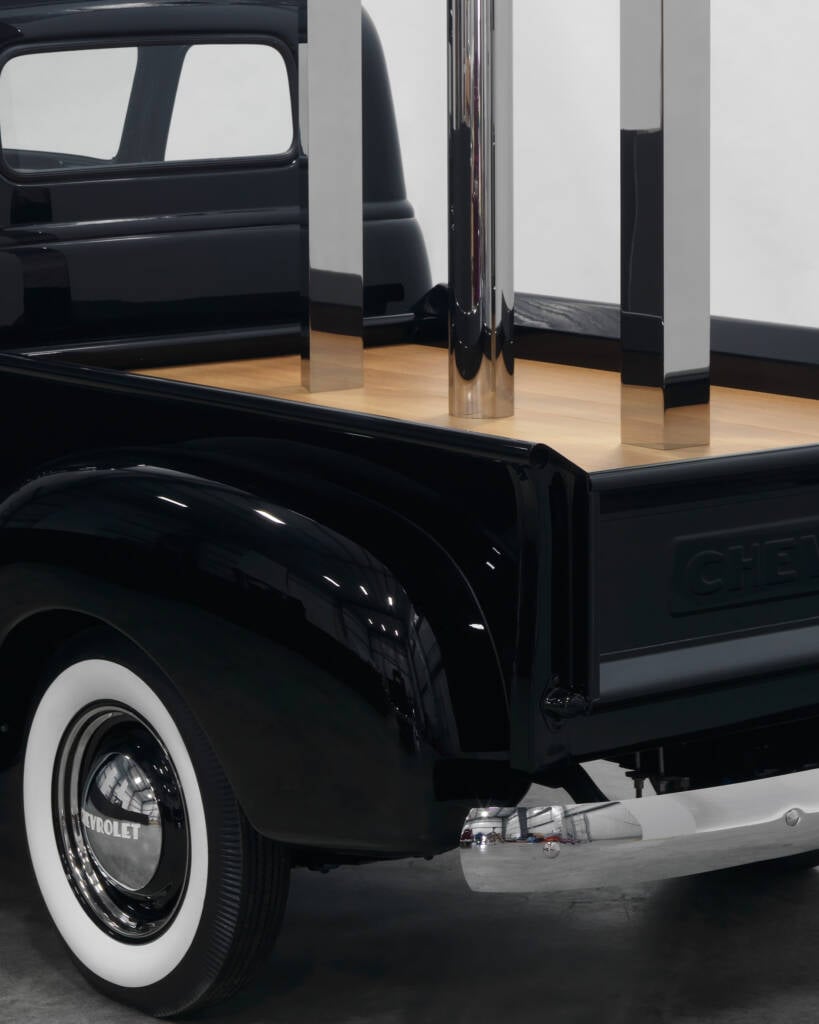
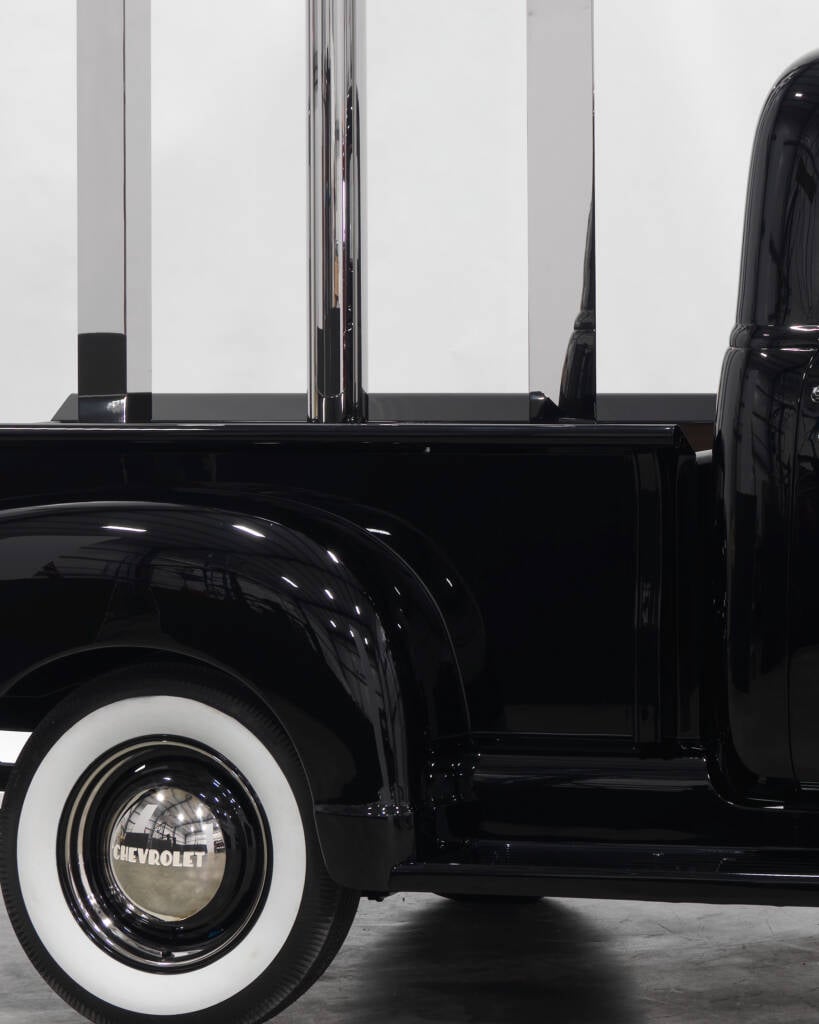
Black Truck / Triangle, Circle, Square, (detail) from Truck Trilogy, 2011–17
3 1950s Chevrolet half-ton pickup trucks, white oak, and stainless steel, in 3 parts,
each: 120 x 75 x 195 inches (304.8 x 190.5 x 495.3 cm), overall dimensions variable
© 2025 ESTATE OF WALTER DE MARIA
Photography by ROB MCKEEVER. Courtesy of GAGOSIAN
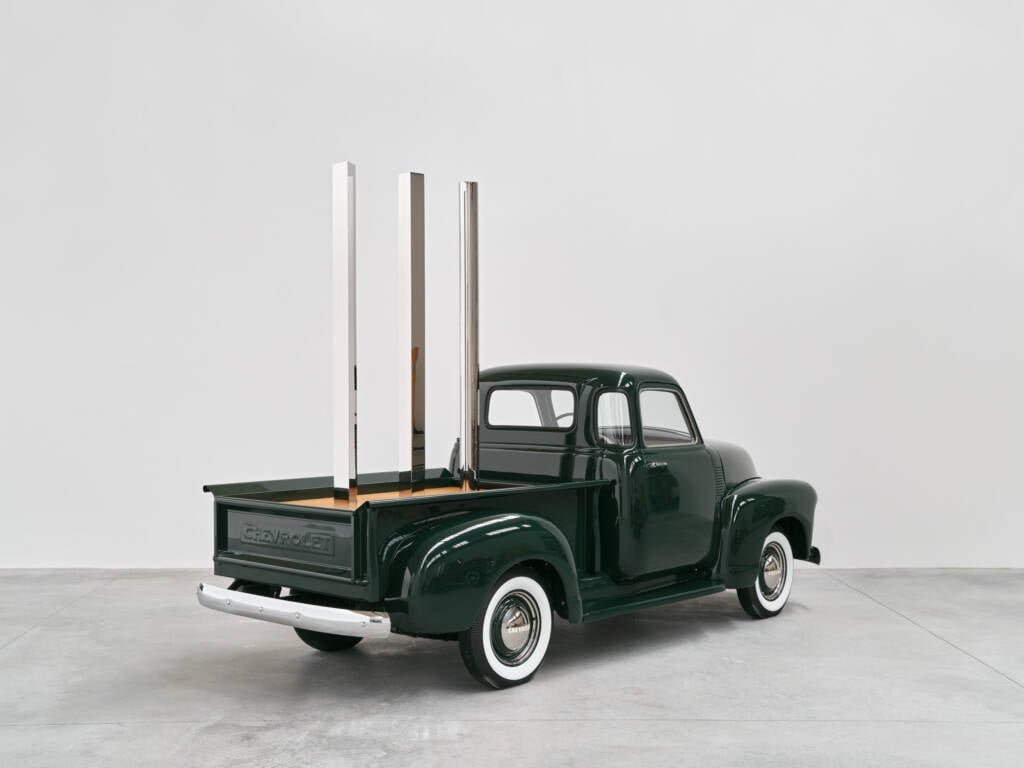
Green Truck / Circle, Square, Triangle, from Truck Trilogy, 2011–17
3 1950s Chevrolet half-ton pickup trucks, white oak, and stainless steel, in 3 parts,
each: 120 x 75 x 195 inches (304.8 x 190.5 x 495.3 cm), overall dimensions variable
© 2025 ESTATE OF WALTER DE MARIA
Photography by THOMAS LANNES. Courtesy of GAGOSIAN
The Singular Experience at Le Bourget, on view until 18 April 2026, features De Maria’s Truck Trilogy, presented for the first time outside the United States. Despite the title’s suggestion of singularity, the emphasis is not solely on the installation, which is, in itself, monumental, not only in scale but also as De Maria’s final sculpture.
Other works inhabit the vast concrete industrial space, which feels less like a backdrop than an essential counterweight to the exhibition’s gravity. The main space features the trucks, while the rest of the space includes his various metal and earlier wooden sculptures, drawings, and several videos.
Similar lightning rods are on the back of the Truck Trilogy sculpture. The Truck Trilogy features three 1950 Chevrolet Advanced Design double trucks in black, red, and green. There is also something comical about them such as the bulbous faces of the trucks. It’s interesting that he chose vehicles from the 1950s because it is somehow part of his own boyhood.
What’s fascinating about the sculptures is that he has removed some elements: mirrors were stripped away, and so were the windshield wipers, taking them down to an essential form, down to a sculpture. On the bed of each truck are metal rods in silver, square, and triangular shapes. The verticality is interesting and the fact that the rods have these different shapes shows his interests in geometric forms. They alternate on each one.
This is not his first foray into the automotive trilogy format. Previously presented at Fondazione Prada, he began with the Bel Air Trilogy (2000-2011), a body of work that has since become iconic in its own right.
Another work on view is 14 Open Polygon Series (1984). Seventeen sculptures were originally produced, fourteen of which are included in the exhibition. Each work is composed of a multi-sided open polygon, beginning with ten sides and increasing, with the growing number of sides expanding the form itself. While the polygon follows a rational, mathematical order, the ball introduces an element of the irrational. Its placement appears to shift from one side of the polygon to another, almost at random, adding a subtle sense of softness to the coldness of its mathematical accuracy.
13, 14, 15 Meter Rows (1985) is an extension of the work A Computer Which Will Solve Every Problem in the World (1984). It is a series of stainless steel rods shaped into a polygon, with very precise permutations and carefully measured distances between each one. The idea of looking at something beyond and infinite, which is a recurring aspect of his work, there is always this feeling of contemplation.
Both 14 Open Polygon Series and 13, 14, 15 Meter Rows exemplify De Maria’s use of generative systems, a logical progression that enlarges the work while reinforcing a sense of continuity. It reflects a lot of the artists’ work at that period, where there was always an interest in geometry, mathematics, logic, and very rational systems.
At the beginning of the 1960s, he began moving his practice out of the studio and into the landscape. In the video installation Hard Core (1969), a scene unfolds through a rotating camera movement punctuated by the repeated appearance of two men, one of them the artist Michael Heizer. The atmosphere evokes a Western-style standoff and in its final scene, the image of an Asian girl appears. Produced at the height of the Vietnam War, anti-war sentiment was widespread and the juxtaposition of imagery carries the weight of that historical moment. The work reads as a political statement.
The film is accompanied by oceanic sound. De Maria, who was trained in piano and percussion, was deeply interested in music. He played in an early experimental group called the Primitives, which would later evolve into The Velvet Underground, though he did not remain with the band for long.
In a discreet room at the back are the Invisible Drawings (1962–1963). De Maria was fascinated by the tension between what can be seen and what remains unseen. The works activate a subtle dialogue between the finite and the infinite, turning perception itself into the subject. They are at once clever and poetic: the viewer must look closely to register what is there. From afar, the frame appears empty. But upon closer inspection, faint words written in pencil begin to emerge—trees, mountains, rivers, sun, clouds, sky, field, grass.
On our visit, curator Donna De Salvo from Dia Art Foundation recalled that De Maria once claimed to have seen an Unidentified Flying Object (UFO). The sighting apparently prompted a series of drawings Flying Saucers (1974), also presented at the exhibition, which have become in a way evidence of his longstanding fascination with flying saucers and the possibility of other things beyond our own understanding.
On the second floor of the exhibition, at the very end, is the Ball Drop (1961–64). In this piece, the viewer must move the ball, shifting it from one box to another and back again. The gesture may be “meaningless,” but the act of imagining transforms the sculpture into a performance. His early 1960s works consisted of wooden boxes designed to be manipulated, where sculpture became a site of action or “meaningless work.”. The largest collection of this work is in Houston.
There remains a persistent question: was he a Minimalist, a Conceptual artist, or a Land artist? In truth, he skirted all such categories. The 1960s marked a period in which artists sought to move beyond the white cube, to think expansively rather than adhere to labels. De Maria employed mathematical systems, yet always left room for something unpredictable, for humor, for action, for reality, acknowledging that contradiction is a human condition that can never be taken out of the equation
At times, the work can feel as though it is attempting to contain the uncontainable—to measure the infinite, to frame the un-framable. Yet one of the challenges of this exhibition lies in the artist’s own resistance to over-explain his practice. De Maria was apparently wary of excessive interpretation, believing that too much mediation would obstruct the encounter between viewer and artwork.
For an artist whose practice seems not about human connection, it is ultimately the viewer who completes it. In a sense, the work does not fully exist until it is encountered. Our interpretations do not explain it. In a way, they bring it into being.
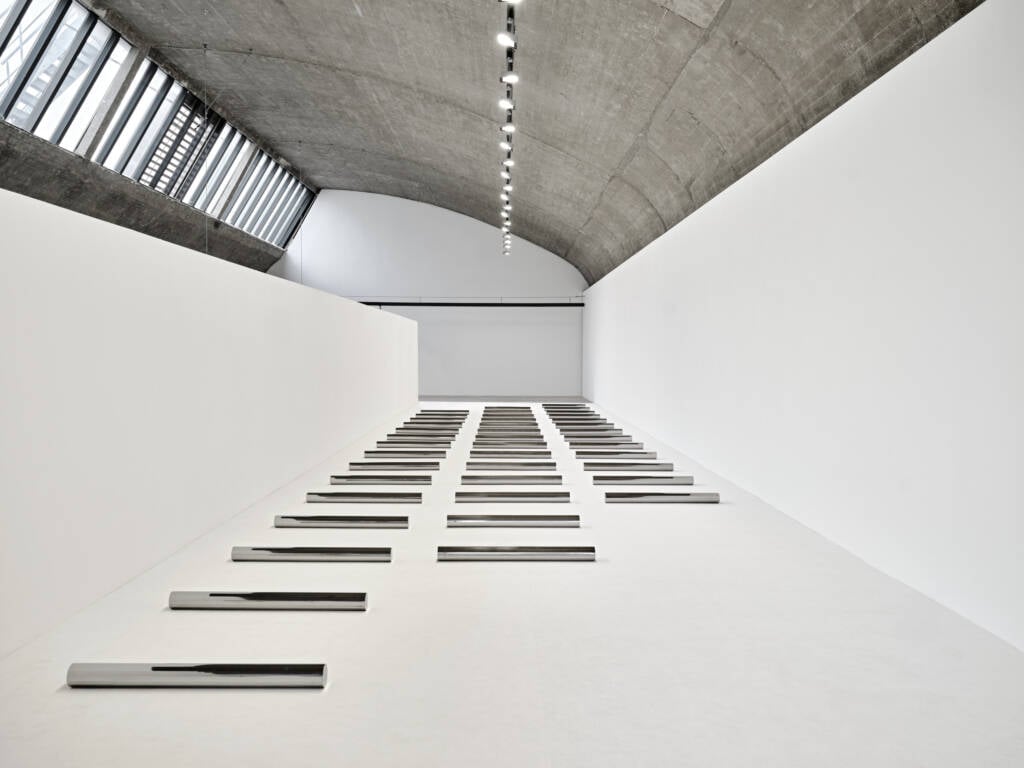
The Singular Experience, 2025, installation view
© 2025 ESTATE OF WALTER DE MARIA
Photography by THOMAS LANNES. Courtesy of GAGOSIAN
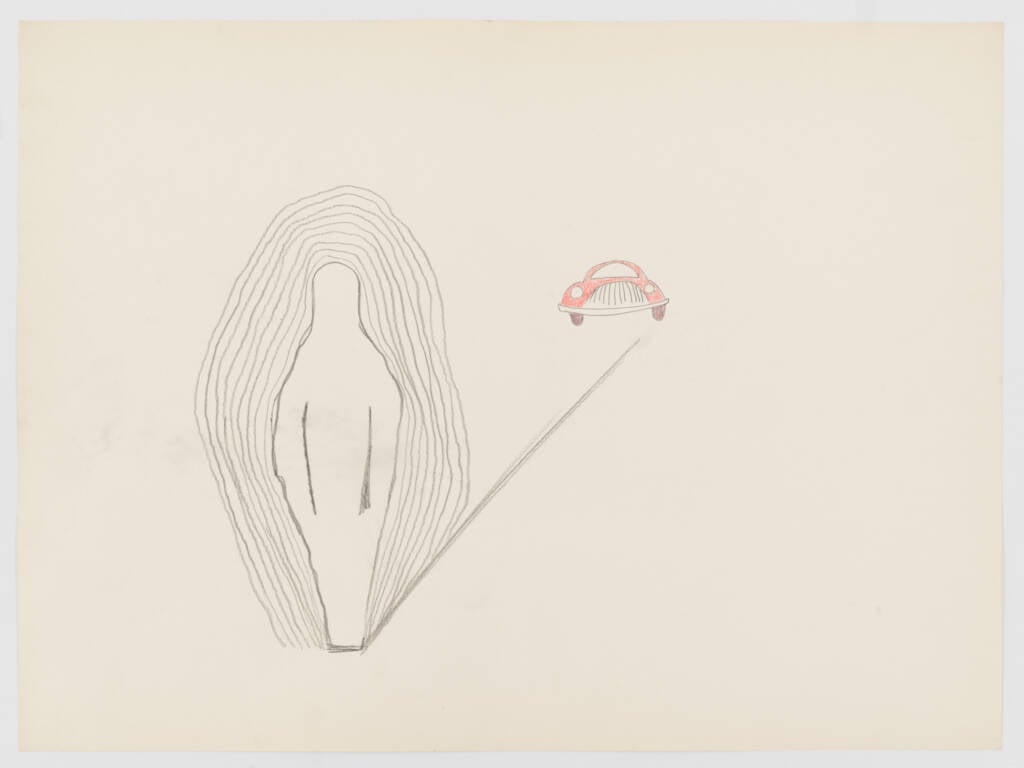
Shadow with red car, c. 1961–64
Graphite and colored pencil on paper
18 x 24 inches (45.7 x 61 cm)© 2025 Estate of Walter De Maria
Photography by ROBERT MCKEEVER. Courtesy of GAGOSIAN
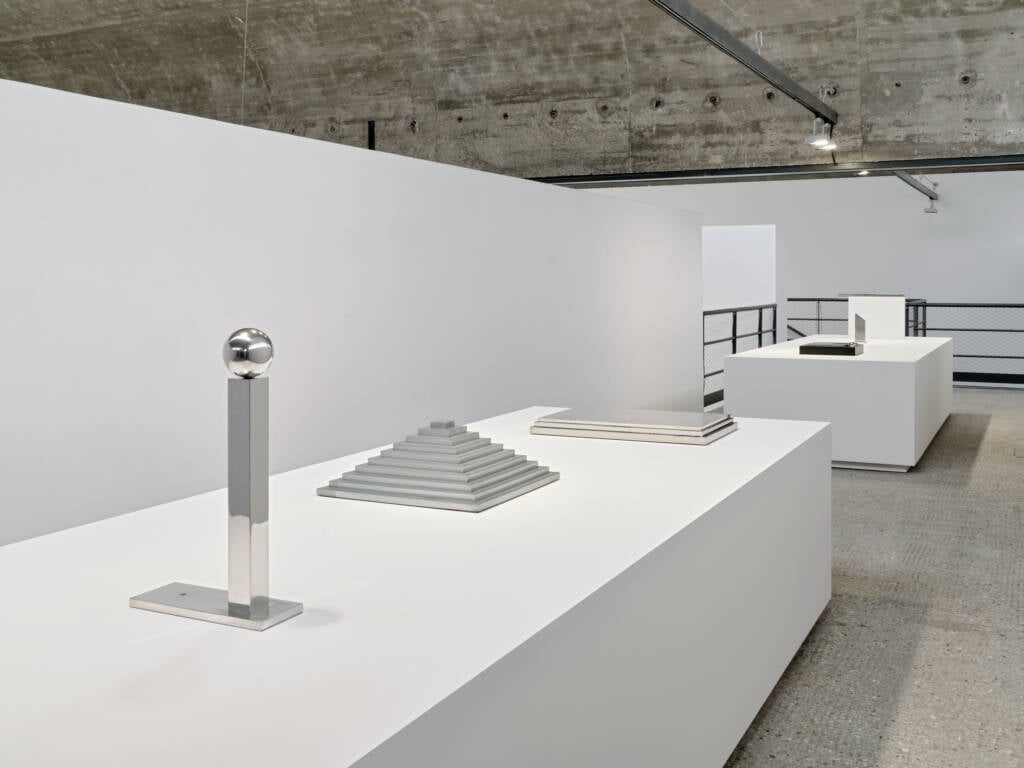
The Singular Experience, 2025, installation view
© 2025 ESTATE OF WALTER DE MARIA
Photography by THOMAS LANNES. Courtesy of GAGOSIAN

Courtesy ESTATE OF WALTER DE MARIA and GAGOSIAN
Words: LIZ BAUTISTA