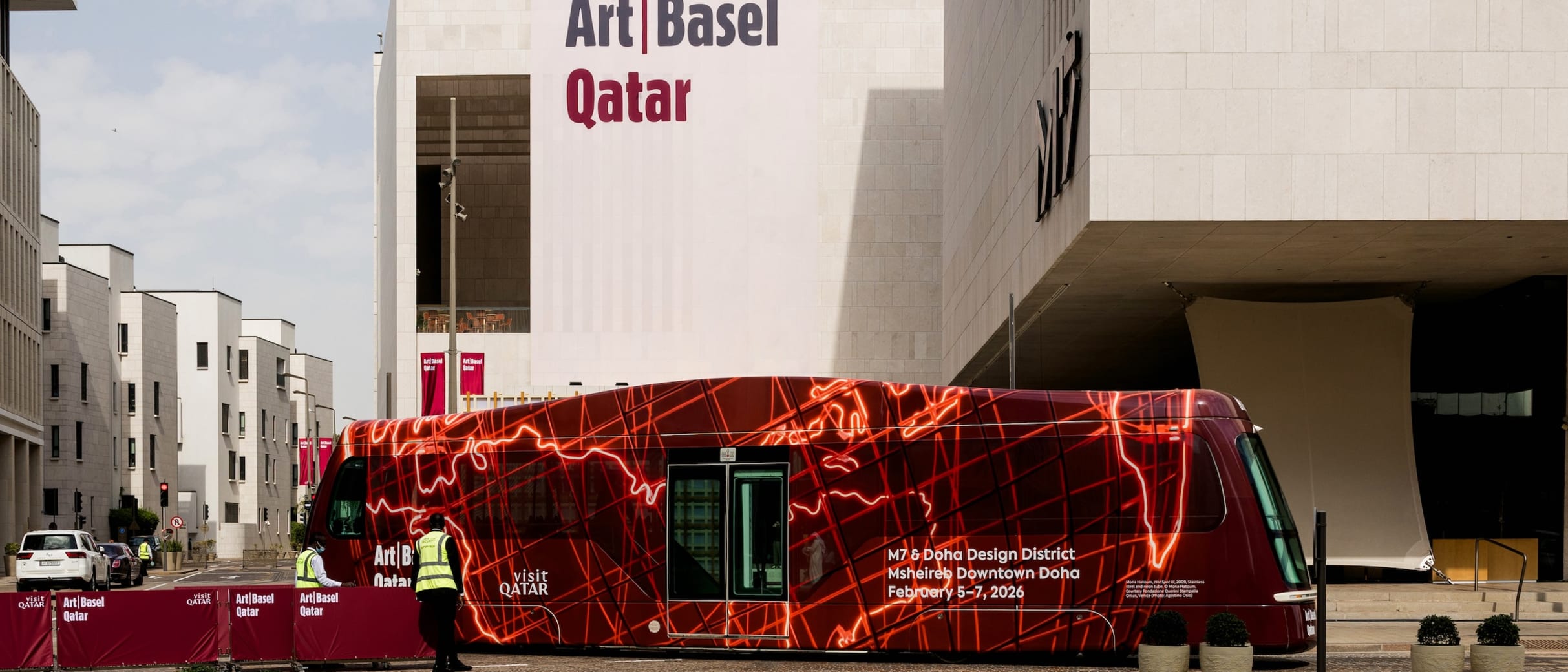
At the beginning of February, from 5th to 7th (with previews on 3rd and 4th), the first edition of Art Basel Qatar unfolded across M7 and the Doha Design District in Msheireb, bringing together 87 galleries presenting 84 solo artist projects. Participants came from 31 countries, including 15 first-time Art Basel exhibitors, marking a measured yet ambitious debut for the brand’s fifth global fair.
Artistic Director Wael Shawky, working closely with Art Basel’s leadership, replaced the traditional booth model with a curated, open format structured around the theme Becoming. The concept examined transformation—of identity, systems, and cultural narratives—positioning the Gulf as a site where history and rapid modernization intersect. In Qatar, the fair signaled more than a market expansion; it underscored the country’s long-term investment in culture as infrastructure.
By the close of the week, over 17,000 visitors had attended, with nearly half of private collectors traveling from the MENASA region. Galleries reported sustained engagement from institutions and collectors in Qatar, Saudi Arabia, the UAE, and Europe, translating into sales across a broad range of price points. Representatives from more than 85 museums and foundations were present, reinforcing Doha’s growing institutional gravity.
Ivona Mirkovic traveled to Doha for hube to attend the inaugural edition on the ground. Reporting from across multiple venues, she examined the solo presentations and spoke with artists and gallerists about what participation signals at this formative moment. Her account offers a close look at a fair that could play a defining role in reshaping the region’s cultural landscape.
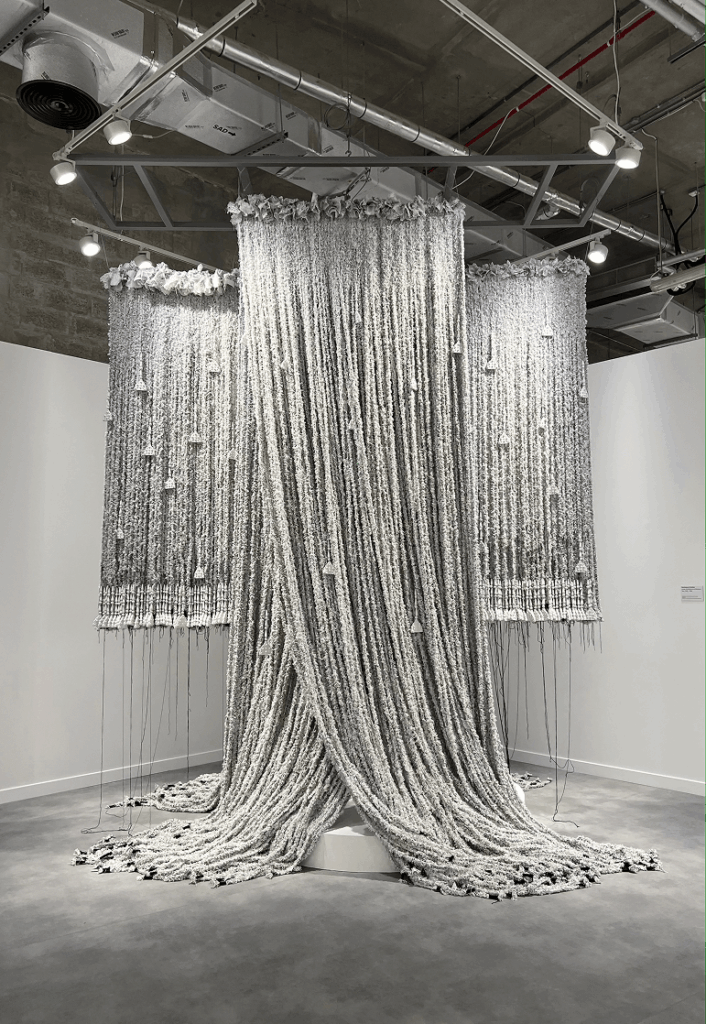
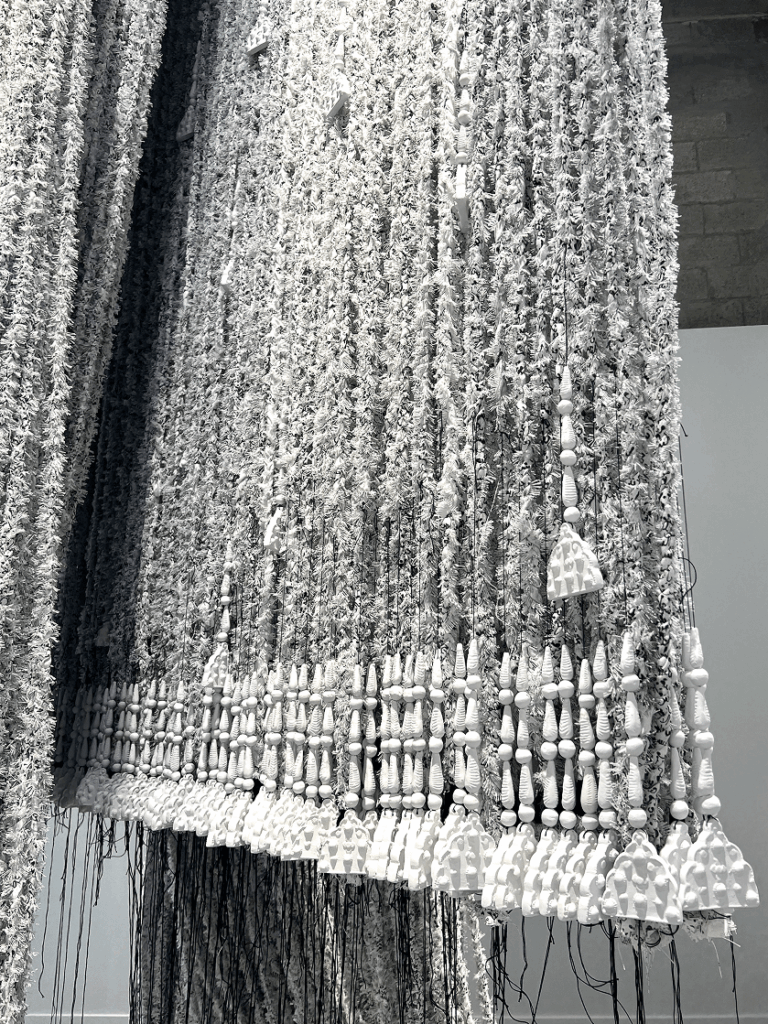
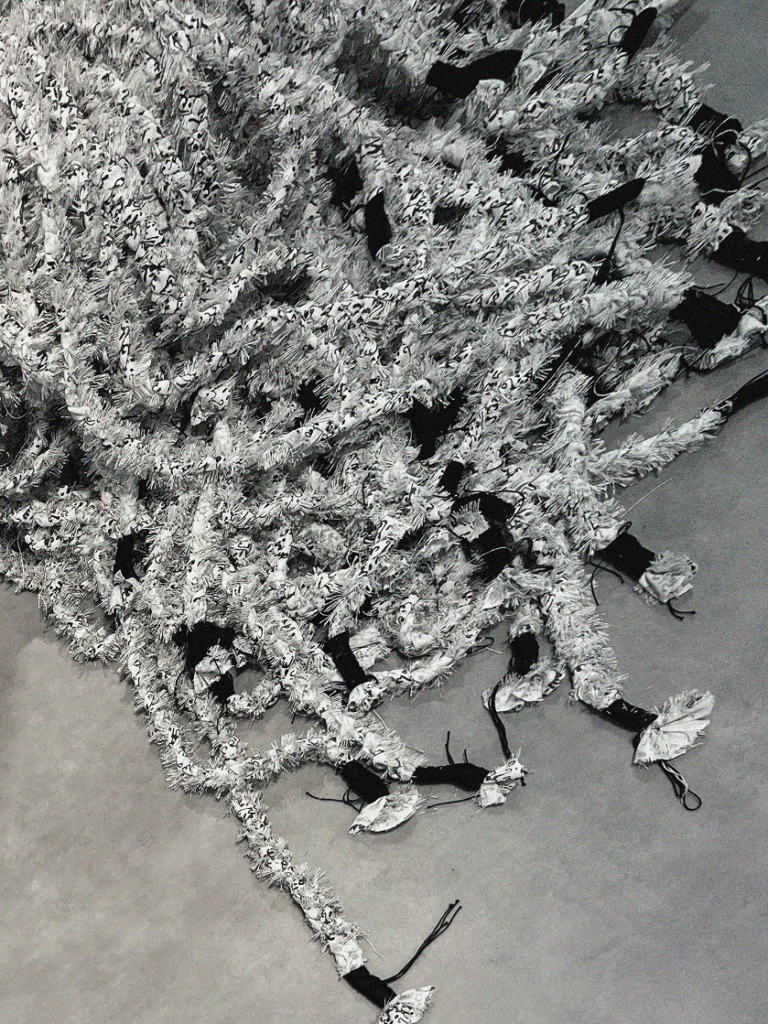
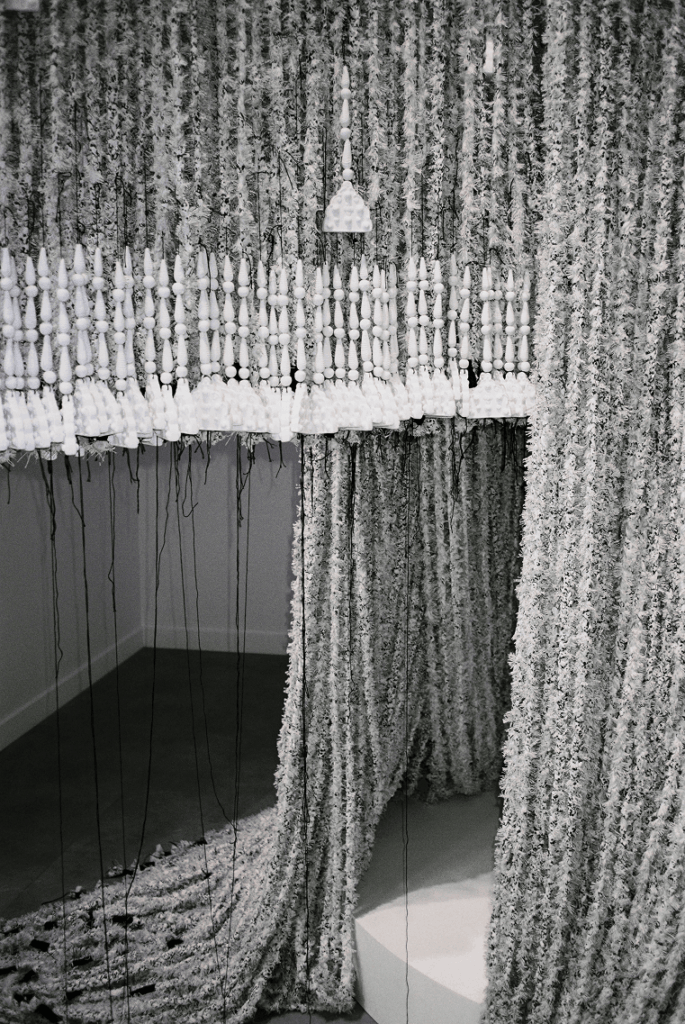
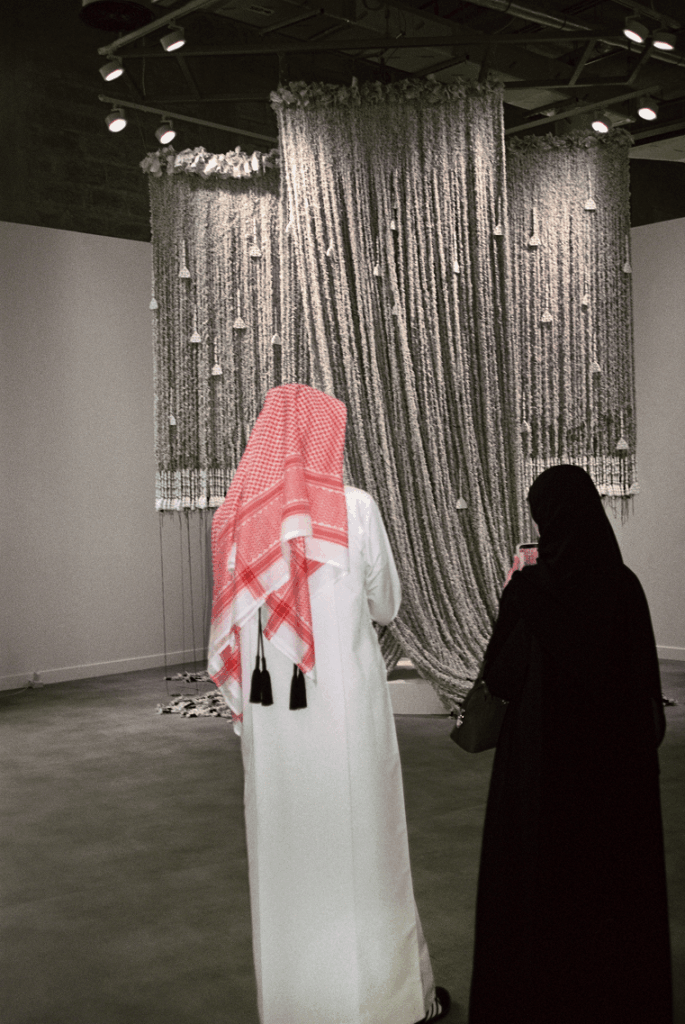
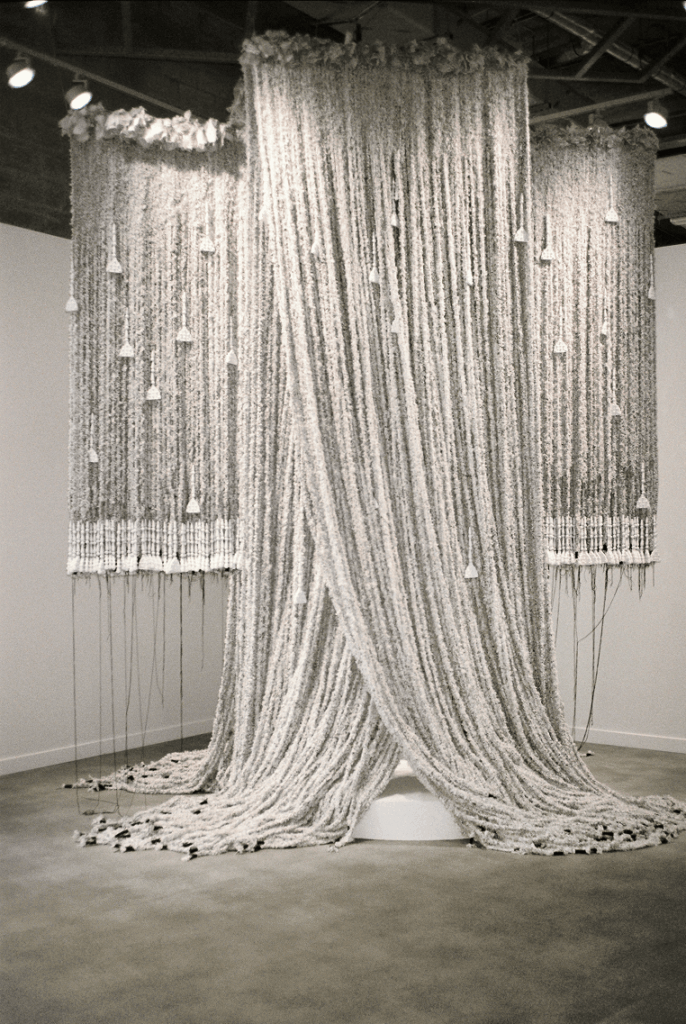
‘LIVING: Architectures of Memory’ by Bouthayna Al Muftah at the al markhiya gallery
Living: Architectures of Memory considers memory as a tangible, inhabitable condition rather than a static archive—something we recognize energetically, not intellectually. Using elements of a deconstructed thobe and the everyday rituals of hair braiding shared between mothers and daughters, the work becomes an immersive conceptual artist book—a tangible archive holding poetry and oral traditions within hundreds of braids, anchored by ornaments that symbolize those passed down through generations.
Ivona Mirkovic: What does it mean to you to be part of the inaugural edition of Art Basel Qatar? How do you hope it will impact your career or visibility as an artist?
Bouthayna Al Muftah: Being part of the inaugural edition of Art Basel Qatar has been an incredible experience. It’s a powerful global platform and a great space to meet, connect, and network with people from across the art world. What’s especially meaningful to me is the opportunity to showcase art from here—from the region—and to share our voices with an international audience. Art speaks beyond borders, and I hope that my work has left a lasting impression, or at least planted a seed that people carry with them after experiencing it. For me, being part of this platform feels like a valuable learning moment and a step forward in my journey as an artist, offering exposure, dialogue, and the chance to grow through new perspectives.
IM: Many emerging artists view global art fairs as pivotal moments in their careers. How do you personally define success at an event like Art Basel Qatar? Is it exposure, exchange, inspiration, or something else?
BAM: I think it’s a combination of all three, but if I had to choose what matters most to me, it would be exchange and inspiration. Events like this create space to bridge cultures, share knowledge, and exchange ideas, and that kind of dialogue is incredibly important to me as an artist. Those conversations don’t just inspire my own practice, but also open up meaningful discussions with others. For me, success at an event like Art Basel Qatar isn’t only about visibility—it’s about the connections made, the ideas shared, and the conversations that continue beyond the fair.
IM: How do you see the role of the artist in society today? Do you feel a responsibility to address social, political, or environmental issues through your work
BAM: I don’t think there’s a single role that applies to all artists, and I wouldn’t want to speak on behalf of everyone. Each artist comes from a different place, with different motivations and responsibilities. For me, I see my role as part of a larger collective—one that helps keep culture alive and evolving. The work I create isn’t solely for an audience; it’s also a way for me, to stay grounded, connected, and responsive to the world around me.
I believe we’re all part of a system in which each voice contributes in its own way, and when artists are honest in their practice, social, political, or environmental questions often surface naturally. Rather than feeling a pressure to address specific issues, I feel a responsibility to stay present, thoughtful, connected and sincere in what I create, trusting that the work will find its relevance through that process.
Ivona Mirkovic: How do you expect the launch of Art Basel Qatar shaping the contemporary art market in the Middle East over the next few years?
Peggy Sue Amison (Development Director at al markhiya gallery): Art Basel Qatar has the potential to positively contribute to the development of the contemporary art scene in Qatar and beyond. It brings together museums, institutions, art advisors, and new collectors giving them the chance to discover artists from Qatar and the wider region. At the same time, it introduces local collectors and artists to international talent exhibiting at the fair. This kind of exchange strengthens the regional art market and opens up exciting opportunities for visibility, dialogue, and growth.
IM: Have you observed a shift in the openness of regional collectors or the general public toward experimental or emerging artistic practices? How might Art Basel Qatar accelerate this trend?
PSA: We have seen a growing openness to experimental and emerging artistic practices in Qatar, both among regional collectors and the wider public. Artists are exploring new approaches, and audiences are drawn to work that challenges familiar formats while pushing the boundaries of media and process. Collectors are becoming more willing to support new work beyond traditional commercial models.
Since 2008, al markhiya gallery has showcased artists across a wide range of media, developing that reflect and support Qatar’s growing arts scene. Universities and institutions in Doha have added to this momentum through innovative programmes and artist residencies that encourage experimentation and critical thinking. Art Basel can build on this momentum by using its global platform to spotlight regional voices, connect artists and collectors, and create opportunities for local artists to exchange ideas with peers around the world. By fostering these connections and increasing visibility, it can help spark a global conversation about contemporary arts practice and shape a future where ambitious, experimental work is widely seen, supported, and collected.
IM: Beyond immediate sales, what long-term impact do you hope Art Basel Qatar will have on your gallery and on the broader Middle Eastern art ecosystem?
PSA: Beyond immediate sales, we hope Art Basel Qatar will strengthen both our gallery’s international profile and the wider art ecosystem in the region. As a recognised global platform for artistic excellence, Art Basel’s presence in Qatar will further energise the growing art market, attracting critics, curators, collectors, and cultural leaders from around the world.
This increased attention will help expand Qatar’s creative and intellectual potential on a global stage. Over the long term, having Art Basel I Doha will contribute to the country’s continued development as a dynamic cultural hub for art, dialogue, and innovation, benefiting galleries, artists, and institutions across the region.
Hazem Harb reconfigures history at the Tabari Artspace
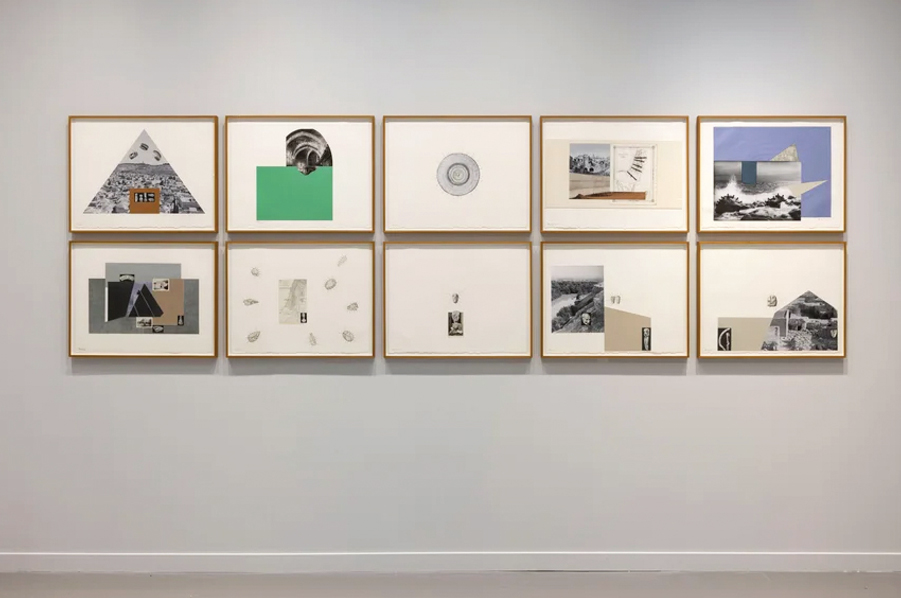
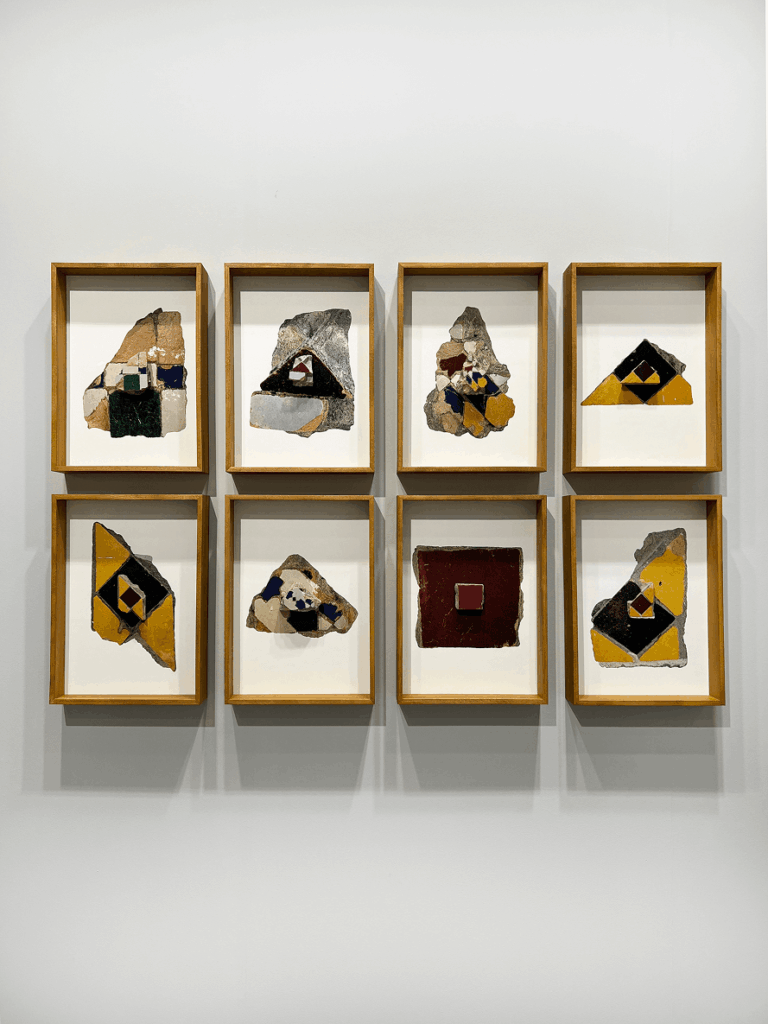
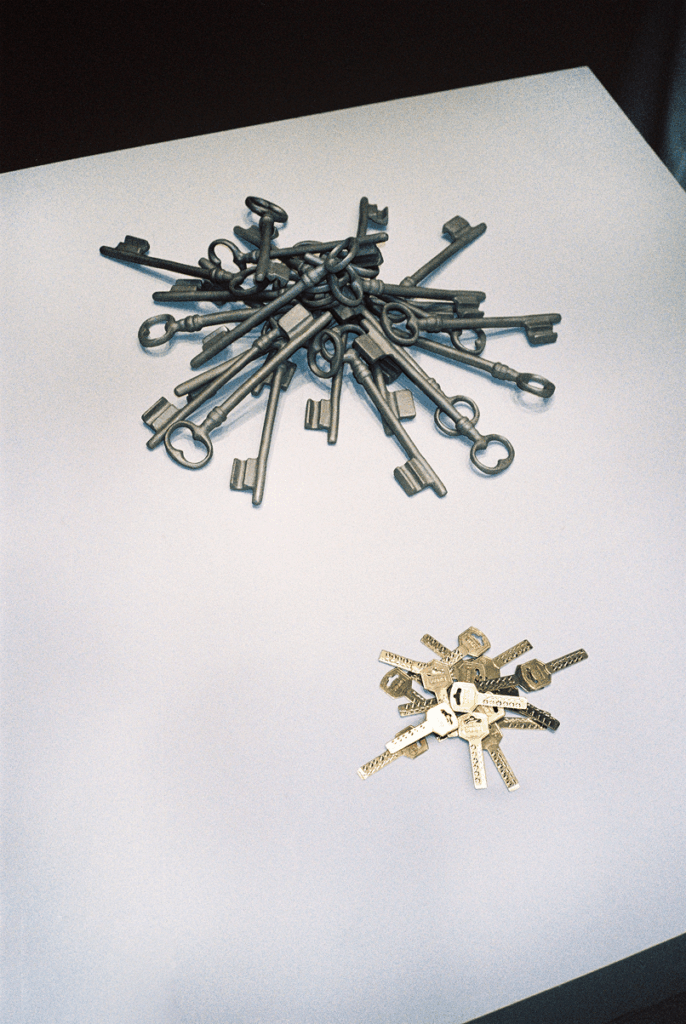
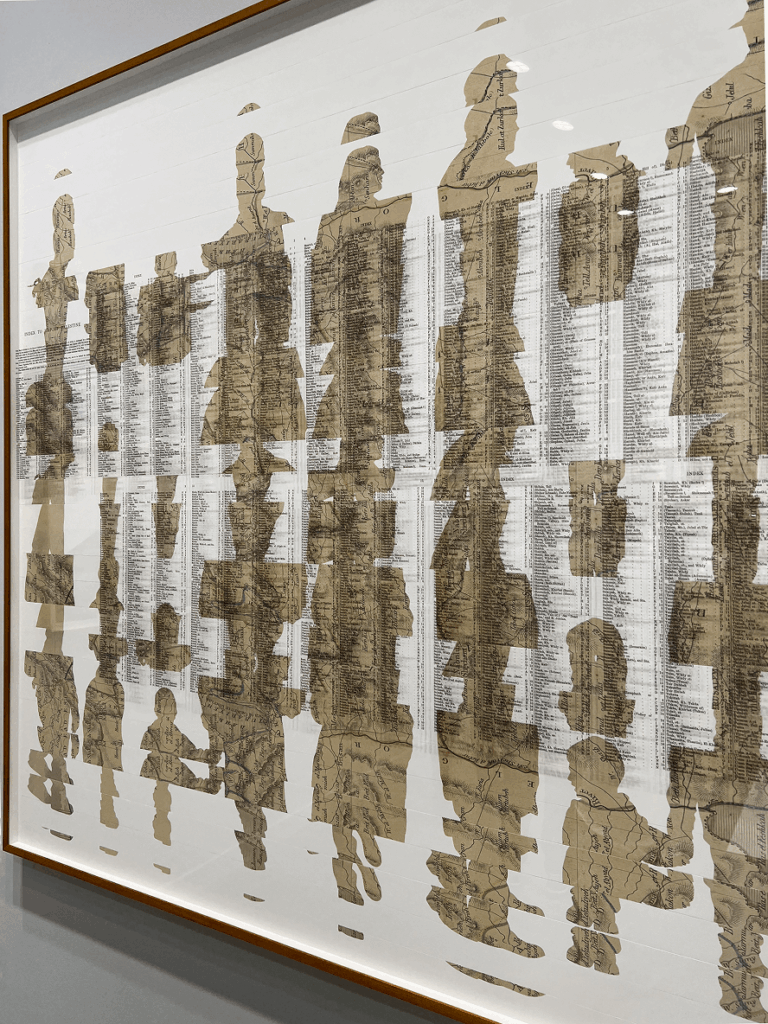
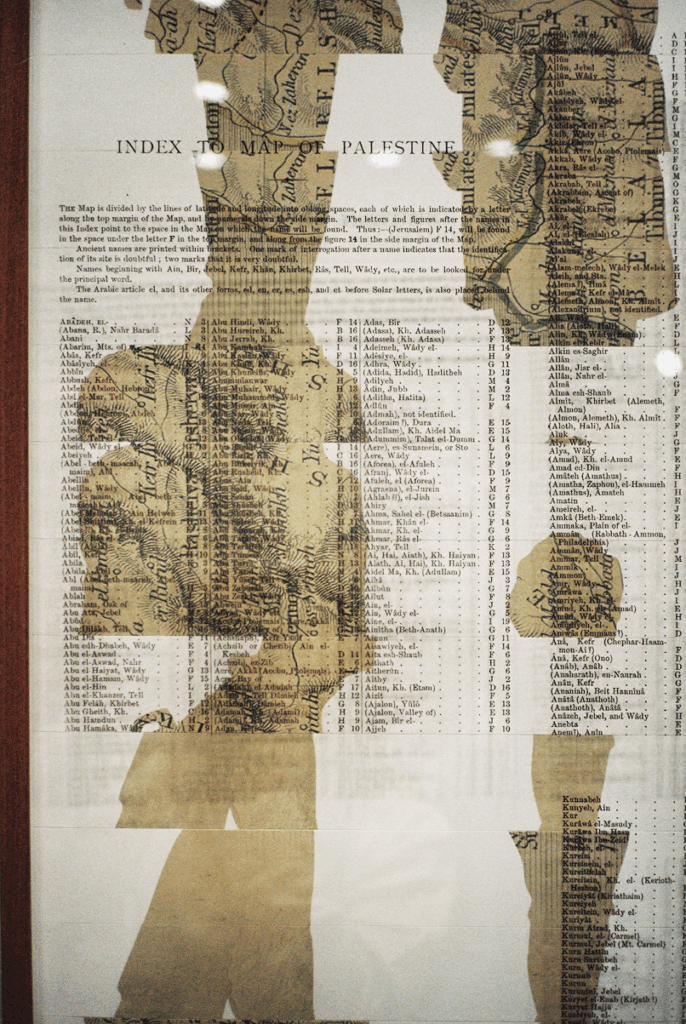
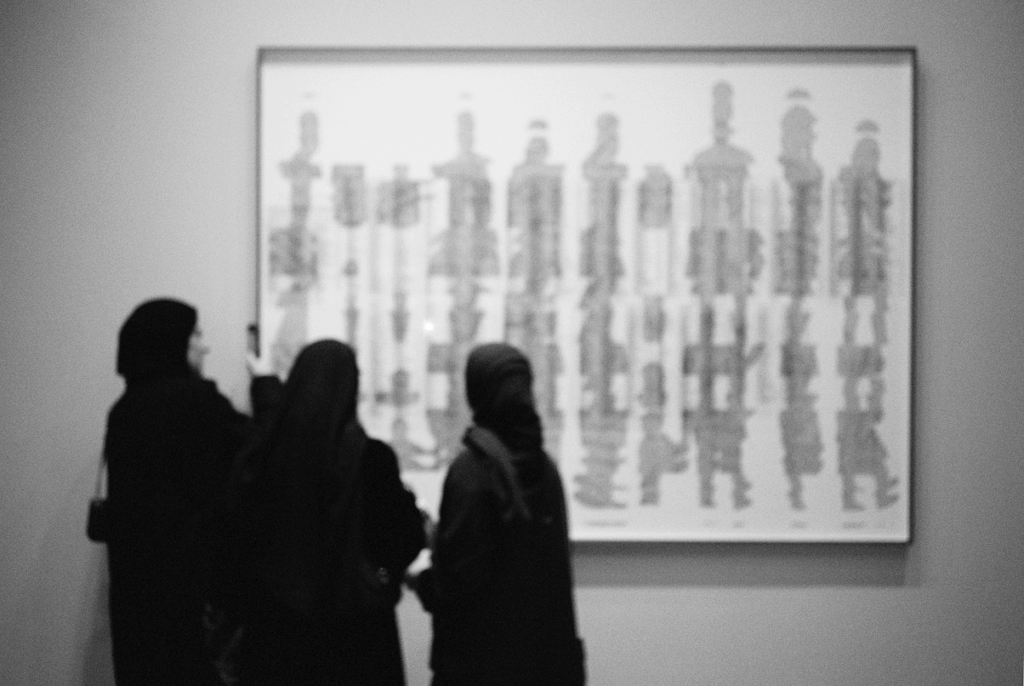
Palestinian visual artist Hazim Harb’s project mobilises archaeology as a critical framework through which to examine displacement, circulation, and the epistemic violence embedded in the production of historical knowledge. Drawing together works produced across distinct moments in his practice, from 2018 to the present day, the presentation brings collage and installation into dialogue around a sustained concern with how objects, images and people are extracted, transported and reclassified across time and space.
“By dismantling and reassembling fragments, I create conditions where new relationships surface. It is an approach that acknowledges rupture as a lived condition. Histories are carried in pieces that rarely align.”—Hazem Harb
Ivona Mirkovic: Art Basel Qatar is more than an exhibition—it’s a gathering of diverse cultures and ideas. How do you hope this platform will foster meaningful dialogue between artists, collectors, and audiences from different regions?
Hazem Harb: As a Palestinian artist, the fair offered access to an international audience in a manner that remained attentive to the specificity of regional histories. The presentation allowed these histories to circulate within a broader art framework without recourse to simplification or extractive framing. This positioning is particularly relevant given the contemporary conditions under which Palestinian cultural production is mediated and received. In this context, the fair functioned as a site where such work could be encountered as materially and conceptually complex, rather than as illustrative content.
The one-artist-per-booth format also generated points of resonance across geographies. Practices from Latin America, for example, revealed shared concerns with displacement, material histories, and the political life of ruins. Discussions with visitors further demonstrated how works acquire layered meanings as they circulate. Architectural fragments from Gaza prompted associations with other sites of division and historical rupture, including post-war Europe, enabling conversations grounded in lived experience rather than analogy. Such encounters underscore how art can operate as a site of translation, where specific histories remain intact while becoming legible across different contexts.
IM: From your perspective, what does the emergence of Art Basel Qatar signal for the Middle Eastern art scene? Do you think it will reshape how the global art community perceives artists from this region?
HH: The inauguration of Art Basel Qatar constitutes a significant development within the region’s contemporary art ecology. Realised to a high standard, the fair established a framework that facilitated exchange across international and regional positions while remaining attentive to local histories and conditions. Its emphasis on artist-led presentations shaped an environment oriented toward prolonged encounter, allowing practices to be taken-in as coherent trajectories. The one-artist-per-booth format supported ways of viewing that privileged attention, duration, and contextual reading. As an international fair, curated by a regional artist, Wael Shawky, Art Basel connected an international audience to some of the key artists and galleries of the region in a way that felt considerate allowing MENA voices to speak on their own terms. Within this structure, my presentation brought together works from different moments of my practice, tracing a sustained engagement with archaeology, fragmentation, and the afterlives of modernist infrastructure. The booth was conceived as a unified spatial proposition, drawing together collage and sculptural works with materials sourced from Palestine’s built environment, including fragments from Gaza’s former airport. These elements were arranged to register processes of suspension, interruption, and erasure, foregrounding material continuity alongside political rupture without imposing narrative resolution.
IM: How do you see the role of the artist in society today?
HH: My practice is shaped by a commitment to safeguarding Palestinian experience from cultural erasure. Working with fragments, archives, and material residues, I approach the past as a force that persists within the present. In conditions marked by censorship, violence, and historical distortion, artistic practice carries particular responsibility. It provides a means of capturing the present under a climate of growing censorship. Through art we can represent reality or imagine alternative ones, we can think differently, art can sustain a space for reflection and spark empathy across borders. These concerns are integral to my work.
Ivona Mirkovic: How do you expect the launch of Art Basel Qatar to shape the contemporary art market in the Middle East over the next few years?
Maliha Al Tabari (Founder of TABARI ARTSPACE): Art Basel Qatar enters the region through a particular curatorial and institutional approach that is already well established here. Qatar has long invested in building museums and collections that approach art from the region on its own terms, attentive to context, discourse and meaning rather than external market frameworks. That sensibility was visibly extended to the fair.
What distinguished Art Basel Qatar was the degree of respect afforded to artistic practice. This comes from the artist-led approach under the excellent leadership of Wael Shawky. The fair was conceived with a sensitivity to how work is encountered and read. Presentations conversed, generating moments of mutual enquiry alongside friction and rupture. The result was an experience that felt visually coherent and intellectually rigorous.
Over the coming years, I see Art Basel Qatar acting as a critical axis between the region and the international art market. It opens new conversations and modes of engagement, grounded in the specific cultural and historical frameworks of MENA. In doing so, it has the potential to recalibrate how the region is positioned globally, as a site brimming with artistic production and intellectual enquiry.
IM: Beyond immediate sales, what long-term impact do you hope Art Basel Qatar will have on your gallery and on the broader Middle Eastern art ecosystem?
MAT: Beyond commercial outcomes, the fair’s long-term value lies in its capacity to deepen institutional and collector engagement with the region. I anticipate that Art Basel Qatar will attract an increasingly international and regionally based clientele, expanding the collector base while contributing a more informed and committed mode of collecting.
For the broader ecosystem, the fair brings visibility to the depth and quality of artistic practices emerging from the Middle East and North Africa. It reinforces that the region’s contemporary art scene is shaped by rigorous inquiry, innovation and historical continuity. This recognition feels overdue, and Art Basel Qatar provides a platform through which that value can be articulated and sustained.
IM: If you could highlight one unique aspect of your gallery or your artists that you hope international audiences take away from Art Basel Qatar, what would it be?
MAT: Over the past two decades, Tabari Artspace has built a dialogue between modern and contemporary practices from the region. Our programme began with a focus on modernism and has continued through sustained support of artists working today, attentive to questions of the present moment, representation, cultural legacy and lived experience.
We position the gallery as a bridge between geographies and generations, forging connections that are often unexpected. This includes revisiting histories marginalised or omitted from dominant narratives and creating space for those voices to enter contemporary discourse.
We privilege authenticity, materially and conceptually. The artists we work with engage directly with the present, ensuring that their realities are articulated with integrity. I hope audiences encountering our programme at Art Basel Qatar come away with a sense of the complexity of the region’s artistic legacies, the vitality of its contemporary practices, and the seriousness with which these histories and futures must be held.
‘Pollinated Migration’ by Hugo McCloud at the Sean Kelly Gallery
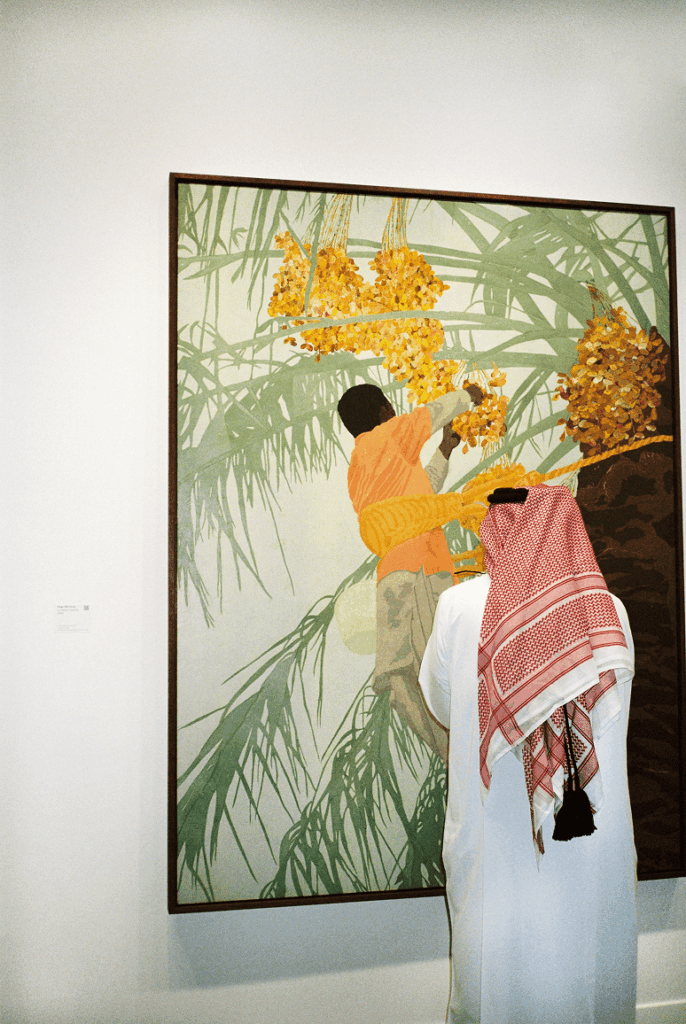
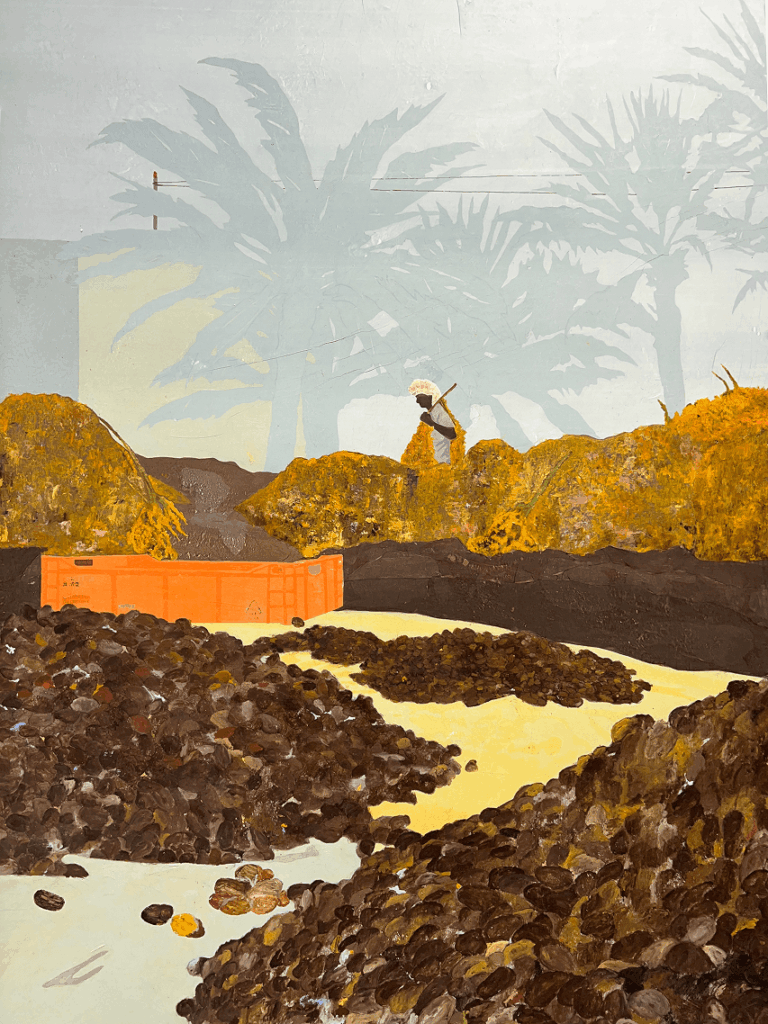
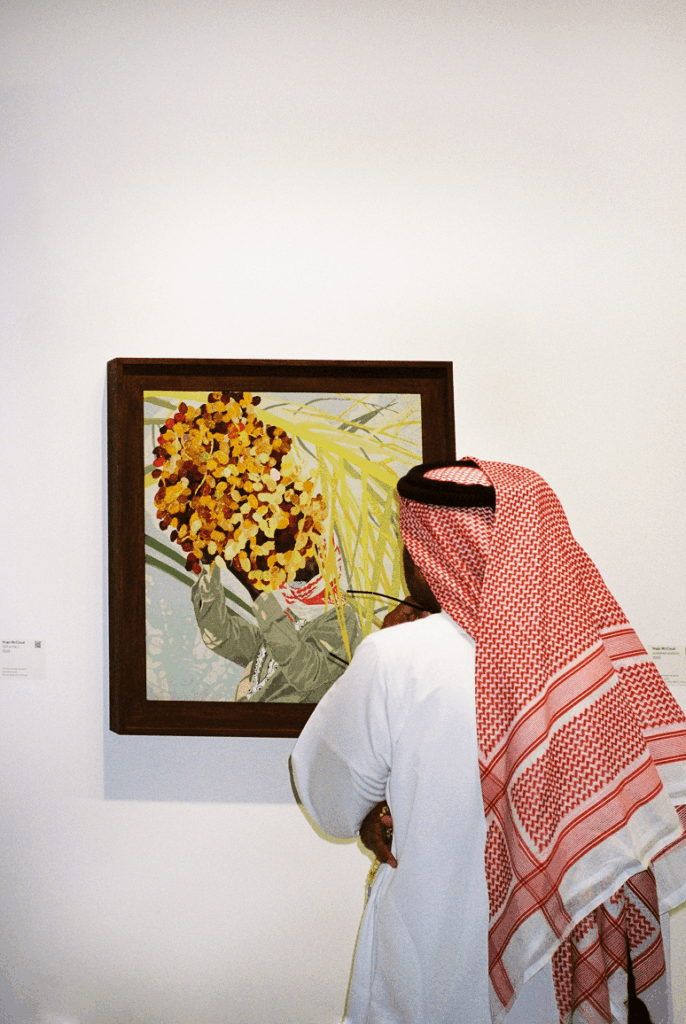
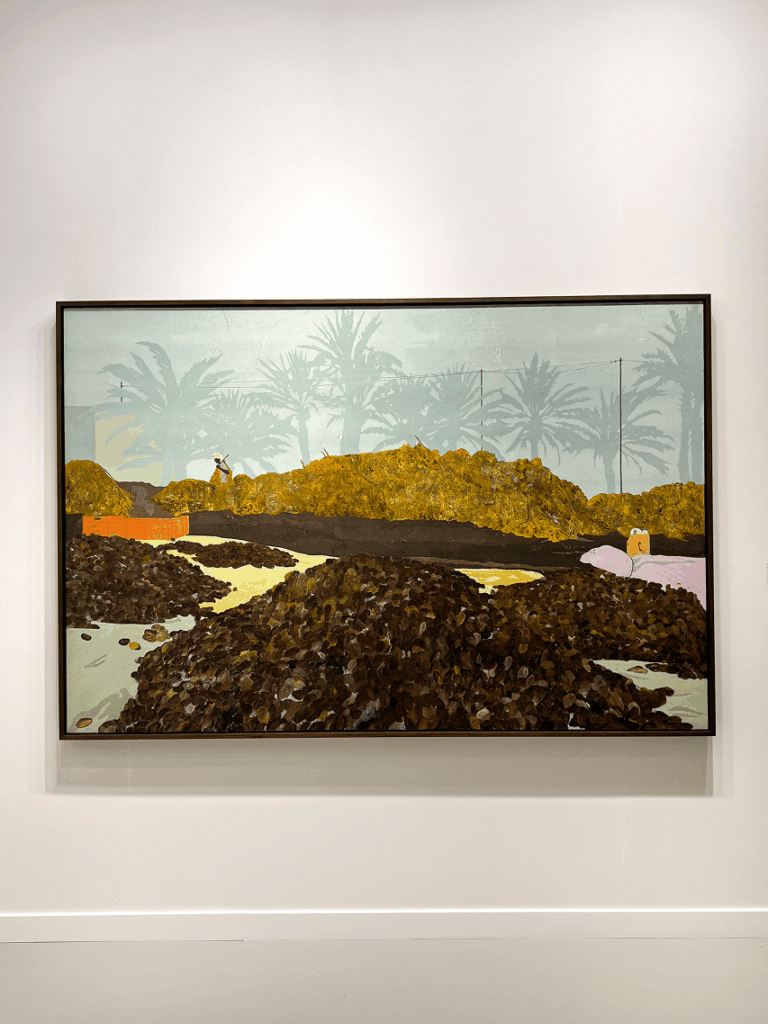
Created specifically for the fair, Pollinated Migration deepens McCloud’s ongoing exploration of migration, global commerce, and the ecological systems that bind these narratives together. Known for transforming single-use plastic into richly layered compositions, McCloud continues to expand the language of his practice, charting the movement of people and goods through scenes of flora, markets, and everyday labor.
For over a decade, McCloud has traveled to markets and industrial sites across India, Mexico, the Philippines, South Africa, and the UAE, observing and documenting the networks of exchange that structure contemporary life. These journeys inform both the material and subject matter of his work: plastic bags are cut, fused, and layered into tactile surfaces that map environmental impact and the unseen workforce behind worldwide circulation.
Ivona Mirkovic: How do you see the role of the artist in society today? Do you feel a responsibility to address social, political, or environmental issues through your work?
Hugo McCloud: In my opinion, the only responsibility an artist holds is to stay true to themselves and their practice. It’s easy to pick a direction that may be current or “in,” but that does not make it authentic. An artist’s life—like a human’s life—is their own, and their experiences, though they may be shared by many others, are still unique to the individual. So if they are drawn to social, political, or environmental issues, then I say yes—do it. I believe all directions in art are needed.
IM: Are there recurring themes or ideas in your work that you feel speak specifically to a cross-cultural dialogue?
HM: Yes, I have always been drawn to the subject of “value and labor” and how this depending on each individual’s circumstances shapes humans.
IM: How do you personally define success at an event like Art Basel Qatar? Is it exposure, exchange, inspiration, or something else?
HM: Being connected to so many creative, like-minded individuals you normally would not have contact with, and seeing how the gift of creativity is expressed across different cultures and regions around the world.
IM: What was the most inspiring part of Art Basel Qatar—is it interaction with other artists, seeing new works, or engaging with diverse audiences?
HM: First, I would say that it’s always inspiring to be in a new country, city, or culture, and to engage with new audiences while learning how things are viewed through a new lens.
Ivona Mirkovic: Are there specific opportunities you hope Art Basel Qatar will create for cross-regional partnerships, collaborations, or cultural exchange?
Lauren Kelly (Partner & Director at Sean Kelly Gallery): Art Basel Qatar was an opportunity to deepen the creative dialogue at a moment when artistic exchange feels especially vital. We were delighted to meet so many interested and engaging new collectors and curators at the fair. The level of curiosity and critical engagement was exceptional. We made some very strong contacts who stopped by our booth, and we hope those introductions will grow into lasting collaborations over time. Fairs like this create the environment not just for transactions, but for sustained relationships that connect artists and institutions across regions in thoughtful and dynamic ways.
IM: Beyond immediate sales, what long-term impact do you hope Art Basel Qatar will have on your gallery and on the broader Middle Eastern art ecosystem?
LK: We very much hope this marks the beginning of ongoing collaborations in the region. Beyond immediate sales, our goal is to build sustained relationships, with collectors, curators, and institutions, that can evolve into exhibitions, loans, and deeper dialogue. We believe the fair has the potential to further amplify conversations between local and international artistic communities in meaningful ways.
IM: How does your gallery decide which works or artists to bring to a major fair like Art Basel Qatar? Does the context of the region influence those choices?
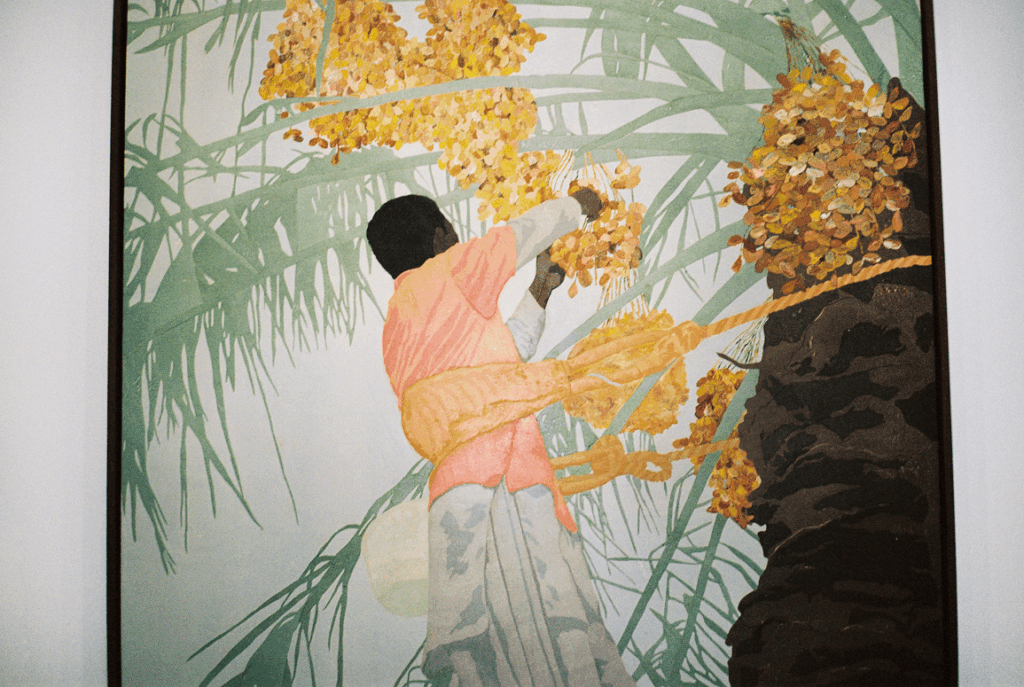
LK: The context absolutely informs our decisions. We think very carefully about presenting work that is rigorous, visually compelling, and conceptually meaningful within the region. The response to Hugo’s work was especially encouraging, visitors truly appreciated the research and sensitivity behind this new body of work. In these pieces, Hugo portrayed workers alongside depictions of dates, a subject that carries a profoundly layered history within the region, symbolizing sustenance, labor, migration, trade, and cultural continuity.
The conversations around these works were thoughtful and engaged, and it was clear that visitors recognized the care with which the artworks were developed. This presentation also marks the beginning of a new series that Hugo intends to explore further, expanding his investigation into fruit as a symbol, product, and connective thread within a region’s identity and economy. For us, bringing work that responds to place with this level of intentionality creates a richer and more authentic exchange.
‘Tracing Lines of Growth’ by Lina Gazzaz at the Hafez Gallery
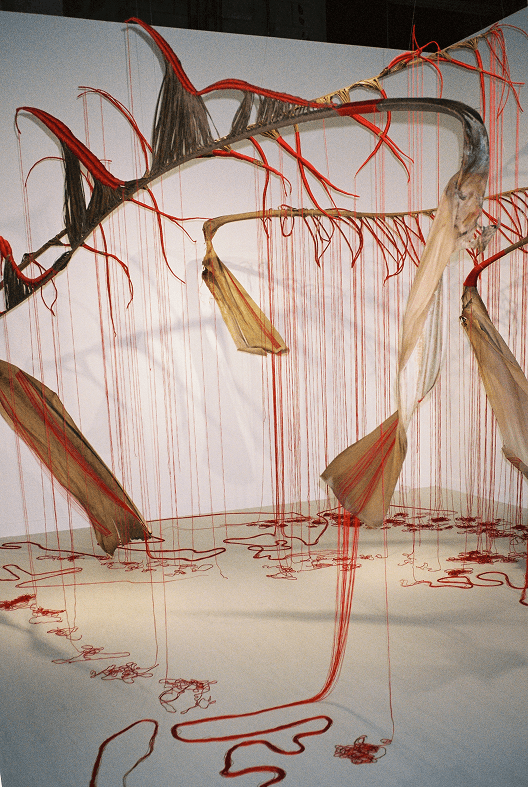
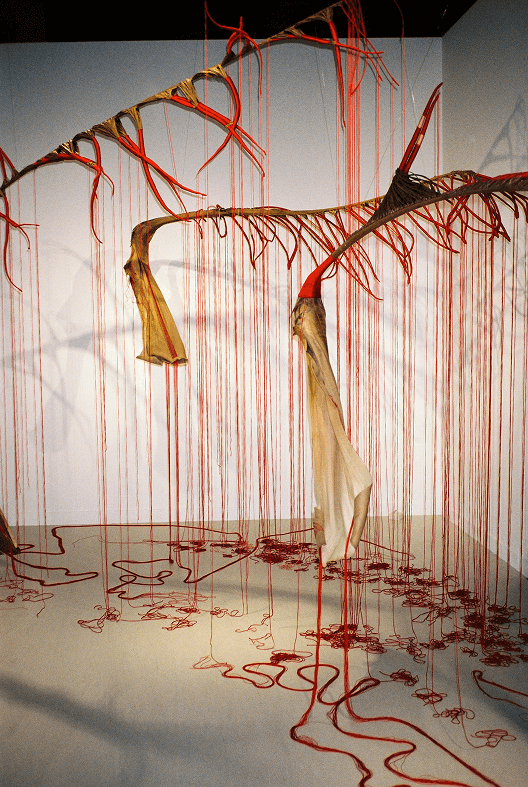
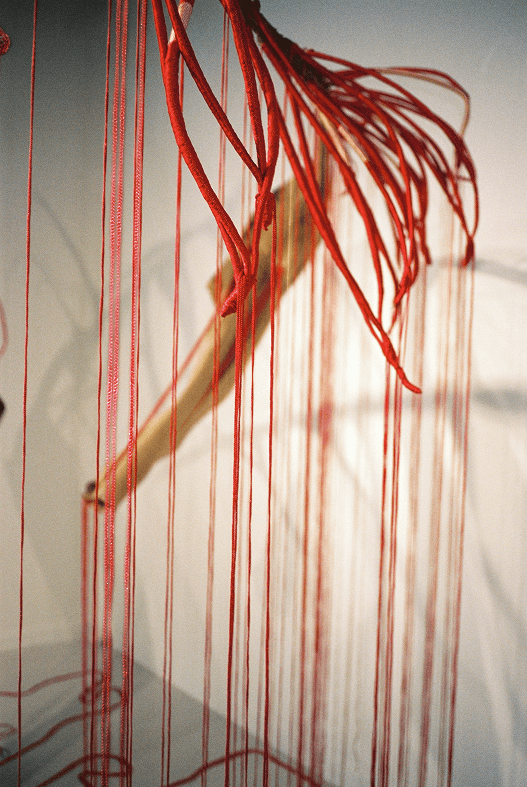
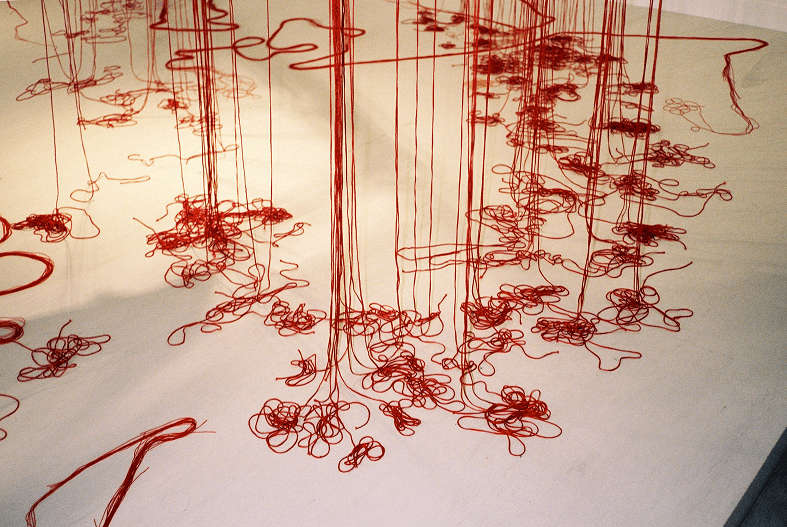
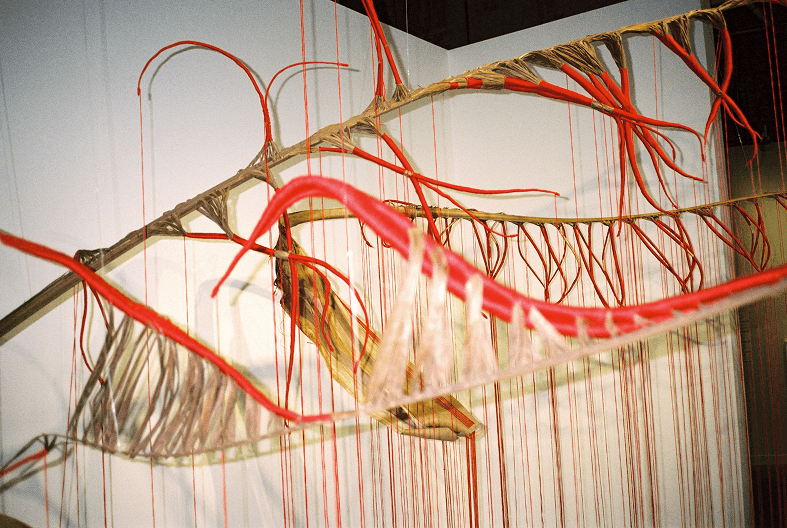
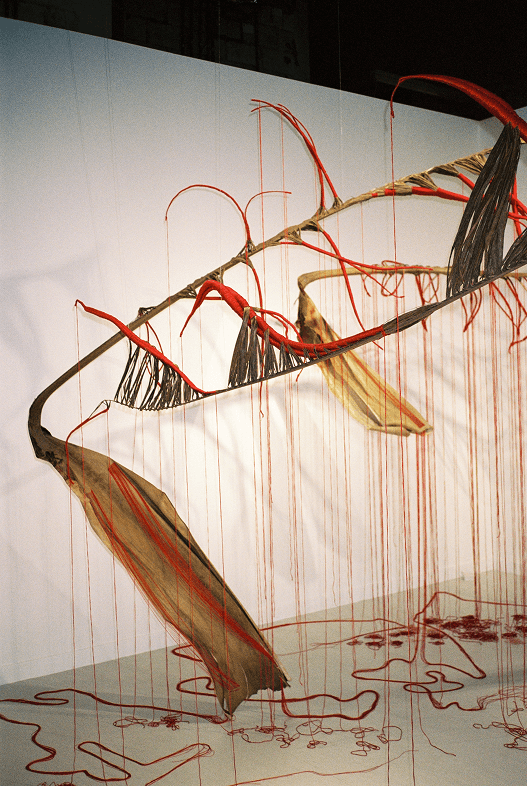
Tracing Lines of Growth by Saudi artist Lina Gazzaz is treated as a cache of human and ecological narratives. She describes a feeling of working with materials that “have witnessed civilization,” attributing to them a deep collective memory. The palm has evolved into a symbol of the land and its people. Throughout the Arabian Peninsula, it is still one of the few agricultural exports; and plays an integral role in the livelihood of agrarian communities. Gazzaz uses fine red thread, the color of life and energy, to narrate the longevity of growth, embodying themes of balance, fragility, transformation and movement. It is about the continuous existence in different forms and interaction; within the concept of time.
Ivona Mirkovic: From your perspective, what does the emergence of Art Basel Qatar signal for the Middle Eastern art scene? Do you think it will reshape how the global art community perceives artists from this region?
Lina Gazzaz: It was an honor to be part of this first edition of Art Basel Qatar. It made the region part of the global art foundation and created an important dialogue between regional and international art scenes. Art Basel was full of magical surprises on all levels.
IM: In your own practice, how do you explore themes that speak across different backgrounds or challenge cultural assumptions?
LG: As an experimental and search-based artist, inspired by nature, human culture and memory, I use local material in connection to quantum physics properties of the universe to discuss the continuous existence in different forms and interactions with the concept of time which I believe is a universal language.
IM: Are there materials, techniques, or cultural references you’ve explored recently that have shifted the way you approach your art?
LG: I am currently exploring further applications of Tracing Lines of Growth using glass as the main medium. I am also working on an even larger scale and more complex palm tree installation.
Ivona Mirkovic: How does participating in Art Basel Qatar influence your gallery’s positioning in the global art market?
Kenza Zouari (Head of special projects at Hafez Gallery): Participating in Art Basel Qatar positions Hafez Gallery as a key player within the West Asian art scene and the wider international market. It also places our artists in dialogue with leading galleries from around the world, affirming that Saudi artists belong at the center of the international art scene rather than at its margins. And we believe that this visibility helps curators, institutions, and collectors situate our program within that context.
IM: Beyond immediate sales, what long-term impact do you hope Art Basel Qatar will have on your gallery and on the broader Middle Eastern art ecosystem?
KZ: Our ambition is for Art Basel Qatar to deepen the long‑term infrastructure around West Asian art. For Hafez Gallery, that means building sustained relationships with museums, biennials, foundations, and serious private collections, leading to acquisitions, institutional exhibitions, commissions, and residencies for our artists. More broadly, we hope the fair contributes to embedding Arab modern and contemporary art within the market, encourages more confident and informed regional collecting, and inspires the next generation of artists to imagine careers that are both flourishing locally and fully engaged internationally.
IM: Are there specific opportunities you hope Art Basel Qatar will create for cross-regional partnerships, collaborations, or cultural exchange?
KZ: Yes, Art Basel Qatar could become a catalyst for concrete cross‑regional collaborations; joint exhibitions with galleries abroad, co‑curated projects, artist exchanges and residency programs, and shared research initiatives with institutions from all over the world.
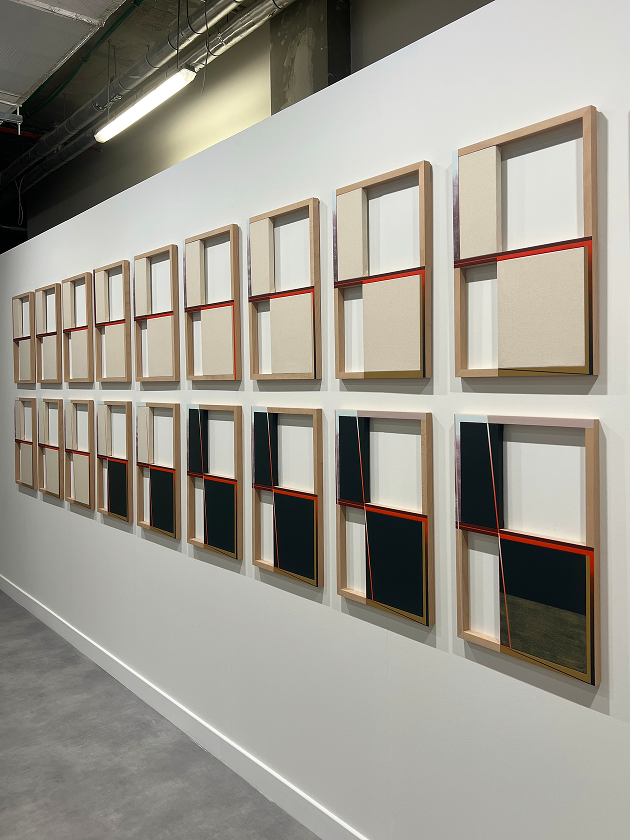
‘In Folded Space’ by Sarah Al Mehairi at the Carbon 12 Gallery
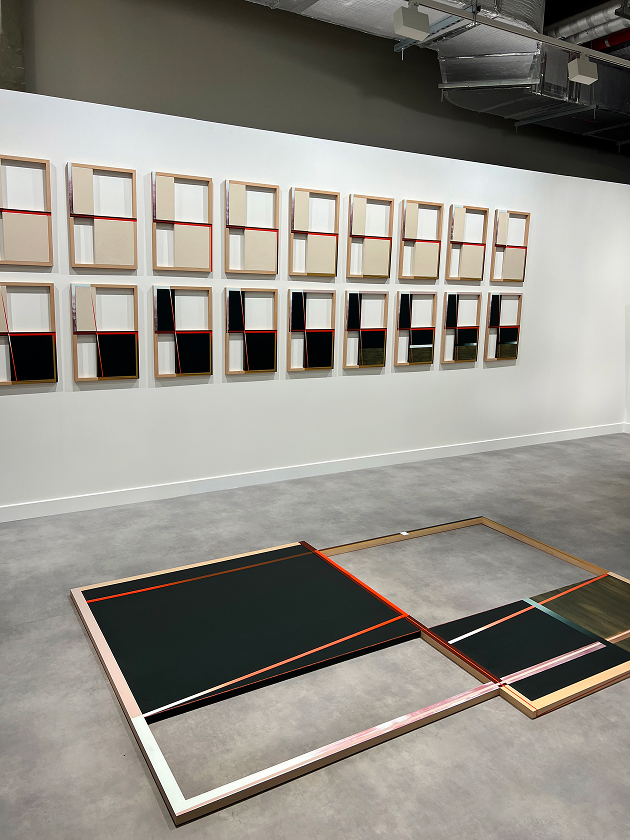
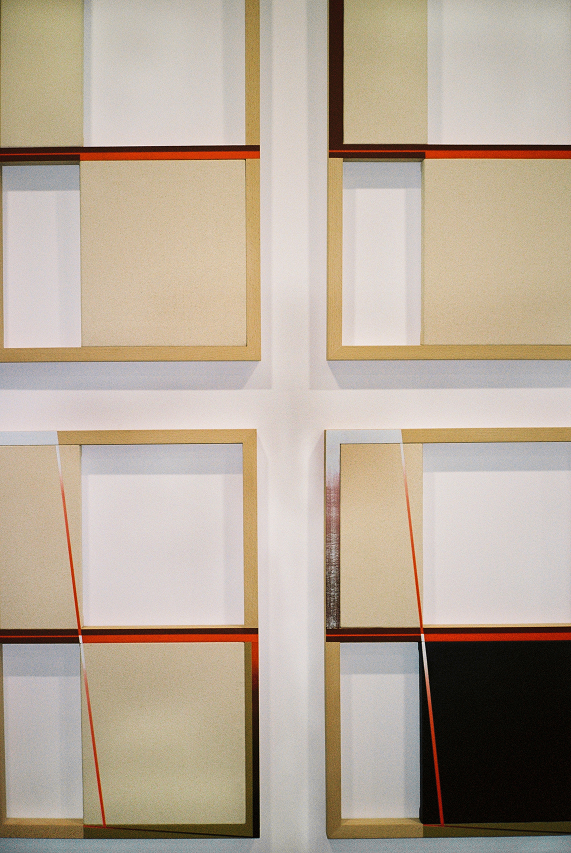
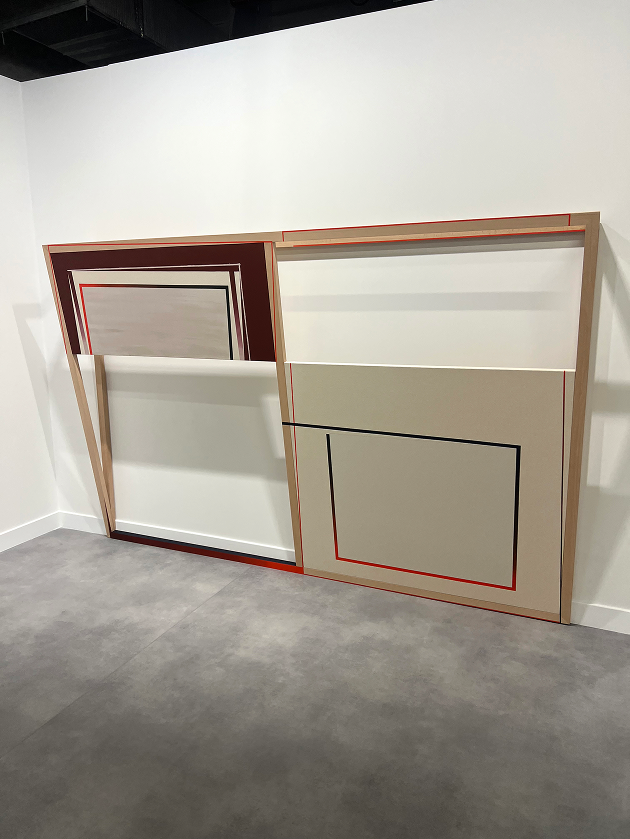
Emirati artist, Sarah Al Mehairi presents In Folded Space, a project that plays off her Off Centered series as she continues to explore abstraction as a language attuned to flux and expands her investigation into language and structure. Voids and intervals are as significant as form, suggesting that meaning emerges as much from absence as from presence. Through a constellation of wooden frames and gridded forms that lean, rest, and intersect across the booth, these modular units echo architectural fragments yet resist firm closure. Rather, they fold into one another and the surrounding space. Within the theme of Becoming, the work reflects on layered sites of transformation, whether as a person, as a space, or as a region, where histories are continually inscribed and re-inscribed
Ivona Mirkovic: What does it mean to you to be part of the inaugural edition of Art Basel Qatar? How do you hope it will impact your career or visibility as an artist?
Sarah Al Mehairi: I feel absolutely honored to be part of the inaugural edition of Art Basel Qatar. It’s a truly special moment to actively participate in a defining chapter of this region’s art and cultural history. There’s something profoundly impactful about being in a new setting while still feeling so close to home. I hope my participation in Art Basel Qatar expands my visibility beyond the region while also deepening my connection within it. Being part of a platform of this scale at such a defining moment is both a privilege and a responsibility. I’m truly grateful to contribute my voice to this larger, evolving, and collaborative ecosystem.
IM: From your perspective, what does the emergence of Art Basel Qatar signal for the Middle Eastern art scene? Do you think it will reshape how the global art community perceives artists from this region?
SAM: From my perspective, the launch of Art Basel in Qatar, the first of its kind in the region, signals a powerful shift for the art scene, reinforcing that this region is indeed central to the global cultural conversation. It’s always been local to global but now it feels like the global has become local, physically present, integrated in dialogue, platforms and relationships. We have an incredible group of artists here, and a platform of this scale gives us the opportunity to be seen, heard, and engaged with in a more direct and expansive way. I believe it has the potential to reshape how the global art community perceives artists from this region. It creates space for our narratives to be understood on our own terms, within our own context, and within our community first. It begins here.
IM: How do you personally define success at an event like Art Basel Qatar? Is it exposure, exchange, inspiration, or something else?
SAM: At an event like Art Basel Qatar, as an exhibiting artist, I define success through conversations. Conversations lead to relationships, and relationships foster support and defining moments. For me, it comes down to meaningful exchange, the kind that continues long after the event itself.
IM: Are there recurring themes or ideas in your work that you feel speak specifically to a cross-cultural dialogue?
SAM: Because I work in abstraction, cross-cultural dialogue happens quite naturally. I use forms, patterns and compositions that feel familiar but I don’t define them completely. I give just enough information for someone to grasp onto something, or to lean in a little further, while still leaving space for interpretation. That space is important to me because that’s where the conversation begins.
Ivona Mirkovic: How do you expect the launch of Art Basel Qatar shaping the contemporary art market in the Middle East over the next few years?
Nadine Knotzer (Founding director at Carbon 12 Gallery): We hope it allows artists and galleries to showcase important projects, leading to acquisitions by strong and relevant collections and institutions in the region. Art Basel Qatar and the fair’s program also give collectors from abroad the chance to travel to the Middle East and discover new practices. With the idea of an entire Basel fair only showing solo presentations, we can expect well-curated displays that give visitors a clear sense of each exhibiting artist’s practice. A fair like Art Basel Qatar definitely puts the art scene on the map.
IM: Are there specific opportunities you hope Art Basel Qatar will create for cross-regional partnerships, collaborations, or cultural exchange?
NK: We are interested in giving our artists different platforms to exhibit. The idea is always that strong collaborations emerge from such presentations. You don’t just want to go to an art fair or a new art scene and sell to one or two private collectors; the goal is to ensure that artists’ practices are shown and promoted where it matters most.
IM: Have you observed a shift in the openness of regional collectors or the general public toward emerging artistic practices? How might Art Basel Qatar accelerate this trend?
NK: I can only speak for what we see and experience in the UAE. Our art scene has grown and continues to evolve, with the help of galleries, new collectors engaging with the art scene, and artists producing fantastic work in the country. It requires a whole ecosystem, and a growing ecosystem depends on fairs like Art Basel to allow the art scene to thrive.
Photography and words by IVONA MIRKOVIC (unless otherwise stated)