Clym Evernden illustrations for fashion brand illustrations
CLYM EVERNDEN. Courtesy of ACQUA DI PARMA

Clym Evernden: a life in lines

Clym Evernden is a London-based artist and illustrator and commercial artist renowned for his distinctive linear renderings of urban life—ink-based impressions depicting whimsical vignettes of city scenes in a style that has become among the most recognisable in contemporary luxury advertising. From brand campaigns to illustrations for fashion, Evernden has developed a visual language that is instantly identifiable. If his name is unfamiliar, his work almost certainly is not. At a pace of creation that seems almost unfathomable, Evernden’s cityscapes invite viewers into the cinematic lens through which he observes and renders urban life.

Evernden’s client list includes houses such as Acqua di Parma, Rolls-Royce and Hermès, to name a few. Through bespoke brand illustrations for leading luxury labels, alongside a widely followed digital presence at @clymdraws—where he frequently transforms his drawings into animated short video sequences—he has established himself as a true tour de force, becoming one of the defining figures shaping the visual landscape of modern luxury advertising.

hube: Your drawings don’t just depict scenes—they conjure entire atmospheres. Whether it’s a crowded street, a moonlit sky, or an elegant soirée, there’s a palpable sense of movement and mischief. Do your images begin as inner emotional landscapes, or are they sparked by lived encounters and observations?

Clym Evernden: I think my artwork comes from a combination of both observation throughout my life, but also a very active imagination. Hopefully it’s a successful synergy between the two. I think I’ve always been very observant. Ever since I was a child, I was always looking about and noticing things. I was very interested in nature, so that helped me grow that muscle. At the same time, I think my imagination and ability for storytelling have always been something that I both enjoy and are very active in the way that I portray artwork.

h: There’s often the sentiment that one lives in their head or in the present, but there’s often a struggle to connect the two. Can you share a bit more about how you experience the relationship between them?

CE: I think for me they’re connected. I draw on lived experiences, but I can build on those in my brain to create a more imaginative narrative. So for example, with my artwork, often there are cinematic environments and, having grown up in the countryside in the UK, I’m pulling from the atmosphere of the landscape at dusk or something that I’m then embellishing. I’m lucky enough to be able to see a whole different scene, which is not necessarily something I’ve witnessed, but I’m drawing from those life experiences.
Clym Evernden
illustrations for fashion
brand illustrations
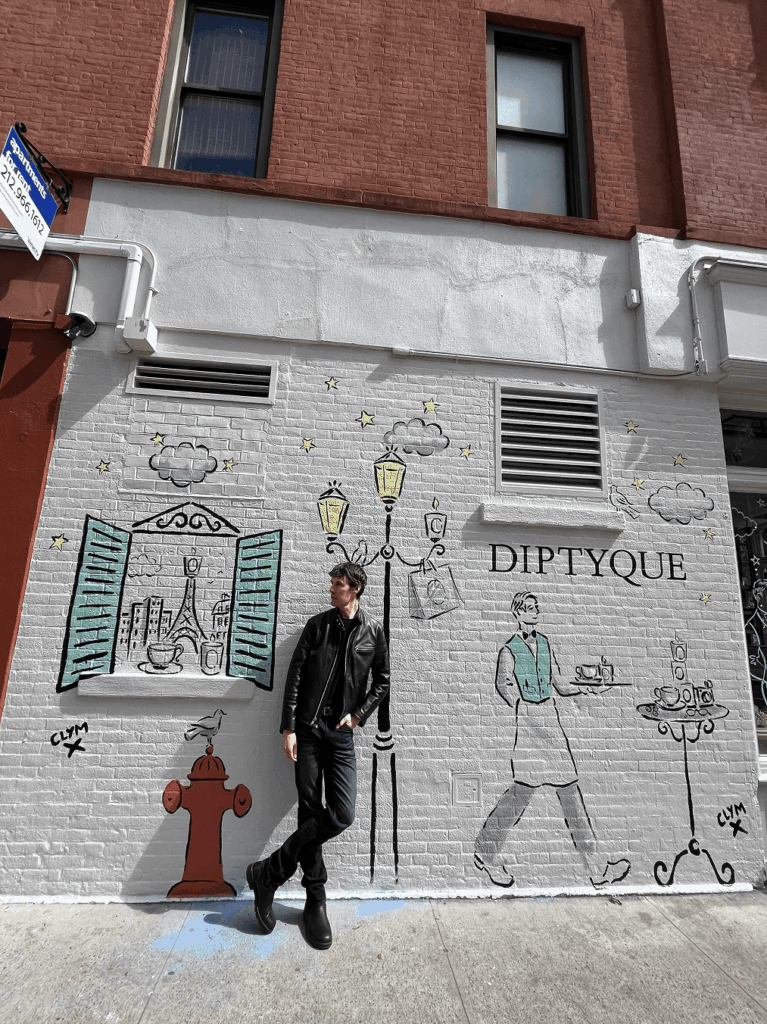
DIPTYQUE MURAL
Clym Evernden
illustrations for fashion
brand illustrations
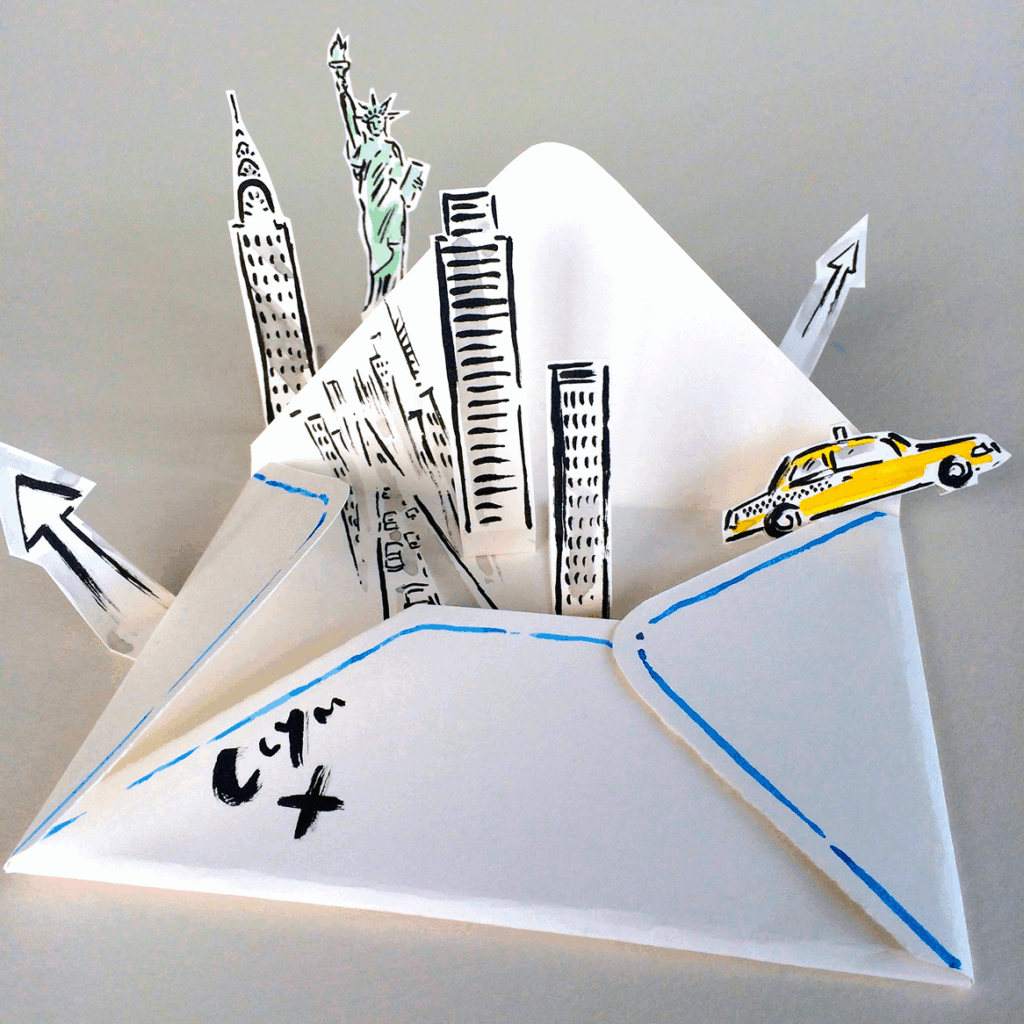
NEW YORK MAIL
Clym Evernden
illustrations for fashion
brand illustrations
DIPTYQUE WINDOWS 
Clym Evernden
illustrations for fashion
brand illustrations
CLYM EVERNDEN 
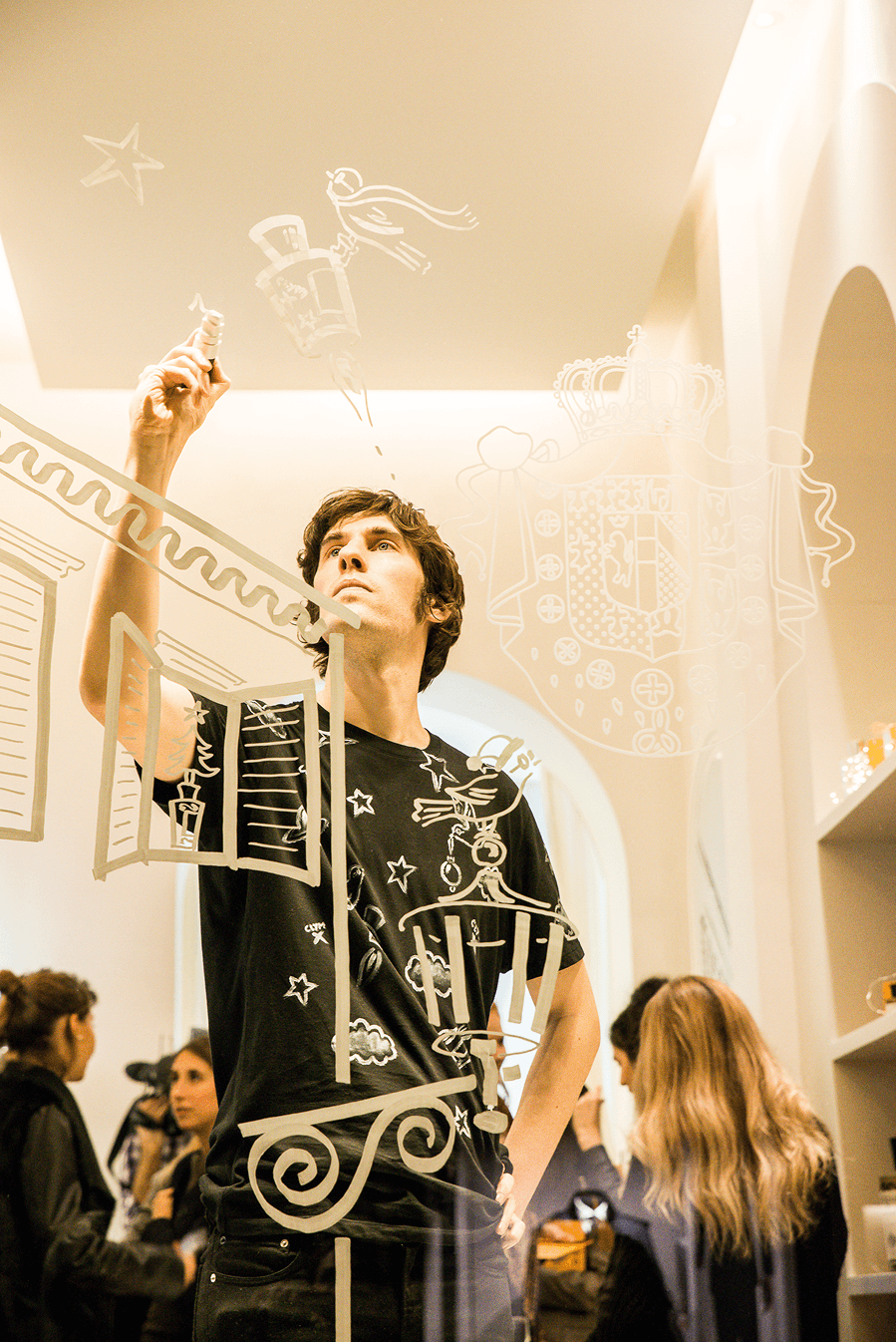
AMI EVENT LIVE PORTRAIT
Clym Evernden
illustrations for fashion
brand illustrations
THE CARLYLE CALENDAR
Clym Evernden
illustrations for fashion
brand illustrations
CLYM EVERNDEN
ROLLS ROYCE Event Portrait Totes

h: The worlds you create feel alive, almost cinematic, with characters drifting in and out of narrative moments. How do you choreograph these visual stories—and how do you recognise when a drawing has reached its natural conclusion?

CE: It depends what the artwork is. People often ask this question with the unfolding story videos I’m known for, where I fold up a piece of card and it slowly unfolds, revealing different scenes. For those I have to plan them. People sometimes ask, ‘are they totally spontaneous?’ I have tried doing that, but there has to be planning and there has to be an end point as well where the story is finished. I look at this and it’s done.

A lot of those kinds of things, for example videos, have to be planned out. I love making things for Instagram because you get to be your own art director, film director, choreographer, so you can make these little films or ballets or plays which only last 30 seconds. You could put a soundtrack with them. I think inside me there’s a frustrated film director or something where I love curating these little narratives that very much have a start point and an end point. In terms of my still artwork, I think a lot of my style has to do with quite an edited look. My line work just picks up on certain things, not all the things. I suppose I’ve learned how to pick what I need from something I’m looking at, whether it be in real life or in my imagination, and hopefully knowing when to close that off and not embellish it too much, because I do think there’s a real skill in editing.

h: Line work has become your unmistakable signature. What led you toward this distilled visual language, and at what point did you realise illustration would become your primary voice?

CE: I think it’s all coming from the same place in my creativity. Drawing has always been the tool that I developed from a very early age and feel most comfortable with. I was really interested in nature, so I was always drawing birds and animals and stuff, and I think that helped develop that skill. For me, drawing was a way, when I was young, to just get down what things I’d seen or things in my imagination. It wasn’t really that I was trying to make a nice drawing, it was just that I was trying to express myself. At the same time, I’ve always been really interested in music and I think that helped me explore the idea of something that’s kind of alive and has motion, because any kind of soundtrack in a film or a fashion show has this feeling of things happening and things evolving. Whether it be a still artwork or something in motion, I’m always seeing things in a cinematic way.

When people talk about or look at artistic mediums, sometimes they just look at it in terms of just the technique or in terms of its category, whether it be fine art painting or illustration or photography. But I think often successful art is just a little snapshot of something much bigger, and the artist is trying to pull all this energy into a little offering from something larger, and that’s just the medium that they felt most comfortable doing that in.

I have tried different things for various projects. I started a big global collaboration by launching it with a large mural on the outside of a building in New York. That was really fun. It’s kind of outside my comfort zone, but I really enjoyed it. I’ve tried collage or a more fine art approach with paints, but with this more illustrative style, I’ve found that it’s the approach that just flows naturally from head to hand. The other artistic medium that I absolutely adore and is something I go towards in galleries—I love doing as an amateur just with my phone—is photography. I just always get drawn to photos, taking observational photos myself of quite unexpected things like on the pavement or in the sky or whatever. But it’s also a medium that I get drawn to in terms of other artists. I’m also often really interested in photography.

With photography, what’s fun—especially with just using our phone to take photos and it’s such a quick thing—is just having that snapshot decision of just what to frame and what you are saying by what you frame. I took a photo of a bin the other day and it was just the angle I took the photo from that made it look like a face, with these two torn bits of paper that was stuck outside the bin. I took it in this way that highlighted that and would hopefully bring some humour to people seeing that.

h: Your work feels spontaneous yet precise, playful yet controlled. Do you approach each drawing with a clear intention, or do you trust a process of discovery and visual improvisation? Or Your collaborations span very different brand universes. How does your creative mindset shift when working across houses with distinct identities—and how do you maintain your own visual authorship within those frameworks?

CE: A lot of that is about understanding the brand DNA, and I studied fashion design at Central St. Martin’s in London. I have a background in understanding fashion and luxury brands, so it’s partly about understanding the feel of the brand and then bringing that into how I represent it in my artwork. I’m honoring that pre-decided vision that the brand has, but also bringing in my creativity and, hopefully, creating a successful union rather than dominating the brand with just whatever I want to do. I always find it fun to collaborate with brands so I can slightly bend my vision to fit their brand DNA.

I did a project with a leather accessory company where they were focusing on a menswear collection of bags, wallets, and accessories, and it was quite a tight colour palette. There, for example, I just used the colour palette—which was mostly primary colours: red, yellow, and blue—and only those three colours, then added my black ink line work around the products, suggesting very subtly figure shapes maybe wearing or carrying the bag or wallet. The product became the main focus, and again, it’s about editing it down. The vision was strong and also had a very edited, and for lack of a better word, stylish quality.

h: Illustration today exists within an ecosystem of constant visibility. What role does social media play in your creative life—as a platform, a pressure, or perhaps a form of sketchbook?

CE: It was vital for me when Instagram started. It’s so democratic in a lot of ways because anyone can show the world, depending on their following, what they’ve made. That was really good, because before social media, you’d have to write to people or try to get a meeting with them. Obviously, it’s a vastly different audience size now. I owe a lot to Instagram, because I think many people have learned about my work or contacted me for a commission via social media. I try not to let it become a pressure, because there’s this feeling that it should always be moving forward. It’s quite quick. Social media feels like it wants to be fed, wants something new, and wants you to post. But I’ve found a rhythm with it. I show when I’m ready to show something, and I also try to make things for myself as well as things for clients.

A lot of what’s on my Instagram, @clymdraws, is just creative things I’ve decided to do—ideas that come to me quickly when I’m in the gym, going for a walk, or somewhere else, and I think, I’m going to do that. Sometimes those things that I’ve done for myself inspire clients, and often the ideas they have and how they want me to collaborate with them come from something that I’ve just done for myself.

I’ve never had a disciplined approach to social media. I’ve always, hopefully, let my work shine the way I remember I started—when I first joined Instagram, I was just drawing people on the street. It was a time when there was a lot of growth in street style photography, with people like The Sartorialist and a few others taking photos of what people were wearing on the street. The focus moved from just seeing what’s on the runway or high-end fashion to how people looked on the street, which I really liked. So I’d sit outside cafes and just sketch people, and then post.

There wasn’t a strategy. Then I started going to fashion parties and drawing models backstage, and brands started taking notice. But I’ve always tried to keep a spontaneous and sparky live approach to how I work on social media. I shudder when I hear people say they have year-long planners for what they want to achieve from social media—it’s not me. Often, what’s nice is that you can overthink things so much, and actually the only thing that’s necessary is that you’re just yourself and let yourself shine through naturally. You can overthink and embellish things with processes or aspirations that aren’t really necessary.

h: Certain cities seem to carry a particular emotional weight in your work—almost like recurring protagonists. Are there places that have shaped you more deeply than others, and how have those cities influenced the atmosphere, characters, or narratives within your drawings? 

CE: In terms of location, I do love cities for the constant thoroughfare of people. I find people so interesting, and I’ve always been drawn to New York. I just love the energy. It can be quite a difficult city, it can be very challenging, but it can also be euphoric. For me, it’s somewhere where I’m constantly awestruck—not only by the people, but also by the architecture and the vertical feel of it. Italy as well—just that underlying volcanic energy, the people, the food, and everything. I also love London, where I live. I’ve always loved it. I’ve lived here for quite a long time now, and I love the layers of history in the city, and again, the people. I think Soho, for me, in London is one of the best places to people-watch.

I grew up in the countryside, observing animals and nature, but then in my teens, I shifted to being into fashion and people. I still love all of that. I love nature and those environments, but in terms of my work, I get a lot from city environments.

I think now I categorize it in terms of the more real observations I have—especially when working with brands—which come from my city experiences, and then the more imaginative visions, often in my unfolding story videos, which come from more natural experiences. They’re more imaginative, they’re more make-believe. That’s how I categorize those two environments.

I just think I’m in my New York rather than what the real New York is. I love it. I love it when people create something where you want to enter that world.

h: You’ve collaborated with iconic fashion houses such as Hermès and Louis Vuitton. What have these partnerships taught you about storytelling through fashion, and how does working within luxury contexts reshape your creative process?

CE: I really like the storytelling aspect of my work with fashion and luxury brands. I love being given the task of, “Here’s this season we are promoting,” or “Here’s this product we are launching, but we need to create this whole narrative around it, create a world around it, something engaging that gives it more of a stage set than just the product or just the launch.” I love being tasked with that. I think often, hopefully with clients, I’ve come up with ideas that they haven’t thought of, so part of the appeal of working with me is just that initial discussion—a creative discussion.

I actually really like what I do in terms of being given a brief. I’m not so much a fine artist where the work comes only from myself all the time. I actually like being given parameters. I love what I do with each client being slightly different—obviously, they are very different—and they have their own brand DNA, but they also have a very specific brief: We’re working with this thing or this launch; how would you create an artwork for the window, the store windows, or for a social media piece that links into the store windows that you’ve done? I like being given the restraints of a brief and thinking, What would you do with this?

Clym Evernden
illustrations for fashion
brand illustrations
GLENLIVET NYC
Clym Evernden
illustrations for fashion
brand illustrations
CLYM CUT OUT
Clym Evernden
illustrations for fashion
brand illustrations
THE FRENCH LAUNDRY INVITATION
Clym Evernden
illustrations for fashion
brand illustrations
JOSEPH PHELPS VINEYARD 
Photography by ALLISON WATKINS @ALLISONWATKINS.STUDIO
Clym Evernden
illustrations for fashion
brand illustrations
COURVOISIER L’ESSENCE
Clym Evernden
illustrations for fashion
brand illustrations
Courtesy of HERMES
Clym Evernden
illustrations for fashion
brand illustrations
LIBERTY BEAUTY Advent Calendar creation

h: Fashion imagery has become increasingly polished and algorithmic. Do you see illustration today as resistance to perfection—or has it become another aesthetic commodity?

CE: This question, in my experience, I don’t totally agree with. I do agree that imagery, especially on social media, has become increasingly—definitely increasingly—algorithmic. That frustrates me so much from a personal standpoint. I just don’t understand why, if I’ve looked at one thing, I then need to get a million more of the same thing. I like variety, and I think variety is healthier in life.

But in terms of fashion imagery and luxury brand imagery, I think there’s a rawness that people are becoming more and more interested in—maybe in the style of imagery, photography capturing things in a very ad hoc, quick way. I think that’s become more fashionable.

There was a time in the last decade or two when everything became very polished. Everything looked like a campaign, whether on Instagram or on a billboard, and it just became too clean and boring. I think people are now interested in bringing that idiosyncrasy, that “individual feel,” back into imagery and having it feel more raw.

I think illustration resists perfection. My artwork personally—I’ll always be trying to bring soul to things. I don’t believe that there’s such a thing as perfection, and I think it’s a really dangerous thing to chase, because I don’t think it exists—whether in the way something looks or in the idea that there’s some ultimate perfection. It’s kind of fascist, you know what I mean? I don’t really believe that it either exists or should be encouraged.

h: With AI now capable of mimicking drawing styles, what do you believe remains truly human—and irreplaceable—in your practice?

CE: I don’t really see it as a risk in terms of what I do. I think it’s something that will just live alongside what a lot of creative people do, and it’s not going away. I’ve already done projects where I’ve created the artwork, but the company or the brand will say, “Is it okay if we use this part of the artwork within this AI context?” I’ve already created the artwork, and they’re just manipulating something. I personally don’t think that AI can ever replace human-made creative work. It’s a bit like a famous singer—you can’t mimic someone singing by creating a fake version of them.

People will always be interesting. If it’s people looking at the creative output, then they’ll always be interesting in something people have made. If it was a robot trying to appreciate the output, then it might be more interested in the AI version. But as people, I think we will always be drawn to a live artist, where you can see how they’ve created something—their vision, and how it relates to their personality and character, whatever it is: a singer, how they express themselves. I think people will always be interested in other people.

I’ve found with my work, especially on social media, that the thing that engages people most is when they can see my hand moving and drawing, because they just love to see that—the creation of something. I think there’s a spark there that’s difficult to replicate via AI.

h: Art has the power to leave lasting imprints. Can you recall the first artwork that profoundly moved you—and the most recent one that shifted your perception?

CE: One of my earliest memories is when my mum took me to an exhibition at the Hayward Gallery in London, and I absolutely loved it. It was an exhibition called Field, by Antony Gormley, but it also linked to the idea of “feel.” It was an entire room of little clay figures just staring at the doorway where you walked in. There was a kind of wit there that I connected to, and it obviously had such an impact—it was so funny, but it also made a strong impression.

Most recently, I absolutely loved an exhibition by Bill Viola at the Royal Academy, which was incredible video art—almost transcendental, very expansive, euphoric videos of someone slowly lifting up from a slab of concrete, almost like a resurrection, or something very cinematic and moving. That was really incredible and left a lasting impression.

Words: ISABELLA MICELI

ISSUE 7

The new edition is here