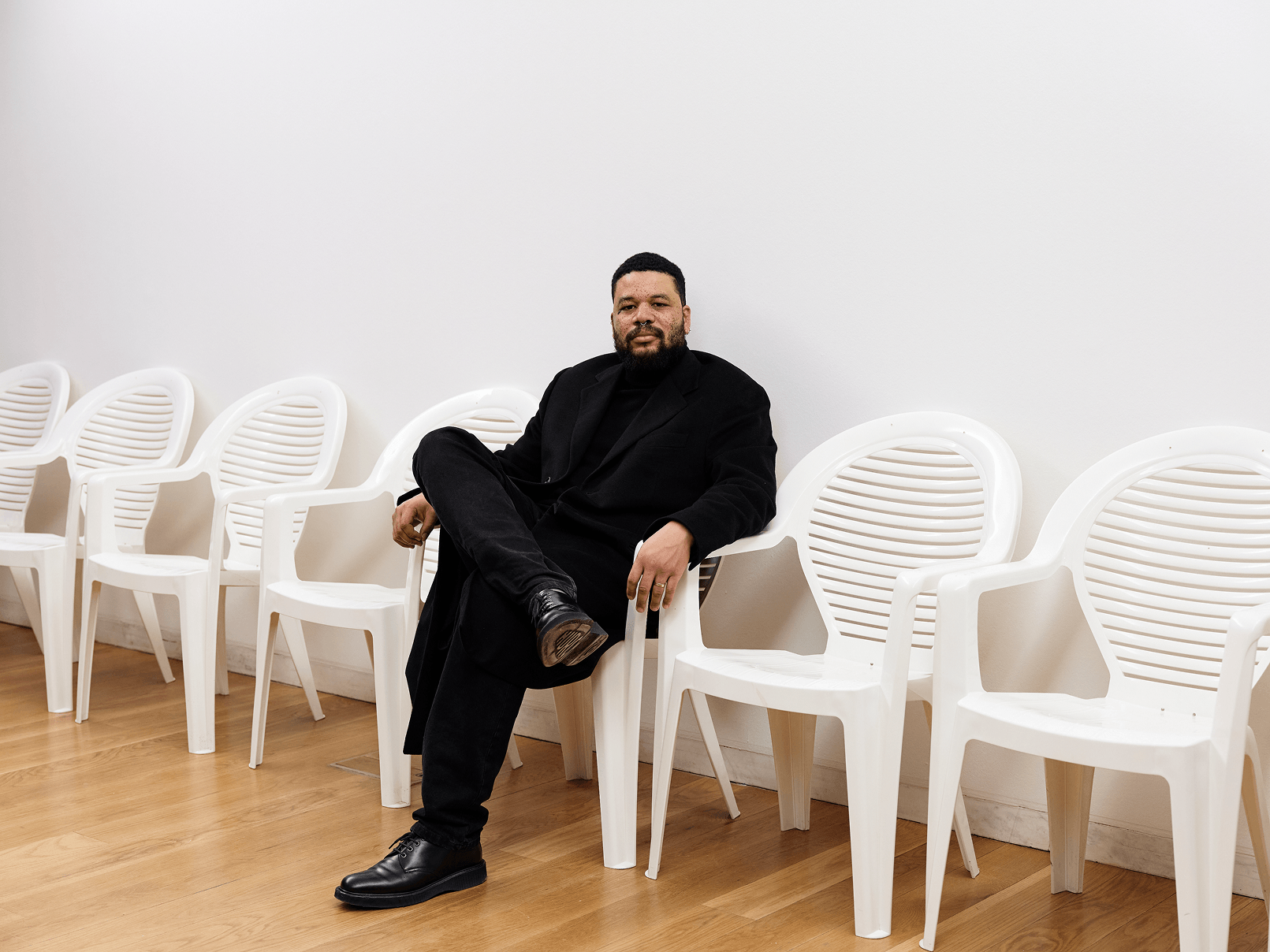
Colombian artist Oscar Murillo has exhibited his work around the world, including at prestigious institutions such as the Tate Modern in London and as part of the 36th São Paulo Biennial. He has earned acclaim for an inventive practice that draws on both traditional techniques and experimentation to reflect broader social commentaries on the human experience.
Murillo’s output ranges from large-scale paintings and installations to long-term projects and socially engaged art, most notably Frequencies, which involved schools all over the world and invited students to draw and mark on blank canvas fixed to their school desks. Ongoing for over a decade, the resulting archive was later compiled into a book of the same name, published in 2024. Murillo’s latest solo exhibition at the Kurimanzutto gallery in Mexico City, el pozo de agua, featured paintings and installation works that propose a well of shared energy, embracing the dialogue between material, mark-making, collectivity and art.
Until August 9th of 2026, his exhibition ‘Collective Osmosis’ will be on view at DAS MINSK and the Museum Barberini in Germany, serving as the inaugural collaboration between the two institutions. In this interview, Oscar Murillo opens up about the tension between aestheticism, beauty and social contradiction, and the power of collective ‘mark-making’ as a way of registering the complexities of our time.
hube: Looking back, when did art first become meaningful to you? Was creativity part of your everyday life growing up, or did it emerge later—perhaps as a response to movement, displacement, or change?
Oscar Murillo: What became formalised as art was always meaningful for me. Before I was uprooted from my village in Colombia, I loved immersing myself in construction sites after school. When I was seven, my family—my parents and younger sister—moved to the newest part of the village. We were one of only about five houses that were newly constructed, so as the neighbourhood grew, my after-school recreation was always helping out on construction sites. I think that experience was instrumental.
Later, upon arriving in London at the age of eleven, I felt the severity of the cultural shift. I grew up among mango trees and rivers and found myself in social housing in East London. Drawing became the only vessel that carried my depression and nostalgia. The early years on construction sites and the friendships left behind were suddenly situated on a kitchen table next to a pirate radio. So, creativity was always meaningful; it just shifted.
h: When you begin a new work, what usually comes first: an image, a feeling, a question, or a situation? And when doubt or resistance enters the process, what helps you stay with the work rather than abandon it?
OM: My former art history professor, Patricia Bickers, was an inspirational figure—she was the person who helped me understand how to bridge the gap between art and life, between society and politics, and find the gaps within those universes where I, as an artist, can exist. The practice becomes a method, a constant situation; doubt and resistance are always allies.
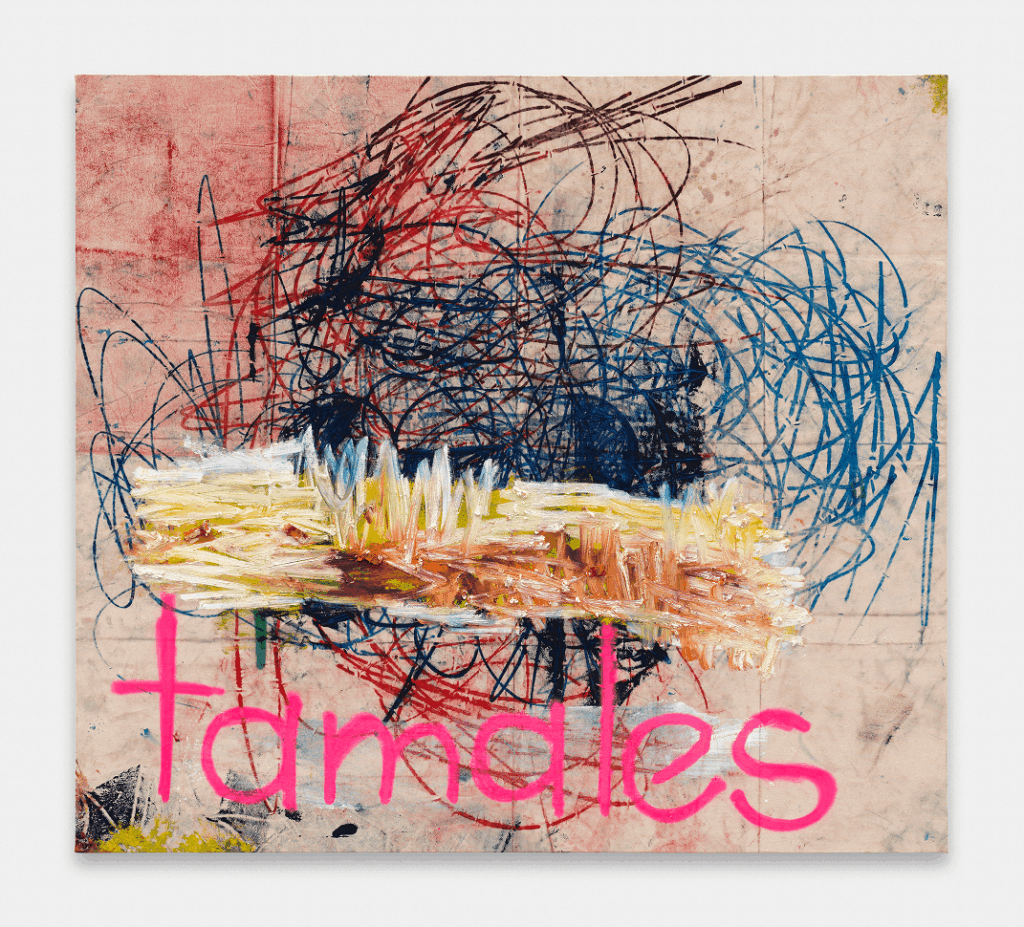
tamales (Drawings off the Wall), 2012, oil, oil stick, graphite and dirt on canvas, 170 × 190 cm.
Courtesy of the artist © OSCAR MURILLO. Photography by TIM BOWDITCH & REINIS LISMANIS
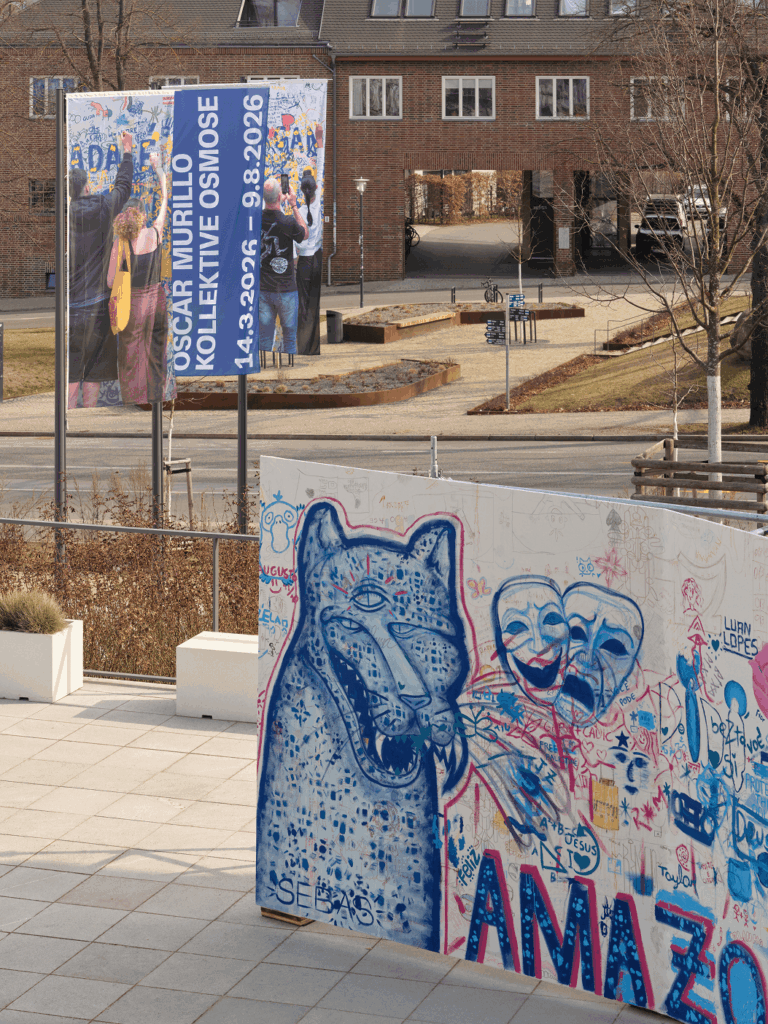
Photography by TIM BOWDITCH
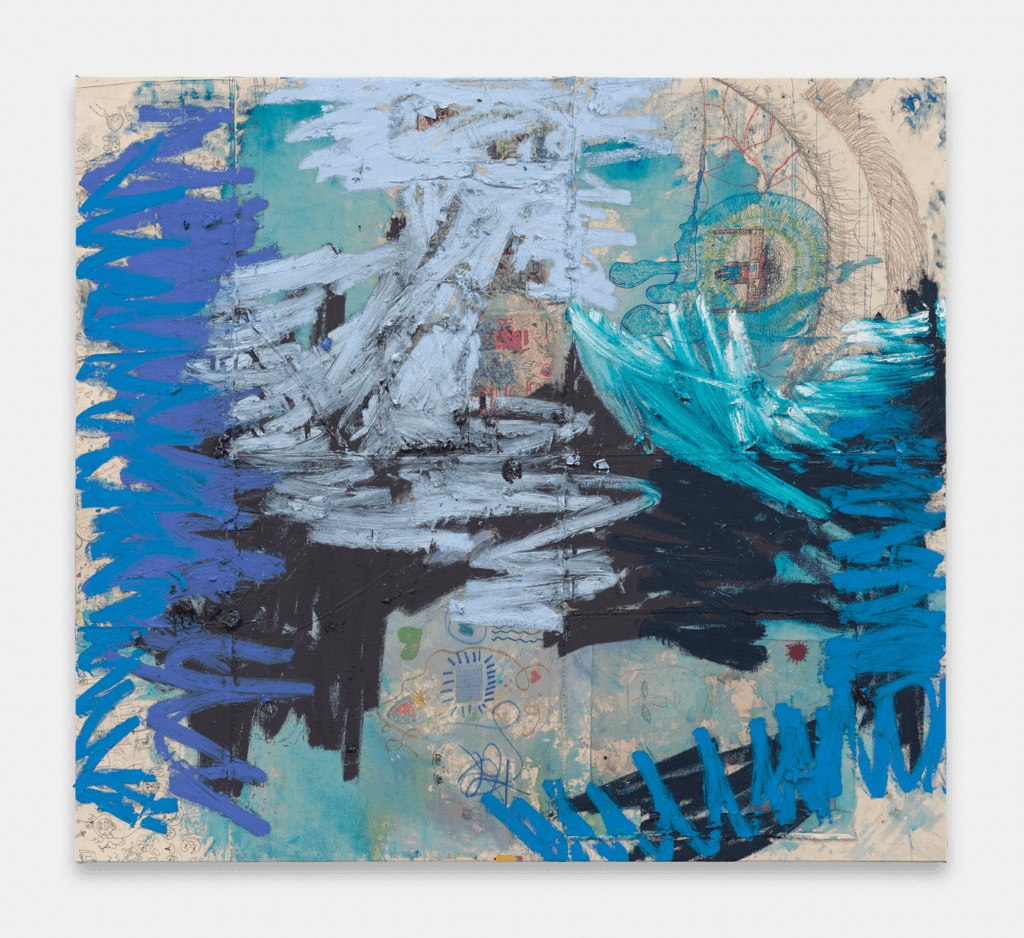
disrupted frequencies (United States, Japan, Colombia), 2013–2025, oil, oil stick, ballpoint pen, fountain pen, graphite, felt tip pen, highlighter pen, permanent marker, paint, crayon, staples, natural pigments, debris, and other mixed media on canvas, 180 × 200 cm.
Courtesy of the artist © OSCAR MURILLO. Photography by TIM BOWDITCH & REINIS LISMANIS
Photography by TIM BOWDITCH

Photography by TIM BOWDITCH

Photography by TIM BOWDITCH

Photography by TIM BOWDITCH
h: Frequencies places art inside a classroom, embedding canvases into school desks. How has your own experience of education shaped this project? Do you see learning as a space of freedom, control, discipline—or all of these at once?
OM: This question has many layers that do not particularly interest me. Education is, of course, a fundamental part of life, whether in the classroom or on a construction site. But Frequencies is not about education; it’s about utilising the universal consistency of a school’s infrastructure to record. Frequencies engages with the porosity of a young human brain to register its environment. The canvas picks up soil, dust and sedimentation through the simple gesture of touch, to the scrawling of cultural statements, however trivial or profound. The students are vessels to register the environment.
h: Movement between countries and cultures has been central to your life. How has migration shaped not just what you make, but how you think about belonging and visibility?
OM: This question makes me think about the Dutch-American painter Willem de Kooning, who was stowed away on a British freighter in 1926, arrived in Virginia, and later settled in New York. When he first arrived, he survived by working as a house painter and decorator. Movement and migration are part of us all. I am not special when it comes to a cultural shift—but the tamales that my aunty cooked when I was growing up in London extinguished some of the nostalgia for the village. Eventually, it all became art, just as Warhol’s Catholic upbringing did.
h: In Social Cataracts, you reference Monet’s Water Lilies to speak about contemporary blindness and selective attention. What drew you to Monet as a point of departure, and how do you think historical beauty can be reactivated to speak about present-day discomfort?
OM: I love modernist painting—Henri Matisse, Marc Chagall, André Derain and, of course, Claude Monet. Fauvism, the Blue Rider group, and Impressionism were all reasons I would spend hours listening to Colombian pirate radio and getting lost in drawing and painting most evenings after school. Social consciousness oppresses this childhood love, giving way to more immediate realities. Scrawling the word ‘tamales’ on a canvas just makes it more personal. It was upon reading of Monet’s anguish—suffering from cataracts—that I discovered a reconciliation between darkness and beauty, between suffering and empathy.
Everything fell into place when I made a trip to Paris to see Monet’s immersive Water Lilies. They were impossible to see properly. The room was crowded, and most people were just taking pictures; nobody was actually looking at art. This made me feel sad, and I thought of Monet’s frustration at losing his sight. I also wondered about the quality and virtuosity of these paintings—was it achieved as a result of his troubled vision? In every Social Cataracts painting, I leave messages; I scrawl words that gradually get lost in the layers of gestural marks. This is perhaps my message to Monet and a message to the viewer—something subliminal.
h: Presenting Social Cataracts at Art Basel while reading Parque Industrial: romance proletario created a strong tension between privilege and precarity. Did you experience that moment as a confrontation, a contradiction, or a necessity—and how do you navigate such tensions in your practice more broadly?
OM: It was such a tremendous moment filled with many contradictions. The night we finished the installation was the same night Gustavo Petro, Colombia’s current leftist president, won the election in a landslide. My work was installed at the Union Bank of Switzerland (UBS) in its Basel branch—a bank owned by BlackRock, Vanguard and Norges Bank.
These contradictions and confrontations are ingested constantly. It’s like meeting the owners of Colombina, the sugar plantation and candy factory where my parents worked as labourers for over fifteen years. I didn’t meet them in La Paila, Colombia, where the factory is based, but years later with the Rubell family in Miami in 2012. That encounter was instrumental for my 2014 show The Mercantile Novel at David Zwirner in New York. Or hearing stories from collectors of my paintings—the glitch that happens when their Mexican gardener stands in front of a painting with the word ‘tamales’ or ‘burrito’ scrawled on it. This is a calibrated infiltration through the love of aesthetics, and an acknowledgment of the contradictions that define life, peril, and destruction.
h: You’ve mentioned that you don’t like to look at your work once it’s finished. Is this a form of release, avoidance, or trust in the process—and does this attitude extend to how you relate to the past in your own life?
OM: It is because I don’t like art at all. So this goes back to the first question: I could have become a construction worker, had I stayed in my village. A construction worker just moves on; they don’t contemplate. The body is not there to muse over things. You are there to work or, in my case, to process the energy and work.
h: Your upcoming exhibition Collective Osmosis presents a series of works engaging with Claude Monet while inviting viewers to participate through their own ‘mark-making’. As a work concerned with democratisation, water, and obscurity, it feels in some ways like an immersive culmination of themes you’ve explored before. What has excited you most about this project, and what do you hope viewers will take from the experience?
OM: Working in Germany again, in the epicentre of Europe, in the current turbulent and socially charged environment, is a fascinating opportunity to witness. Through individual marks made in a collective context, the show becomes a repository of all this energy that will be produced across different parts of the country. What are people channeling during these challenging circumstances?
h: How would you describe the future in 3 words?
OM: We positively hope.

(untitled) scarred spirits, 2025, oil, oil stick and graphite on canvas, 220 × 300 cm.
Courtesy of the artist © OSCAR MURILLO. Photography by TIM BOWDITCH & REINIS LISMANIS

Photography by TIM BOWDITCH

surge (social cataracts), 2025, oil, oil stick, and spray paint on canvas, in three parts, overall 250 × 750 cm, detail.
Courtesy of the artist © OSCAR MURILLO. Photography by TIM BOWDITCH & REINIS LISMANIS

A song to a tearful garden, part of the 36th SÃO PAULO BIENNIAL, Not All Travellers Walk Roads—Of Humanity as Practice, Ibirapuera Park, São Paulo, Brazil,
September 6, 2025–January 11, 2026
Courtesy of the artist © OSCAR MURILLO. Photography by REINIS LISMANIS
Words: ISABELLA MICELI
