“Culture is never just a matter of ownership, of borrowing and lending with absolute debtors and creditors.”—Edward Said
Few thinkers have articulated the entanglement of culture and power more clearly than the Palestinian American academic Edward Said. Museums, he understood, are never neutral repositories; they are stages upon which civilisations narrate themselves into history. For centuries, that arena was overwhelmingly European. Masterpieces were gathered, categorised, and canonised within imperial capitals, their arrangement reinforcing a particular vision of universality—one shaped largely from the West outward. The so-called “universal museum” emerged not simply as an intellectual project, but as a geopolitical one: a system of classification that mirrored, and in many ways legitimised, imperial reach. And as English art critic and novelist John Berger observed, what we see is always contingent on how it is framed. The museum does not simply preserve objects; it produces the conditions under which they are understood. In this sense, it does not merely reflect culture—it actively constructs its own canon.
The establishment of the Louvre Abu Dhabi in 2017 marked a deliberate intervention of that historical framework. Through its landmark partnership with the Louvre Museum, the United Arab Emirates didn’t simply import a brand; it repositioned the very premise of universality within a region long positioned as a subject rather than an author of art-historical discourse. What is at stake is not only geography, but authority—who tells the story of civilisation, and from where. In the span of a single generation, the Gulf has undergone a transformation unprecedented in pace, and continues at speed to ‘2030’. A region once defined externally by oil reserves, maritime trade, and strategic geography now asserts itself through more intellectual institutions of scholarly aesthetic exchange. This cultural acceleration is neither incidental nor ornamental. It is strategic—an effort to translate economic modernity into knowledgeable and symbolic permanence. Louvre Abu Dhabi stands at the centre of that transformation, not as an accessory to national identity, but as one of its principal instruments.
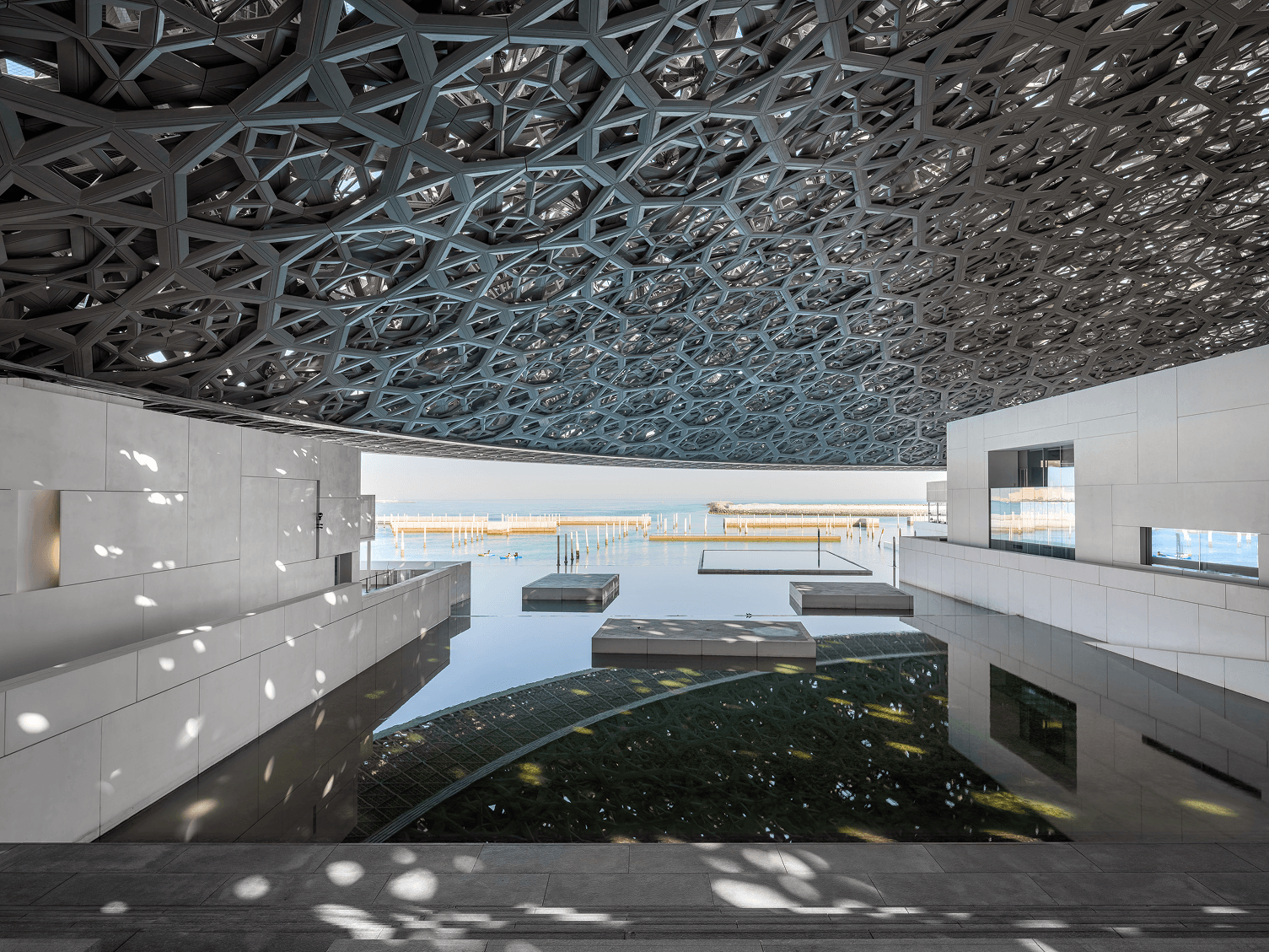
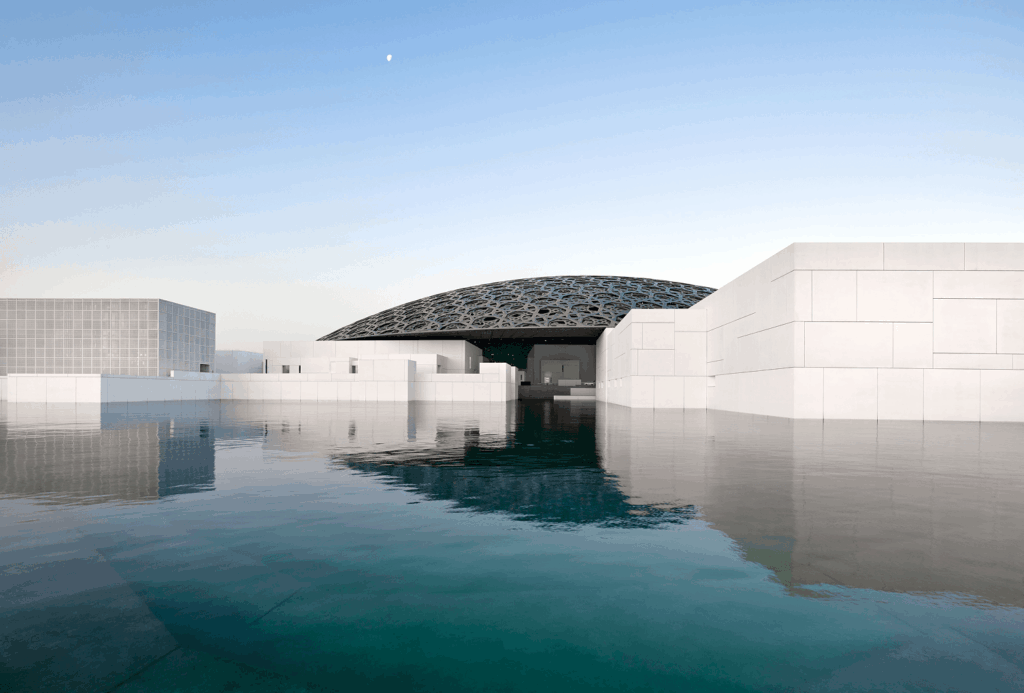
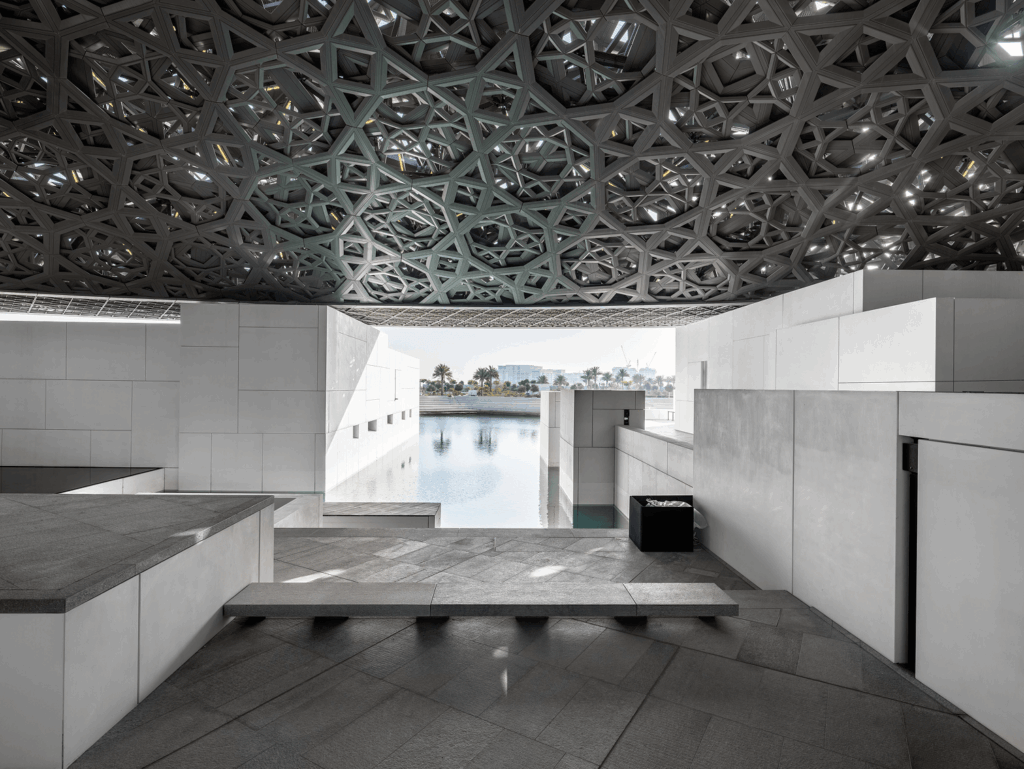
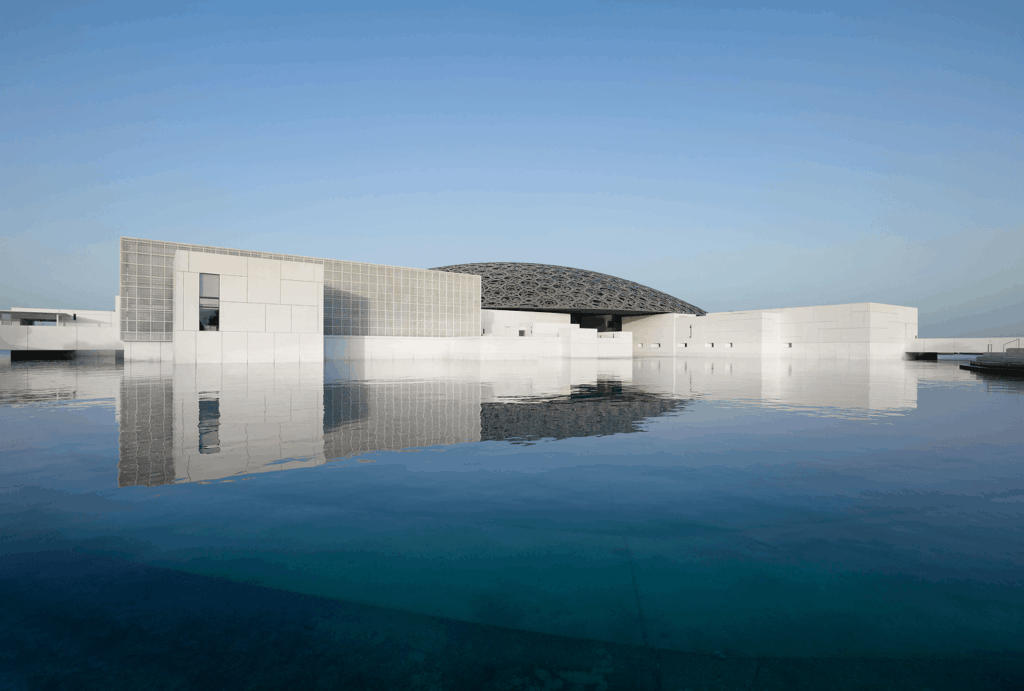
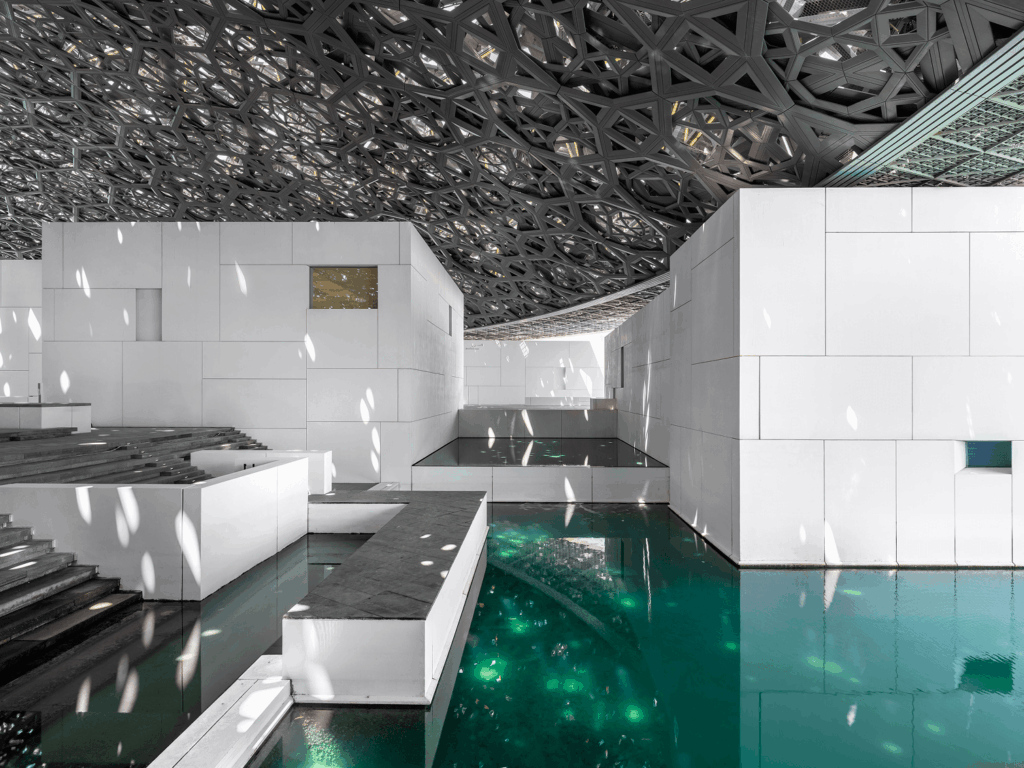
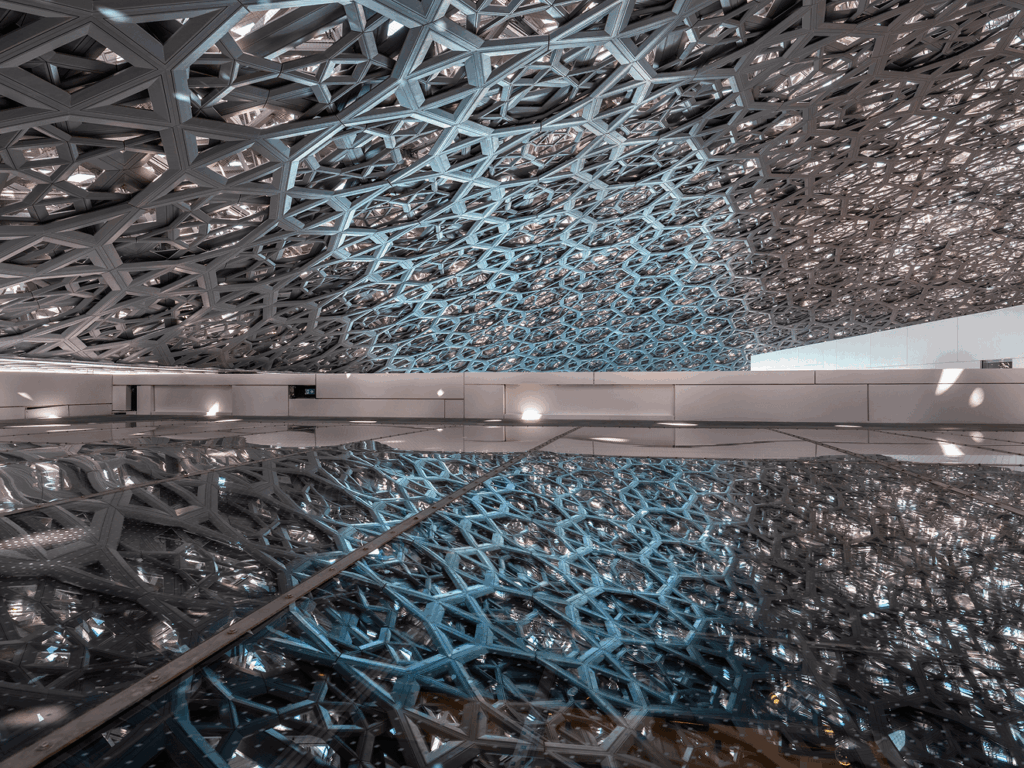
Designed by Jean Nouvel, the museum’s vast perforated dome filters the Gulf sun into what he famously described as a “rain of light.” The effect is both sensory and conceptual. Light appears broken, is refracted and dispersed—falling in shifting constellations across stone and water. The architecture evokes the spatial memory of the medina—porous, layered, communal—while maintaining the clarity and order of the modern museum. It is at once shelter and aperture, of enclosure and openness. In this sense, the building itself performs the museum’s central proposition: that culture is neither fixed nor singular, but filtered through context, geography, and time.
Inside, the curatorial extends beyond the architectural. Through agreements with French institutions, artworks move between Paris and Abu Dhabi, yet their arrangement resists simple transplantation. Rather than reaffirming a linear, Eurocentric chronology, the galleries unfold as a series of thematic constellations. Civilisations are placed in proximity to one another, rather than hierarchical. A Buddhist sculpture is in touching distance to a Gothic Madonna; Islamic manuscripts converse with Renaissance portraiture; African artefacts are not relegated to ethnographic margins but placed within a shared narrative of making and meaning. Europe remains present—necessarily so—but it is no longer a singular axis. It becomes one voice among many, as the world is reimagined without boundaries. This repositioning is subtle, but its implications are profound for our understanding of cultures and the characteristics of life on Earth. The universal museum, historically synonymous with Europe, is envisaged from the other side of the world. The story of civilisation is no longer told solely from the banks of the Seine, but from the shores of the Arabian Gulf—a geography historically defined by exchange, circulation, and encounter. For Europe, the project represents both continuation and concession. The Louvre’s name extends its cultural diplomacy, reinforcing France’s institutional authority. Yet its migration also signals an acknowledgement: cultural capital is no longer geographically fixed. The Gulf’s investment in culture—from biennales and art fairs to archives and research centres—reflects a broader ambition to contribute to the visual experience. A soft power certainly, culture is reflective of a civilised society, that is seen and sought out by its closest and furthest countries. Where oil economies speak to extraction, cultural institutions speak to duration. They are designed to outlast the conditions that produced them.
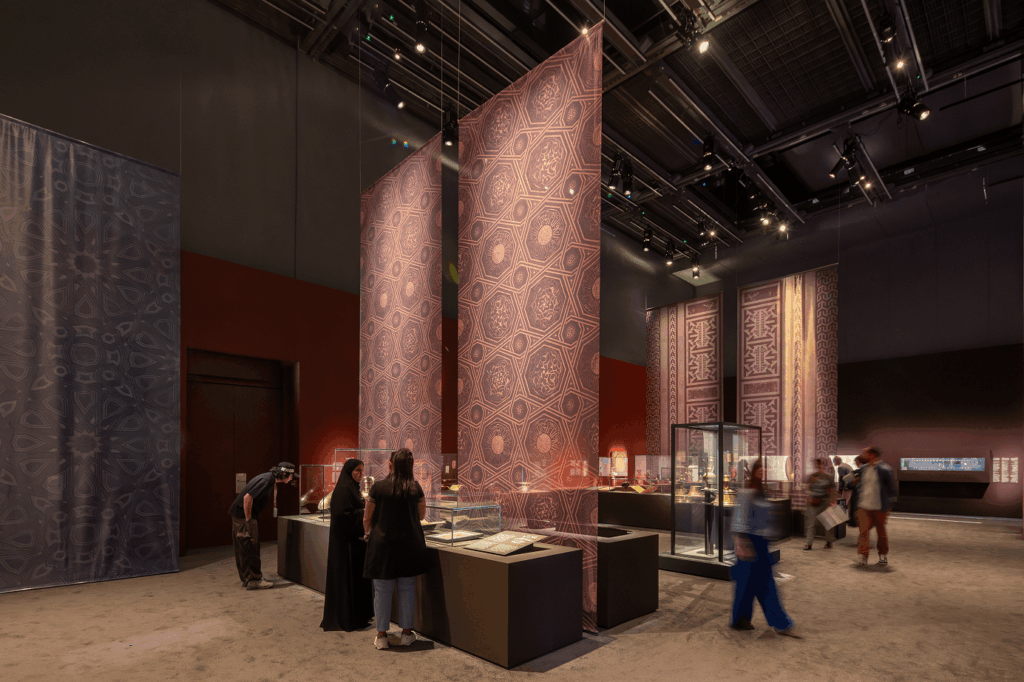
If the permanent collection articulates a philosophical proposition, the museum’s major exhibitions test that proposition in practice. It is through temporary programming that Louvre Abu Dhabi most clearly recalibrates historical perspective, shifting attention across geographies and temporalities with increasing confidence. Among the most intellectually compelling of these exhibitions was Mamluks: Legacy of an Empire (17 September 2025—25 January 2026). Long before globalisation entered contemporary discourse, the medieval Mediterranean was already a theatre of movement. Merchants traced maritime routes linking Venice to Alexandria and beyond; scholars travelled between courts; artisans and objects circulated across vast territories, carrying with them techniques, motifs, and ideas. The Mamluks themselves embodied this condition of mobility. Originally military slaves, displaced and severed from their origins, they rose to sovereignty in Egypt and Syria, constructing a state defined not by lineage but by meritocratic hierarchy, disciplined spectacle, and strategic patronage. The exhibition resisted the tendency to treat the Mamluk Sultanate as a peripheral chapter within Islamic history. Instead, it positioned it as a cosmopolitan force whose networks extended across the Mediterranean, Anatolia, the Levant, and the Indian Ocean. Cairo emerged as a crossroads civilisation—a hub through which trade, diplomacy, and scholarship converged. Venetian merchants negotiated access; Byzantine envoys exchanged gifts; Mongol influences filtered into material culture. What unfolded was not an isolated court, but an interconnected system.
The objects themselves articulated this system with remarkable clarity. Calligraphic Qur’ans, enamelled mosque lamps, and inlaid brass basins were presented not as decorative artefacts, but as instruments of political authorship. For the Mamluks, legitimacy was inseparable from visibility. Power had to be inscribed, illuminated, and publicly performed. Mosque lamps bearing the names of sultans and emirs functioned as both devotional objects and declarations of sovereignty. Metal basins, shimmering with scenes of courtly life, narrated authority through ornament. Geometry and script formed a disciplined visual language—one in which surface coherence became synonymous with control. Crucially, the exhibition foregrounded circulation and exchange rather than isolation. It aligned seamlessly with the museum’s broader mission: to present cultures not as sealed identities, but as interdependent currents; one world. Islamic civilisation was not framed as an adjunct to a European narrative, but as a central protagonist within a shared Mediterranean ecology. The implication was subtle yet decisive: history, like commerce, moves in multiple directions. The Louvre Abu Dhabi appears to be rewriting the wrongs of history, not only to introduce and include the region, but to illuminate the world beyond what we already know.
If The Mamluks exhibition articulated a world structured by coherence—by inscription, order, and the visibility of power—the museum’s subsequent exhibition, Picasso, the Figure (21 January—31 May 2026), turns toward rupture. In the hands of Pablo Picasso, the human body ceases to be a site of stability and becomes a field of uncertainty instead. Faces fractured, limbs appeared from crooked lines criss-crossing his canvases, and perspective collapsed into competing planes. The exhibition traced Picasso’s sustained return to the figure, not to see it as whole, but with cubist eyes, of his desire to dismantle it—to expose the body as constructed, contingent, and constantly changing. Placed within the Louvre Abu Dhabi’s broader curatorial framework, this fragmentation acquires a new approach. Seen alongside non-European traditions—where figuration often operates symbolically, hieratically, or cosmologically—Picasso’s distortions no longer appear as violent acts of modernist invention. Rather, they emerge as part of a longer, entangled history of representation. European modernism, long positioned as a radical rupture, reveals itself as dependent upon visual languages drawn from African, Oceanic, and Iberian contexts—appropriated, translated, and reconfigured within the avant-garde, often without acknowledgement.
What has historically been framed as innovation begins, in this context, to read as reconfiguration. Picasso’s fractured bodies do not simply break from tradition; they reassemble fragments of other visions into a new, destabilised form. The modernist claim to originality is here unsettled. Becoming part of a broader continuum—one in which influence flows across cultures, though not always on equal terms. The contrast with the Mamluks is instructive. Where Mamluk objects assert authority through reason and logic, Picasso’s figures wrestle that certainty away to reveal his contoured creatures. The Renaissance ideal of proportion gives way to a body unsettled and suffering from modernity, psychologically and physically. In this juxtaposition, the museum stages not a linear progression, but a dialectic. Coherence and rupture coexist, each illuminating the other.
Such programming reflects the leadership that has shaped Louvre Abu Dhabi through its formative years. The recent departure of Manuel Rabaté marks the close of a foundational chapter defined by institutional consolidation, diplomatic calibration, and the careful articulation of a curatorial voice. The forthcoming appointment of a successor will signal the museum’s next phase—one in which its identity may shift from establishment to assertion. At a museum built upon cross-continental collaboration, leadership is never merely administrative; it is ideological.
The timing of this transition is significant. As the Gulf’s cultural ecosystem matures—with biennales, collections, and research initiatives gaining depth—Louvre Abu Dhabi must navigate its dual identity with increasing care. It can no longer rely solely on the authority of the Louvre name. It has to continue to define what it means to stage a universal museum from this geography, under this light. The speed of this transformation continues to invite scrutiny. Europe’s great museums evolved over centuries, shaped by Enlightenment thought and imperial expansion. The UAE’s cultural district has emerged over recent decades. Can depth accompany acceleration? Louvre Abu Dhabi suggests that it can—though not without tension. Its strongest exhibitions balance scholarship with scenography, resisting spectacle for spectacle’s sake.
Yet tension remains embedded within the institution’s structure. Contractually and symbolically linked to France, the museum operates within a framework that inevitably raises questions of autonomy. Can a museum so closely tied to European institutions articulate a fully independent regional voice? Or does validation continue to circulate along familiar axes? The answer lies increasingly in its framing of a new narrative. By foregrounding exchange routes—the Silk Road, Indian Ocean circuits, trans-Mediterranean networks—the museum reframes universality as relational rather than hierarchical. Europe is neither displaced nor dominant; it is one strand of a wider weave of cultural production, and within Nouvel’s building, light itself becomes metaphor. Illumination is filtered, broken, shared. There is no single source, no singular perspective. If Said argued that culture cannot be reduced to ownership, Louvre Abu Dhabi extends that argument into spatial and curatorial form. Universality, here, is not a fixed condition, but a negotiation—an ongoing process shaped by movement and encounter. In the shifting architecture of global culture, Louvre Abu Dhabi was never intended as Europe’s outpost in the Middle East, but as a hinge—a site where authority and historical memory are renegotiated in real time. The birth of the Louvre in the United Arab Emirates was not merely an act of expansion; it was a declaration that the stage upon which civilisation narrates itself has widened to the rest of the world. Under the Gulf sun, filtered through patterned steel, the past is no longer simply preserved—it is refracted, contested, and being rewritten.
Photography by DARYLL BORJA-SEEING THINGS
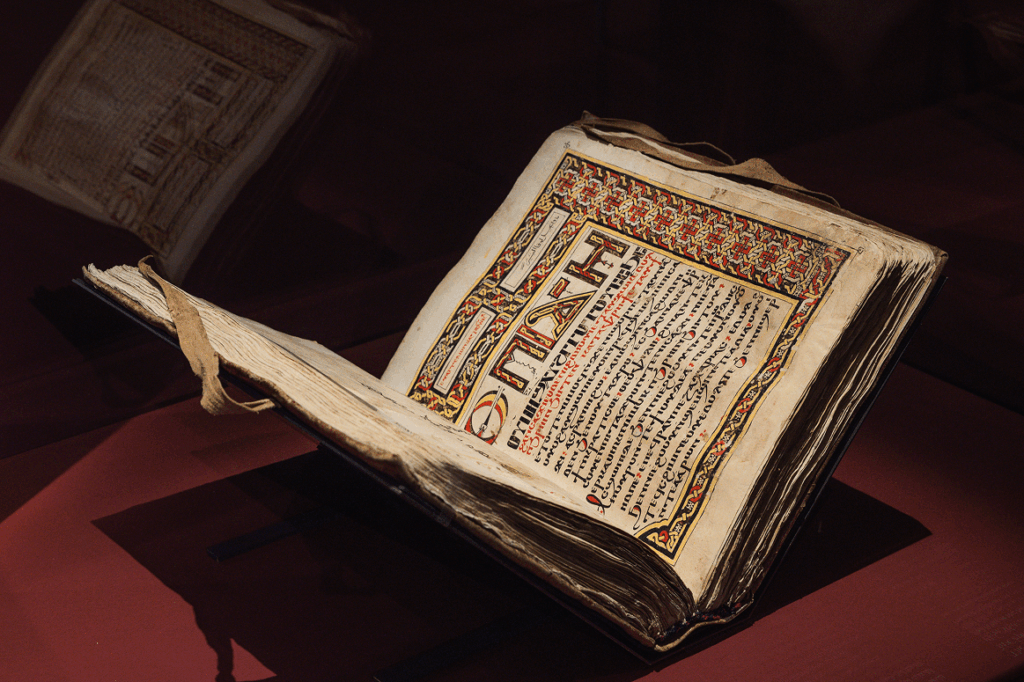
Egypt, Wadi el-Natrun. 982 (Year of the Martyrs) /1266 CE. Ink and pigments on paper
Abu Dhabi, LOUVRE ABU DHABI
Courtesy of DEPARTMENT OF CULTURE AND TOURISM–Abu Dhabi. Photography by DARYLL BORJA-SEEING THINGS
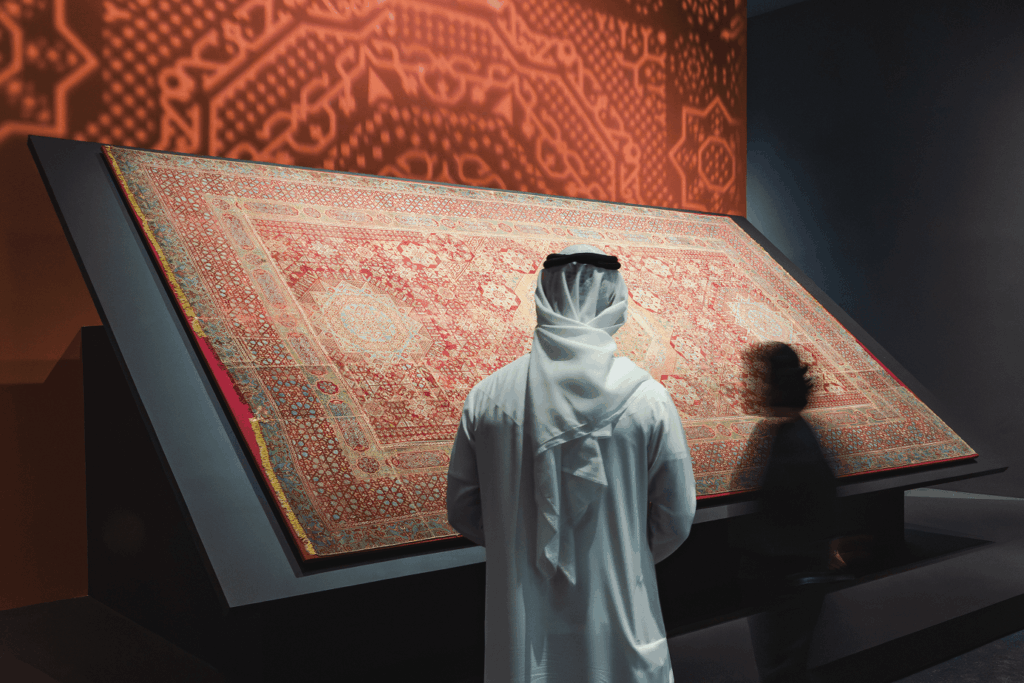
Egypt, Cairo. Second half of 15th century. Knotted wool
Abu Dhabi, LOUVRE ABU DHABI
Courtesy of DEPARTMENT OF CULTURE AND TOURISM–Abu Dhabi. Photography by DARYLL BORJA-SEEING THINGS
Words: RAJESH PUNJ