Photography courtesy of PACE PRINTS
Photography courtesy of PACE PRINTS
Photography courtesy of PACE PRINTS
Before ruin became a corrosive condition of the present, it was already being rehearsed in the fragmented languages of modern art. Visible in the densely covered surfaces of American Jackson Pollock’s work, the painting was no longer confrontational, but laid flat on to the studio floor, exposed to the energies and elements of the artist—broken into impulsive gestures that fall like bodies on top of one another, as an accumulation of grievances suffocating the surface of space, and reality out of reach. Whilst for his contemporary, Robert Rauschenberg, the canvas itself gave way to the world, absorbing its rubble and ruin, as fragments of newspapers, fabric, debris and the readymade—were applied onto a surface that was at once honest and undone. In both, their materials ceased to sit quietly; instead, appearing entirely fractured, bruised, broken into new incarnations of meaning. It is within this lineage of breakdown and recomposition that Leonardo Drew can be situated, extending their radical treatment of matter into a more explicitly sculptural and regenerative terrain.
Images of wreckage and ruin have, as French conceptualist Christian Boltanski predicted, come to surpass idyllic landscapes and lifestyle magazines as the dominant visual register of modernity—cities reduced to rubble, architectures split open, and histories erased in real time. Yet for Drew, the energies of damage and destruction are inseparable from those of creation; they are necessary conditions through which the world might be seen anew. Ruin, once the distant subject of painting, now occupies the present as an unflinching force. It is no longer a metaphor alone, but condition—for vast swathes of displaced lives. And yet, as Russian anarchist and philosopher Mikhail Bakunin argued, the urge to destroy is also a creative urge, and as the English writer Graham Greene observed, destruction itself may be understood as a form of creation. Read together, these propositions are less a romantic call to arms than an invitation to think through our opposing values—suggesting that within the act of undoing lies a latent, if uneasy, potential for renewal. Within this climate of violence, the question persists: what remains possible after the break? What forms of making can emerge from a world so visibly unmade?
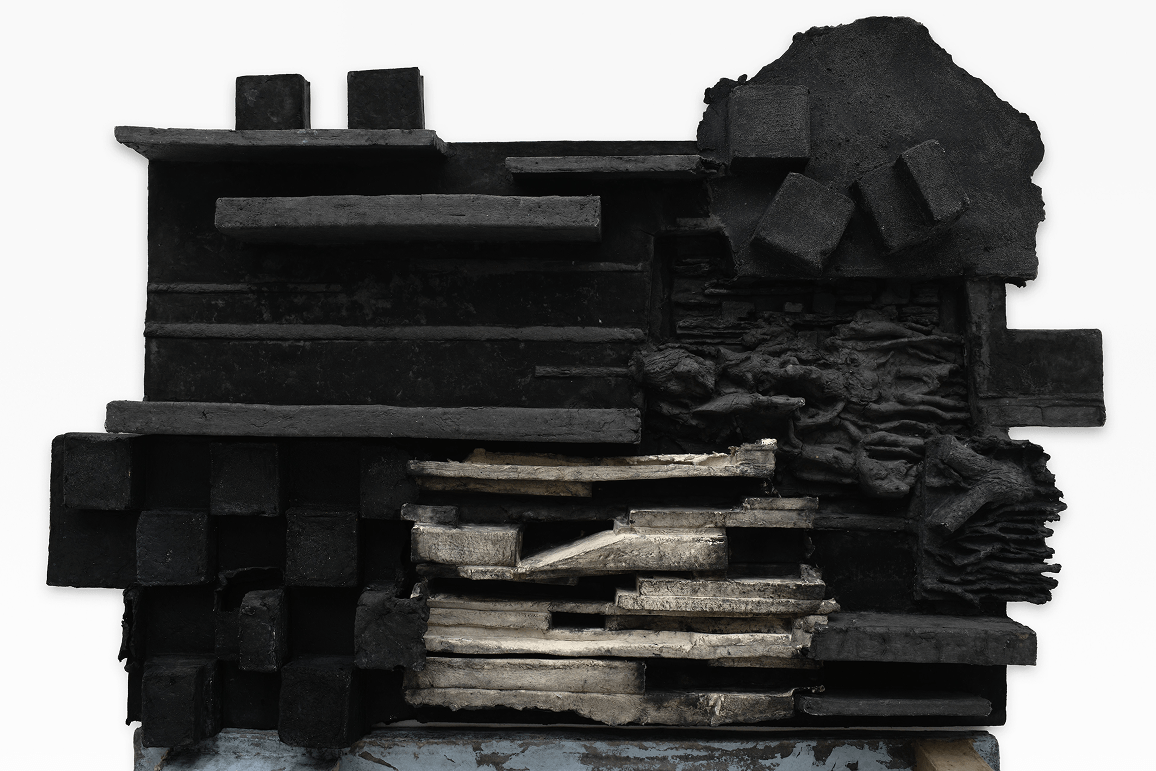
In Drew’s work, ruin is rarely an end point; it is a condition of possibility. Across two concurrent exhibitions—Alchemy at the Bruce Museum (28 November 2025 – 10 May 2026) and a solo exhibition project at Pace Prints (19 March – 25 April 2026)—he turns to paper not as a passive support, but as a site of transformation. Here, material is broken down, layered, and reconstituted into something that resembles both landscape and residue. Paper becomes both medium and environment—torn apart, remade, and, in its reincarnation, made to speak again.
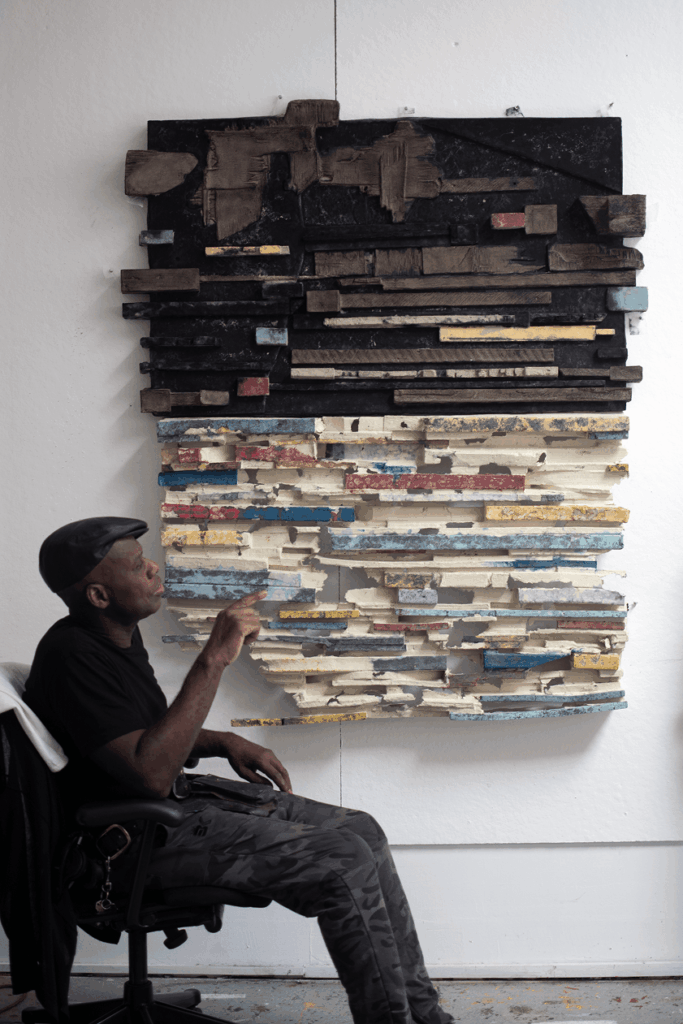
In the artist’s hands, paper refuses its historical role as a surface of inscription. It is not the bearer of image, but its very condition—fibrous, unstable, susceptible to time and touch. Cast, torn, soaked, ripped and reassembled, it undergoes a series of controlled degradations that mirror processes of erosion and entropy in the natural world. Yet this is not destruction for its own sake. What emerges is a form of material thinking: an insistence that undoing can be generative, that collapse might contain within it the logic of something new. Drew’s works do not depict ruin; they enact it, allowing the viewer to encounter matter in the midst of its own becoming.
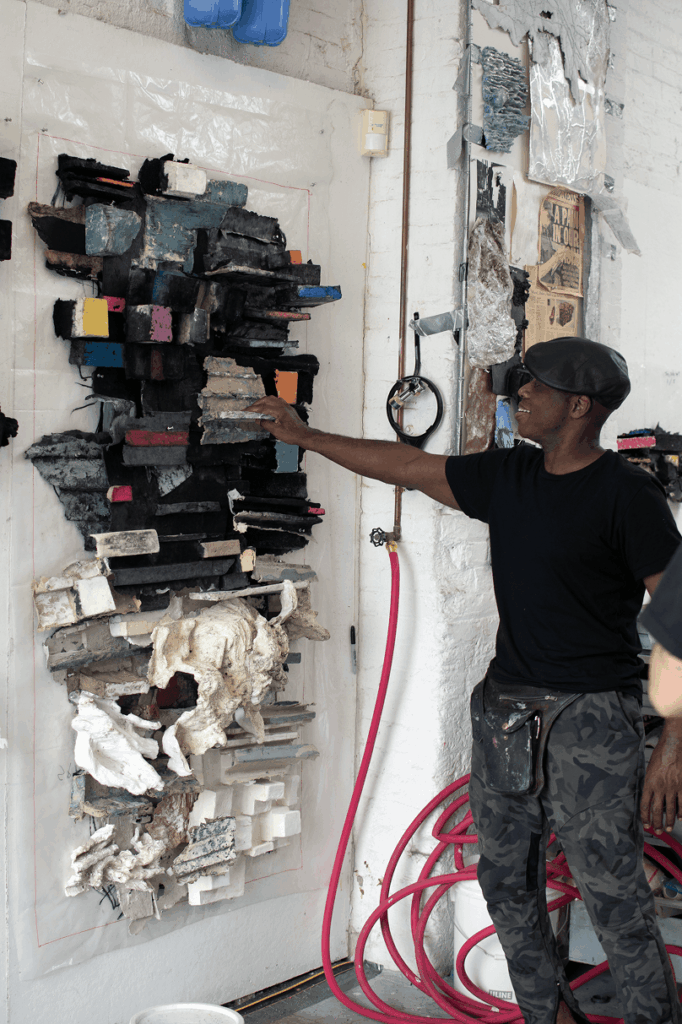
The Bruce Museum’s exhibition title, Alchemy, is instructive. Historically tied to the transmutation of base materials into gold, alchemy was never simply proto-science, but a philosophy of transformation—of believing that matter could exceed its given state. Drew’s practice extends this lineage into the present. His paper works are not elevated through illusion or representation, but through process: the repetitive, almost ritualistic handling of material that collapses distinctions between making and unmaking. The studio becomes less a site of production than one of conversion, where discarded or degraded substances are granted a second ontology. At Pace Prints, this logic finds a particularly charged articulation. Printmaking, traditionally associated with reproduction and multiplicity, is here rethought as a medium of resistance. Drew approaches the print not as a fixed matrix, but as an unstable field—subject to pressure, abrasion, and interruption. The resulting works resist clarity and resolution; they appear worn and weathered, as though excavated rather than produced. Ink behaves less as a vehicle of image than as residue—a trace of contact between surface and force. In this way, the print aligns with the sculptural, sharing in the same vocabulary of fracture and reassembly that defines his broader practice.
What binds these exhibitions is a sustained commitment to regeneration. Drew does not seek to restore objects to a prior state of wholeness, nor to aestheticise their damage. Instead, he inhabits the space between ruin and repair, where material is neither fully lost nor fully recovered. It is here, in this unstable interval—so resonant with the present—that his work finds its force. Wreckage is not merely salvaged; it is reimagined, its histories compressed and rearticulated through touch, pressure, and time. And in an age marked by fracture, Drew’s work proposes neither consolation nor escape, but a more demanding proposition: that even within cycles of violence and erasure, matter—and perhaps meaning—can be made again.
Rajesh Punj: We spoke previously about your work at the Yorkshire Sculpture Park—a body of work that felt highly physical, expansive, almost architectural. What strikes me now, looking at the works on paper in the exhibitions at the Bruce Museum and Pace Prints, is a shift in scale and intimacy. The works appear more fragile, more contained. How do you understand the relationship between those two modes of working—the monumental and the intimate?
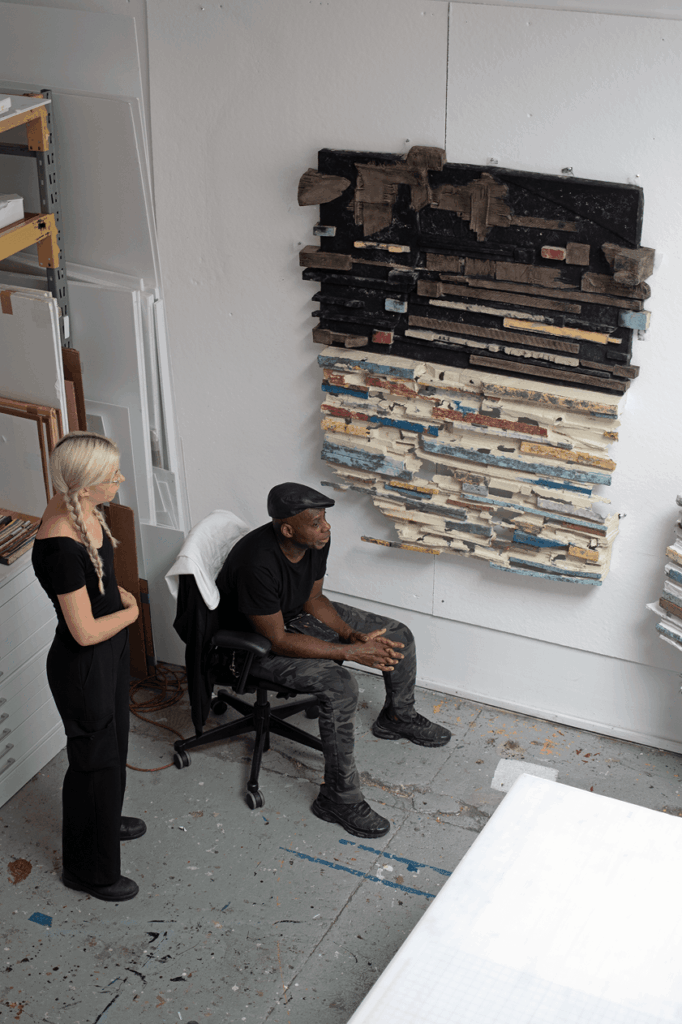
Leonardo Drew: I think if you were to see them in person, you’d realise they’re still very physical. They’re really sculptures on paper—that’s probably the best way to describe them. The prints also move into that territory. There’s a physicality that remains, even at a smaller scale. What happens is that the framing puts them into a context that makes them more legible—it cleans them up, in a way—but at the same time it gives them a kind of legitimacy, a sense of presence as something real.
RP: It’s interesting you mention framing, because your work often resists containment—it spills, expands, almost exceeds its own edges. How do you reconcile that tension between containment and overflow?
LD: I think of it almost like looking at a Jackson Pollock. There’s always a border, but the work feels like it’s defying it. That tension is important. There’s something additive about the frame—it doesn’t just contain; it can extend the work conceptually. But it’s a tightrope. There are moments when it works, and moments when it doesn’t. And practically speaking, people are more comfortable with works on paper being framed—it protects them. So, you’re negotiating between that expectation and what the work itself wants to do.