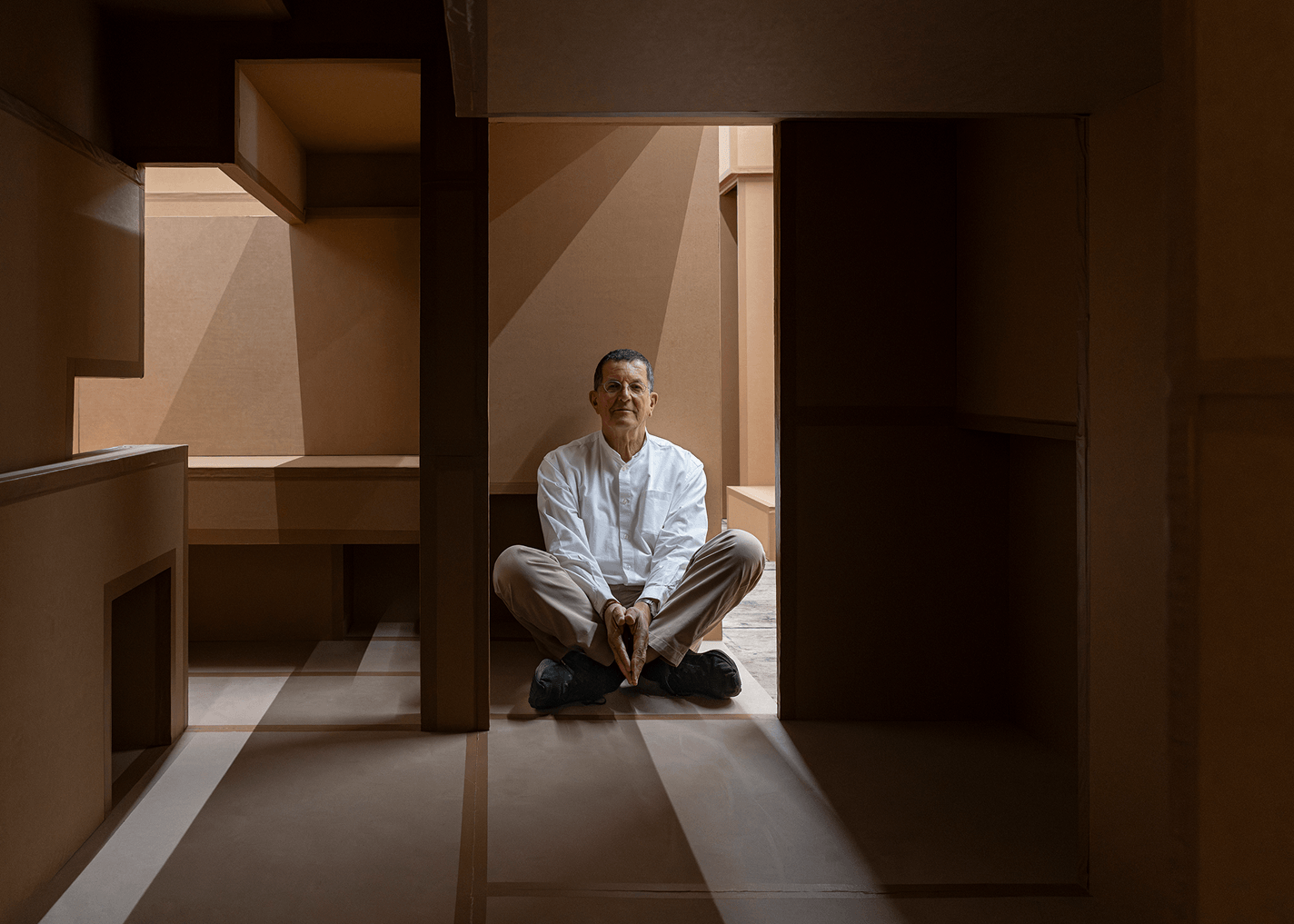
ANTONY GORMLEY, 2026 © the artist and GALLERIA CONTINUA. Photography by ELA BIALKOWSKA, OKNO STUDIO

Antony Gormley: body as building 

“I never wanted the work to colonise space. I’ve always wanted it to activate space,” insists British sculptor Antony Gormley, and if the history of sculpture has largely been written through objects, Gormley has spent the better part of four decades arguing that its true subject lies elsewhere. Not in the thing itself, but in the space it displaces, activates, and makes conscious. “The subject of sculpture is space-making,” he insists, a statement that fundamentally overturns the traditional understanding of sculpture as an art of form, monument, and representation. The late American sculptor Richard Serra saw space similarly, observing that The space of the work is not the space of the sculpture; it is the space between the sculpture and the observer.” For Gormley, sculpture is less concerned with what we see than with what we experience. It is an instrument through which we become aware of our own physical presence in the world, of our weight, our vulnerability, and our movement through space and time. As he goes on to explain, “Sculpture is the articulation and the instrument through which our spatial experience is made apparent to us, made conscious and felt.” The body remains central to this enquiry, but not as an image to be observed. Rather, it becomes a site of testing, a vessel of consciousness, and a measure through which the invisible dimensions of existence might be felt.

The exhibitions What Holds Us (9 May – 13 September 2026) at Galleria Continua, San Gimignano, and Geestgrond (23 May – 20 September 2026) at KMSKA, Antwerp, reveal the continued evolution of that enquiry. Throughout our conversation, Gormley repeatedly returned to the distinction between appearance and experience. “Surface alone,” he argues, “is insufficient.” Reflecting on Buddhist and Hindu sculpture encountered during recent travels through Sumatra and Java, he speaks of an “inner breath”: a latent pressure within the body that exceeds outward form. What interested him was not the description of anatomy but the suggestion of an interior life; the sense that matter could somehow carry spirit. The body emerges not as a collection of organs and limbs, but as a container of sensation, memory, consciousness, and being.

This concern with interiority has increasingly led Gormley towards architecture. Yet architecture, in his hands, is never merely functional. “The living body,” he suggests, depends upon a “second body”, the built environment that humanity has constructed around itself. Buildings become extensions of ourselves, just as cities become materialisations of the collective body. The remarkable proposition of recent works such as Innercity lies in their collapse of the distinction between sculpture and architecture. Bodies become buildings; buildings become bodies. The viewer is invited not simply to look, but to enter, crawl, kneel, and navigate. Space ceases to be something observed from a distance and instead becomes something encountered physically. Here, Gormley recalls the insight of French philosopher Maurice Merleau-Ponty, who argued that perception emerges not through detached observation but through the body’s immersion in the world. We do not stand outside space contemplating it; we understand it because we are already within it.

The implications of this shift are profound. Gormley’s sculptures refuse the traditional monument’s claim to permanence, authority, and spectacle. Instead, they propose uncertainty, dependency, and vulnerability. Their crude blocks of basalt, terracotta, iron, and cardboard carry emotional states not through narrative description but through bodily attitude and spatial relation. The artist speaks of leaning against a wall, of loitering, of uncertainty, even of terror. These are not emotions illustrated by sculpture but embedded within it. Material itself becomes expressive. Stone breathes, brick feels, architecture dreams. Perhaps the most compelling aspect of Gormley’s current work is its insistence that sculpture remains a fundamentally human enterprise in an increasingly disembodied age. Against a culture dominated by virtual experience, his work returns us to weight, gravity, touch, and scale. French philosopher Gaston Bachelard once described architecture as “the topography of our intimate being.” Gormley extends this proposition further. His sculptures become spaces of possibility rather than functionality; places where the body might rediscover itself through movement, hesitation, and encounter. They ask us to feel rather than merely recognise, and to inhabit rather than simply consume.

In conversation there is a real feeling of the elemental, that has eroded from our lives, and at the heart of this practice lies a deceptively simple conviction: that the body is not an object in the world but a place within it. I want people to get inside my work, both empathetically and physically,” Gormley remarks. It is a statement that illuminates the trajectory of his entire career. From the earliest body casts, when you see photographs of him first wrapping himself in clingfilm before being covered from head to toe in plaster, effectively mummified for what must have felt like a lifetime, to the expansive architectural environments of today, his sculpture has consistently sought to transform viewing into experience and objects into situations. What emerges is not a representation of human presence but a means of testing it. The body becomes building, sculpture becomes space, and space itself becomes the medium through which we encounter the possibility of being alive. His ambition, as he explains, remains to place “a human-made thing back into an elemental context.” Whether submerged by tide, exposed to weather, or set against the immensity of landscape, his sculptures are never autonomous objects. Rather, they operate as instruments of awareness, reminding us of what he describes as our continuing dependence on the biosphere. In this sense, sculpture becomes less an act of occupation than a form of orientation, a means of locating the body within larger systems of time, matter, climate, and space.
Antony Gormley exhibition
antony gormley interview
Geestgrond
ANTONY GORMLEY
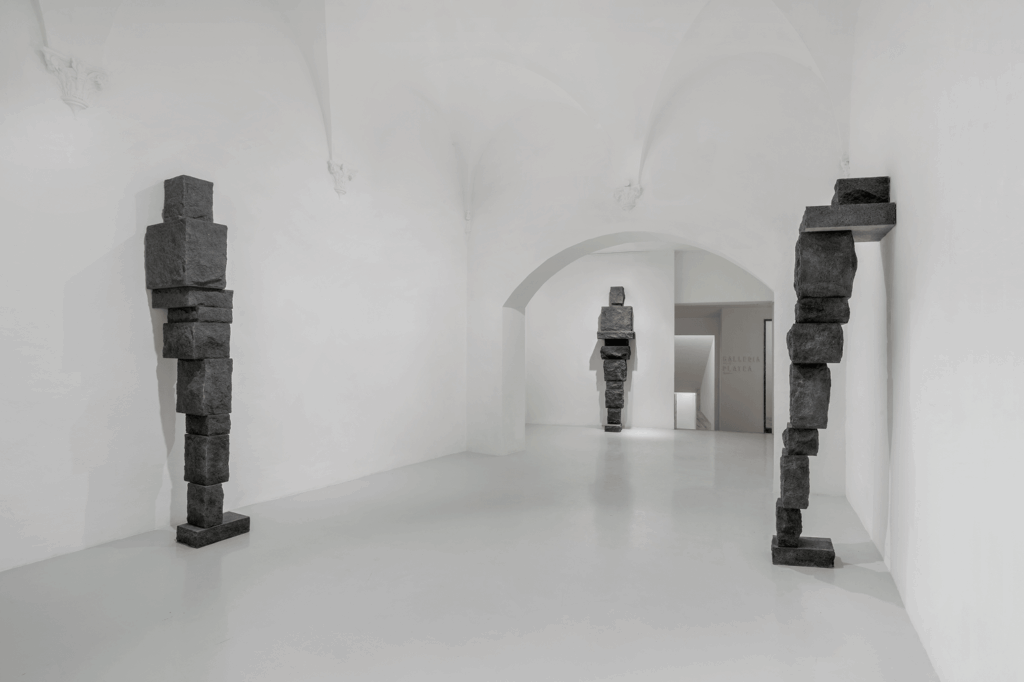
What Holds Us, 2026, exhibition view GALLERIA CONTINUA, San Gimignano. © the Antony Gormley, What Holds Us, 2026, vedute della mostra GALLERIA CONTINUA, San Gimignano, © l’artista e GALLERIA CONTINUA
Photography by ELA BIALKOWSKA, OKNO STUDIO
Antony Gormley exhibition
antony gormley interview
Geestgrond
ANTONY GORMLEY
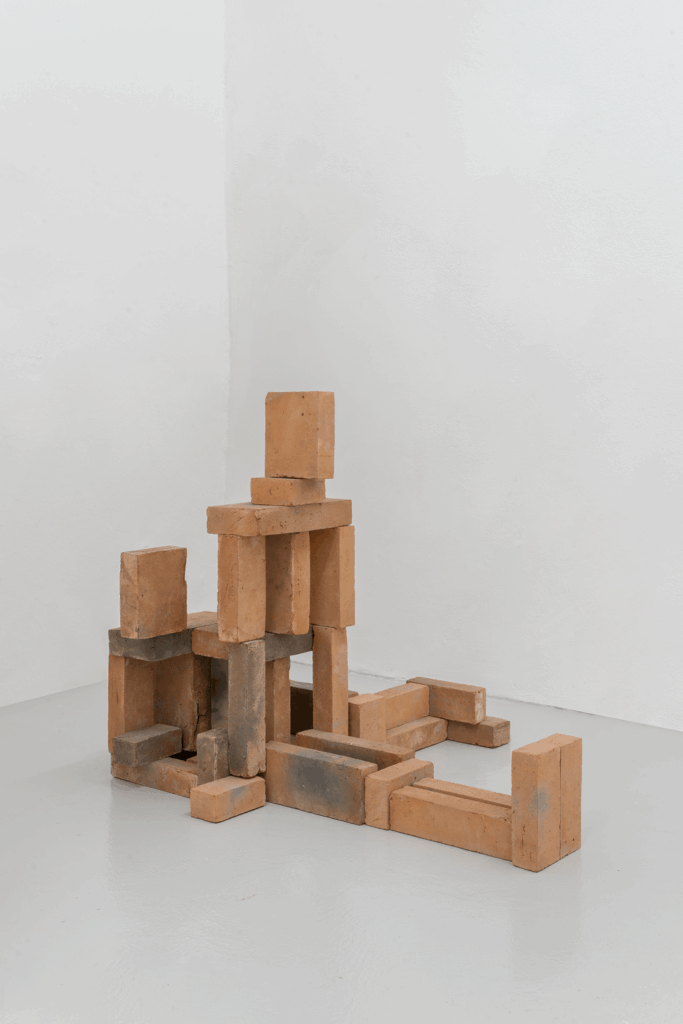
SMALL HARBOUR, 2026, clay, 54.5 x 56.5 x 69 cm, 21.46 x 22.24 x 27.17 in.
Courtesy of ANTONY GORMLEY and GALLERIA CONTINUA, Copyright: © the Artist Photography by ELA BIALKOWSKA, OKNO STUDIO
Antony Gormley exhibition
antony gormley interview
Geestgrond
ANTONY GORMLEY
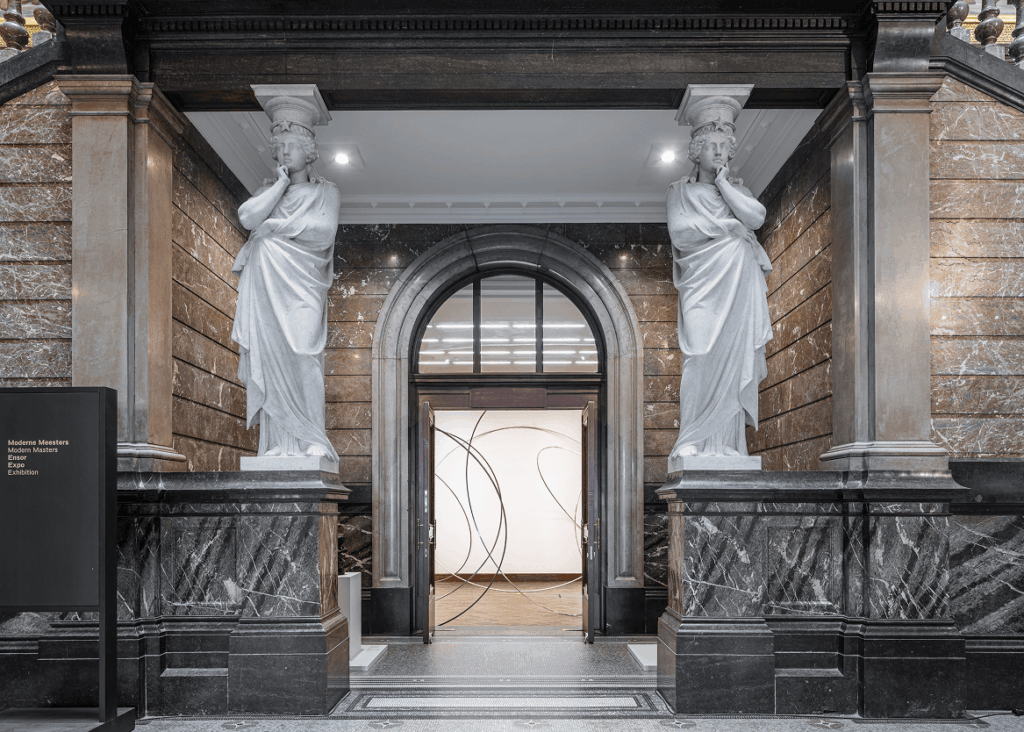
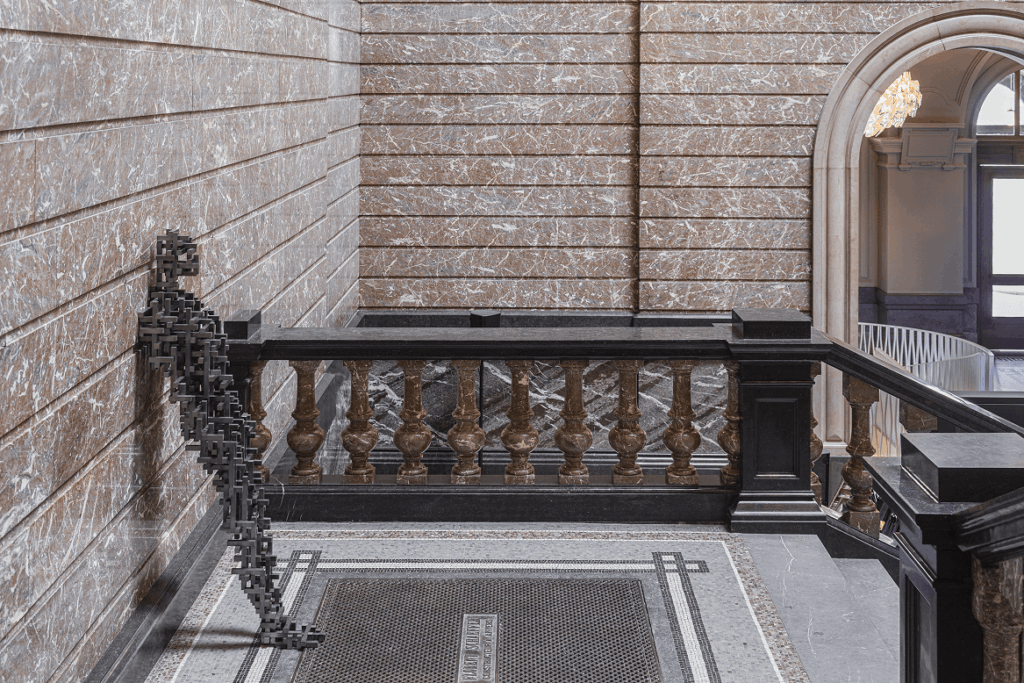
Orbit Field III, 2026, 37 rings of 23 mm square section aluminium tube and stainless steel spigots, dimensions variable
Photography by OAK TAYLOR-SMITH, courtesy of ROYAL MUSEUM OF FINE ARTS ANTWERP (KMSKA)
Antony Gormley exhibition
antony gormley interview
Geestgrond
ANTONY GORMLEY 
Brace, 2023, 20 mm square section mild steel bar, 176.6 × 48.3 × 76.5 cm.
Photography by OAK TAYLOR-SMITH, courtesy of ROYAL MUSEUM OF FINE ARTS ANTWERP (KMSKA)
Antony Gormley exhibition
antony gormley interview
Geestgrond
ANTONY GORMLEY 
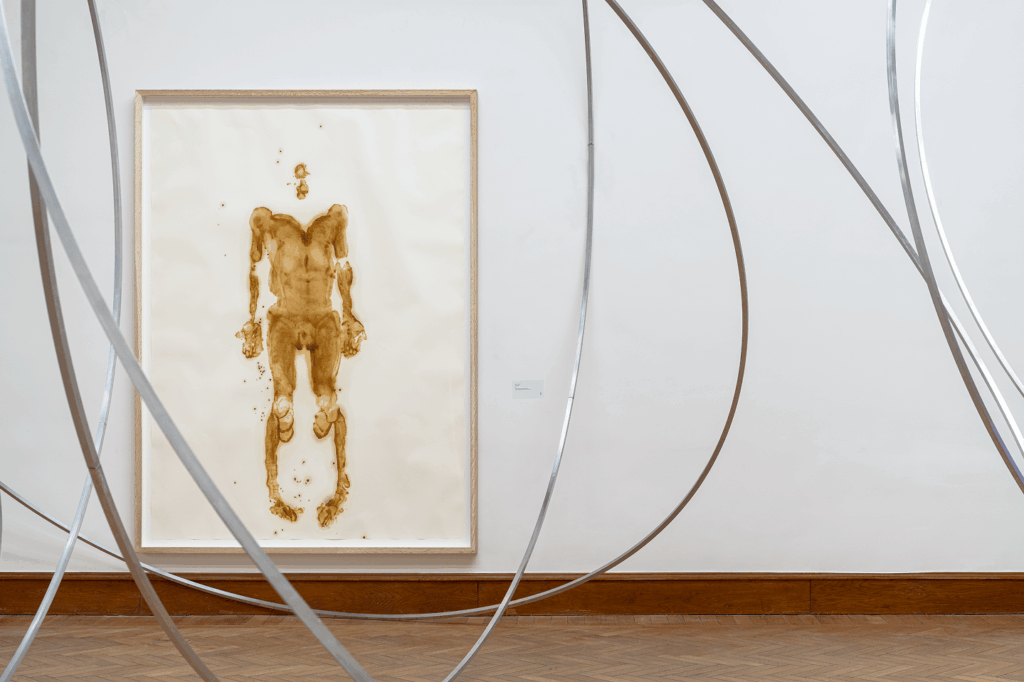
Ground, 2025, crude oil, linseed oil and petroleum jelly on paper, 240 × 173 cm, and Orbit Field III, 2026 (detail), 37 rings of 23 mm square section aluminium tube and stainless steel spigots, dimensions variable.
Photography by OAK TAYLOR-SMITH, courtesy of ROYAL MUSEUM OF FINE ARTS ANTWERP (KMSKA)
Antony Gormley exhibition
antony gormley interview
Geestgrond
ANTONY GORMLEY
OPEN WARD, 2026, concrete, 189.5 x 39 x 33.5 cm.
Courtesy of ANTONY GORMLEY and GALLERIA CONTINUA, Copyright: © the Artist Photography by ELA BIALKOWSKA, OKNO STUDIO
Antony Gormley exhibition
antony gormley interview
Geestgrond
ANTONY GORMLEY
OPEN WARD, 2026, concrete, 189.5 x 39 x 33.5 cm.
Courtesy of ANTONY GORMLEY and GALLERIA CONTINUA, Copyright: © the Artist Photography by ELA BIALKOWSKA, OKNO STUDIO
Antony Gormley exhibition
antony gormley interview
Geestgrond
ANTONY GORMLEY
Field, 1984–85, lead, fibreglass, plaster and air, 196 × 551 × 42 cm, and Corner II, 2022, concrete, 90 × 68 × 80.5 cm. 
Photography by OAK TAYLOR-SMITH, courtesy of ROYAL MUSEUM OF FINE ARTS ANTWERP (KMSKA)
Antony Gormley exhibition
antony gormley interview
Geestgrond
ANTONY GORMLEY
Attend, 2025; Natural Selection, 1981 (detail); Blanket Drawing I, 1983; Exercise Between Blood and Earth, 1979/2026; Flat Tree, 1978 (detail); Field, 1984–85 (detail); Man Rock I, 1982; Mother’s Pride V, 2019; Seeds VI, 2008; Full Bowl, 1977–78; and Land Sea and Air I, 1977–79
Photography by OAK TAYLOR- SMITH, courtesy of ROYAL MUSEUM OF FINE ARTS ANTWERP (KMSKA).
Antony Gormley exhibition
antony gormley interview
Geestgrond
ANTONY GORMLEY
Attend, 2025 (detail), cast iron, 191.6 x 49 x 33.1 cm.
Photography by STEPHEN WHITE & CO, © ANTONY GORMLEY
Antony Gormley exhibition
antony gormley interview
Geestgrond
ANTONY GORMLEY
What Holds Us, 2026, exhibition view GALLERIA CONTINUA, San Gimignano. © the Antony Gormley, What Holds Us, 2026, vedute della mostra GALLERIA CONTINUA, San Gimignano, © l’artista e GALLERIA CONTINUA
Photography by ELA BIALKOWSKA, OKNO STUDIO

Rajesh Punj: To begin, when I see the body, I think of its outer skin and inner organs, of its blood and guts, yet I see the body in your work as weight, mass and volume.

Antony Gormley: It doesn’t matter whether you’re talking about a body-case or a body-form, any object or any body in space. Appearance is the result of light falling on the surface, the bounding condition of a body or a building. The sight of something is revealed by light. But the minute you then ask, “Yes, but what is displaced by that surface, what lies on the other side of what something looks like?” you have no choice but to go inside. What in Pallavan, Chola, Mathura and Khmer art is indicated by pneuma, or breath, the idea of a certain inflation of the surface that suggests there is an inner pressure. The recognition inherent in that tradition, particularly when carried by the mass of a stone sculpture, that surface or superficial appearance is insufficient to carry the inner spirit or condition of a body, I find really powerful. I’ve just come back from three weeks in Sumatra, Java and Bali, looking at primarily Buddhist and Hindu temple precincts and some sculpture. There was a Prajnaparamita at Candi Gumpung outside Jambi in southern Sumatra, a 13th-century Buddhist monastic site that expresses exactly what I’m talking about: a sense of inner breath.

If we now shift to the exhibition here in San Gimignano, I’m very interested in how you can totally ignore the representation of the body and still give a sense of this internal condition, or internal breath. In this exhibition, the dialogue between the three stone basaltic volcanic pieces and the cardboard Innercity tries to set up a dialogue between mass and space that runs from the most archaic and earthy of materials to the most modern and impermanent. What I’m trying to do there is, in that first room, talk about the dependency of the living body on the second body: architecture and the made environment, the habitat that our species has found necessary to make. Then, in Innercity (2026), to say yes, there is a way of actually getting inside sculpture. In the fifteen body-buildings, there is an invitation to physically enter the work. Once inside, you recognise that the external look of the thing leaves you unprepared for the experience of the internal volumes, even though they are separated by only twenty-five millimetres of laminated cardboard. The inside is a plethora of extensions and continuations of orthogonal space illuminated by light that was often coming from an indirect source. You could say this is an empirical object lesson on the distinctions between internal and external reality, but I hope it’s more than that. The proposition or invitation of my work has always been to inhabit the space that they displace. I imagine a kind of empathic inhabitation. Those first basalt works in the first room are very crude. They have no limbs, there is no attempt at likeness, but they express an attitude in the set of the body. That is something that you can feel. The reason for that is that they come from a lived moment of human time. They come from the registration of me leaning on and being supported by a wall. I made them purposefully, knowing that they were going to go into this voltaic ground-floor space of a 14th-century townhouse. But despite the crudeness of these stacked blocks, people can recognise, without the conscious mind, through muscle memory, what it feels like to stand like that, and furthermore identify the feeling of dependency, vulnerability, uncertainty or loitering that they carry.

In contradistinction, the invitation of Innercity is to actually move through its field. It’s a landscape made of boxes, made of orthogonal volumes stacked one on top of the other. You probably don’t notice at first that they are bodies. You can work hard and see that they are bodies, all perforated. They are all made porous, all opened to space. And the invitation is, as you get more and more stuck, because it is a kind of labyrinth, and you might come down a dead end, that it’s easier to move through the bodies than between them. In exploring those interiors bodily, you have to completely alter the unwritten laws of decorum in terms of how to engage with art in a gallery or a museum. You have to get down and crawl or kneel, or at any rate bend very low. Once you’ve got used to that, you must use your body as a receptor, as a perceiver, as an engager in space and time, rather than your conscious mind (even though you might use that too).

My hope is that in the diminishment of scale and the encouragement to behave in a childlike way, you may be enchanted by both sculpture’s and architecture’s ability to play with space. The works of Innercity are of a certain scale chosen to resonate within this place of spectacle. This was an opera house that became a cinema, a place where a passive public looked at and listened to the active drama of an opera. That spectacle was then replaced by the spectacle of the silver screen. Here now, with the installation of Innercity, the passive space of the stalls becomes the arena for a first-hand physical investigation. In going inside on your knees, you return to the position of an animal or child. So, we go back a step or two in our evolutionary history, and are invited to look at these spaces, hopefully not trying to find representation or story, but to actually feel what they feel like: how the volumes either extend or invite an anticipation of the place around the corner or the light at the end of the tunnel. I am hoping that this does two things: firstly, it re-enchants us with the poetic potential of architecture itself through the way that it deals with light and the variation of volume. It allows us to dream with our eyes open. It allows us to feel our own embodiment, our own vitality within the vessel of our bodies. But secondly, it allows us to detach from representation per se and enter a dimensionless space. You may say, “Well, what’s he talking about? This is clearly a cheap, lightweight cardboard environment”. But I think it’s very precarity, the acceptance that it is by its nature a provisional proposition, allows one to treat the experience as an instrument for a certain kind of imaginative enchantment. I’m just hoping that people will sit awhile, lie down and just sense these spaces for what they are: how light comes in indirectly, how volumes that we can’t necessarily relate to what we have seen on the outside interrupt or complicate the internal forms. How the muscle memory of us has been trained by the mind-muscle of a furnished room to treat a surface of forty-three centimetres high as somewhere to sit, but it could be a shelf on a mountainous cliff. All of those reactions to scale within our furnished lives are denied in a scale that is super large for a model, and here is a model that we are invited to enter. Through the scale of these bodies that are also buildings, we can begin to detach interiority from functionality and perhaps begin to see these interiors as simply places of possibility. This is an antidote to Corbusier’s notion that architecture is a “machine for living”. I think that architecture is a mood manifester and a mood extender, as well as a mood maker. So, architecture works directly on your limbic sense of being and can reinforce well-being, but that part of its power has been suppressed in the cost-benefit-analysis world of architecture in its role as a quite significant part of late-capitalist exploitation of human need.

RP: In the context of how you explain the ‘body as a building’, isn’t architecture in some ways a burden upon the body, because of how we have to navigate through space when within it.

AG: But it shouldn’t be, should it? So, a corridor, particularly if colonnaded, is no longer about the boring thing of having to go from point A to point B, possibly past any number of doorways. It’s actually an interval in space not dissimilar from the beat or rhythm of music, and if it is in harmony with the body, it suddenly makes this journey from here to there into a movement not unlike the intervals of a Bach partita. You perform that movement not simply for the boring business of mechanically moving a body of 85 kilos from this position to that position, but as an amplified expression of vitality.

Good architecture emphasises and enriches the whole experience of moving through space and time. That’s something that Brunelleschi understood. It is something that all great architects understood, among them Borromini, Michelangelo, and today Chipperfield and SANAA. At the Foundling Hospital of Brunelleschian influence, for example, there is a courtyard defined by colonnades. But what does it do to your spirit? You feel like this is a place where you want to sing, because the architecture lifts you! The truth is that we have given up expecting too much from architecture and have accepted that living in boxes is our condition, and that so long as we have our internet connection and are kept dry and warm, we don’t ask for more. But that denies the potential of architecture to be freeing of the spirit. Maybe this is strange, to have a sculptor talking about architecture, because the common understanding of a sculptor’s job is to make objects that occupy space in a meaningful way. I’ve always worried about that. I never wanted the work to colonise space. I’ve always wanted it to activate space, and to acknowledge that the space displaced by the object is in intimate dialogue with the space in which it finds itself, whether elemental or architectural.

Antony Gormley exhibition
antony gormley interview
Geestgrond
ANTONY GORMLEY
INNERCITY, 2026, cardboard, 15 figures, variable dimensions
Courtesy of ANTONY GORMLEY and GALLERIA CONTINUA, Copyright: © the Artist Photography by ELA BIALKOWSKA, OKNO STUDIO
Antony Gormley exhibition
antony gormley interview
Geestgrond

RP: For a long time, I’ve been fascinated by space and the idea of it. Having completed a series of interviews with artists of different disciplines about pictorial and physical space. And then I recall Richard Serra has previously talked about work that he made, highlighting the significance of space, and about how it wasn’t about the work, it was about the space itself. What is space and where is the sculpture?

AG: That is what sculpture is.

RP: I’m fascinated by your perspective on that.

AG: Sculpture is the articulation and the instrument through which our spatial experience is made apparent to us, made conscious and felt. Yes, people do consider that sculpture is about things. But I don’t think it is. It’s about experience. Rather than trying to colonise or occupy space, it tries to activate it in a way that makes the experience of space more present and engaged. The subject of sculpture is space-making. You could say, “Well, no, that’s the job of architecture.” But I would say it’s the job of both, and they are mutually supportive. I think it’s not surprising that when Brunelleschi takes up Donatello’s challenge, we find that Brunelleschi is as great a sculptor as he is an architect, and equally, we find that Michelangelo is as great an architect as he is a sculptor.

RP: Yes, space is something. The other thing that really interests me, and for some time, is your choice of materials. There’s something incredible in how you talk about the ephemeral and the emotional, then I see these physical forms, blocks, that are undeniably of weight and mass, and I wonder about finding the emotional in those, and how you manage to?

AG: Well, I’m surprised myself, because I didn’t know whether it would work. Obviously, I’ve been playing around with this ‘Blockwork’ language for a long time now, trying to simplify it more and more. But I’ve never allowed the stoniness of stone to speak so clearly as in those first three pieces. And they are so brutal and crude, and yet everything matters. Every single coaxial face or slightly shifted one is working to communicate the attitude, the inherent set of the body. I don’t identify the emotions in the work very often, but if you had been there for the little talk I gave to the gallery staff, I did say, “Well, this one looks like a monument, but in fact expresses uncertainty and a certain degree of terror. This one is at the Wailing Wall”.

I never do that normally because I don’t want to use sculpture to illustrate things, but to allow the viewer to find their own response. But it was so shocking to me how immediately clear the feeling became. There were two things that were entirely experimental: we hadn’t used basalt in this way before, and we had not worked at this scale in stone before. I was literally stopped in my tracks because of the embedded emotion in the work. I’ve been dealing with that more. If then you go downstairs, having seen that first room, and see the two terracotta double works, particularly the first one and the one in the tower next door, I’m exploring the same thing: how these unbelievably crude masses, huge slabs, 140 millimetres thick, can carry emotion. Why should they be able to carry emotion? Carl Andre uses brick, but he uses it to say, “This is our condition. We live in an organised world in which we have exploited natural materials to make formal choices. Here are some pre-ordained arrangements of bricks, either along headers or along stringers”. I am allowing the brick to carry feelings of vulnerability and closeness.

RP: But Andre isn’t someone who comes to mind, when I think of the emotional.

AG: Well, his work does have emotion, and the main emotion is a calm acceptance of what is, but very Puritan and tight. I’m trying to say, “Oh well, Carl, you may not be here anymore, but I’m taking your bricks, and I’m making them feel, I’m making them touch us. You allowed us to walk on your work, inviting us to think that we could be the subject of art, denying the plinth, denying all the hierarchies of power and any kind of representation.” I have literally wanted people to get inside my work, both empathetically and physically. I want to talk about human vulnerability, precarity, all of those things. And you might say, “Why? Why do you do it in such a clumsy way?” But curiously, the clumsiness is the very thing that makes it effective.

RP: Possibly the thing that fascinates me the most is the obvious strength and less apparent vulnerability of your materials, and the bridge between the two.

AG: They’re all very common materials.

RP: The terracotta works downstairs have me think of India, specifically of Haridwar and the river Ganges, where there are countless burial sites, evoking the cycles of life, of death and birth and rebirth, so there’s this sense of something of that. As I mention, I’m curious by your choice of materials, and the relationship to such ephemeral, emotional and sensitive ideas occur.

AG: On one hand, I’m trying to re-enchant and reactivate our sense of architecture; on the other, I’m trying to use the materials that we have built our second body out of through time. The exhibition starts with stone, and we go on to terracotta, then to iron, and we finish with cardboard. They’re all very familiar to us. You could say that the brick is the first pixel. The brick is the first part-whole relationship that gives us the city, which is the materialisation of the collective body. But we have become blind to the fact that the forms of cities, the high-rise, the glinting glass, steel and concrete, are icons of our time, but are also representations of our desire and fear. I want to take those materials, common and crude though they are, and make them speak to our inner selves, and use them in a way that allows the silence and stillness of sculpture to act on our inner selves. Maybe those are the bits of us that hide because they are uncertain. I hope that sculpture can allow them to be felt, that’s the job that sculpture can do.

Antony Gormley exhibition
antony gormley interview
Geestgrond
ANTONY GORMLEY
What Holds Us, 2026, exhibition view GALLERIA CONTINUA, San Gimignano. © the Antony Gormley, What Holds Us, 2026, vedute della mostra GALLERIA CONTINUA, San Gimignano, © l’artista e GALLERIA CONTINUA
Photography by ELA BIALKOWSKA, OKNO STUDIO
Antony Gormley exhibition
antony gormley interview
Geestgrond
Photography by ANTONY GORMLEY
Cave, 2019, 8 mm weathering steel, 732 × 1411 × 1137 cm.
Photography by OAK TAYLOR-SMITH, courtesy of ROYAL MUSEUM OF FINE ARTS ANTWERP (KMSKA)
Antony Gormley exhibition
antony gormley interview
Geestgrond
ANTONY GORMLEY
Cave, 2019, 8 mm weathering steel, 732 × 1411 × 1137 cm.
Photography by OAK TAYLOR-SMITH, courtesy of ROYAL MUSEUM OF FINE ARTS ANTWERP (KMSKA)
Antony Gormley exhibition
antony gormley interview
Geestgrond
Installation view, The Heart
Photography by OAK TAYLOR-SMITH, courtesy of ROYAL MUSEUM OF FINE ARTS ANTWERP (KMSKA)
Antony Gormley exhibition
antony gormley interview
Geestgrond
ANTONY GORMLEY
Domain XCIX, 2025, 10 mm square section stainless steel bar, 188.5 × 68.2 × 36.6 cm. Photography by OAK TAYLOR-SMITH, courtesy of ROYAL MUSEUM OF FINE ARTS ANTWERP (KMSKA)
Antony Gormley exhibition
antony gormley interview
Geestgrond
ANTONY GORMLEY
Domain CI, 2025, 10 mm square section stainless steel bar, 186.2 × 69.2 × 29.5 cm. Photography by SANNE DE BLOCK, courtesy of ROYAL MUSEUM OF FINE ARTS ANTWERP (KMSKA)
Antony Gormley exhibition
antony gormley interview
Geestgrond
Portrait of the artist, photography by JOHN O’ROURKE

Words: RAJESH PUNJ

ISSUE 8

issue no8

Discover the new issue — available now