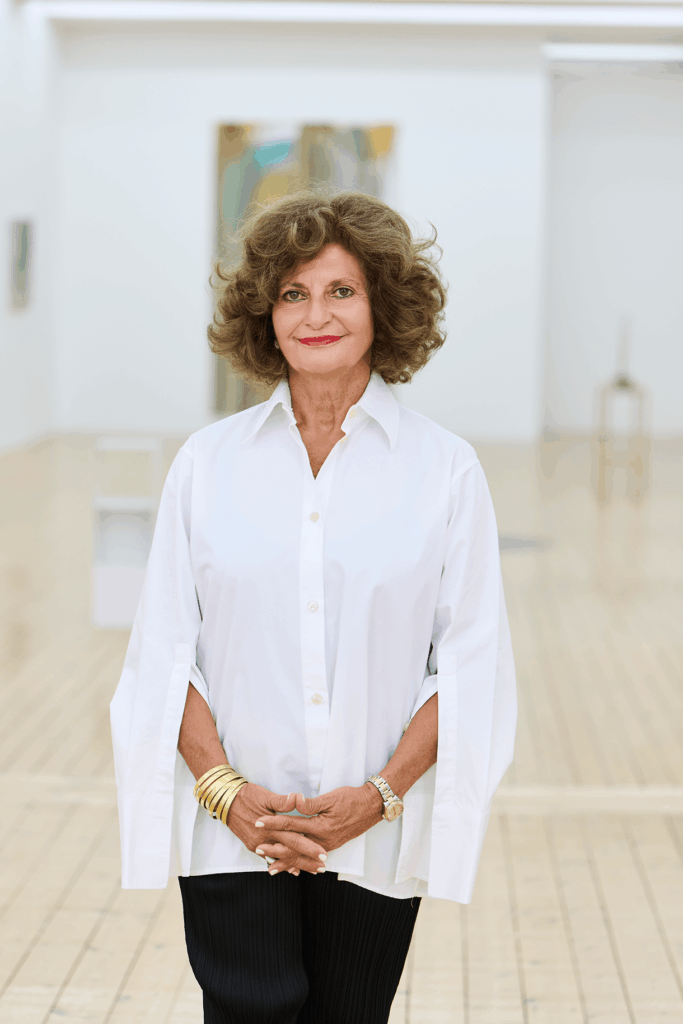

Andrée Sfeir-Semler is one of the most influential gallerists bridging the contemporary art worlds of Europe and the Arab region. Born in Lebanon, she worked as an assistant to Pierre Bourdieu and earned a PhD in Germany; there, in 1985, she began her career as a gallerist. What started as an intuitive leap into the unknown evolved into a rigorous, decades-long commitment to advocating for Middle Eastern art on the global stage. In 2005, she opened the first white-cube space in the Middle East—a region that almost lacked contemporary art infrastructure.
Now running two Sfeir-Semler galleries, in Hamburg and Beirut, she continues to support artists from the Arab world, helping them gain recognition in the international art scene. This dual presence has positioned her as both witness to and active shaper of artistic dialogues across continents. Her practice reflects a belief that meaningful art must be rooted in its time and place yet transcend it through formal sophistication—an approach shaped through early work with renowned Western artists and later deepened by her engagement with emerging and established voices of contemporary Arab art. In this interview with hube, Andrée Sfeir-Semler reflects on her path, the connections between art and migration, and the current state of the art scene in the Middle East.
hube: In 1985, you opened your first gallery in Germany. Looking back, what was the moment or intuition that made you believe this was the path you wanted to follow?
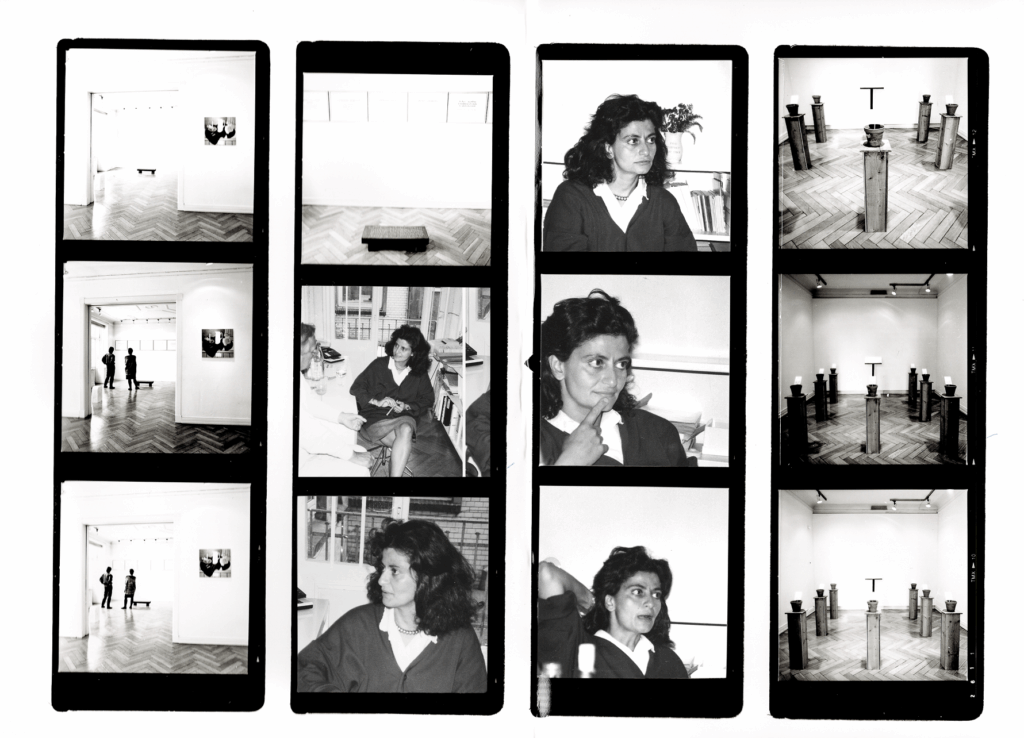
Andrée Sfeir-Semler: It was really destiny, actually. I had just finished my PhD and was in the middle of nowhere—in the north of Germany, in a city called Kiel, by the Baltic Sea. The gallery I used to visit as a student was closing down, and the owner asked if I would take it over. I said yes, finalized my PhD, and started. It was like a jump in deep water.
hube: After two decades in Germany, you returned to Beirut and opened your gallery there in 2005. What did this return mean to you personally, and what kind of cultural space did you hope to create?
Andrée Sfeir-Semler: I was born Lebanese and left for studies in Germany. Then the war started in Lebanon and I could not go back. My husband is German, and I’ve now lived longer in Germany than I ever lived in my country of birth. In the early 90s, Lebanon got out of that war—or seemed to be getting to a peaceful horizon. I decided to open a gallery there to celebrate the 20th anniversary of my first gallery.
In Germany, no one really needed me—there were already many professional galleries. But at that time I felt there was no professional gallery in the Arab world: no white cube, no large space where artists could articulate their work. Other galleries that existed didn’t work the way Western galleries do: they would not represent and support artists, they would not explore conceptual art. So I thought I would do it—and again, it was destiny. I visited the Karantina area by the port with my friend Bernard Khoury, an architect, who had just moved to a new office in a former iron factory. The space was incredibly impressive—1400 square meters. He said, “The floor above me is empty. Do you want to rent it?” I did—and I started.
hube: For many years, your galleries in Hamburg and Beirut have existed between different worlds, histories, and audiences. Do you see yourself as a bridge between cultures, or is the relationship more complex than that?
Andrée Sfeir-Semler: When I started the gallery, I worked with important Western international artists from Europe and the United States. In the 90s, a group of artists from the Arab world began to emerge. They changed the DNA of the gallery, and I started concentrating more and more on these young talents, assisting and pushing them to develop and become professionals. Many were already professional, but didn’t have an advocate to fight for them.
I started working with Walid Raad, Akram Zaatari, Marwan Rechmaoui, Rabih Mroué, Wael Shawky, Yto Barrada, then Etel Adnan, and so on. Little by little we became more specialized in contemporary art from the region. We were very lucky because there was a gap that we could fill, and we were able to develop and help artists get to international platforms, such as the Venice Biennale and Documenta, and get their work into important museums all around the world. It became something we could specialize in very early on. It was lots of fun to work with these people, and to bring new talents, new expressions, new atmospheres from the Arab world to Western audiences. We were very fortunate because many curators liked and supported what we were doing, which allowed it to continue.
hube: What is it that makes you recognise an artist’s voice and feel that their work deserves to be shared with the world?
Andrée Sfeir-Semler: I’m trained as a historian and art historian, and I also studied sociology with Pierre Bourdieu, a very important 20th-century sociologist. I was very lucky to be his assistant in Paris during my studies. This led me to believe that meaningful art is the product of a society and a socio-geographical environment. Only an artist who observes their surroundings and reflects social context can be relevant to the wider world. But the work needs to be shaped as art—it cannot be an essay on politics going on now. It needs to be beautiful, with a singular handwriting. The artist must be articulate and do actual art, not a newspaper article.
The first twenty years of the gallery were an extremely important training; I worked with artists like Sol LeWitt, Robert Barry, and Ulrich Rückriem. The more you look at art, the better you become at recognizing talent. I was fortunate to be able to go around and see so many museums, so much amazing art, to have such incredible historical training that allowed me to recognize the right people.
hube: Your Hamburg gallery is currently presenting Alia Farid’s solo exhibition Elsewhere in Puerto Rico, República Dominicana & Cuba—the largest iteration to date of her long-term project mapping Arab and South Asian migrations to the Caribbean and Latin America. What initially drew you to this expansive body of work, and why did this feel like the right moment for her debut in your Hamburg space?
Andrée Sfeir-Semler: Alia Farid’s project couldn’t be more timely and relevant today. It speaks about diasporas, it speaks about immigration, it speaks about people coming from elsewhere and settling in another country. It’s amazing that she’s been working mainly with people from the Arab world and Southeast Asia who immigrated to the Caribbean and South America—so it’s a topic that is relevant everywhere, and her language is so particular.
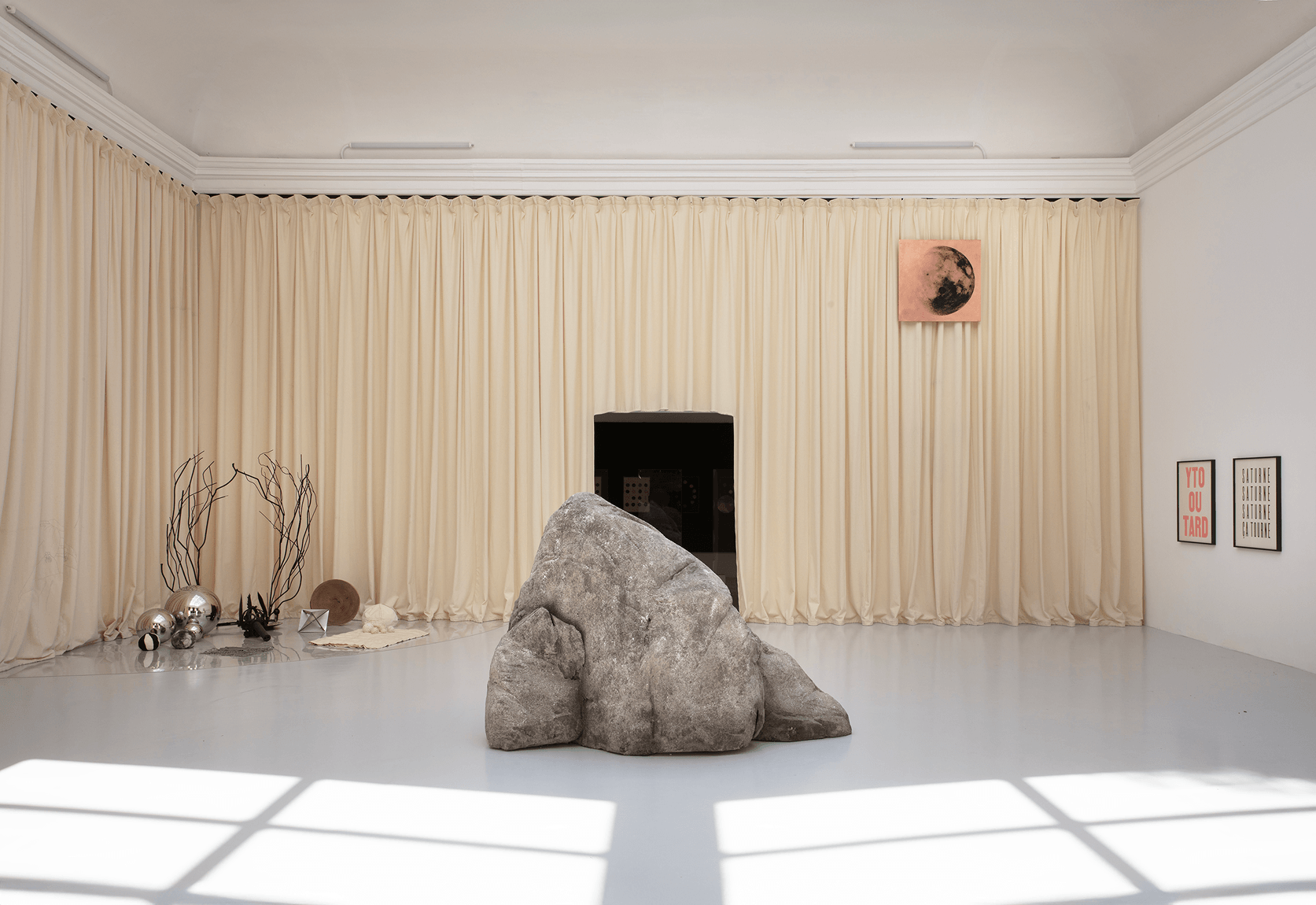
She works with a technique of embroidery on blankets that comes from southern Iraq and resembles Kilim. She portrays individuals she has interviewed—Arabs who live in South America—and reflects on who they are. She does the work as a carpet, manufacturing the pieces in southern Iraq and bringing two very different cultures together. It becomes very complex and very interesting; the carpets speak Spanish. It couldn’t be more singular. The way she has installed the work in the Hamburg space is extremely immersive and creates something akin to a shelter. Those carpets are actually embroidered old blankets that have been used by nomads in the Arabian Peninsula as covers and tents. They have many purposes and speak to this nomadic idea of people leaving their country and going elsewhere.
hube: The current exhibition at your Downtown Beirut space, J’aime les fleurs comme les étoiles, brings together a rich selection of Aref el Rayess’s works on paper. In the context of Beirut’s history and its ongoing resilience, what contemporary resonances do you see in presenting his work today, and what do you hope visitors take away from this encounter with his multifaceted legacy?
Andrée Sfeir-Semler: It has been very tough to open a new exhibition, because the country is going through war. But we really wanted to proceed with it, and I thought that Aref el Rayess was a very beautiful answer to all of this. We are showing his joyful flowers and nature aquarelles and drawings, as well as his abstract pieces that he calls Hommage au Petit Prince. They are very fresh and light. At the same time, we are presenting a series of lithographs, The Road to Peace, that he made in 1976—a reflection of the Lebanese Civil War that started in 1975. The confrontation between war, nature, flowers, and abstraction creates an exhibition that is both uplifting and reflective.
hube: Your gallery has had a significant presence on the global stage—most recently at the inaugural Art Basel Qatar and the 61st Venice Biennale. How do these participations reflect the evolving position of contemporary Arab and Middle Eastern art in major international platforms?
Andrée Sfeir-Semler: We’re very proud and thankful that we were able to do this. In Doha, Qatar, we represented MARWAN (Kassab-Bachi), a Syrian painter who lived in Berlin since 1957 and was a professor at the School of Fine Arts. In my eyes, he is one of the most important modern painters from the Arab world of his generation, and the expression in his paintings is extremely meaningful and strong. His work was very well received. We also had two special projects—one by Rayyane Tabet, who is Lebanese, and one by Khalil Rabah, who is Palestinian. So we had a very beautiful presentation at Art Basel Qatar with three of our artists. Rabah as well as Taysir Batniji, Samia Halaby and Walid Raad were featured in the Mathaf museum exhibition, so we were quite present in Qatar, which we are very proud of.
At the Venice Biennale, Yto Barrada, a Moroccan artist, represents France. Sung Tieu, a Vietnamese artist I discovered in high school in Hamburg, represents Germany. Dana Awartani represents Saudi Arabia. Walid Raad is in the main exhibition, and Lawrence Abu Hamdan had an amazing presence in the center of the city. Alia Farid had a work in the Qatari pavilion. We couldn’t be prouder to be as well-represented in Venice as we were.

Transition, among other things, ART BASEL QATAR – Special Projects Commission, 2026

SFEIR-SEMLER GALLERY HAMBURG, Germany, 2026


May your tears never dry, you who weep over stones, exhibition view, SAUDI PAVILION, LA BIENNALE DI VENEZIA, 2026

450XL: The Story of a Fugitive Sound, installation view, COMPLESSO DELL’OSPEDALETTO, Venice, Italy, 2026


Road to Peace, 1976/78, 36 prints in a folder, 34 x 49.5 cm,
Courtesy of the estate of the artist & SFEIR-SEMLER GALLERY

hube: Beirut has always been a city shaped by both loss and creativity. How has the city itself influenced the way you think about art, resilience, and cultural memory?
Andrée Sfeir-Semler: Since the day I was born, I’ve been facing war. For us Lebanese, it is tough every day, it is tough every minute, yet we proceed, and proceed, and proceed. I don’t have an explanation—it’s just how it is. I think that art is the only chance to survive these wars, and to give future generations a message of peace and culture rather than only of destruction. We don’t want war, we’re just caught in it, and the only way to survive this is to do art.
hube: Over the years, contemporary art from the Arab world has gained greater international visibility. What changes have you witnessed, and what do you think still needs to be understood better?
Andrée Sfeir-Semler: Art cannot make international political changes. It is a topic for the few, not the masses. All we can contribute is our thoughts, ideas about freedom, freedom of opinion, freedom of thought, the love of life, the love of survival. We can’t change everything. We can only try to help those who want to listen—that’s all we can do.
hube: What advice would you offer to emerging gallerists or curators in the Middle East who are passionate about building platforms for conceptual and politically engaged art?
Andrée Sfeir-Semler: To look around. To follow their deep inner self. To look and look again. To be resilient. To continue even if success doesn’t arrive immediately. And to make no compromises when it comes to work. It’s about the art, not about the market.
hube: In a world increasingly shaped by digital media, migration, and shifting power dynamics, how do you envision the future of contemporary art from the Arab world and its place in the global canon?
Andrée Sfeir-Semler: The more we do, the more important museums and spaces are created—institutions in Qatar, biennales in Saudi Arabia, the Sharjah Art Foundation and Sharjah Biennale, the museums in Sharjah and Abu Dhabi, Art Dubai and other art fairs—the more things happen in the Arab world, the more artists will come up. You create a market, you create demand, you offer platforms and art schools, so that students and young people have the ability and opportunity to become professional artists.
hube: As the art world continues to evolve, what role do you believe independent galleries can play today—beyond simply presenting and selling artworks?
Andrée Sfeir-Semler: I think contemporary art galleries shape the art world, because we begin very early on. It’s only later that museums and collectors buy art. It’s the galleries who find the artists and give them the opportunity to do what they are doing and to express themselves. I think the role of contemporary art galleries is significant, and they are the ones who, in fact, drive it all forward.
But you need all facets in order to create an art ecosystem. You need art, you need art schools; you need to sell art, so you need collectors and institutions. All of it creates a new platform for art from that part of the world. It needs to be exported to the West in order to influence internationally. The more you do, the more galleries come, the more artists will come up and will proceed. Last year, the book I edited, The Rise of Arab Art, was published—and it features articles by 46 major figures who have influenced and made this scene happen so far.

What Dreams May Come, ART BASEL QATAR – Special Projects Commission, 2026
