Lisa Konno Paul Kooiker fashion film Goodwill Dumping
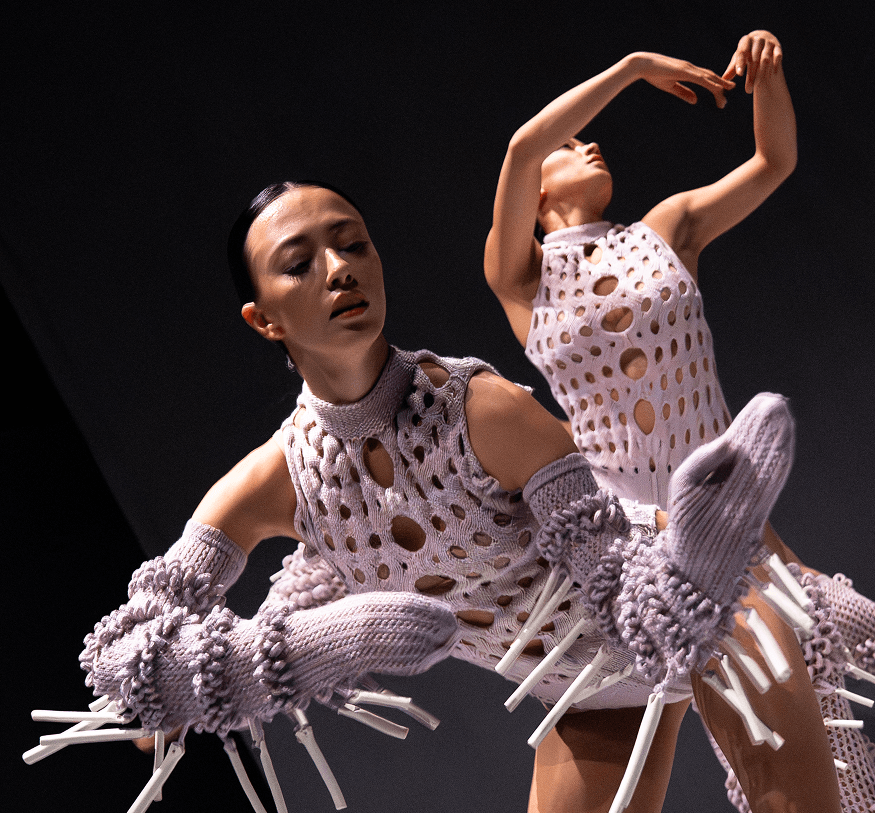
LISA KONNO and PETER LEUNG, 'Figure,' Studio Boekman. Courtesy of ALTIN KAFTIRA

Lisa Konno: the stories we wear

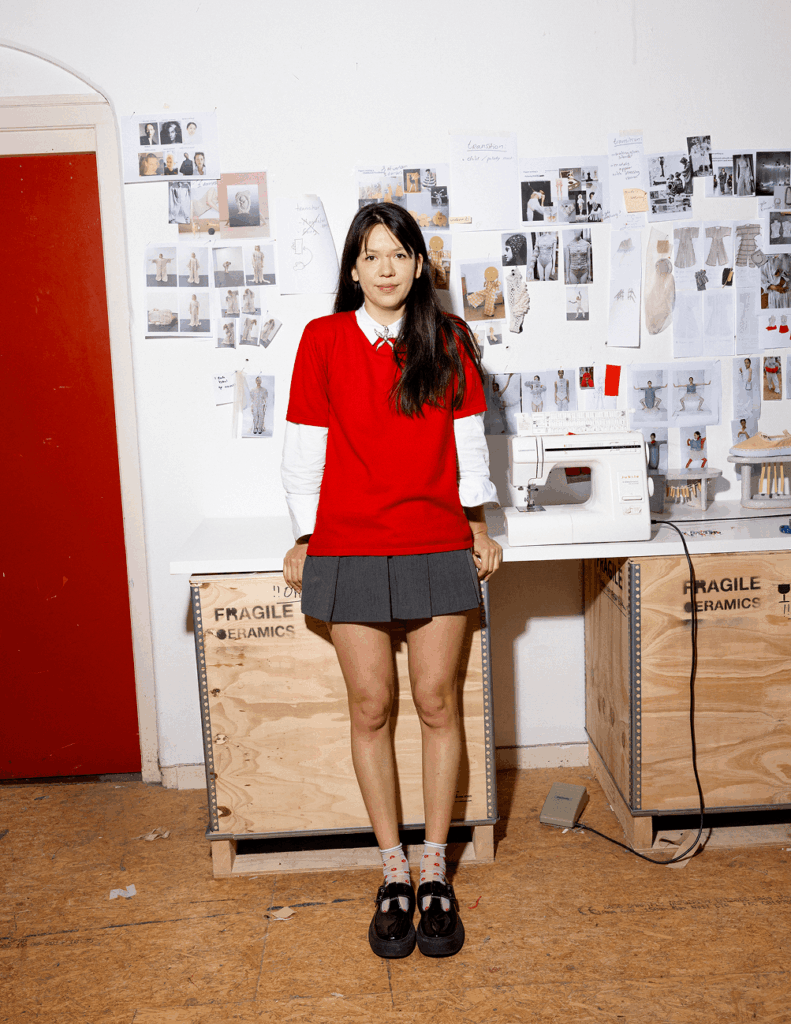
With Lisa Konno Paul Kooiker currently on view at Museum Kranenburgh in the Netherlands, we spoke with Konno about the importance of centring humanity and empathy amid the commerciality of fashion. Her pensive and thoughtful energy infuses the conversation with sincerity, a quality which anchors the versatility of her practice. Konno’s projects are just as pertinent to the museum as they are to the screen or the stage, narratives of play and boundlessness. Community provides fertile ground for her inquisitiveness. Through the creation of something individual, personal, and intimate, the universality of human experience comes into focus.

h: Your current exhibition with Paul Kooiker at Museum Kranenburgh invites visitors to look at fashion in unexpected ways. When two artistic practices are placed in dialogue, what becomes possible? Have there been moments when Kooiker’s work changed the way you saw your own?

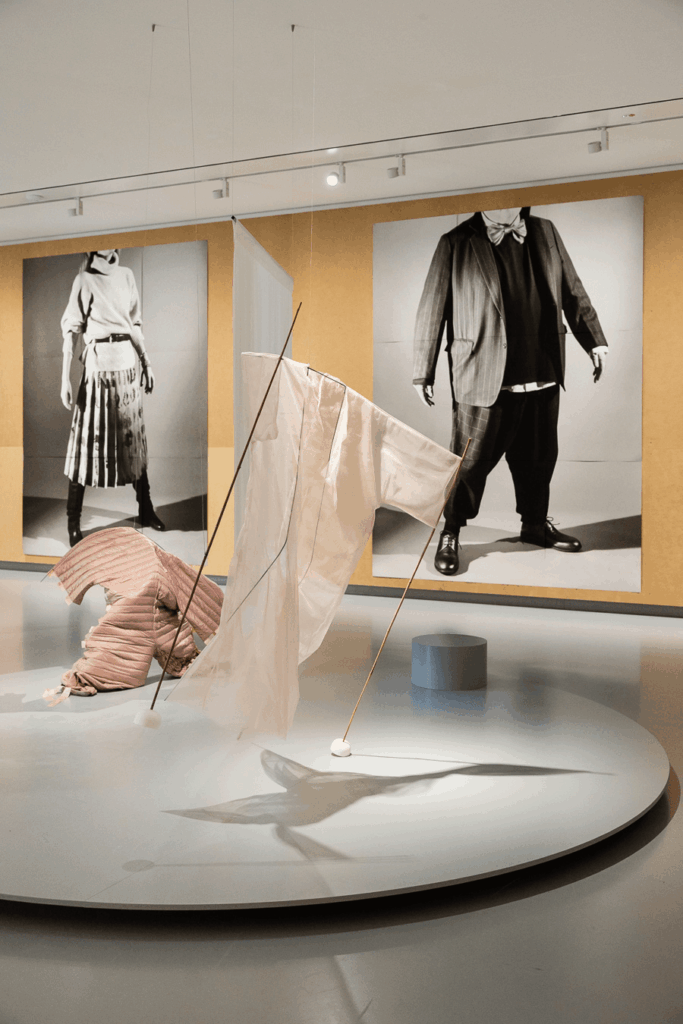
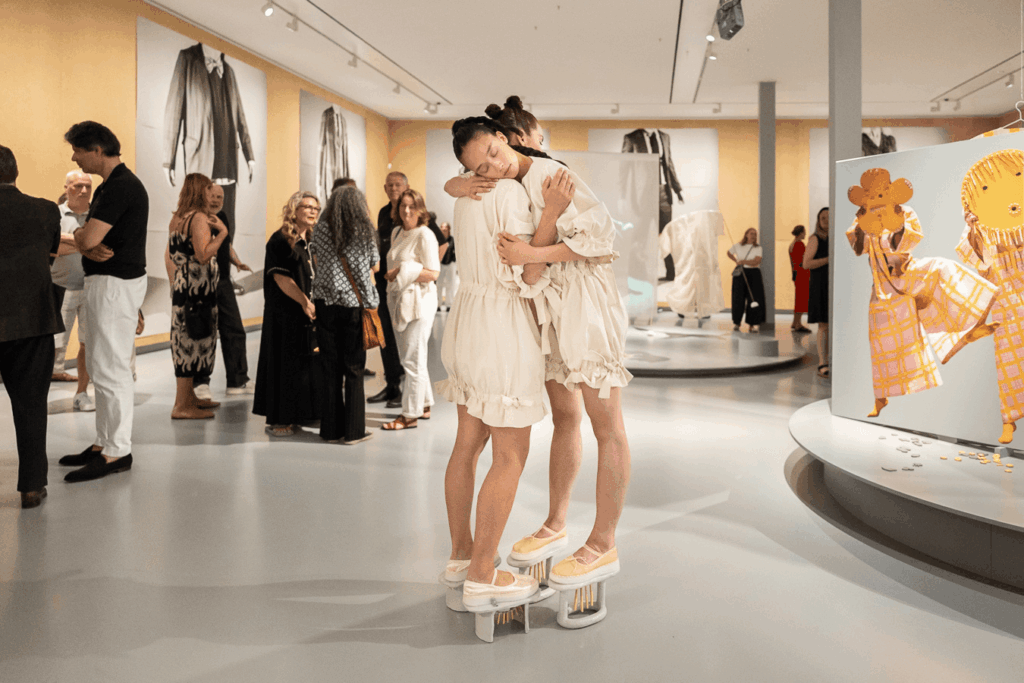
LK: Our practices derive from very different perspectives, but what we have in common is that we both work with fashion but are not necessarily in fashion. We strengthen each other’s ideas, yet each artist’s work stays individual. For instance, Paul’s photographs are of CEOs and creative directors of big fashion houses, but the photographs crop just below the head. We don’t see who they are; they’re just like mannequins. The pieces I’m exhibiting are costumes for a ballet [titled Figure, performed by the Dutch National Opera & Ballet]. The dance is about the different stages of a woman’s life. Placed in the context of Paul’s work, it becomes a commentary on the fashion system.

It’s like a confrontation. You are confronted by how it all feels together. I started to focus on the shapes. What is the rhythm in the space? I was no longer hung up on the detail, or the linear storytelling that happens on stage. It allowed me to see my work as sculptural. Each piece becomes a sculpture.

h: With Figure in mind, what interests you most about the moment when an object becomes something that is worn, moved in, and performed?

LK: There is a line between fine arts and applied arts. I aspire to blur that line. I think this separation is an artificial construct. To me, art is how you live your life, not just what you make. Objects in a museum can be brought back to life by performance.

We hosted a performance during the opening night of our exhibition. And there are video screens in the exhibition which show the costumes ‘activated’. It removes the ‘glass box’ of the museum, where things are only there to be preserved. I like this aliveness. Everything becomes tactile and visceral. It emphasises the dramatic purpose behind the pieces.

For Figure, I made gloves with long ceramic beads attached to the wrists. When the dancer moved, their arms produced sounds. I loved it, but I felt that there was still a lot of untapped potential in that idea. You could even make a symphony, making music through clothing. There is wonder, but also tension. You are afraid of it breaking; the fragility is surreal.
Lisa Konno
Paul Kooiker
fashion film
Goodwill Dumping
Courtesy of LISA KONNO
Lisa Konno
Paul Kooiker
fashion film
Goodwill Dumping
Kranenburgh opening Lisa Konno Paul Kooiker 
Photography by MAARTEN NAUW
Lisa Konno
Paul Kooiker
fashion film
Goodwill Dumping
Kranenburgh opening Lisa Konno Paul Kooiker 
Photography by MAARTEN NAUW
Lisa Konno
Paul Kooiker
fashion film
Goodwill Dumping
Kranenburgh opening Lisa Konno Paul Kooiker 
Photography by MAARTEN NAUW
Lisa Konno
Paul Kooiker
fashion film
Goodwill Dumping
Lisa Konno Paul Kooiker at the MUSEUM KRANENBURGH
Photography by MICHEL KLAUS
Lisa Konno
Paul Kooiker
fashion film
Goodwill Dumping
Kranenburgh opening Lisa Konno Paul Kooiker 
Photography by MAARTEN NAUW
Courtesy of LISA KONNO
Lisa Konno
Paul Kooiker
fashion film
Goodwill Dumping
LISA KONNO
Figure
Photography by PAUL KOOIKER
Lisa Konno
Paul Kooiker
fashion film
Goodwill Dumping
LISA KONNO and PETER LEUNG 
Figure, Studio Boekman 
Courtesy of ALTIN KAFTIRA

h: Goodwill Dumping, a hybrid documentary fashion film you made in collaboration with director Teddy Cherim, reveals the disquieting surreality of the second-hand clothing industry and its impact on the Global South. An awareness of the environmental and ethical impacts of the fashion industry seems to be fundamental to your work. Could you tell us more about this?

LK: In Goodwill Dumping, I placed recognisable items in an alternative context: Kenya, where a lot of the clothes that are discarded by the West end up. There is a lot of power in using objects that are highly recognisable. When placed in a different context, they become symbols.

These are distinctly Western items that I found in donated clothing bins in the Netherlands. We combined these with local Kenyan patterns and shapes. Through this, the constructed garments became big juxtapositions. It’s like taking a mango tree and placing it in the cemented streets of Amsterdam. It’s all so far removed from its origins that we are instantly jolted into comprehending the journey the garment has been through.

h: Your practice often involves this subversive repurposing of typical, everyday garments or household objects. These items are repositioned, multiplied, or rendered in unexpected proportions, like in Porcelain Body, your solo exhibition at Museum JAN. How do different material cultures from around the world inspire and influence your practice?

LK: Being bicultural is something that influences me even when I don’t directly reference it. Growing up between two different cultures is an immensely valuable experience. It shows you how different the social rules in different places are, what’s normal in different places.

Sometimes things are so different they feel like fantasy. Differences show you that other ways of life are possible. It makes me feel hopeful, positive, and optimistic. Through this, I can imagine ways in which the world can be different from what it is.

h: Speaking of hope and optimism, let’s look ahead. What stories would you like to tell in the future? Where is your curiosity leading you next?

LK: At the moment, I am looking into how different cultures cope with mortality and remember the dead, from both a Japanese and a Dutch point of view. I am interested in the objects that are used in rituals, funeral clothing, or the clothing people are buried in. These are ideas that have not yet formed a concrete project. For now, I’ve just been collecting images.

In the Netherlands, there is a hunger for rituals. I feel this may be because it’s quite a secular society. There is a need for rituals that are not necessarily religious. A need for group experiences and the hopefulness of community. It’s such a contrast to Japan.

h: You move freely between fashion, film, performance, design, and visual art. Do you still think in terms of disciplines, or are those boundaries becoming less relevant to you?

LK: Even though my practice moves through many different disciplines, I would never claim that I am an expert in all those disciplines. I just enjoy collaborating with others who are experts in their respective fields.

I graduated as a fashion designer, but I didn’t want to just produce a bunch of stuff to be sold seasonally. I want to resist that over-consumption. I want to keep a bit of distance from that system that I consider so unethical.

h: The trilogy NOBU BABA HENK is deeply collaborative and centred on real people. You made these films with director Sarah Blok. What do you need in order to create a genuine connection with someone you’re working with?

LK: For a good collaboration, you have to trust your collaborator and let them do their thing. There has to be mutual trust. The strongest collaborations emerge through respect for each other’s work. Sometimes there are moments where you’re like, ‘I don’t know about this! But I’ll let you try it, because I trust your vision’. I’ve been lucky to experience this with Sarah and with other collaborators.

h: Leading on from this, how can collaboration form the foundations from which personal histories—like those of Nobu, Baba, and Henk—can be shared, amplified, and celebrated?

LK: I do believe that objects can carry a person’s story. But, through a garment alone, it can be really difficult to read that story. As an audience, you need more context to be able to interpret this message. And so, I was hungry to work with narrative. Film seemed like the ideal way to make this happen. At the time, I felt that a lot of fashion films were really just campaigns, not using the medium to its full potential.

h: Documentary feels like something that is raw and honest; it’s the bare bones of something. Whereas fashion films are often so glamorous and stylised, all about character and performance. What was it like to hold that balance?

LK: We would go to fashion film festivals and they’d say, ‘this actually is not what we would consider a fashion film’. And I guess that’s true.

The same would happen at documentary festivals. However, all documentaries are edited. Nothing is truly raw. The fact that you’re there with a camera changes the situation.

When Nobu, Baba, or Henk wore the garments, it acted as an icebreaker. Through the act of wearing, they broke the fourth wall. They reflect on what they are wearing, even joke about it. We acknowledge the performative aspect; it’s not a secret. The garments were conversation starters, tools for storytelling, prompts to talk about their life.

My work is made to measure. With Nobu Baba Henk, I try to go a step further. It’s not just made for someone’s body, but it’s made for their story.

Courtesy of LISA KONNO
Lisa Konno
Paul Kooiker
fashion film
Goodwill Dumping
LISA KONNO and PETER LEUNG 
Figure, Studio Boekman 
Courtesy of ALTIN KAFTIRA
Lisa Konno
Paul Kooiker
fashion film
Goodwill Dumping
Courtesy of LISA KONNO
Lisa Konno
Paul Kooiker
fashion film
Goodwill Dumping
LISA KONNO
The Porcelain Body, 2024
Courtesy of SALMIAK STUDIO
Lisa Konno
Paul Kooiker
fashion film
Goodwill Dumping
LISA KONNO and SARAH BLOK 
NOBU, Filmstill
Lisa Konno
Paul Kooiker
fashion film
Goodwill Dumping
LISA KONNO
The Porcelain Body, 2024
Courtesy of SALMIAK STUDIO
Courtesy of LISA KONNO

Words: MARTA TERESA

ISSUE 8

issue no8

Discover the new issue — available now