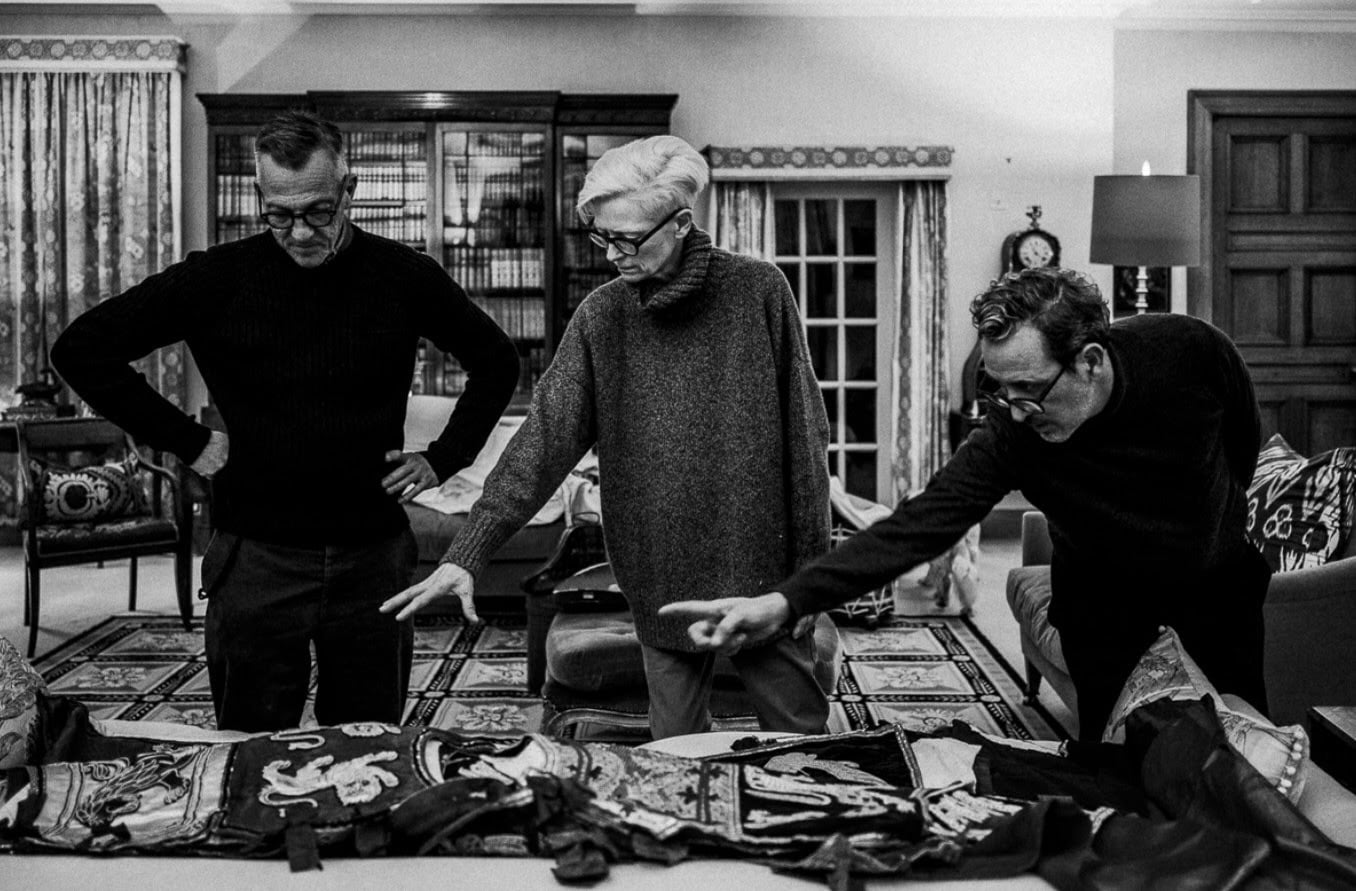
A new Tilda Swinton exhibition has arrived in Warsaw, bringing cinema, photography, fashion and performance into dialogue through the artistic relationships that have shaped the Scottish actress and artist’s practice. Tilda Swinton – Ongoing is on view at the Institute of Creative Industries from September 18th, 2026, to January 17th, 2027, marking the project’s first presentation in Poland.
An exhibition that built on relationships
Curated by Amsterdam’s Eye Filmmuseum in close collaboration with Swinton, Ongoing moves beyond the traditional retrospective. Instead of following her career chronologically, it traces a network of enduring friendships, artistic collaborations and shared experiments.
Eight artists occupy the centre of this story: Pedro Almodóvar, Luca Guadagnino, Joanna Hogg, Derek Jarman, Jim Jarmusch, Olivier Saillard, Tim Walker and Apichatpong Weerasethakul. Working across film, photography, fashion and performance, they reveal Swinton as both performer and creative collaborator.
The exhibition brings together works born from these encounters, including Swinton’s Oscar ceremony dress associated with Michael Clayton, for which she received the Academy Award for Best Supporting Actress.
From cinema to photography and fashion
By placing filmmakers alongside photographer Tim Walker and fashion curator Olivier Saillard, Ongoing expands beyond cinema, examining the intersections of performance, image, costume and film.
Derek Jarman holds a particularly important place in this story. His influence on Swinton’s early career became foundational to her artistic practice, and his work extends into the exhibition’s accompanying film programme.
A new life for a former printing house
The Warsaw edition occupies the South Hall of the Institute of Creative Industries at 65 Mińska Street, housed within a former Polish Press Agency printing works in the Praga district. Its raw industrial architecture contrasts with the intimacy of the creative relationships explored throughout the exhibition.
Award-winning Polish architect Maciej Siuda designed the exhibition, adapting the previously inaccessible hall for its first major public project of this kind.