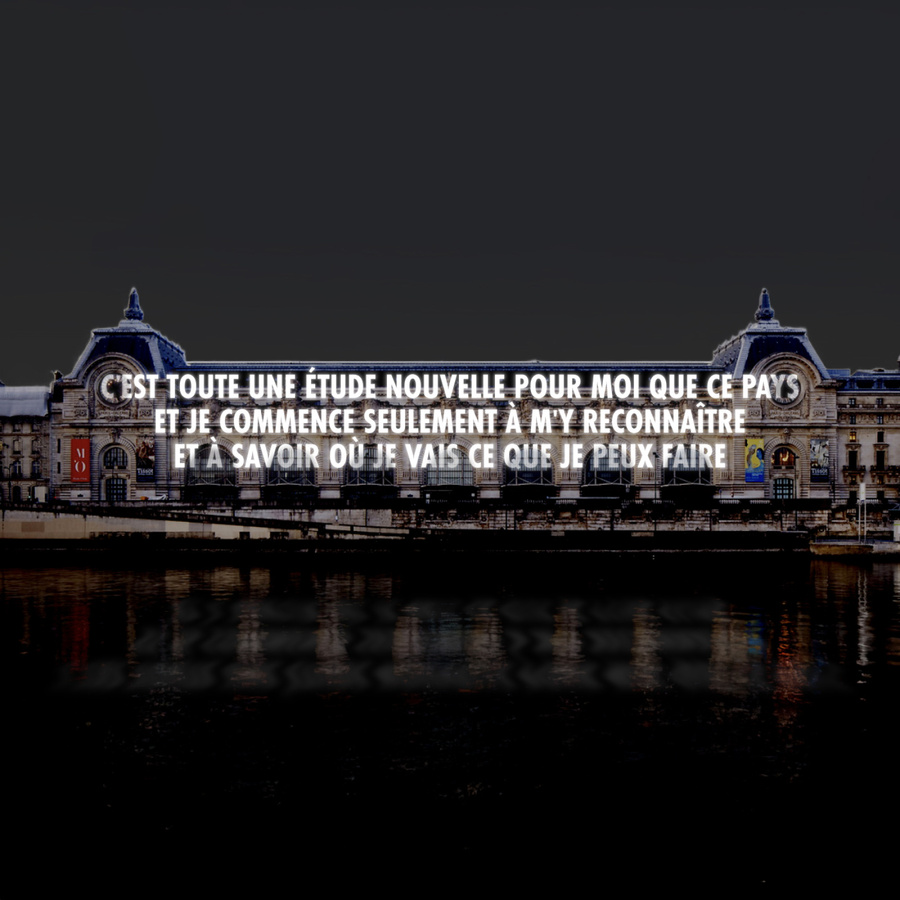
Jenny Holzer’s ÉCLAIRÉ projects nearly 250 excerpts by 34 authors onto the Musée d’Orsay’s historic façade, bringing overlooked voices from French history into the public realm. Running from October 18th to 22nd, 2026, the monumental light installation draws on artists’ letters, literature and political commentary to examine the conflicts that shaped nineteenth- and early twentieth-century France. The work accompanies J’AI VU, Holzer’s exhibition at the museum from October 20th, 2026 to February 21st, 2027.
Words across the Seine
For more than four decades, Holzer has wielded language as an artistic medium and a form of public address, from scrolling LED displays to monumental projections and carved stone. In ÉCLAIRÉ, historical texts sweep across the former railway station’s façade, their visibility shifting with the architecture and night air.
The excerpts address the Franco-Prussian War, the Paris Commune of 1871, colonialism, anarchism, workers’ strikes, military conscription and political corruption. Artists’ correspondence sits alongside literary and political writing, revealing conflicting perspectives on a turbulent period. The projection runs nightly from 7 to 11 pm, freely accessible from the banks of the Seine.
From light to Redaction Paintings
Inside the museum, J’AI VU extends Holzer’s investigation of history and power through illuminated displays, monumental installations and newly commissioned stone sculptures. Seventeen benches and two columns engraved with historical texts engage with the museum’s architecture, while paintings related to war from the collection deepen the exhibition’s focus on conflict, memory and commemoration.
These themes recur in Holzer’s Redaction Paintings, developed from the mid-2000s using declassified government documents and other archival material. Texts printed on linen are layered with oil paint and, in some works, gold, platinum or palladium leaf. Blacked-out passages interrupt legible language, exposing how institutions control access to information.
Addressing torture, surveillance, government corruption, arms trafficking, military technology and artificial intelligence, the paintings confront the tension between state secrecy and public accountability. Their reflective surfaces shift with the light, drawing attention to both what documents disclose and what they conceal.
Across ÉCLAIRÉ and J’AI VU, Holzer makes the visibility of language a political act. Projected onto the museum’s façade or obscured beneath layers of paint, historical words challenge the idea of the past as a settled record, revealing competing voices whose questions remain urgent.
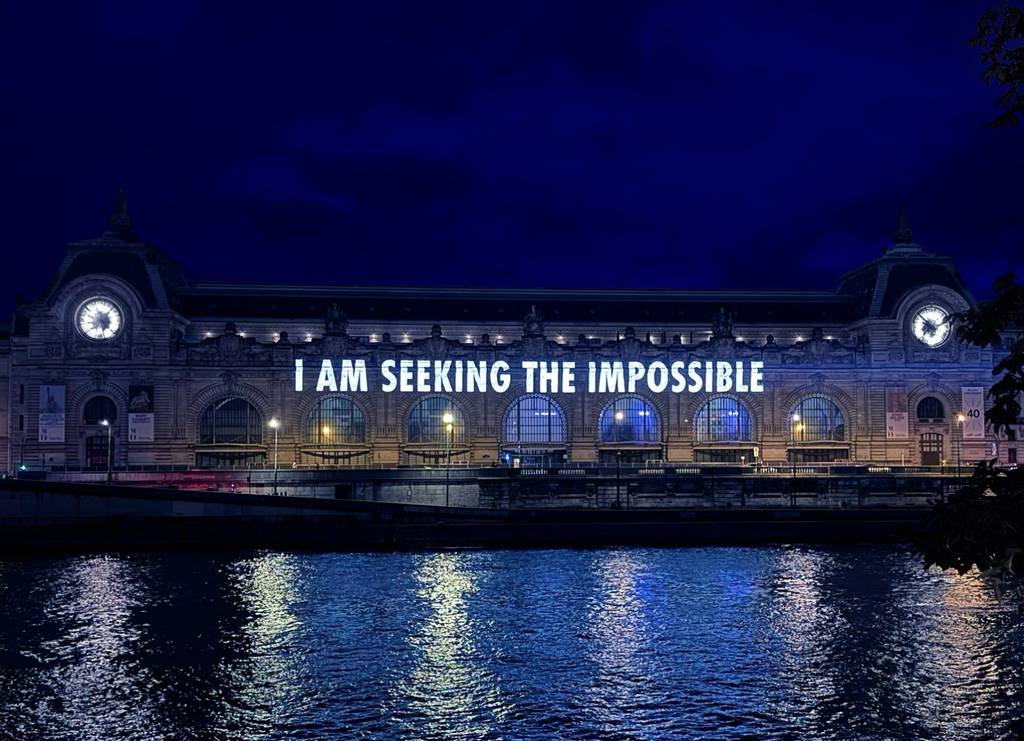
CLAUDE MONET, letter to Gustave Geffroy, September 10, 1918. From Claude Monet: A Life in Letters, THAMES & HUDSON LTD, London
© 2026. Used with permission /ADAGP, Paris