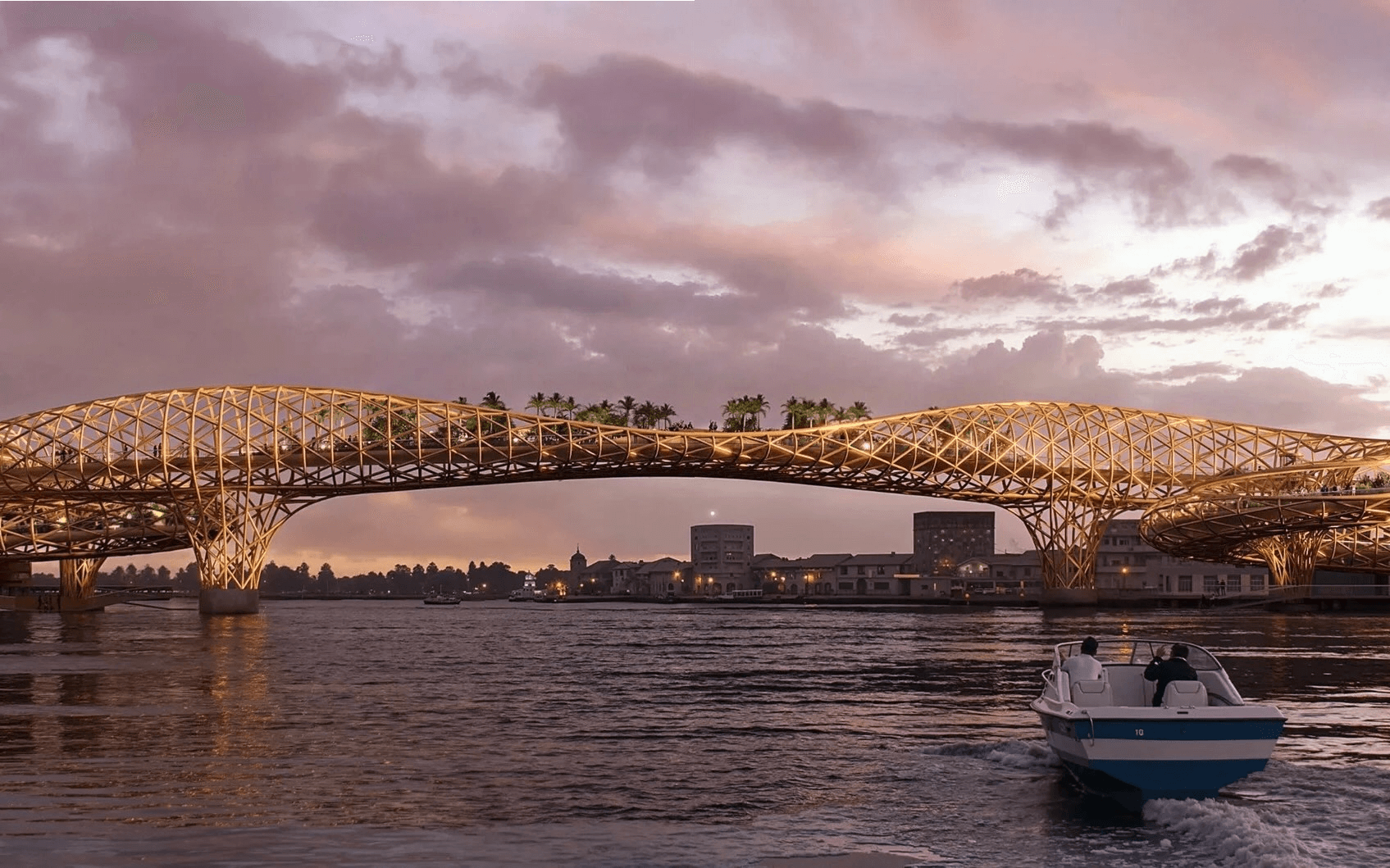
Bangkok is preparing to introduce a striking new pedestrian bridge across the Chao Phraya River, envisioned as both an infrastructural link and an elevated public space. Recently unveiled by the Bangkok Metropolitan Administration (BMA), the proposed project places bridge design at the forefront of urban life, prioritising slow movement, landscape, and human-scale experience over traffic and speed.
Planned between existing vehicular crossings, the bridge will offer a dedicated route for pedestrians and cyclists, creating a people-first alternative to ferries and congested roads. While an official opening date has not yet been announced, the project is currently in the proposal and planning phase.
Bridge design shaped by movement, light, and landscape
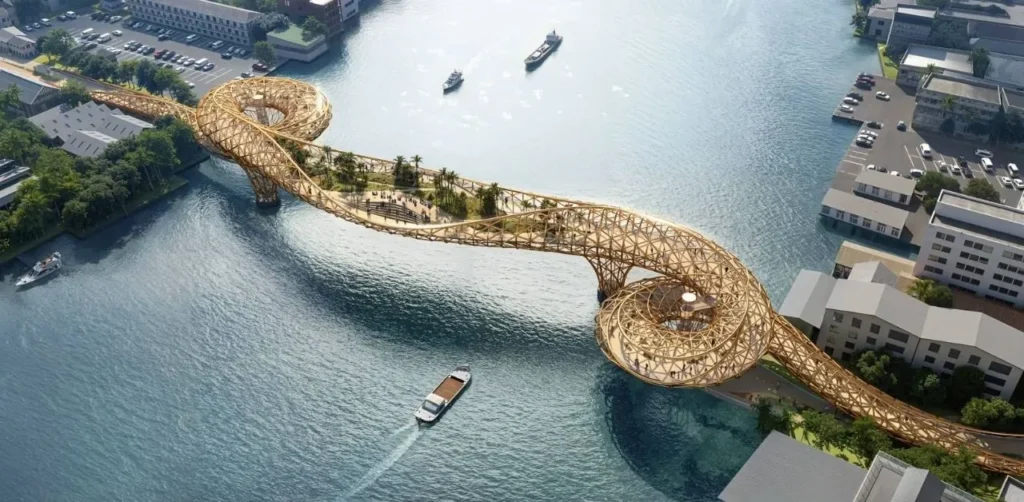
At the heart of the project is a sculptural bridge design defined by a flowing, serpentine form wrapped in gold-toned metal latticework. A diagonal steel grid encases the walkway, forming a semi-enclosed volume that shifts in density along the span. This lattice acts as a passive shading system, filtering Bangkok’s intense tropical sunlight while allowing river breezes to pass freely through the structure.
The bridge subtly widens at its midpoint to create an elevated garden and public plaza. Here, stepped terraces interrupt the linear path, inviting pedestrians to pause rather than simply pass through. Timber platforms integrated into the steel framework provide informal seating, while planters filled with tropical vegetation reinforce the idea of the bridge as a suspended landscape above the water.
A pedestrian bridge connecting districts and daily life
Designed exclusively for foot traffic and cyclists, the bridge will link the historic Phra Nakhon district with the residential neighbourhood of Thonburi. Running parallel to the Memorial Bridge, it introduces a new east–west crossing that complements the existing ferry system and reshapes everyday mobility across the river.
Engineering with environmental awareness
Structural considerations play a key role in the bridge’s design. The deck height has been carefully calculated to allow the safe passage of express boats and cargo barges beneath it. Massive concrete piers rise from the riverbed, aligned with the current to minimise turbulence and reduce impact on the waterway.
Hidden lighting embedded within the lattice structure will softly illuminate the bridge at night, enhancing safety without disrupting views of the river. Environmental and cultural impact studies are ongoing, with a focus on preserving historic sightlines and respecting the Chao Phraya’s ecological rhythms.
This pedestrian bridge is more than just a crossing; it is also conceived as an urban platform — a place to walk, rest, observe and reconnect with the river. If realised as envisioned, it will become a contemporary landmark that stitches together Bangkok’s past and present through its thoughtful design and human-centred architecture.
Images courtesy of BANGKOK METROPOLITAN ADMINISTRATION (BMA)