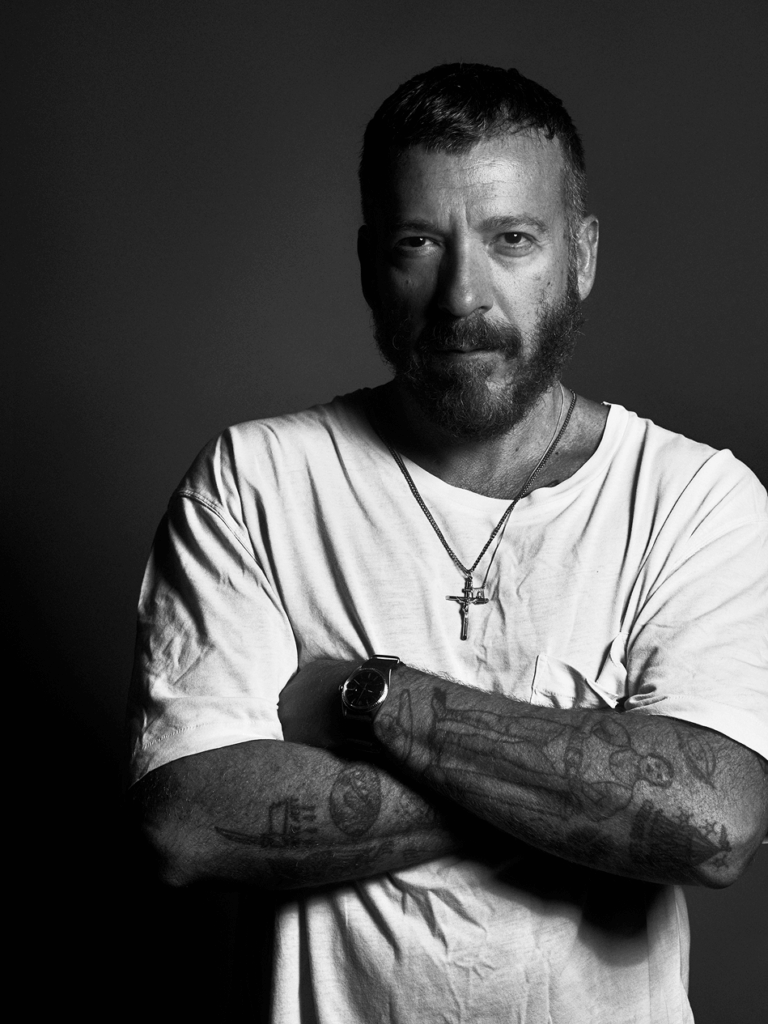
Photography by FILIPPO THIELLA

Photography by ALESSANDRO FURCHINO


Photography by ALESSANDRO FURCHINO
Andrea Pompilio is an Italian fashion designer with a career spanning collaborations with Prada, Calvin Klein, and Yves Saint Laurent. His work is defined by a thoughtful exploration of modern masculinity—balancing structure and fluidity, tradition and irreverence. Pompilio’s designs favor an outlook that transcends strict European codes, resulting in garments that move comfortably between the runway and the street. Since establishing his own label, he has cultivated a reputation for collections that marry sophisticated tailoring with a lived-in sensibility, often reinterpreting traditional sartorial elements through an international lens.
Since 2017, as Creative Director of Onitsuka Tiger, he has brought this same restless intelligence to one of Japan’s most storied sportswear houses. There, he has braided European craft with Japanese heritage and a broader global outlook, producing collections that feel like conversations across continents. Throughout his work, Pompilio returns insistently to the primacy of emotion and intuition—qualities he views as stubbornly human and resistant to replication. In his hands, fashion becomes a way of seeing the world that finds beauty in its imperfections and freedom in its contradictions. In this conversation with hube’s editor-in-chief, he reflects on the beauty he finds in the “wrong” things, the principles that shape his work at Onitsuka Tiger, and the limits of AI in fashion.
Sasha Kovaleva: You grew up in a creative household with your family deeply involved in clothing. How did this environment shape your earliest understanding of beauty and form?
Andrea Pompilio: It definitely affected me. The family business was totally different from what I’m doing now, but I grew up in a very creative environment. So more than affecting my good taste, I believe it affected my mind—it opened my mind to absorb all the information in the family, and especially when I grew up, from every different point of view: art, cinema, music. All of this created my creativity. It’s more that they passed an open mind to me, my family, so that by the time I grew up I could absorb so much information in a very different way. That definitely helped a lot.
SK: The human body is one of the most enduring and significant themes in the history of art and often serves as the starting point for discussions about beauty. Fashion is intricately connected to the human body, to its proportions and functionality. How do aesthetics and utility intersect for you?
AP: I don’t consider myself an artist, first of all, because I think there’s a big difference between art and fashion. Fashion people just make beautiful things, beautiful clothes, playing with proportion, for example. But I don’t consider myself, or even my colleagues, artists. I think art and fashion connect, but there is a big, big difference.
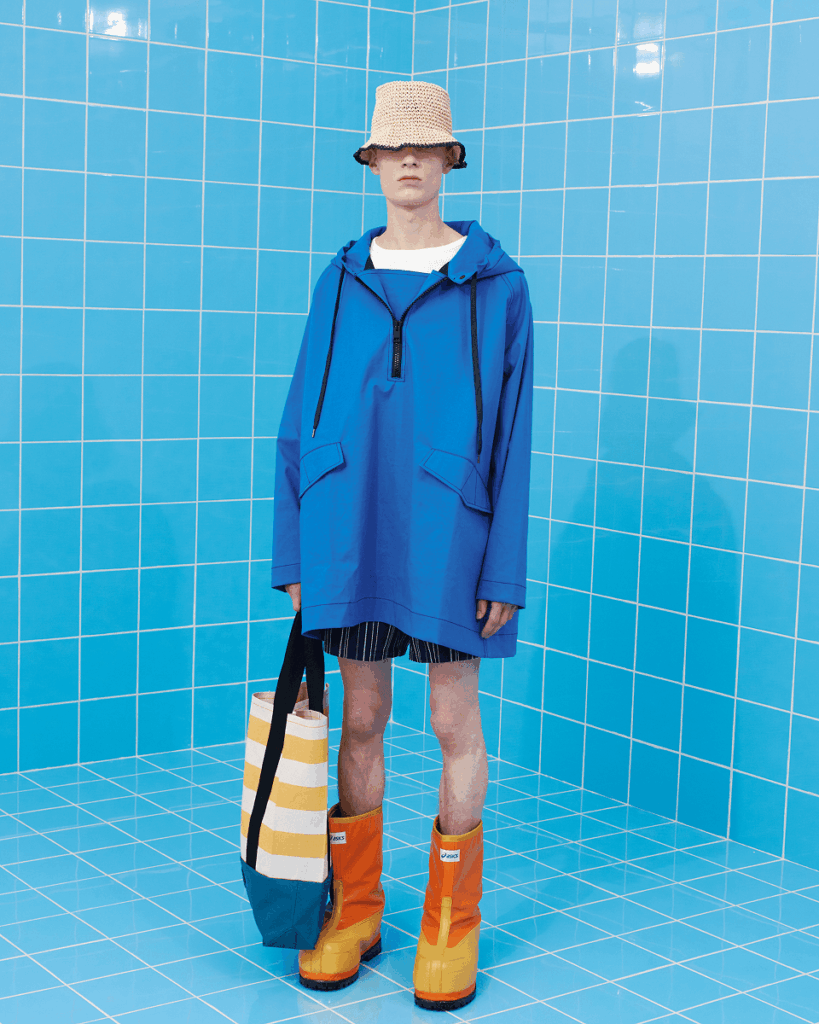
I’m always attracted to very weird things and very wrong things, and I think what’s made my career quite successful is that I’ve always been interested in wrong-taste people, wrong color combinations, and so on. I created my whole thing from this—my signature, in a way, is built on this kind of thing. Sometimes we love it when we’re styling, my colleagues, collaborators, and I, because it reminds us of something—“Oh my God, she looks like she came out of the house to go pick up the bread downstairs.” But for me that’s cool. It’s the easiness.
Maybe it’s because I grew up in Italy, and there, and in Europe in general, we have a totally different way of dressing compared to the rest of the world. We’re very attached to the fashion industry. We know what’s good and what’s not good; we all have very good taste. So the fact that I grew up always with very good taste next to me makes me much more interested in bad taste than in the good one. That, for me, is extremely interesting, because I reinterpret almost everything I see as bad taste in my own vision, with my own eyes. Sometimes, to other people, it looks beautiful; they say, “Wow, this is great, how did you do it?” But everything comes from the bad side. Nothing comes from the good.
Sk: Your own label has been celebrated for its sophisticated yet wearable menswear. What core idea of modern masculinity have you sought to explore and evolve through your collections over the years?
AP: It all starts from bad combinations, but always with a very sartorial touch. In my family, for example, I had two grandfathers, totally different, and it was very formative for me. One was like the perfect man—always very well dressed, always with the Borsalino hat, always with the Church’s shoes, the convertible car, almost like the playboy of the town. The other was like a military general. Both of them represented elegance in a totally different way, and for me that was a very big starting point as an attitude toward elegance.
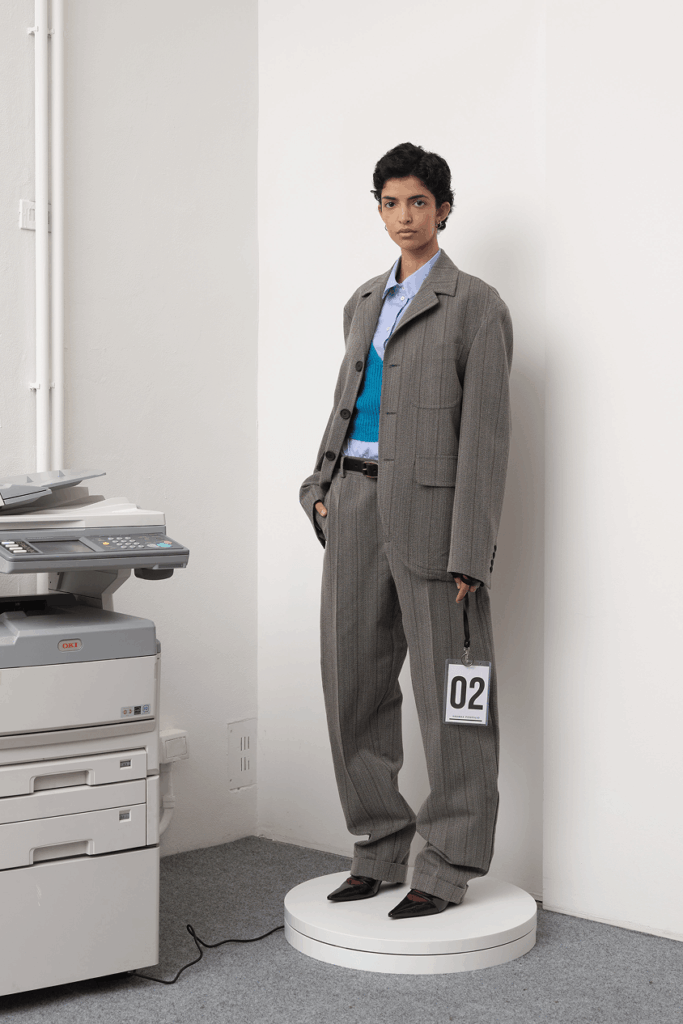
On the other hand, I connect these two men to my own taste. My taste is always looking around, watching people and the way they dress, and trying to create a new elegance in a way—starting from the sartorial concept of the jacket, the trousers, the coat, but mixing it in a very international way. When I say international, I mean less European: playing with color, putting the wrong shirt with the wrong trousers, but it comes out as a cool thing. So I consider myself much more international than an Italian or European person or brand—because my taste, sometimes, I find quite hard to pin down to an Italian or European mind.
SK: Since 2017, you have served as Creative Director of Onitsuka Tiger. What drew you to this iconic Japanese sportswear heritage, and how has reinterpreting it allowed you to bridge Eastern and Western sensibilities?
AP: It’s very strange, because the approach I had with Onitsuka Tiger from the beginning was exactly the same one I explained before. First, to create a more international brand with a strong DNA of Japan, but with a European or Italian vision, because I’m designing for them. The mix of all this creates the DNA of the whole collection, the Onitsuka Tiger DNA, in one way. As an Italian, I love Japanese culture, and I try to represent it—but I don’t want to represent only Japanese culture. I want to represent an international point at the same time. So there’s a mix: internationality, Japanese culture, and my own European vision, all together.
SK: Fashion is often discussed as a language, but languages can become repetitive or exhausted. What keeps your vocabulary from becoming predictable over time?
AP: Sometimes predictable is good too, in a way. I try not to be too predictable—that’s for sure. But I have a couple of colleagues who did very lush collections for five years, and then the next collection is totally minimal. It doesn’t match the rest, and it’s much more predictable than what they did for the last five years—but it was cool at the right time. So I think it’s a matter of how you do something, and when. If it’s the right time for this, it’s the wrong time for that. It’s about timing, because sometimes you can do even a predictable collection, or a predictable piece of clothing, but if the timing and the market and everybody are looking for that, it’s perfect.
So it depends a lot on our hearts—and I’m not talking about myself, I’m talking in general, about our creativity in the fashion industry. We play a lot with art. We play a lot with sensation. There’s no recipe to make a collection; it’s about emotion. I choose purple because at that moment purple gives me a good vibe. I choose green because green gives me a good vibe. I choose that proportion because that proportion, for me, is new in my mind—maybe it’s not new for somebody else, but for me it’s new. So I always try to listen to my brain and my heart together.
SK: In an age of AI and rapid replication, what irreplaceable human qualities do you believe will continue to define authentic creation?
AP: A lot, honestly, because artificial intelligence takes its information from the internet. It doesn’t have a personality. It doesn’t have—as I explained—a brain. It doesn’t have a heart. So art in general, I think we’re safe. Art and fashion can’t be replaced by artificial intelligence at all, because it’s about the emotion of the person behind the brand. It’s the emotion of the artist. The guy who’s singing—there’s emotion. I don’t think, at the moment, that can be replaced. Maybe after our generation something will change, but at the moment I’m not scared about artificial intelligence.
I think it’s extremely useful for so many things. Sometimes in the most daily way—for example, I go to the doctor, I get all the information, and I look it up with AI—this is super convenient. But if I ask for something else, it’s not going to be equally nice. It’s good at taking information from the biggest computer in the world, but if something isn’t there, it can’t reply to you, because that information isn’t there. Plus, as I said, it’s about emotion. Life is about emotion—and especially the whole life of art. Artistic people play a lot with emotion, and I don’t think artificial intelligence can represent that part, at the moment.
SK: We live in a world where rigid concepts of gender still heavily impact many aspects of our lives. Exploring and observing the evolution of women’s and men’s fashion, how do you see the future of fashion in terms of gender?
AP: I’m quite a free person. It depends on the company, for sure, because I do a lot of consulting—some companies are quite open-minded, and some maybe still prefer to keep women and men separate, without thinking about other genders. But I think the most important thing isn’t really about the clothes; it’s about mentality. I can show a beautiful dress on a beautiful model on the catwalk, but if somebody else wants to wear it, I’m totally open to it—and I love it. That doesn’t mean I’m not open to seeing a boy in a skirt, or a boy in a beautiful lace dress. Or a woman who feels beautiful in a tie, the bow tie, the tuxedo, or the jacket. I find this extremely interesting, because fashion is about freedom, especially for me. Even these contrasts, they make me really alive, very happy, and very interested.

Photography by ALESSANDRO FURCHINO

Photography by NIC SOLAND


Photography by ALESSANDRO FURCHINO

Photography by ALESSANDRO FURCHINO

Photography by ALESSANDRO FURCHINO

Photography by ALESSANDRO FURCHINO


Photography by FILIPPO THIELLA
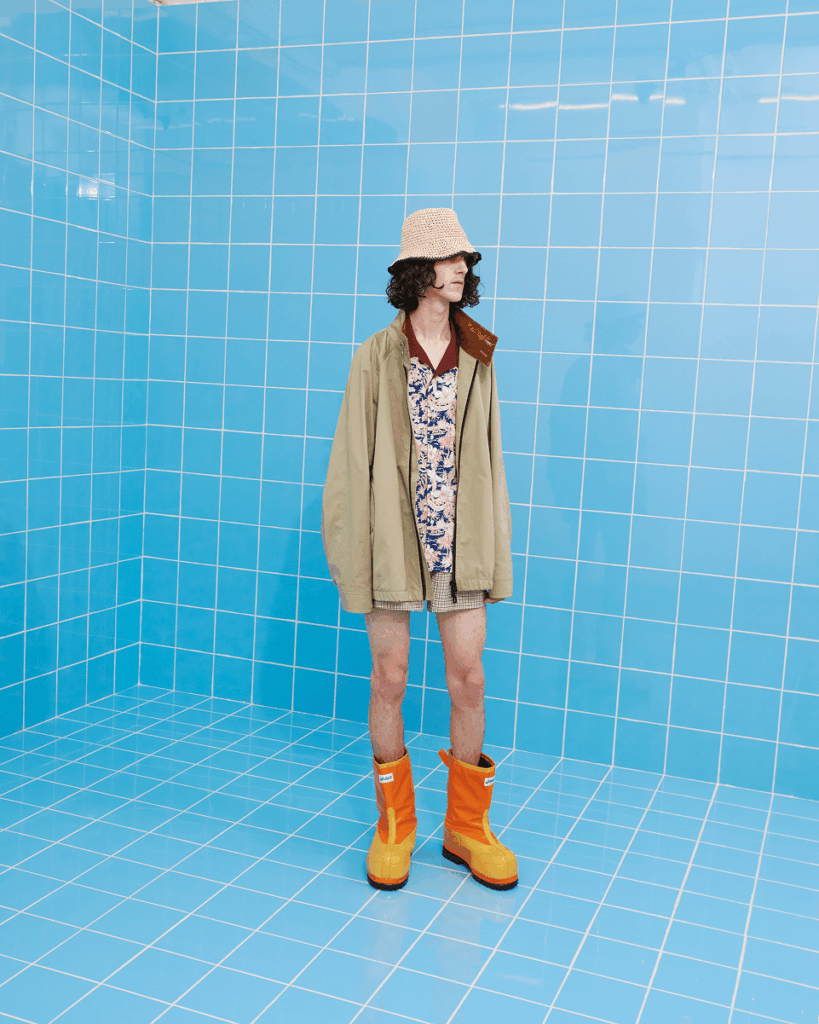
SK: You often move between Milan, Tokyo, and other creative hubs. How does place actually enter your design decisions—beyond inspiration or aesthetics?
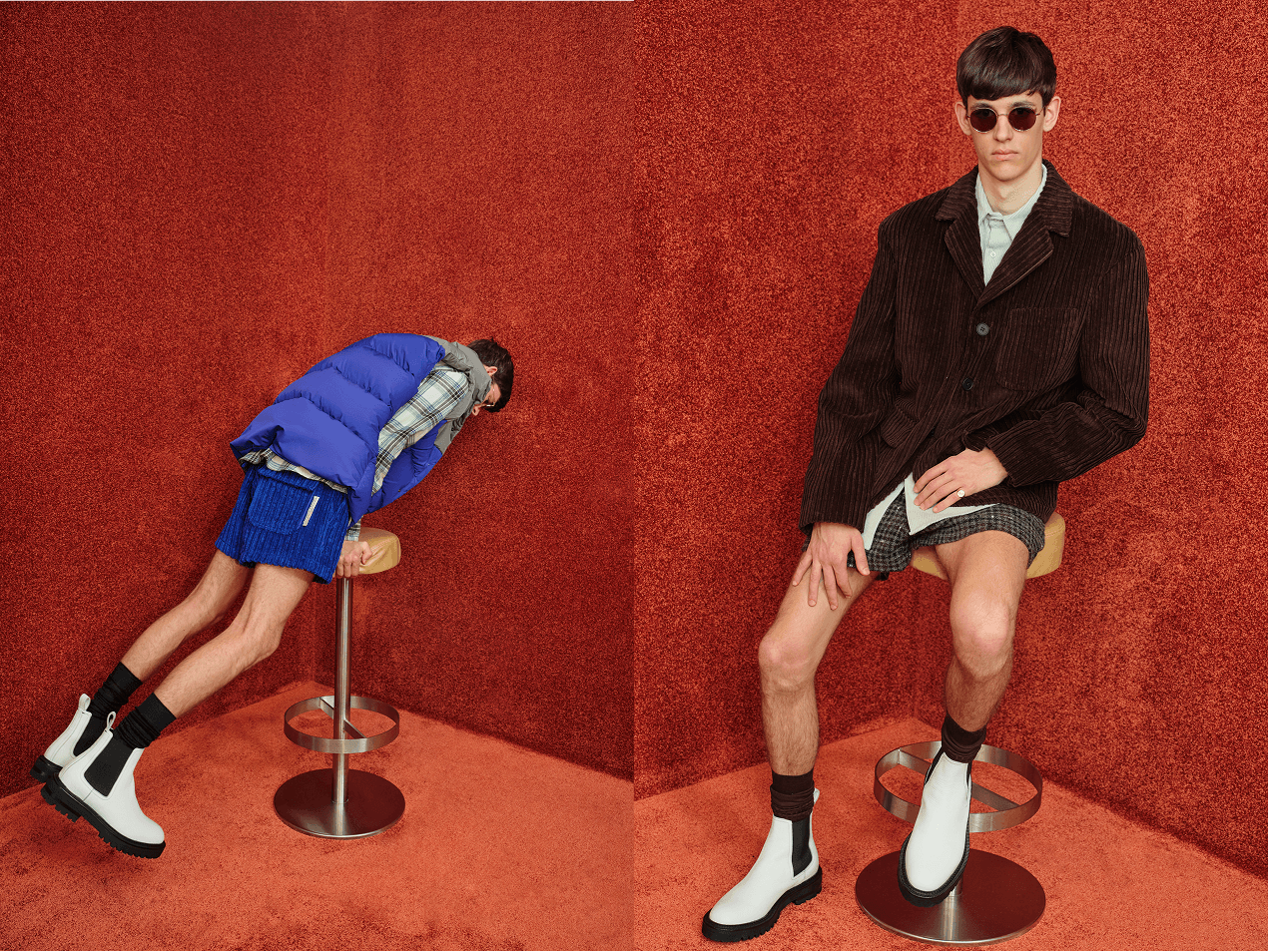
AP: This is everything for me. Travelling, music, art, cinema are some of the most important inspirations of my life in general—not only for my business, for fashion, but for life in general. So travelling is one of the most important things, especially understanding and seeing different cultures. It’s exactly the same clash of ways of putting stuff together—maybe it doesn’t work. Sometimes, at the point of styling, we say, “Oh my God, this look is so nice—but where do they come from, the white boots?” I remember I was in New York, and I saw a very wasted lady living on the street with these beautiful cowboy boots, skirt, and a leather jacket. In my mind I took a picture of that, because everything was wrong, not good at all, but in that one picture I found something. I created a totally different look, inspired by that one, and it was super good.
SK: What was the last piece of art, music, or writing that moved you deeply?
AP: There isn’t only one, because I’m a very curious person—I put my nose everywhere: art, cinema, comics, everywhere I can. This is one of the most difficult questions to answer, because there’s nothing really attached to me. Both when something is really precious for me and when something is really horrible for me, I can always find something beautiful—about a painting, or a piece of art, or a movie. So it’s quite hard to answer, because I think there’s always beauty in everything, in one way, and there’s no one favorite thing or one negative thing.
I’m quite open to seeing the good even in the negative things that sometimes happen in life. You say, oh, why is this happening to me? It’s happening because there’s a reason—because I need a change, because I need to jump to the next train, take the next trip. So even this reflects my personality a lot, and it’s why I find it very difficult to judge, or to choose one special piece of music or one special artist. In the morning, I wake up to classical music. At the gym, I need something stronger. At night I go dancing in the club. Even in one of my days there are a lot of different moments, and for each different moment I need something different.
SK: What is something in fashion you secretly find underrated?
AP: This is one of my favorite questions, actually, and I always answer with a very simple thing: two things, the white T-shirt and the menswear boxer, because for me they represent the sexiness of a man. They’re worn underneath, so you don’t see them from outside, but they’re secretly yours. No one thinks about them, but for me they’re the most important and beautiful and sexy accessory ever. And I even find it extremely sexy to see a woman wake up out of bed in a menswear boxer. So there’s this kind of confession in my mind about these two pieces. The white basic T-shirt—they’re all the same, but they’re not all the same. And the boxer—they look all the same, but they’re not all the same.
SK: If you could invite any 3 people—living or dead—to dinner, knowing they would definitely attend, who would you choose?
AP: For sure, Marilyn Monroe, because I was very attracted to her, and I’d like to spend a dinner with her to understand whether she was a very clever girl or just nuts. We always have this beautiful person, but I never understood how clever she was, or how stupid.
The second one is Michael Jackson, because I was very impressed by his style, and I’d like to spend one night at dinner with him to understand him a little bit more. He was always so powerful with his music, but they always said so many things about him. And because I’m quite good at reading people, at catching the sensibility of a person, I’d like to spend some time with him.
The third is John F. Kennedy Jr.—because he was one of the most iconic and handsome men. If you ask who’s the most beautiful man in the world, you probably have John F. Kennedy Jr. in mind, and he represents me a lot, because he was always dressed in an extremely wrong way. Check it out: sometimes he looks good, but sometimes he’s totally wrong—the baseball cap with the English jacket, the T-shirt underneath—it’s totally wrong. It became iconic, and that’s part of my philosophy sometimes, exactly what I was trying to explain about how I love wrong things together. We’re talking about the eighties and nineties—but that’s exactly what I was trying to explain to you before about myself.

Photography by NIC SOLAND