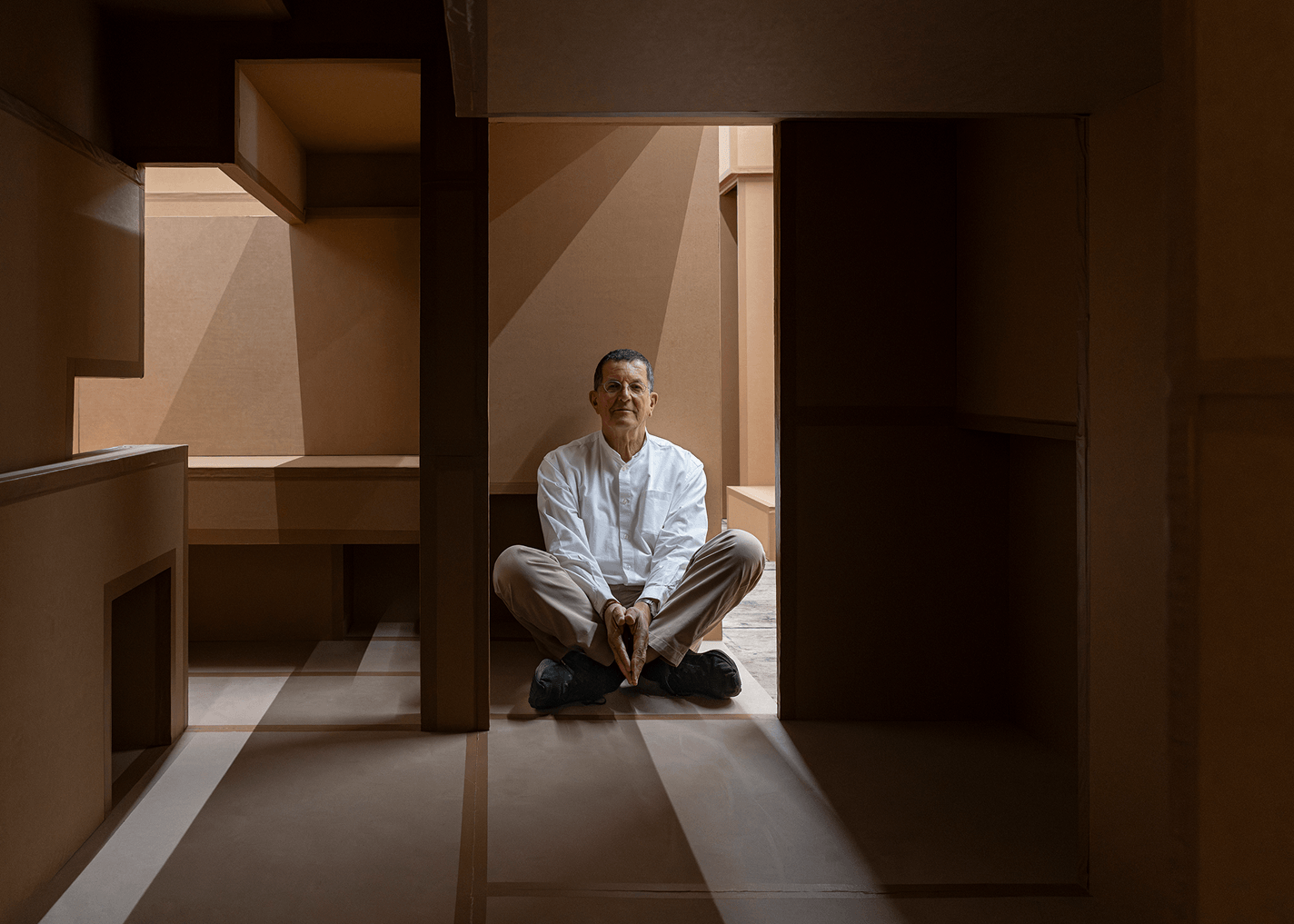
“I never wanted the work to colonise space. I’ve always wanted it to activate space,” insists British sculptor Antony Gormley, and if the history of sculpture has largely been written through objects, Gormley has spent the better part of four decades arguing that its true subject lies elsewhere. Not in the thing itself, but in the space it displaces, activates, and makes conscious. “The subject of sculpture is space-making,” he insists, a statement that fundamentally overturns the traditional understanding of sculpture as an art of form, monument, and representation. The late American sculptor Richard Serra saw space similarly, observing that “The space of the work is not the space of the sculpture; it is the space between the sculpture and the observer.” For Gormley, sculpture is less concerned with what we see than with what we experience. It is an instrument through which we become aware of our own physical presence in the world, of our weight, our vulnerability, and our movement through space and time. As he goes on to explain, “Sculpture is the articulation and the instrument through which our spatial experience is made apparent to us, made conscious and felt.” The body remains central to this enquiry, but not as an image to be observed. Rather, it becomes a site of testing, a vessel of consciousness, and a measure through which the invisible dimensions of existence might be felt.
The exhibitions What Holds Us (9 May – 13 September 2026) at Galleria Continua, San Gimignano, and Geestgrond (23 May – 20 September 2026) at KMSKA, Antwerp, reveal the continued evolution of that enquiry. Throughout our conversation, Gormley repeatedly returned to the distinction between appearance and experience. “Surface alone,” he argues, “is insufficient.” Reflecting on Buddhist and Hindu sculpture encountered during recent travels through Sumatra and Java, he speaks of an “inner breath”: a latent pressure within the body that exceeds outward form. What interested him was not the description of anatomy but the suggestion of an interior life; the sense that matter could somehow carry spirit. The body emerges not as a collection of organs and limbs, but as a container of sensation, memory, consciousness, and being.
This concern with interiority has increasingly led Gormley towards architecture. Yet architecture, in his hands, is never merely functional. “The living body,” he suggests, depends upon a “second body”, the built environment that humanity has constructed around itself. Buildings become extensions of ourselves, just as cities become materialisations of the collective body. The remarkable proposition of recent works such as Innercity lies in their collapse of the distinction between sculpture and architecture. Bodies become buildings; buildings become bodies. The viewer is invited not simply to look, but to enter, crawl, kneel, and navigate. Space ceases to be something observed from a distance and instead becomes something encountered physically. Here, Gormley recalls the insight of French philosopher Maurice Merleau-Ponty, who argued that perception emerges not through detached observation but through the body’s immersion in the world. We do not stand outside space contemplating it; we understand it because we are already within it.
The implications of this shift are profound. Gormley’s sculptures refuse the traditional monument’s claim to permanence, authority, and spectacle. Instead, they propose uncertainty, dependency, and vulnerability. Their crude blocks of basalt, terracotta, iron, and cardboard carry emotional states not through narrative description but through bodily attitude and spatial relation. The artist speaks of leaning against a wall, of loitering, of uncertainty, even of terror. These are not emotions illustrated by sculpture but embedded within it. Material itself becomes expressive. Stone breathes, brick feels, architecture dreams. Perhaps the most compelling aspect of Gormley’s current work is its insistence that sculpture remains a fundamentally human enterprise in an increasingly disembodied age. Against a culture dominated by virtual experience, his work returns us to weight, gravity, touch, and scale. French philosopher Gaston Bachelard once described architecture as “the topography of our intimate being.” Gormley extends this proposition further. His sculptures become spaces of possibility rather than functionality; places where the body might rediscover itself through movement, hesitation, and encounter. They ask us to feel rather than merely recognise, and to inhabit rather than simply consume.
In conversation there is a real feeling of the elemental, that has eroded from our lives, and at the heart of this practice lies a deceptively simple conviction: that the body is not an object in the world but a place within it. “I want people to get inside my work, both empathetically and physically,” Gormley remarks. It is a statement that illuminates the trajectory of his entire career. From the earliest body casts, when you see photographs of him first wrapping himself in clingfilm before being covered from head to toe in plaster, effectively mummified for what must have felt like a lifetime, to the expansive architectural environments of today, his sculpture has consistently sought to transform viewing into experience and objects into situations. What emerges is not a representation of human presence but a means of testing it. The body becomes building, sculpture becomes space, and space itself becomes the medium through which we encounter the possibility of being alive. His ambition, as he explains, remains to place “a human-made thing back into an elemental context.” Whether submerged by tide, exposed to weather, or set against the immensity of landscape, his sculptures are never autonomous objects. Rather, they operate as instruments of awareness, reminding us of what he describes as our continuing dependence on the biosphere. In this sense, sculpture becomes less an act of occupation than a form of orientation, a means of locating the body within larger systems of time, matter, climate, and space.
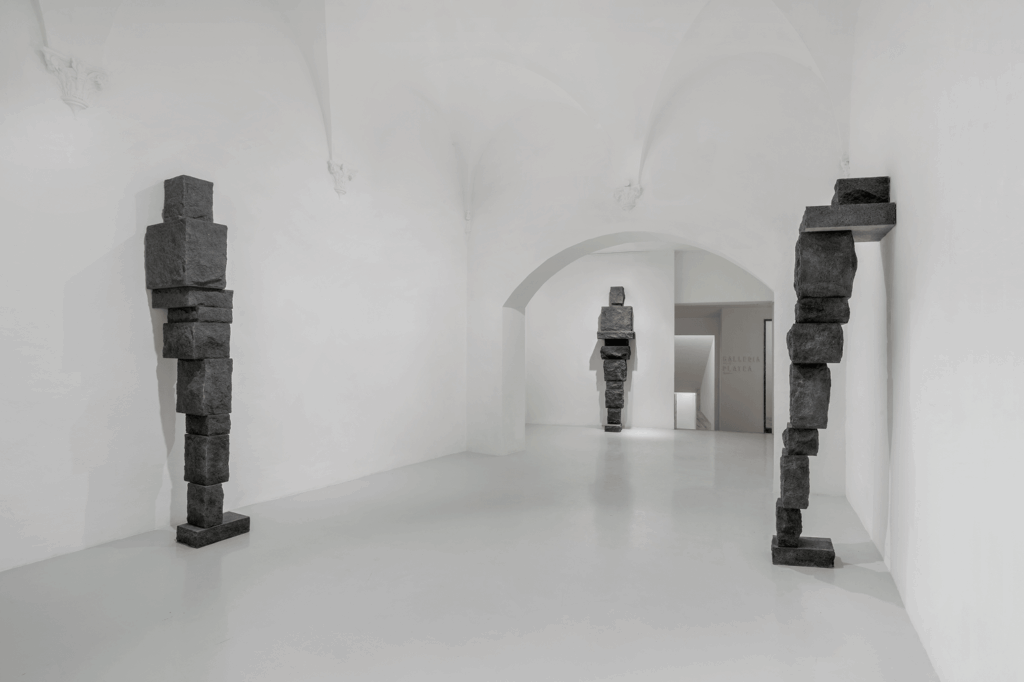
What Holds Us, 2026, exhibition view GALLERIA CONTINUA, San Gimignano. © the Antony Gormley, What Holds Us, 2026, vedute della mostra GALLERIA CONTINUA, San Gimignano, © l’artista e GALLERIA CONTINUA
Photography by ELA BIALKOWSKA, OKNO STUDIO
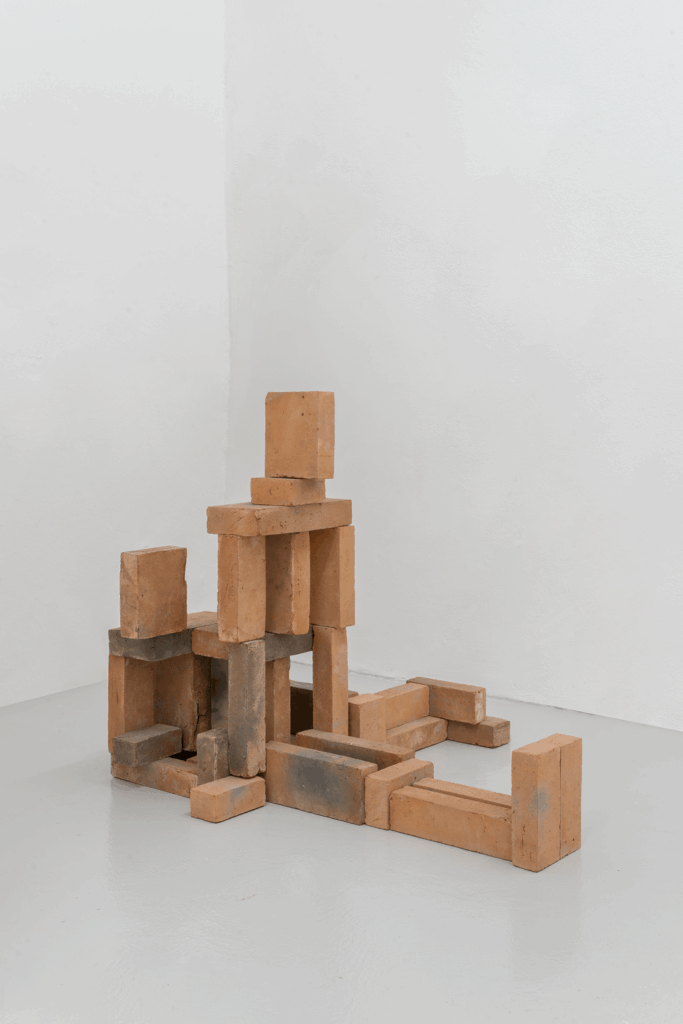
SMALL HARBOUR, 2026, clay, 54.5 x 56.5 x 69 cm, 21.46 x 22.24 x 27.17 in.
Courtesy of ANTONY GORMLEY and GALLERIA CONTINUA, Copyright: © the Artist Photography by ELA BIALKOWSKA, OKNO STUDIO
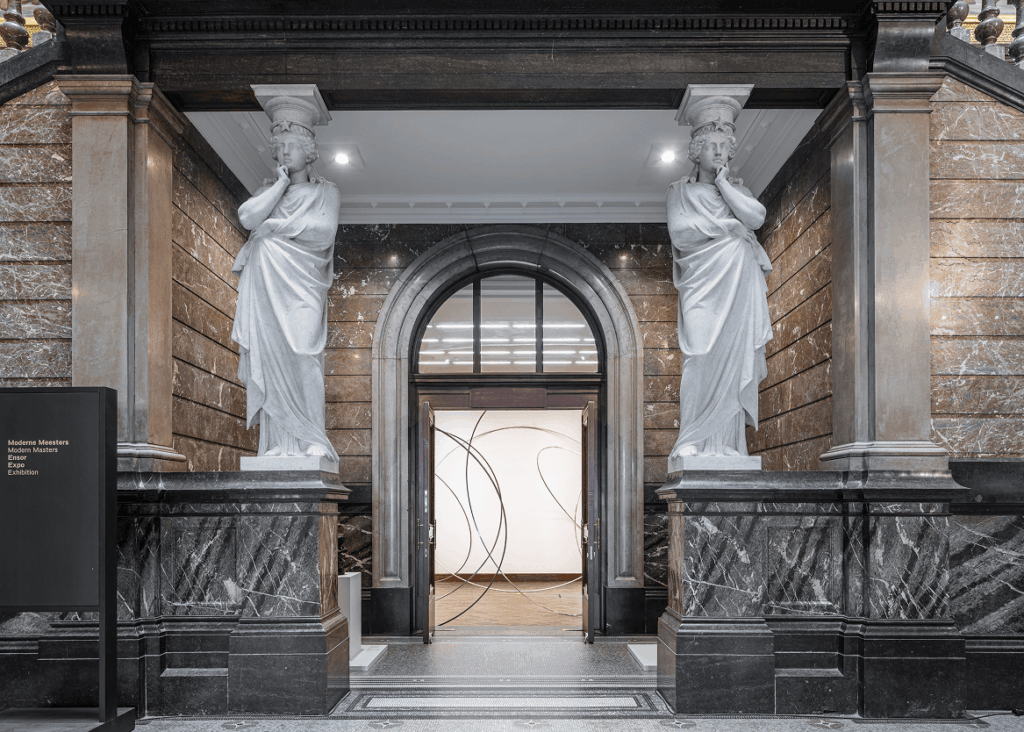
Orbit Field III, 2026, 37 rings of 23 mm square section aluminium tube and stainless steel spigots, dimensions variable
Photography by OAK TAYLOR-SMITH, courtesy of ROYAL MUSEUM OF FINE ARTS ANTWERP (KMSKA)
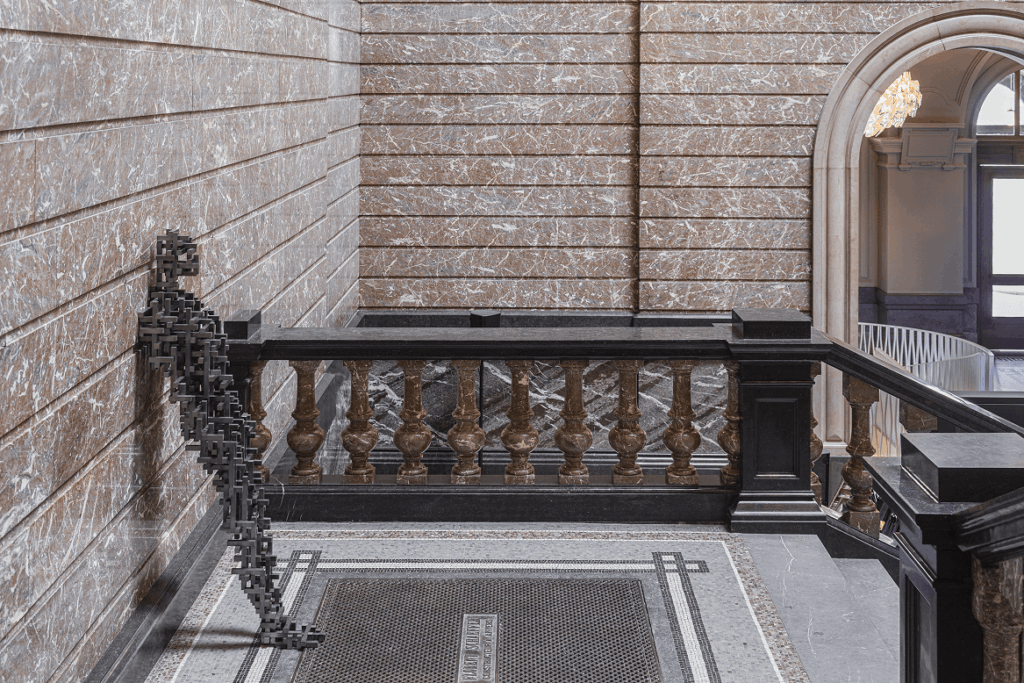
Brace, 2023, 20 mm square section mild steel bar, 176.6 × 48.3 × 76.5 cm.
Photography by OAK TAYLOR-SMITH, courtesy of ROYAL MUSEUM OF FINE ARTS ANTWERP (KMSKA)
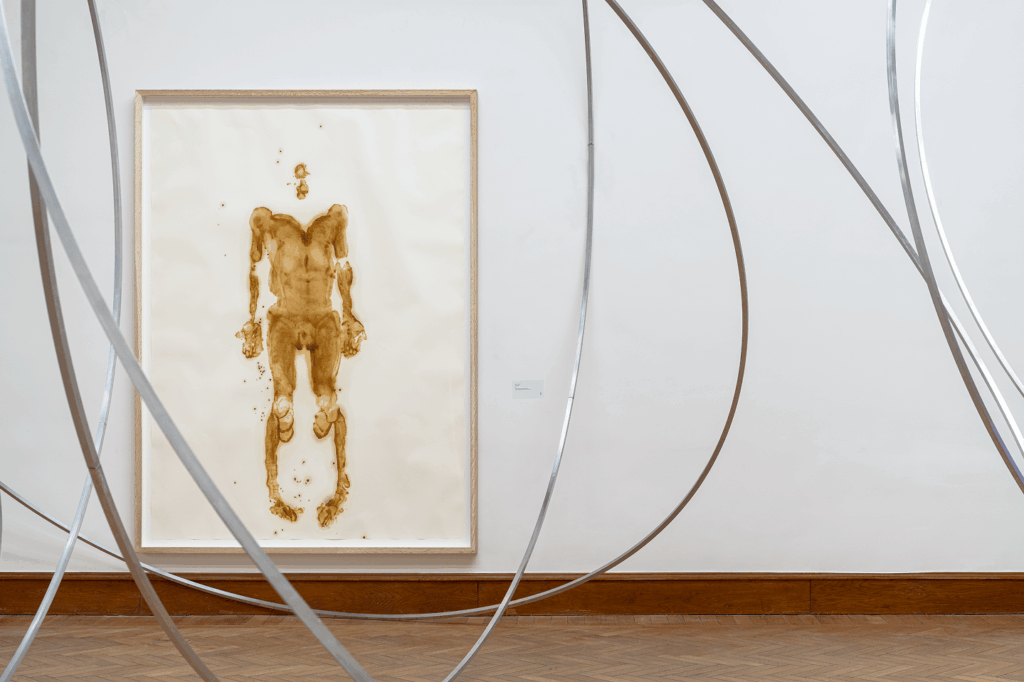
Ground, 2025, crude oil, linseed oil and petroleum jelly on paper, 240 × 173 cm, and Orbit Field III, 2026 (detail), 37 rings of 23 mm square section aluminium tube and stainless steel spigots, dimensions variable.
Photography by OAK TAYLOR-SMITH, courtesy of ROYAL MUSEUM OF FINE ARTS ANTWERP (KMSKA)