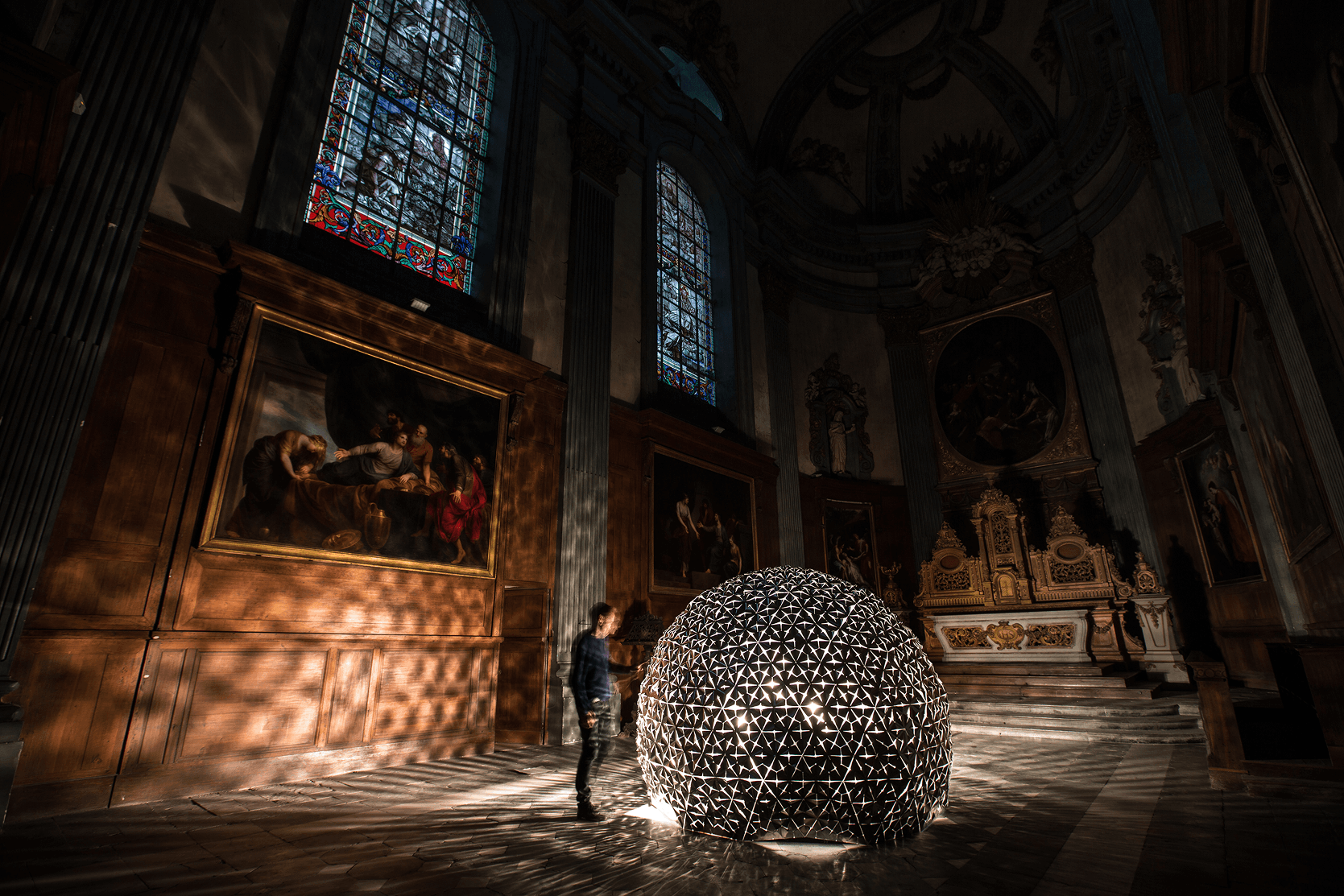
Daan Roosegaarde founded his studio in 2007 in a former glass factory in Rotterdam, a place he still calls the Dream Factory. There, with a multidisciplinary team of designers, engineers, and scientists, he develops what he terms “landscapes of the future”: immersive public installations that sit at the intersection of environmental art, technology, and innovation.
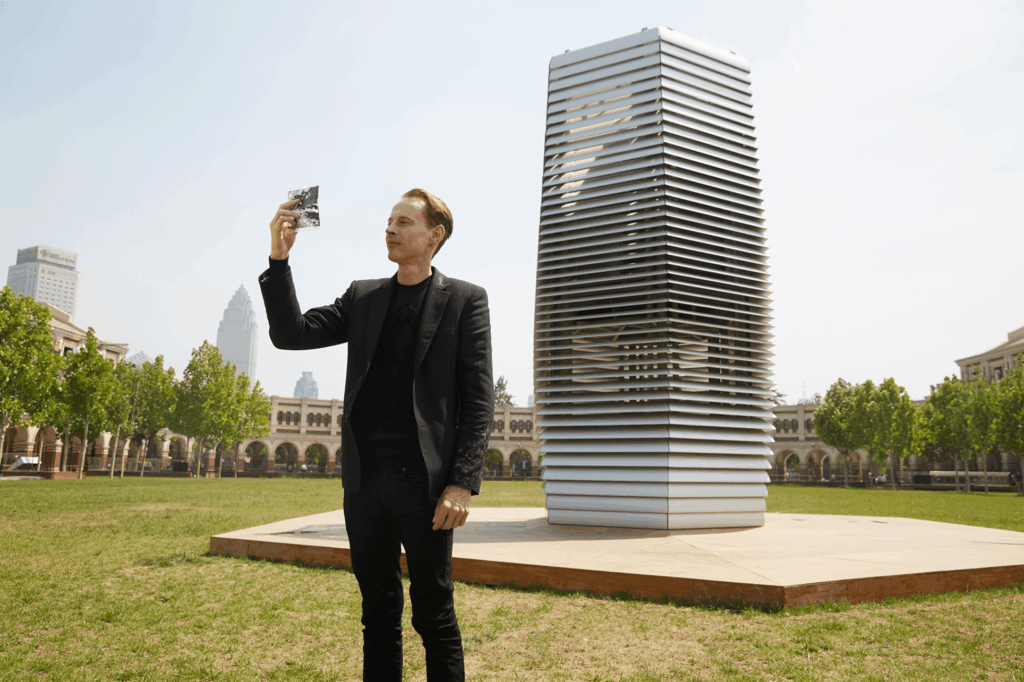
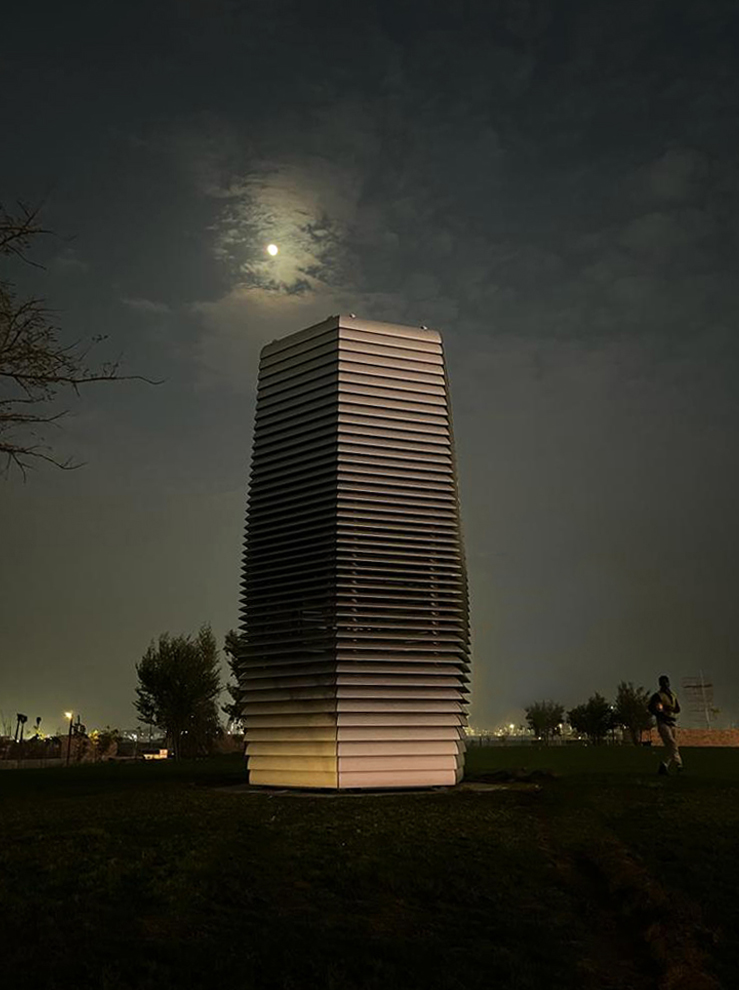
Light is his preferred medium—almost weightless, yet capable of rendering the abstract tangible. A virtual flood can hover above a city square; his patented Smog Free Tower—a giant outdoor vacuum cleaner—can create pockets of clean air and condense smog into jewelry; a bicycle path can glow with the remembered brushstrokes of Van Gogh; space debris can be reimagined as controlled shooting stars. These projects are frequently collaborative, developed in conversation with institutions as varied as NASA, ESA, and local farming communities, and they treat nature less as subject matter than as co-author.
The studio’s guiding conviction appears to be that people are moved less by data than by experience, and that the most effective environmental argument may be the one that arrives, unexpectedly, as wonder. Roosegaarde’s installations function as temporary atmospheres—spaces raising environmental awareness, where questions about pollution, biodiversity, clean energy, and even the night sky can be felt rather than merely discussed. In an age crowded with forecasts and statistics, his work proposes something more elusive: that the future might still be imagined as a place one would actually want to inhabit, and that art, at its most effective, can help us rehearse that possibility in the present.
hube: Looking back, what was the moment you realized beauty could be a form of activism?
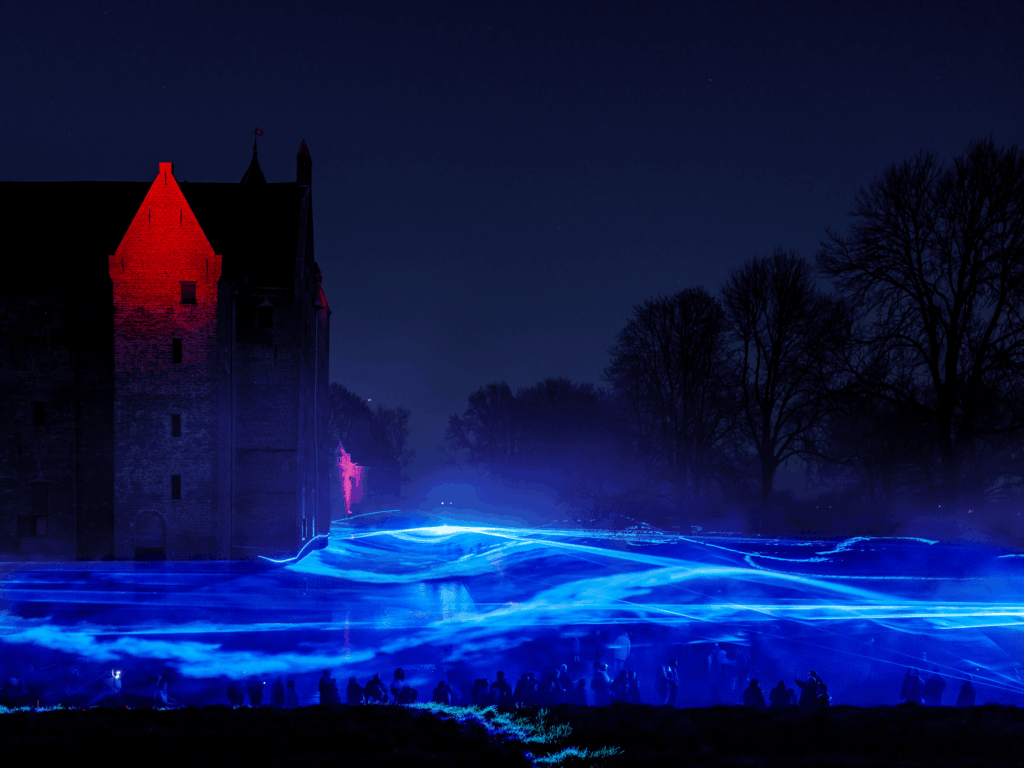
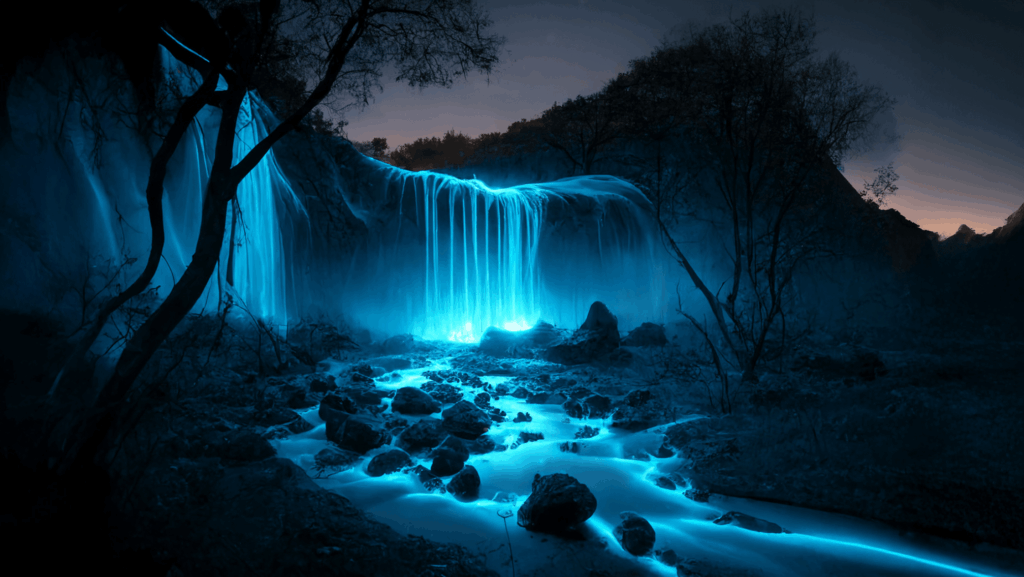
Daan Roosegaarde: There are so many moments. People don’t change because of numbers, but because of experiences—we all do, of good and bad ones. The first thing that comes to mind is when we did Waterlicht in Amsterdam at Museumplein: sixty thousand people under those blue waves. It was magical, but also a bit eerie and scary to realize this could actually be the water level around the year 2100 if we don’t act. Using beauty as an activator to make people feel more connected with the future, and just seeing their experiences and intimate interactions—when I’m there I don’t look at the artwork that much; I look at the people and listen to them. I felt that we were onto something. Experiences and beauty. Using beauty as a strategy to help create change, instead of pointing the finger or bombarding people with numbers. I think that’s really interesting in the world of today.
h: Your studio collaborates across disciplines—engineers, scientists, communities—and even with institutions like NASA. How has this interdisciplinary approach redefined what it means to be an artist or designer today?
DR: The moment you go into the public domain and public art, it’s always collaboration. It’s always negotiation, or a symbiotic relationship, because it’s not just you in a white cube. You’re always in co-control. Instead of seeing that as something annoying or restrictive, it’s actually something that can really contribute or add a new dimension to your work. That’s what I’ve been doing. I always like to be surrounded by people who are in a certain way smarter than me, because that’s how you learn. Whether it’s a scientist or a designer or NASA—there’s always an expert. Every time I do something new, there’s always somebody who knows everything about clouds or orchids or air pollution or fireflies. You have to find that person, challenge him or her, create a vision, create a dream, and get to work.


h: How do you ensure your projects deliver measurable impact while retaining their artistic integrity and emotional resonance?
DR: You don’t. Sometimes people ask me how I know if something is a good idea. In the beginning you don’t, and you can’t really measure impact at the start—or even at the end. You don’t own an idea or a project; you sort of surrender to it. You feed it with love, time, money, and energy, and you give it everything you’ve got, then see how it works. It’s always an experiment, of course in a very focused and intense way.
We do statistics on how many visitors or how many people are listening to the podcast. But in the end, it’s a personal experience, which is not really quantifiable. It’s like having a relationship and knowing how many kisses he or she gave you—that’s sort of weird. We look at numbers, but we also look at the feeling, and we challenge visitors. If you give them what they want, it’s boring. If it’s too abstract, there’s no connection. We call that “MAYA,” a design principle by Raymond Loewy, an American industrial designer—“Most Advanced, Yet Acceptable.” If you go too far with a project people don’t understand, they get confused. If you stay safe, it’s boring. Finding the edge of that project—that’s the key to success for me.
h: Light appears as a recurring language in your work—whether in Waterlicht, GROW, or SPARK. What philosophical or emotional power do you see in light as a medium for social and environmental change?
DR: Light is a language. Even if you look at the backdrop behind me on the ceiling—it’s just beautiful, the water and light. It’s so simple: just a reflection of light and water. But in the end, it’s everything. If you look at Genesis, the book of creation, the first book in the Bible, God said there was light. So light is sort of the beginning of creation. Light is the beginning of creation, but it’s also the future: the light of the stars comes speeding towards us every night at three hundred thousand kilometres per second. It’s the place where we want to travel to—the beginning of the beginning and maybe the end we’re connecting with. Most of all it’s something very intuitive. From a material perspective it’s almost nothing, and therefore it’s sort of everything. Playing with that helps create a very intimate experience with something so minimal that makes it everything.
h: Return of the Fireflies, your short film following the fragile comeback of fireflies shaped by conservation and care, has won international awards. What made you choose film as a medium to tell that particular story?
DR: The fireflies are disappearing in Bali and all around the world. We might be the last generation to see them, because of light pollution and the use of pesticides. That just made me really sad, because they are such magical creatures. They use light to communicate—their blinking is a way to like each other, to sync, to mate. This is literally their language in a very physical way, not metaphorical at all.
We started the world’s first breeding program—it takes ten months from egg to larva to firefly. A firefly lives about twenty-two days, like a butterfly. So it takes a variable amount of time to be born and then a very short time. We focused on the movie because it was a way to show the magic but also the complexity of breeding them. We can’t travel with fireflies; we have to keep them in the garden we designed for them.
It was incredibly complicated to film because we couldn’t use normal white light—they get stressed. So we used red light, because that’s the spectrum they cannot see. The actors could see and I could direct, but it didn’t trouble them. By the way, if you have fireflies and change your lighting to amber or red light, they come to you; they’re not bothered by that. Most of all, we wanted to show appreciation with the hope that there will be more respect for the fireflies and that they will be more restored.
h: The Van Gogh Path transforms a simple bicycle route into a living painting. What have you learned about the role of wonder and everyday magic in reconnecting people with their cultural heritage and surroundings?
DR: It has been absolutely insane on a personal level that a seven-hundred-metre bicycle path became world news, and even more than ten years later I’m still giving interviews about it. It resonated with such a large audience. Maybe because it’s Van Gogh, but it’s more than that. It’s about designing a connection between history and the future, between an energy-friendly landscape, something functional (a bicycle path) and something fantasy. People tell me they go there to propose, or teenagers on a first date. It’s about designing that connection. Most of all it creates a sense of place that is site-specific—Van Gogh literally walked those grounds in 1883; we know that. To take something of his past and something of my future and combine it was really good.
Especially in the world of today, where so many things are AI or ChatGPT or generic and start to look the same, it was so cool to make something super specific, emotional and connected to that place—and to actually see people get on a bike and cycle that path. It’s still a very emotional project. On a side note, what we’re seeing—and I saw it yesterday—is AI-generated videos of the Van Gogh Path. I’m still not sure how I feel about that. It’s good that it inspires, but the idea was always that it was not AI, but real. Let’s just say it’s a compliment. What is cool is that it shows you can make landscapes that charge via the sun and glow at night—energy-neutral. It also shows why we have streetlights burning the whole night when nobody’s there, or billboards shining bright lights after twelve o’clock. To rethink our relationship with light in a more poetic and more sensible way—I think Van Gogh Path was the first exploration of that.


h: Projects like the Smog Free Tower and GROW address pollution and agriculture through artful innovation. How do these works aim not just to solve problems technically, but to shift public consciousness and behavior?
DR: There’s not a lack of money in this world or technology. There’s a lack of imagination about how we want our future world to look like. That’s a problem, because if we cannot imagine that better world, we also cannot create it—we cannot live in it. To be honest, I miss it in the world of today. When you look at the media or read the articles or the Instagram feed, a lot of it is dystopian, future-wise, or even worse, ignorant—we don’t talk about the future. That’s a problem because we are creating that together. We are creators, not just consumers. To address real global challenges and not just make bling-bling bullshit for Instagram that looks pretty, but really have the guts to take a problem and turn it into a potential or even into poetry, hopefully. I think that is the true role of design.
h: Space debris is invisible to most people, unlike smog or floodwater. How do you create a sense of urgency and connection around something so distant and abstract?
DR: I was walking around in the studio and on one of the designers’ screens I saw this huge black space with circles of white dots that appeared to be our Earth. I asked, “What’s that?” She said, “That’s space debris.” I said, “What?” Eight million kilos of space junk floating around. I’d never heard about that. That’s insane. We’re not satisfied with wasting our oceans—we just continue with satellites and broken pieces of rockets. It’s a problem because even a tiny piece travels at such a high speed that if it hits an existing satellite or spacecraft, it’s like a bomb—causing an explosion and creating even more debris.
Kessler, the famous space scientist from the USA, calculated that by the year 2030 there will be so much space junk that we cannot launch anymore because it’s going to get hit by space waste. That’s pretty soon. I became sad and obsessed and fascinated by it. You can be inspired by anything—by beauty, by a problem, by pollution. We really believe the principles of nature: in nature waste does not exist. Waste for one is always food for the other. It’s actually really smart. So we started to look at how we can upcycle and upgrade that.
That was a collaboration with ESA, the European Space Agency. Of course, NASA chipped in a bit, but mostly ESA—they’re very dedicated to clean space. We’re not space experts or rocket scientists, unfortunately, but we do know how to change the perspective. Can we use it to 3D-print houses on the Moon? Can we upcycle it for fuel? Can we create artificial shooting stars from it in a controlled re-entry as a new way of fireworks—and really change the perspective on what we’re looking at? That is the value of our design studio: we look at things in a different way and team up with the experts to make it a reality.
h: Nature keeps reappearing in your work not as a backdrop but as a collaborator and teacher. What aspects of nature’s design still feel unmatched or continue to inspire you most?
DR: When you work with nature, as an artist or designer you like control. But if you work with nature, you realize that God creates—we simply modify. You have to be open and agile because things always happen in a different way than you expect—the known unknown—and you have to use that in the process.
A very simple example: I have a river right here in Indonesia where I have a house. A friend gave me turtles. I didn’t know anything about turtles, so I thought, “I’m going to design the best turtle river in the world.” I placed rocks for sun beds, got the fish they like and the plants, made sure the speed of the river was moving but not too slow—I went a little bit cuckoo and spent way too much time and money, but I liked it. We got the turtles, everything set, and the next day the turtles were gone. We couldn’t find them. I got pretty upset.
The next day one of the staff said they found them—in the worst place, in a very dark toilet all the way down in the basement, maybe because there are more mosquitoes or they just like being in a cave. I still don’t know. It’s so interesting: we thought it was perfect, and they just do something different. Now the turtles live in the toilet. They still live there; they seem happy. We just built another toilet somewhere else so people don’t go there. I still have no idea how they climb up and down the stairs, but they just do.
Working with nature requires a humble, agile attitude. That ability to adjust—nature is really good at that—and the fact that it’s all connected. We’re all part of a network, and if we harm one element, we’re indirectly harming ourselves in the long term. That’s something that keeps fascinating me. What I’ve learned is just to start looking at what’s going on and try to look through the eyes of a butterfly, or a firefly, or a turtle, and not project your human standards and try to force things. Just start looking and listening.
h: What emerging frontiers—whether in materials, energy, or human experience—excite you most as you continue to design landscapes of the future?
DR: That element of curiosity we just addressed is really important. The moment you stop, that’s when the robots win. To know—but not know, to be open and ask questions and place yourself in a position where you’re not the expert, where you’re not familiar, and find your own way—that is uncomfortable, because the brain is trained to keep knowing what it wants to know; it wants control. But if you create or follow your heart or your soul, it wants something different, something new. That process is uncomfortable, but when it’s uncomfortable it also means you’re learning something, which is really important. Have that curiosity of mind, and of course just work hard and long and focused to make sure the idea becomes a reality. It’s a combination of curiosity and persistence.
h: If you could put one of your installations somewhere it would never be seen by the media or critics—purely for the people who live near it—where would you put it, and why?
DR: The first thing that pops up: I would love to design a wish fountain. You know the ones they have in Italy where you throw a coin. But then you throw a little bit of biodegradable powder, and at the moment you throw it in the water it lights up for a second—and your wish will come true. Maybe your life and your brain are the wish fountain. If you’re dedicated and focused enough, your dreams can become true—so we don’t even need the wish fountain. But I would still love to design that.


Photography courtesy of DAAN ROOSEGAARDE
