Dominique White Max Mara Prize for Women contemporary sculpture
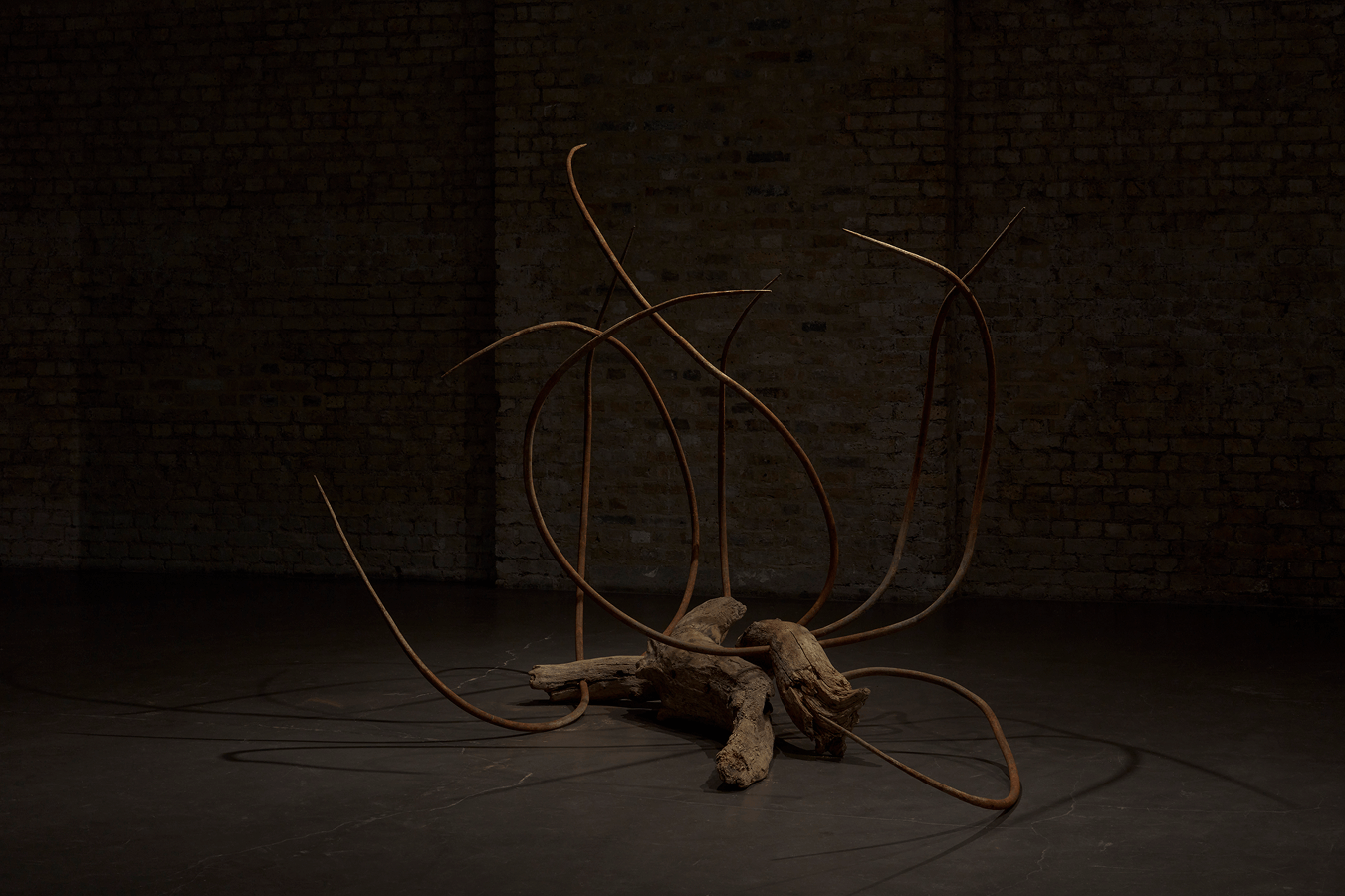
DOMINIQUE WHITE, 'ineligible for death,' 2024. Courtesy of VEDA and DOMINIQUE WHITE, photography by MATT GREENWOOD © ABOVE GROUND STUDIO

Dominique White: on collapse, fear, and form

For the nineteenth-century French essayist and art critic Charles Baudelaire, sin functioned as a sensory appetite. “The unique and supreme voluptuousness of love,” he wrote, “lies in the certainty of committing evil, and men and women know from birth that in evil is found all sensual delight.” Baudelaire understood such extreme sensations—those that puncture and punish our lives—as reckless yet rewarding: an escape from the inertia of not feeling at all. That compulsion to confront an ugly truth sits at the heart of the work of the London-born, Marseille-based artist Dominique White.

Winner of the 2022–2024 Max Mara Prize for Women, White’s work has been presented concurrently at Whitechapel Gallery, London, and Collezione Maramotti, Reggio Emilia. Her sculptures appear as though salvaged from the sea—stranded, scarred, and burdened with histories they refuse to explain. They confront brutality and beauty alike, while insisting on what White has described as her own “blackness”: not as representation, but as lived force. If her collapsing forms suffocate in their silence, denying easy legibility, it is because White is willing to reach inward—to draw on energies of anger, grief, and resistance that are as unsettling as they are generative. Spirited when speaking of identity and freedom, and of “living a nomadic life,” she seeks an abstraction that ruptures inherited narratives, unforgiving of what has already been recorded. If identity politics is central to White’s articulation of her work, the sea becomes its accomplice, rewarding this position with visual and material riches. Her sculptures spill outward onto the floor, as if severed by the sea itself. Reflecting on a lifelong connection to water and a sustained fascination with shipwrecks—vessels that, like human beings, retain layered histories, often preserved by immersion—White destabilises the romantic pull of maritime imagery. Sea and sand may initially conjure the idyllic, but she compels us to sink unceremoniously into their depths: to be cut open by fishhooks and weighted anchors, confronted by their looming shadows.

White’s materials, gathered from shoreline detritus, combine weathered natural and industrial elements—wood, metal, canvas, plastics, pigment—brought together in states of abrasion and decay. In her hands, they impregnate one another, as though death itself has stripped them of fixed identity. Yet, as Baudelaire proposed, such acidic appearances give way to a deeper beauty. These works attempt to seize time: to hold fragments that have not yet fully dissolved.

Rescuing these remnants from the sea’s appetite, White assembles them with equal attention to politics and poetry. Her fragile configurations propose fear as a legitimate emotional register—one that, as she argues, “has to be faced.” Encountered as though at night, when the senses sharpen and natural light is swallowed by darkness, her works operate in a heightened state of anticipation.

Uncertainty, for White, is fundamental. “The sea,” she has said, “is a site of impossibility—a flattening of time and a rejection of order.” This logic materialises in her sculptures’ apparent disorder. Yet they are far from chaotic. Iron rods scribble into space, mangled yet upright; skeletal forms hover above torn fabrics that stain the floor beneath them. To look at one of White’s works is to witness an incident—a body breached, its blood thrown outward, its breath faintly illuminating the dark. Historically, these works resemble no established sculptural lineage. They neither mimic reality nor seek to fill space in order to ennoble it. Instead, they appear riddled with grief, as though on the verge of rot. It is precisely this tension—between balance and brutality—that White sustains deliberately. As she has explained, she is invested in disrupting the power dynamic between object and viewer. Sculpture, she suggests, has long been conditioned to privilege the audience: to remain inert, elevated, obedient. In her work, menace emerges from fragility. Approach too closely, and the object may collapse—or harm you. Like the artist herself, these works are not passive. To encounter them in situ is to walk the seabed, confronting fear without the promise of resolution.

Dominique White has an upcoming solo exhibition at Kunsthalle Basel (CH) titled All Great Powers Collapse from the Centre, which will be open from 13 February to 17 May 2026.

Rajesh Punj: With exhibitions concurrently in London and Reggio Emilia, where are you based?

Dominique White: For the past two years I’ve been pretty much nomadic, because it’s been the easiest way to produce work. Even during the height of the pandemic, it felt easier to push myself creatively—I spent three months alone in Norway. Now, I’m based between Marseille and Essex, England.

RP: You have studios in both cities?

DW: I did before, but I’m moving—hopefully to the French countryside—to have more space. This is always my problem: I move into a studio, and within three months it’s completely full. You can have as many shelves as you want, but if one work is three or four metres long, and you’re making five shows a year, there’s simply not enough room.
Dominique White
Max Mara Prize for Women
contemporary sculpture
DOMINIQUE WHITE 
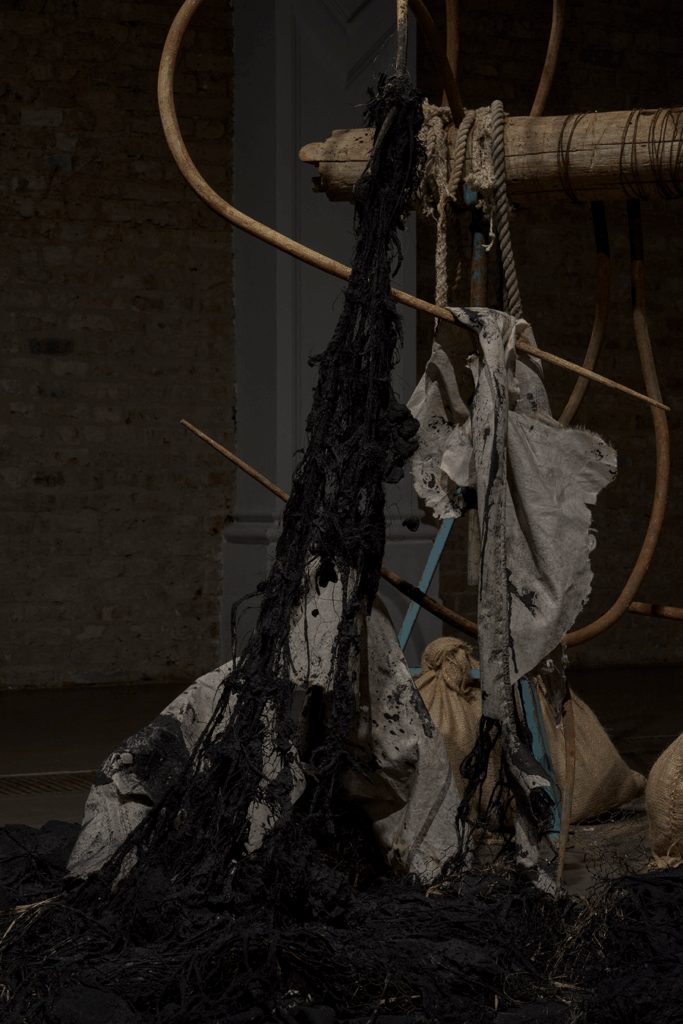
split obliteration, 2024
Courtesy of VEDA and DOMINIQUE WHITE, photography by MATT GREENWOOD © ABOVE GROUND STUDIO
Dominique White
Max Mara Prize for Women
contemporary sculpture
DOMINIQUE WHITE 
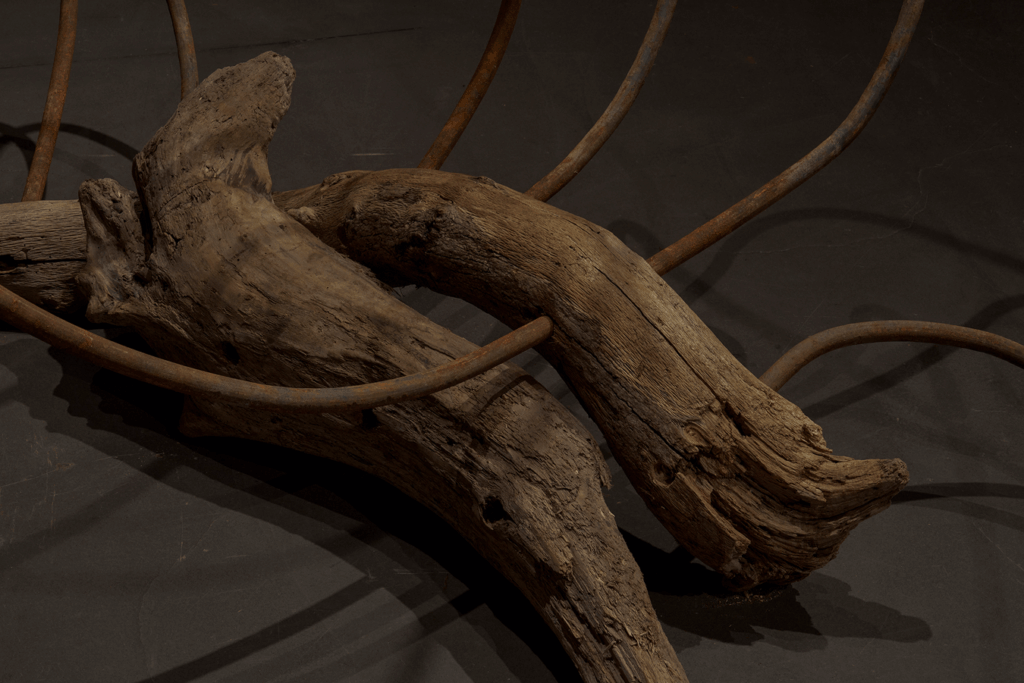
ineligible for death, 2024
Courtesy of VEDA and DOMINIQUE WHITE, photography by MATT GREENWOOD © ABOVE GROUND STUDIO
Dominique White
Max Mara Prize for Women
contemporary sculpture
DOMINIQUE WHITE 
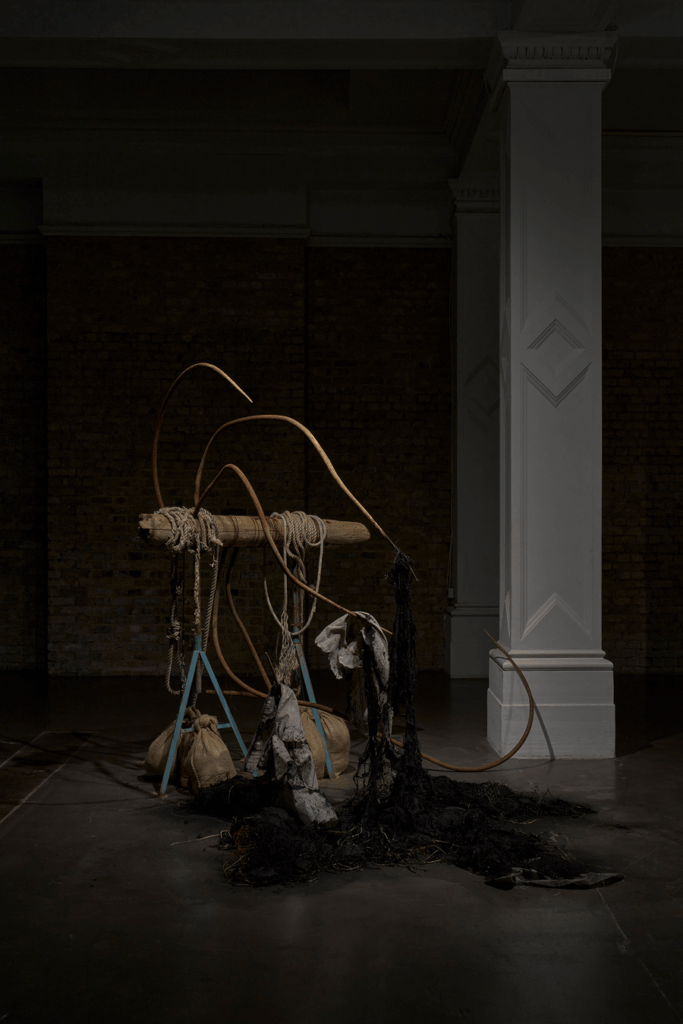
split obliteration, 2024
Courtesy of VEDA and DOMINIQUE WHITE, photography by MATT GREENWOOD © ABOVE GROUND STUDIO
Dominique White
Max Mara Prize for Women
contemporary sculpture
DOMINIQUE WHITE 
the domination of Nothing, 2023
Courtesy of VEDA and DOMINIQUE WHITE, photography by VOLKER RENNER/KUNSTHALLE MÜNSTER
Dominique White
Max Mara Prize for Women
contemporary sculpture
DOMINIQUE WHITE
dead reckoning, 2024
Courtesy of VEDA and DOMINIQUE WHITE, photography by MATT GREENWOOD © ABOVE GROUND STUDIO
Dominique White
Max Mara Prize for Women
contemporary sculpture
DOMINIQUE WHITE
dead reckoning, 2024
Courtesy of VEDA and DOMINIQUE WHITE, photography by MATT GREENWOOD © ABOVE GROUND STUDIO

RP: It wasn’t that you wanted to stay in England.

DW: Everything became more difficult after Brexit. That was one of the reasons I put one foot in France. I went for a residency, and when it became clear that nobody knew what would happen post-Brexit—especially with shipping—I didn’t want to wait and find out. I’m a sculptor making large works; uncertainty is expensive. There were shows where we were close to shipping, and suddenly the curator realised I was British. That alone changed everything.

RP: Beyond logistics, emotionally and culturally, how was the move?

DW: If I hadn’t moved, I probably wouldn’t be an artist now. I would have had to make serious sacrifices, and my career might have been one of them. I might have ended up in Glasgow or somewhere similar, but even then, there are limits. I’ve always been rootless. I travelled a lot as a child, so arriving somewhere with the same suitcase feels natural to me.

RP: That suggests environment matters, but perhaps not the city itself.

DW: Exactly. I still have a presence in cities because I travel constantly. When I arrive somewhere new, I absorb as much as possible—museums, objects, forms—without immediately processing them. That digestion happens later, back in the studio. The object becomes the research.

RP: Is your vocabulary of forms location-specific?

DW: Landscapes blur into one another. For this show, influences ranged from abandoned anchors on Genoa’s shoreline to archival images of boat-making, to reading about sea mammals and whales. I keep deep-sea images on my computer, nonsensical mood boards in the studio. For me, there’s always a line connecting them.

RP: When I saw your work in Tangier, and then encountered a fuller body of work here, someone described the sculptures as “aggressive”. There’s sharpness, danger—but also softness and curve. How do you understand that duality?

DW: Curves usually come from nature. I try to give the works autonomy, which might be where the figurative element comes in. There’s always a tension between fragility and weight. Some works weigh over 200 kilos. I’m one person with an assistant, mediating between materials that want to collapse or stab you. Many of the works feel like bodies—entities breathing in space. When the works were shown at Whitechapel, there was a sense that if you turned your back, they might move toward you. I like working against the idea of the art object as static or polite—especially in museums, with plinths and vitrines. That’s why the lighting here is softer. I want to destabilise the power relationship between object and viewer.

RP: The work resists containment.

DW: Absolutely. Long-term storage would kill them. They want to be seen. There’s rebellion in the materials themselves. I could use bronze—permanent, obedient—but instead I choose kaolin, charcoal, unstable substances that resist control. There’s agency in that resistance.

RP: Is the process trial and error?

DW: Completely. My studio looks like a laboratory after an explosion. Things are burnt, bound, spilled. I’ve had works strapped to walls because they refused to stand. Sometimes they fail. I destroy works. That’s part of knowing when something has been pushed too far.

RP: The shadows seem integral.

DW: The work has to bleed beyond itself. You shouldn’t know where it ends. You might walk into it. I’m always trying to exceed the object’s limits—what it’s expected to do.

RP: The works feel dark, uncomfortable.

DW: They’re meant to reflect struggle, resistance, survival. Abolition will not be easy. If the work were easier, that ideology would disappear. It would become passive.

RP: Do you think about durability?

DW: Not in the conventional sense. We’re obsessed with perfect objects, but I want the work to mutate. The metals have already changed colour dramatically. The wood will continue to shift. That transformation is essential.

RP: That complicates dating the work.

DW: Exactly. The materials have unknown histories. The wood might be centuries old. I seek that ghostliness—a sense of time without clarity.

Dominique White
Max Mara Prize for Women
contemporary sculpture
DOMINIQUE WHITE
the tortuous, 2023
Courtesy of VEDA and DOMINIQUE WHITE, photography by FONDATION VINCENT VAN GOGH
Dominique White
Max Mara Prize for Women
contemporary sculpture
DOMINIQUE WHITE
Can We Be Known Without Being Hunted, 2022
Courtesy of VEDA and DOMINIQUE WHITE, photography by ROS KAVANAGH
Dominique White
Max Mara Prize for Women
contemporary sculpture
DOMINIQUE WHITE 
the swelling enemy, 2024
Courtesy of VEDA and DOMINIQUE WHITE, photography by MATT GREENWOOD © ABOVE GROUND STUDIO
Dominique White
Max Mara Prize for Women
contemporary sculpture
DOMINIQUE WHITE 
the swelling enemy, 2024
Courtesy of VEDA and DOMINIQUE WHITE, photography by MATT GREENWOOD © ABOVE GROUND STUDIO

RP: How do you decide between natural and man-made materials?

DW: Everything must have a prior life. If it’s stainless steel, it has to be destroyed first. These objects have accumulated histories from multiple cultures, gathered by the sea.

RP: Were you raised near the sea?

DW: I’m of Caribbean ancestry—my grandparents were part of the Windrush generation. Water, ships, displacement—all of that is personal. The idea of undermining the nation-state comes from that history. There’s no perfect way to assimilate. If I can’t have it, then you can’t have it—materially speaking.

RP: Anger as energy?

DW: Yes. We’ve inherited a system that was never designed to include us. When politicians speak of the future, they’re not speaking of people like me. If I’m excluded, then I’ll imagine my own future. Pessimism prepares you better for collapse than blind optimism.

RP: History, then, is something you actively dismantle?

DW: Absolutely. Shipbuilding in the seventeenth century propelled colonialism, capitalism, race. These are young systems—only 400 years old. They feel permanent, but they’re fragile. They could collapse overnight.

RP: How important is being a woman to your practice?

DW: It shapes how the work is read. People are surprised that I make such heavy, demanding works. I think about death constantly—that’s where my strength comes from. Fragility and fear are everything in the work. In 200 years, it won’t look like this. It will have rusted to nothing. That’s part of its truth.

RP: Conservation must be complex.

DW: Maintenance is more important than repair. If something breaks, it can stay with the work. I think of collectors as guardians, not owners. These works need care, presence, and exposure—otherwise, what’s the point?

Dominique White
Max Mara Prize for Women
contemporary sculpture
DOMINIQUE WHITE 
split obliteration, 2024
Courtesy of VEDA and DOMINIQUE WHITE, photography by MATT GREENWOOD © ABOVE GROUND STUDIO

Words: RAJESH PUNJ

ISSUE 7

The new edition is here