Donatien Grau: a compagnon de route

Donatien Grau
philology
Julian Schnabel exhibition
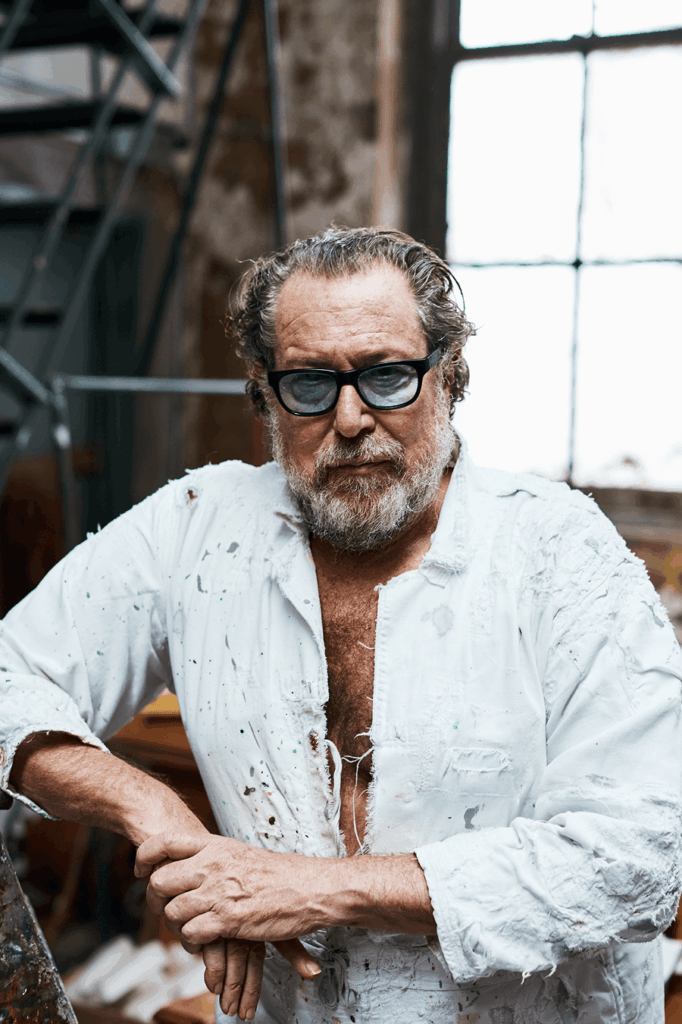
JULIAN SCHNABEL in his studio in New York, 2020
Photography by WESTON WELLS
Donatien Grau
philology
Julian Schnabel exhibition
JULIAN SCHNABEL
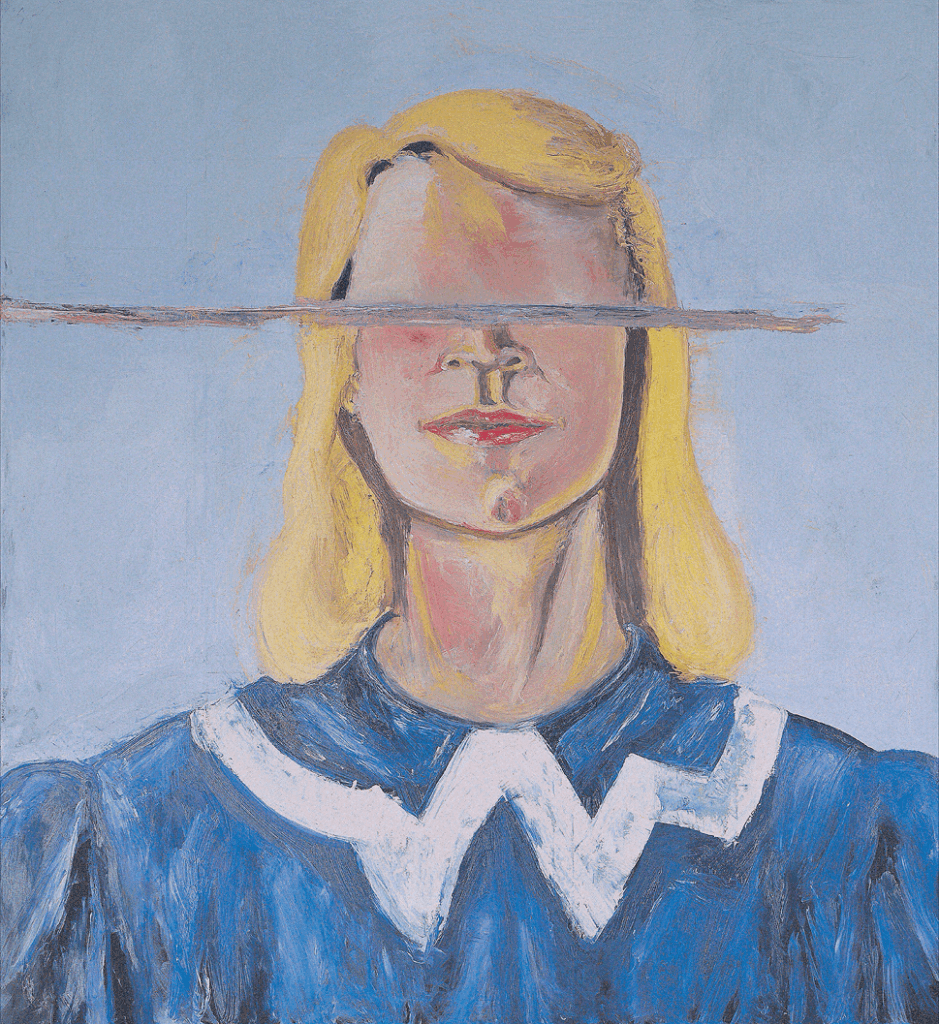
Last Big Girl with No Eyes, 2001
Photography by TOM POWEL IMAGING; Private Collection

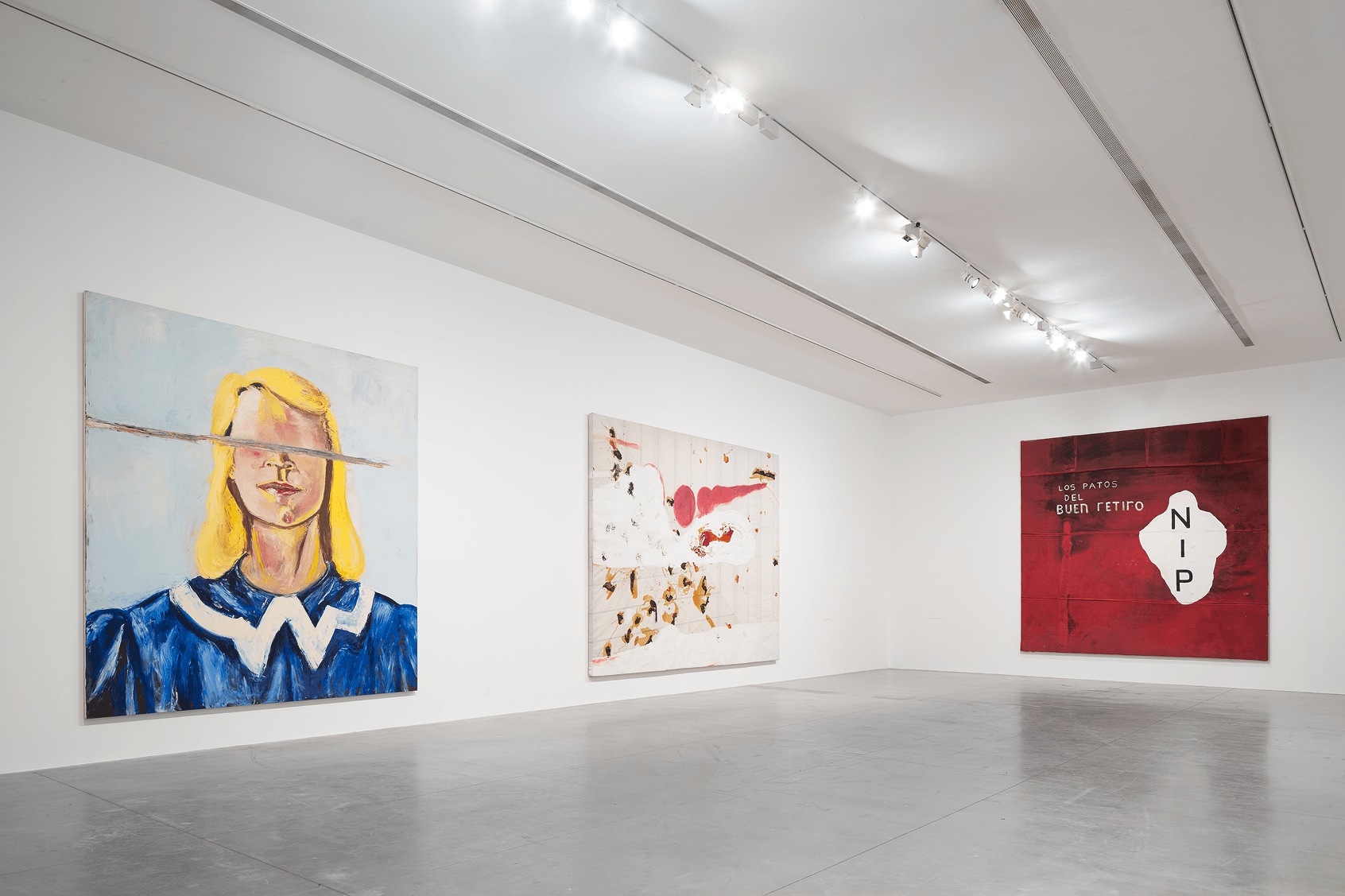
Julian Schnabel: Nine Works at Château La Coste opened in the Galerie des Anciens Chais, where it runs until August 15th. The exhibition brings together nine works spanning five decades from Jack the Bellboy / A Season in Hell, made in 1975, to an Untitled Self-Portrait from 2023. Alongside the nine major works, new paintings of Mediterranean umbrella pines, conceived specifically for the Provençal landscape, are shown in the Bastide, carrying the exhibition outdoors and into dialogue with the light and terrain of Château La Coste.

The works on view move across materials: shattered ceramic plates embedded in dense impasto, velvet, sailcloth, resin, repurposed fabric. The boxing ring floor of The Edge of Victory carries sweat and blood; the sailcloth of Untitled (Sister of Ozymandias) holds the flow of time. Between the earliest mark-making and the most recent figurative work, abstraction and representation remain in permanent, productive tension—never resolved, never still.

The exhibition was selected in close dialogue between Schnabel and Donatien Grau, his longtime companion and collaborator, whose essay accompanies the show in the publication from Hatje Cantz. Donatien Grau—a philologist by training, current head of contemporary programs at the Musée du Louvre, he has also previously held the same title at the Musée d’Orsay, and author of books ranging from studies of the Roman Empire to essays on living museums—has been close to Schnabel for almost fifteen years. He approaches the role not as a conventional curator but as what he calls in French a compagnon de route: a travelling companion, someone whose reading of the work is inseparable from a long, evolving conversation with the artist himself.

In the interview that follows, conducted after the opening of the exhibition, Grau reflects on what that kind of companionship asks of a reader, on the threads that run through fifty years of Schnabel’s painting even when they temporarily vanish from view, and on why the most interesting thing about these paintings is so often not what is there, but what isn’t.

hube: You selected these nine works in close dialogue with Julian. How do you approach that kind of collaborative curatorial process? How do you balance your own reading of an artist’s work with their own sense of what matters?

Donatien Grau: My reading of an artist’s work stems from the artist themselves, and is a reading of their reading. I see it as a constant dialogue, rather than two separate approaches. The artists I write about are always figures whom I am personally related to. Julian is chief amongst them.
h: The nine works span fifty years but are described as cohering as a whole. What is the thread that holds them together? Was that thread something you identified, or something Julian pointed you toward?

DG: I don’t think it’s either/or. It’s a conversation. It was important for me to show the variety and the unity of Julian’s work across time. He keeps trying new things, defusing a conventional approach to painting, and paving different ways for art-making. That is the key to his work, what he does every day as he makes art.

h: You’ve written extensively about Schnabel’s work. Does writing about an artist and curating their work ask different things of you? Do they ever come into conflict?

DG: I have been close to Julian ever since Azzedine Alaïa introduced us; he was so important to both of us, so it is more like a family relation. In this case,  I don’t think of myself as a curator, but rather as a conversation partner to the artist—what we call in French a ‘compagnon de route’. In the same way, when I write about an artist, I need to get to know them, and my job is to unfold their work, a bit like a teacher would do. I taught at a high school for a year, and I still draw on that pedagogical experience.

h: The book draws connections between Schnabel and Rimbaud, Shelley, Proust, Terence, Van Eyck. What is it about his work that invites that breadth of reference and is there a risk of over-reading a painting?

DG: Julian’s work is filled with conversations across time. Many of those references stem from those conversations, whether explicit, such as Shelley and Rimbaud, who are actually cited in the titles of paintings, or less explicit, but very much present, such as Van Eyck, who opened the way to self-portraiture in Western art. Terence’s quote on humanness is one of those totems of living as an artist, while Proust’s notion of reading is very much connected to postmodernism, a movement of which Julian is a key part. All of these influences and more are present in Julian’s work, which is one of its key aspects.

Donatien Grau
philology
Julian Schnabel exhibition
JULIAN SCHNABEL
Jack the Bellboy / Season in Hell, 1975
Photography by JOSHUA WHITE; Private Collection, Courtesy of VITO SCHNABEL GALLERY
Donatien Grau
philology
Julian Schnabel exhibition
Photography by STÉPHANE ABOUDRARAM – WEARECONTENTS
Donatien Grau
philology
Julian Schnabel exhibition
Photography by STÉPHANE ABOUDRARAM – WEARECONTENTS

h:  You’ve known Julian for years and have written about and curated his work on multiple occasions, including the 2018 show at the Musée d’Orsay. How has your understanding of his work deepened over time? What do you see now that you didn’t see before?

DG: I have been close to Julian for almost fifteen years now, and he keeps surprising me. The show manifests that he is always pushing the boundaries of conventions, while being fully aware of them—he just does not care, and he has taken the risks for it. He often quotes the Whitman phrase, ‘I don’t contradict myself, I contain multitudes’, which can also be turned upside down—the multitudes are inside and outside, and he is part of an immensity of the world. The more I look at his work, the more I see that it is not about the overflow of what is present, but quite the opposite. It is about what is not there but may constitute another form of presence.

h: You move between philology, literary criticism, museum leadership, curatorial work, and writing. What connects those practices for you? Is there a single question you’re always asking?

DG: I don’t think it’s a question as much as an act—’reading’. For a long time, I was asked to describe myself and my role, and nothing really worked. So I came up with the phrase “philologist”, which is actually what I technically am, having a PhD in classical philology. Philology is the art of reading, and it can take many forms and be very open. However, we always know that the text comes first and that we work from and with it. The texts may vary, but the method is always central.

Donatien Grau
philology
Julian Schnabel exhibition
Photography by STÉPHANE ABOUDRARAM – WEARECONTENTS
Donatien Grau
philology
Julian Schnabel exhibition
Donatien Grau
philology
Julian Schnabel exhibition

Words: Arina V

ISSUE 8

issue no8

Discover the new issue — available now