One of the highlights among contemporary art exhibitions Paris will host in early 2026 arrives with Tomorrow: Yes, a major new show by Erwin Wurm. Opening from January 17th to April 11th, 2026 at Thaddaeus Ropac Paris Pantin, the exhibition marks the Austrian artist’s first solo presentation to occupy the gallery’s entire expansive space. Bringing together large-scale installations and new sculptural works, the project offers a sharp, often humorous reflection on how ideas, beliefs, and social systems take shape—and deform—over time.
Erwin Wurm’s sculpture as a language of ideas
At the heart of the exhibition are two monumental works that set the tone for Wurm’s approach to form and meaning. One is School (2024), a walk-in sculpture that compresses the architecture of a 19th-century village schoolhouse into a narrow, low-ceilinged structure. Inside, outdated educational posters and tightly packed furniture evoke a physical sense of restriction, prompting visitors to reflect on how inherited systems of knowledge continue to shape contemporary thinking.
Facing it is Star (2025), a full-scale sailing boat bent dramatically at its center. Though fully functional, the vessel is designed to drift in circles rather than travel forward. Referencing leisure culture and notions of progress, the work transforms an object associated with freedom into an emblem of modern futility—an absurd yet pointed gesture typical of Erwin Wurm’s sculpture.
Bodies, clothes, and memory
Beyond these landmark installations, Tomorrow: Yes unfolds through a constellation of sculptural series that give form to the intangible. Wurm’s Blurred Memories translates fragments of childhood recollection into distorted, anthropomorphic shapes, while his recent Mind Bubbles balances bulbous, organic forms on spindly legs, visualising thought itself as something unstable and physical.
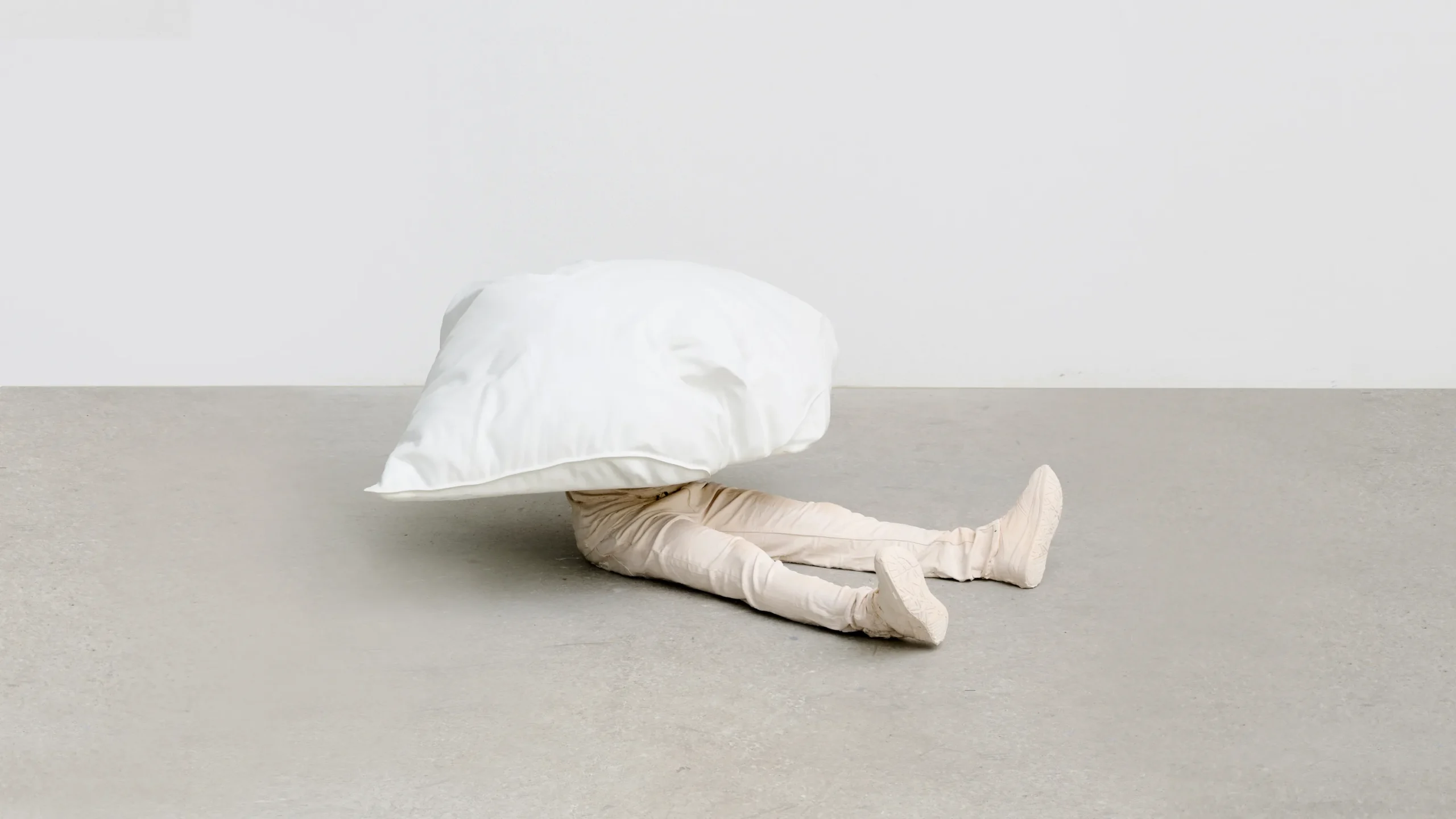
Clothing, which has long been central to Wurm’s practice, reappears in the Substitutes series in the form of empty garments cast in aluminium, bronze or marble. These hollow shells resemble second skins, suggesting the presence of bodies that have vanished, leaving only their social outlines behind. Works such as Shadow (2024), with its weathered bronze patina, and Balzac (2023), a towering pile of draped clothing inspired by Rodin’s monument, connect modern issues to the tradition of art history.
Completing the exhibition is a selection of Wurm’s iconic One Minute Sculptures, participatory works that invite visitors to briefly activate everyday objects with their own bodies. In these fleeting moments, the viewer becomes part of the artwork, underscoring Wurm’s belief that sculpture is not fixed, but constantly shaped by perception and action.
With Tomorrow: Yes, Erwin Wurm positions sculpture as a tool for questioning reality itself—making this exhibition a defining moment within the landscape of contemporary art exhibitions Paris has to offer in 2026.