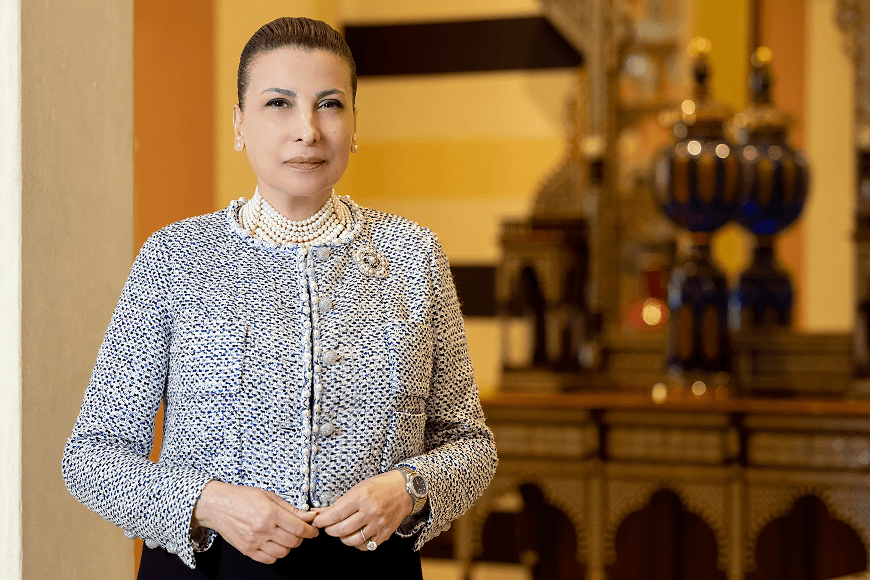
Founder of the Abu Dhabi Music & Arts Foundation (ADMAF) and Artistic Director of the Abu Dhabi Festival, Her Excellency Huda Alkhamis-Kanoo has spent nearly three decades playing a pivotal role in shaping the UAE’s capital into a global stage for creativity and innovative design. She established ADMAF in 1996, and in 2004 launched the Abu Dhabi Festival, which has since welcomed artists such as Yo-Yo Ma, Renée Fleming, and countless others. Under her leadership, the Festival has evolved into one of the region’s leading platforms for global artistry and cultural exchange, bringing together an international cohort of established figures and emerging voices each season.
Huda’s vision has never been about spectacle alone, but about fostering meaningful regional collaboration. Through her long-term commitment and strategic vision, the Abu Dhabi Music & Arts Foundation has become a catalyst for arts education, social innovation, and cultural diplomacy. Her mantra—“Invest in the young. Create the future. Partner with the world”—continues to shape the Foundation’s direction.
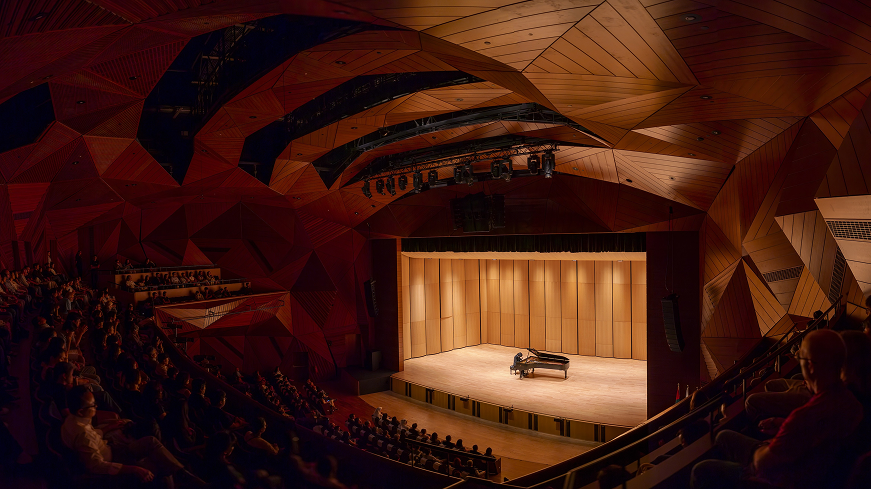
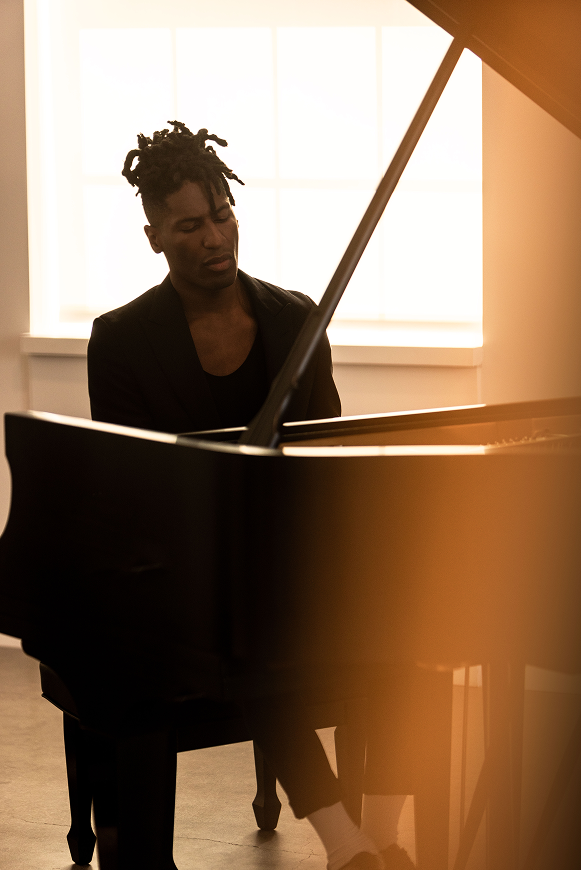
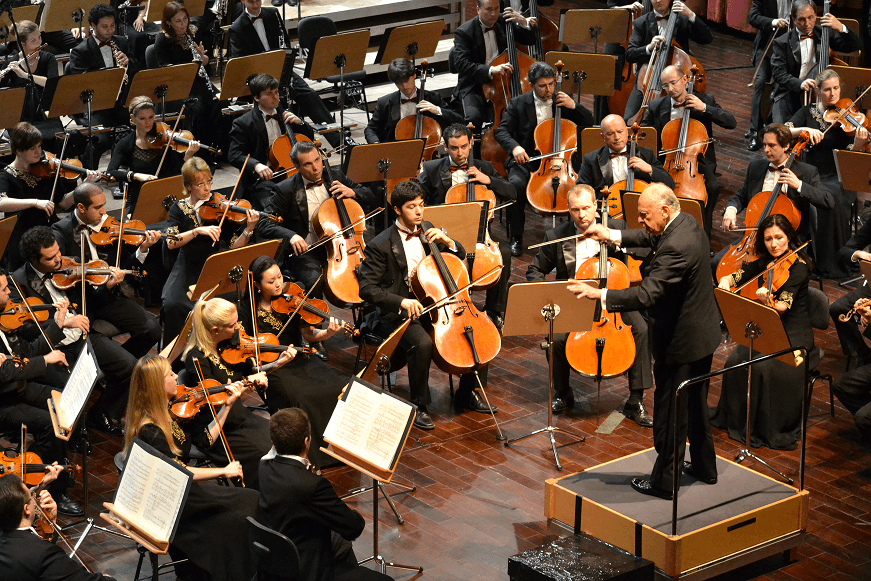
The 23rd edition of the Abu Dhabi Festival promises to carry this message forward, with Jon Batiste in concert at Emirates Palace, the American Ballet Theatre’s Gulf première, performances by the Qatar Philharmonic Orchestra, and Sondra Radvanovsky with Vincenzo Scalera at NYU Abu Dhabi, alongside concerts by Minsoo Sohn and HAUSER. The Festival’s recital series will be dedicated to Emirati artists, including mezzo-soprano Fatima Alhashimi, qanun player Noura Al Mazrouei, cellist Elham Al Marzooqi, and oud players Saif Al Naqbi and Mubarak Al Dhaheri, shining a spotlight on emerging Emirati talent.
In a moment when arts and culture are too often treated as an afterthought, Huda Al Khamis-Kanoo has made them the centre of her life’s work. In conversation with hube Editor-in-Chief Sasha Kovaleva, she reflects on what can emerge when the arts are given the support they need to flourish—not as ornament, but as a vital force shaping society, to the benefit of all.
Sasha Kovaleva: The world is increasingly looking to the Gulf as a cultural compass rather than a newcomer. What do you think the region is uniquely offering that the global art world is now ready to engage with?
Her Excellency Huda Alkhamis-Kanoo: There is a beautiful Arabic word that sums up what the region offers uniquely: ibda. It weaves together the notions of creativity, originality, innovation. It is the act of bringing into existence something never seen before. It implies courage and eagerness. The region brings ibda to the global cultural scene. The UAE in particular: we are a young nation, but we have an old soul. This duality is something unique: we have the energy of youth but the depth of an old, rooted civilization. I also think we come to the art world with a certain sense of responsibility towards the past. Our region has many extraordinary cultural capitals: Baghdad, Damascus, Cairo, and Beirut. Their fortunes might have shifted a little, but it is a proud heritage for all Arabs. And as Abu Dhabi rises as a leading cultural capital, I think we have the duty and responsibility to rekindle this sort of enlightenment in the region. In a fragmented world, the UAE offers a place of harmony. Two hundred nationalities live in peace in this country. Culture, and the celebration of diversity, is one of the platforms through which this harmony is achieved. And I think this makes us quite unique too.
SK: How has ADMAF’s mission evolved as the UAE has transitioned from a young nation to one of the global cultural leaders?
HEHAK: Our core mission has always been to serve the youth, the artists and the audiences of Abu Dhabi, the UAE and the Arab world. We still adhere to this ethos of service, and, in this sense, our mission remains the same. Yet with the UAE rising to global cultural prominence and ADMAF succeeding in many of its undertakings, the meaning and scope of this mission have changed. ADMAF began as a local cultivator of opportunities, talent and audiences. We have now become a global bridge-builder. In addition to nurturing talent at home, we project the Arab cultural voice to the world stage. I remember when I struggled to find a venue for a single concert. We are now a UNESCO City of Music, and by 2030 we will have a world-class performance centre. I remember a time when I had to move mountains just to give a small exhibition some attention. Today, we have major museums attracting both Emiratis and visitors from around the world. This journey defines ADMAF and how our mission evolved: grassroots in spirit and global in reach.
SK: You’ve said that ADMAF ‘builds on the conversations our country has with the rest of the world’. How do you see the arts facilitating forms of diplomacy that politics alone cannot achieve?
HEHAK: I’ve often said that culture is the continuation of diplomacy by other means. What I mean is that diplomats bring structure to international relations and this is vital. Perhaps even now more than ever, at a time when so many tensions are building up around the world. But once those conversations have taken place at a government level, they need to be embodied. That’s what art does. It brings the mind and soul of a nation into the heart of societies abroad. A treaty, however important it may be, will never be as real and relatable as a work of art.
Our collaboration with the Seoul Museum of Art (SeMA), is a great example. The UAE and South Korea have enjoyed wonderful relations. But our twin exhibitions Layered Medium: We Are in Open Circuits that brought the largest ever exhibition of Korean contemporary art to Abu Dhabi last May, followed by Proximities, which brings the works of three generations of contemporary visual artists from the UAE to Seoul in December, takes the conversation closer to people and their hearts. When we experience our shared humanity through art, we pave the way to mutual understanding. Treaties structure shared interests. Culture allows shared emotions.
يونشان ليم
Courtesy of ADMAF
Supplied by artist
Courtesy of ADMAF
Courtesy of ADMAF

Supplied by QPO

Courtesy of ADMAF

Courtesy of ADMAF
SK: You’ve championed Emirati artists long before the world began seeking new cultural voices. What qualities or ideas do you look for in an emerging artist?
HEHAK: I look for sincerity above all else. In this very connected world, young artists sometimes feel they must tick boxes to please the market, to play the algorithm. This is unfortunate for them but also for us, because their talent is lost when they do this. A French author, Jean Guitton, put it beautifully, ‘To follow the wind of fashion is to have the destiny of a dead leaf’. Sincerity is far more powerful than any trend or business plan. Original, authentic voices are those that stand the test of time. Some of these authentic voices might lack experience, or even technical skill, or opportunity. But this is what ADMAF is here for: to help them gain that experience, work on these skills and create opportunities. I look for artists who are ready to fully embrace their role as creators: to follow their inner voice and work with integrity. Whether they are traditional or avant-garde, artists are, collectively, the voice of a nation, a society, its dreams, its concerns, its hopes. We need this collective voice to come from the heart, because when it is sincere, the world listens.
SK: What barriers still exist for young creators in the Arab world, and how can institutions responsibly help remove them?
HEHAK: The primary barrier is a lack of platforms and opportunities. And this, in turn, puts young creators in a position of fragility, isolation, and shyness. When you have no platforms and no opportunities, it makes it harder to earn money from your art and to professionalize. This turns to isolation which also prevents artists from engaging with peers and audiences, which would build their skills. And all this coalesces into a form of shyness. The youth in the Arab World is in no shortage of talent, energy, and eagerness. They simply lack access, and they wander around, struggling to find their way, when other artists in other parts of the world see a clear track of stepping stones to build their careers. And this is where the responsibility of institutions lies. This is exactly why ADMAF exists: to lay those stepping stones, break the isolation and help young artists move to the next stage, whichever this stage might be: scholarships to train, commissions and grants to create, and stages and opportunities as those provided by Abu Dhabi Festival and particularly its Abroad program to build their audience.
SK: Can you share an example of an artist or project that surprised you by challenging your assumptions about Gulf creativity?
HEHAK: There are so many examples but to name one, I’d mention the Emirati composer Ihab Darwish. Abu Dhabi Festival partnered with Robert Townson to bring to life the concert ‘Paintings at an Exhibition’, a musical homage to the legendary artist Bob Peak. We had been following and supporting Ihab Darwish for some time and he was part of this journey with us. He composed a work celebrating one of Bob Peak’s paintings about Curva Grande, the famous curve on the Monza Racetrack. This whole project culminated in a live concert at the Walt Disney Concert Hall in Los Angeles. This concert was played to a full house and ended with thunderous applause and a standing ovation. And it hit that Ihab Darwish’s composition was standing on an equal footing with the works of the world’s greatest––John Williams, Leonard Bernstein. I wasn’t surprised with Ihab’s success––his talent is huge, and I always knew his journey would take him far. What surprised me was how quickly he adapted and how seamless he made it feel.
SK: Many global conversations about art focus on Western paradigms. How does ADMAF contribute to rewriting the narrative from a Gulf or Arab perspective?
HEHAK: We contribute by supporting artists to find their own voice and tell their own stories. Which is why I always look for sincerity in an artist. Emirati, Gulf, or Arab narrative sovereignty is only possible with narrative integrity. It is not a matter of ‘rejecting Western narratives’. After all, in this connected world, stories, forms, ideas circulate worldwide. It is a matter for an Arab voice or story to shape according to their own terms and then find its place in the world.
Which leads me to the other way we contribute. It is not enough to support Arab voices that have integrity. You must then carve a space for them to exist and be granted all the attention and respect they deserve. This is where our international partnerships kick in: we help institutions in the West and in Asia understand the Arab or Emirati perspective and we open these global platforms to Arab artists. Even when we step into supposedly Western territories such as classical music and opera, we work towards supporting Arab perspectives. For instance, when we coproduced Pélléas et Mélisande with the Opéra National de Paris, it was a version directed by Lebanese Canadian director and playwright Wajdi Moawad.
SK: How have women—whether artists, curators, or patrons—reshaped the region’s artistic identity?
HEHAK: Women have been the backbone of this transformation, particularly in the UAE. To be fair, historically, women have always been entrusted with keeping, passing, thus shaping heritage so I wouldn’t want to imply that women haven’t be very active in the world of culture in the past. However, thanks to Sheikh Zayed, and today our President, Sheikh Mohamed bin Zayed’s very active support to the empowerment of women, they have played a more visible and structured role both as artists and as cultural leaders and they have been at the cutting age of the region’s cultural renaissance. We have an exhibition, Proximities co-curated by ADMAF and the Seoul Museum of Art, in December. It traces three generations of art from the UAE. If you walk through this exhibition, you can see how important women have been in the rise of the Emirati and regional art scene. My own journey is living proof of how women are empowered to lead in the world of culture in the UAE and in our region. If anything, it was sometimes in the West more than in our region, that I could feel a hint of doubt that an Arab woman could build a cultural institution of global reach. But as often in ADMAF’s story, the naysayers became our biggest fans.
SK: What excites you most about the intersection of contemporary Arab identity and digital art?
HEHAK: Arab identity is very complex and layered. It is multiple yet a common thread binds it together. The Arabic language is a perfect example: it may have branched into many dialects, yet we share the Arabic language as a common horizon, perhaps even a common ideal. In this context, digital art is an extraordinary tool to explore all these threads, reconnect them. The way digital art can be, in some cases, shared digitally is also something that will bring about inter-Arab cultural exchange in a new exciting way, perhaps opening new inter-Arab artistic conversations and creations. Digital art is a space of reconnection and reinvention for the Arab identity. Digital tools and modes of expression allow Arab creators to explore their heritage, reclaim it, reinterpret it and even challenge it within the digital paradigm and it offers younger generations a medium through which they can explore their identity and share it.
SK: The Gulf is investing heavily in AI, media art, and new technologies. How do you ensure that these innovations enhance culture rather than overshadow it?
HEHAK: It is art that enhances innovation, not the opposite way round. AI is no doubt a paradigm changing field that can only compare to the invention of the wheel or the print press. However, four wheels on a cart doesn’t tell you where you want to go. And having a printing shop doesn’t write books. Art and culture bring to the most powerful tool devised by humans what it lacks: intent. Humanity. Of course, general AI may change this one day. But until that day, it is art, and only art, that has the power to change a set of data points into a story.
I do understand that media art, new technologies and AI might seem to overshadow art. And in this process, artists are suffering. AI is replacing graphic designers and composers every day. It is a collective responsibility for technology and media companies, cultural institutions and regulators to attempt to soften this negative impact. But I still believe that once the dust has settled, art and culture will precisely become the missing link between technology and humanity. Culture brings empathy to algorithms.
SK: You’ve spoken about building a pan-Arab cultural ecosystem. How do you envision this working in practice?
HEHAK: Part of it is organic: as Abu Dhabi rises as the new cultural capital of the Arab World, it is becoming a place where Arab talent and Arab projects can thrive thus helping build this cultural ecosystem. But of course, beyond the organic, this emergence of a pan-Arab cultural ecosystem also requires nurturing and intent. And this is where ADMAF steps in. We are an activator of a pan-Arab cultural ecosystem. Of course, as an Emirati organization we work with Emirati artists, but we also are very active in the Arab World, supporting Arab artists, helping their work circulate within the region and beyond. When we commission new works from Iraqi oud maestro Nasseer Shamma, when we program performances by the Egyptian inshad master Sheikh Mahmoud El-Tohamy we are highlighting Arab excellence, and we are circulating Arab art in the Arab World. The same goes for young Arab talent that we keep on incubating. The Abu Dhabi Festival is a critical component in this emergence: it allows us to keep the pan-Arab cultural conversation alive onstage and backstage, and our Abu Dhabi Festival Abroad program is opening world stages to the Arab voice.
SK: If you could give one piece of advice to the next generation of Gulf creatives, what would it be?
HEHAK: Focus on only two things: your art and your heart. Focusing on your art means to work, work and work to hone your skills, but also to open yourself to other artists, their works, to find your community. Focusing on your heart is what allows you to be sincere and find your voice. When you have worked enough on your art, when you have learned enough from your peers, and when you have found your voice, you will see that everything will align. The search for excellence is a difficult path, but you are not alone. Organizations such as ADMAF are here to support you. And you will find that your peers, your artistic community can be of great help. Don’t chase fame, or likes on social media. If you chase such recognition, you might find it, but it will be hard to sustain. However, if you remain humble, and focus on your art and your heart, you will see that recognition will come organically and will be sustainable. Humility is truly a feature of the great.
SK: Looking forward, what do you think will define the next generation of Gulf artists—in terms of voice, medium, or ambition?
HEHAK: It is for them to define their generation! I can offer an educated guess of course, but youth have a way of surprising older generations, so part of me is hoping that my answer has many blind spots. Young Gulf artists are no different from the societies they live in, in the UAE as in many other countries, we have grown in confidence. We are now very outgoing and curious. So I think the next generation will be defined by their lack of borders both real and imagined.
They are a digitally native generation, so the digital will also define their work, not only as a medium but as a subject of exploration. This generation will use social media but also challenge them, posing questions on the impact of the new digital paradigm, embracing AI while they also explore their own humanity and the philosophical questions that arise from a technologically driven world. Because of post-colonial dynamics, art from our region struggled to be noticed in the past. I think this generation will change everything: their ambition will not be to participate but to lead. I certainly hope they will be unapologetic about their dreams.

Supplied by artist

Courtesy of ADMAF

ALGARABÍA
Courtesy of ADMAF

Courtesy of ADMAF

Devon Teuscher in Theme and Variations. © THE GEORGE BALANCHINE TRUST.
Photography by ROSALIE O’CONNOR PHOTOGRAPHY

Devon Teuscher in Theme and Variations. © THE GEORGE BALANCHINE TRUST.
Photography by ROSALIE O’CONNOR PHOTOGRAPHY

Courtesy of ADMAF
SK: As ADMAF approaches its 30th anniversary, what do you envision for the Foundation’s next chapter?
HEHAK: The answer is twofold.
On the one hand, this anniversary does not change our core values: service, relevance and humility. One way I envision the Foundation’s next chapter is to ‘keep calm and carry on’. This means continuing to build programs in support of education, artists and cultural diplomacy, and reinventing them to grow in relevance and impact.
On the other hand, after thirty years ADMAF has grown into a solid institution, which poses new questions that will define our next chapter: ADMAF now has legacy. It is not measured in numbers or assets but in humans. Our legacy is the youth we supported, the lives we changed. Our next chapter will be about embracing this legacy and finding new ways to support youth and change lives. It will also be about ensuring that the Foundation outlives us all. We have strong governance, so succession is not a concern, but it remains something we want to prepare ahead of time. After 30 years, Abu Dhabi has become a strong cultural ecosystem and ADMAF is proud to have helped build it. In this context, our next chapter will be about collaboration, empowering each other to maximize our collective reach and serve Abu Dhabi better.
SK: This milestone also coincides with the 23rd edition of your flagship Abu Dhabi Festival. What is the significance of this moment, and how does the upcoming programme reflect ADMAF’s continued growth?
HEHAK: The Festival seeks relevance first and foremost. Our primary approach is always that the Festival be about the artists and the global cultural conversation. Not about us.
That said, we felt this milestone should find its way into our approach as long as it respected our ‘prime directive’ of ‘artists and relevance first’. It was an opportunity to pause and look at the story we have been telling for thirty years: a story of passion and pioneering. We have championed culture as a living force, nurtured creators and innovators, built bridges to carry the Emirati and Arab voice globally, and advocated for culture to be seen not as a cost but an investment. The 23rd edition of Abu Dhabi Festival reflects these values, with artists who are trailblazers and embodiments of culture’s living force.
We also wondered what the common thread to these thirty years might be. There were many moments of doubt, when naysayers promised us failure and challenges were huge. In those moments we sought answers in culture itself. Culture carries wisdom: it teaches us to listen, feeds vision, encourages empathy and humility, and inspires understanding and peace. This is why we chose ‘The Wisdom of Culture’ as this year’s theme.
Digital editor: ISABELLA MICELI
