fernanda castro emerging fashion designer knitwear designer Maison Christian Dior
Photography by DAVIDE PAVAN

Fernanda Castro Rios on material memory and creative instinct

Following a formative year of recognition, hube caught up with Peruvian fashion designer Fernanda Castro Rios. Currently pursuing a master’s degree in Knitwear at the Institut Français de la Mode, Castro’s practice has found a second home both on stage and in print. She reflects on the search for self-discovery through craft, the importance of community amidst fashion’s relentless pace, and the quiet power of intuition. Castro takes us behind the scenes and backstage, into the contemplative space of the studio where ideas, intentions, and ambitions take shape. Rooted in openness and curiosity, Castro reminds us of the importance of trusting ourselves, one another, and the creative process.

h: You are currently pursuing a master’s degree in Knitwear at the Institut Français de la Mode. As a practice, knitwear is both highly technical and deeply rooted in cultural and anthropological histories. At a time when much of contemporary fashion is shaped by industrial production and synthetic materials, what role do craft and handmaking play in your practice? How can knitwear designers foster a deeper connection with materials and the processes behind them?

FCR: Knitwear involves not only the construction of a garment, but of the fabric itself. I feel increasingly aware of how things are made. Craft prioritises intention. It slows you down and forces you to understand how materials behave. As a knitwear designer, you have to consider the whole process from start to finish, including the leftovers. This can be used to your advantage, depending on what you want to achieve with each piece. I believe material consciousness is practiced by being ‘hands on’: touching yarns, testing techniques, pushing materials in the ‘wrong’ way just to see what happens.

h: Research is an integral component of the fashion design process. Where do you source your inspirations and influences? Your work consistently subverts our expectations of form and texture: see-through shorts, pleated leather, tulle polka dots, stripes as visual disruption. How do you synthesise your research into material expression?

FCR: My research process is quite intuitive. Growing up outside of major fashion cities, I was used to seeing fashion from a distance, through photos, films, and the internet. That became part of how I work.

I am drawn to things that feel slightly off; when the proportions are strange or materials do not behave as expected. When I design, I try to translate this into the garment by creating contrasts: soft versus structured, transparent versus opaque, playful but uncomfortable. Knitwear allows me to weave those ideas directly into the fabric.
fernanda castro
emerging fashion designer
knitwear designer
Maison Christian Dior
Courtesy of FERNANDA CASTRO
fernanda castro
emerging fashion designer
knitwear designer
Maison Christian Dior
Photography by DAVIDE PAVAN
fernanda castro
emerging fashion designer
knitwear designer
Maison Christian Dior
Model ALISA DANISH
Styled by SHAOUL AVITAL
fernanda castro
emerging fashion designer
knitwear designer
Maison Christian Dior
Courtesy of FERNANDA CASTRO
fernanda castro
emerging fashion designer
knitwear designer
Maison Christian Dior
fernanda castro
emerging fashion designer
knitwear designer
Maison Christian Dior
Model ALISA DANISH
Styled by SHAOUL AVITAL

h: Since graduating from Polimoda in Firenze, your work has continually referenced classic symbols of girlhood: the tutu, the miniskirt, the microshort, the bra, ribbons and lace. We observe a deconstruction and reconstruction of these motifs, and thus the femininity they represent. What keeps you returning to these icons of womanhood? What fascinates you about the act of subverting these symbols?

FCR: I wouldn’t say my work explores girlhood. But rather, I am drawn to individual pieces that I consider visually striking, or even intimidating. I’m intrigued by garments that feel direct and exposing, not necessarily something I’d wear myself.

In a way, I design for this version of a woman that exists in my imagination: someone who is more confident, more outgoing, a bit more extreme. These pieces allow me to explore that character. It’s not really about womanhood, but about projecting a certain attitude or energy.

These symbols already carry so much tension. Through reworking them, I explore an alternative side of my identity that I personally find difficult to show. Instead, by projecting it onto an imagined figure, I can test this ideal, even if it does not really exist.

h: At IFM, you are currently working on a pedagogical project with Maison Christian Dior (with no commercial scope). This body of work delves into their eighteenth-century archives and reinterprets these historical codes through contemporary knitwear. How has engaging with fashion history and sociology shaped your approach to design?

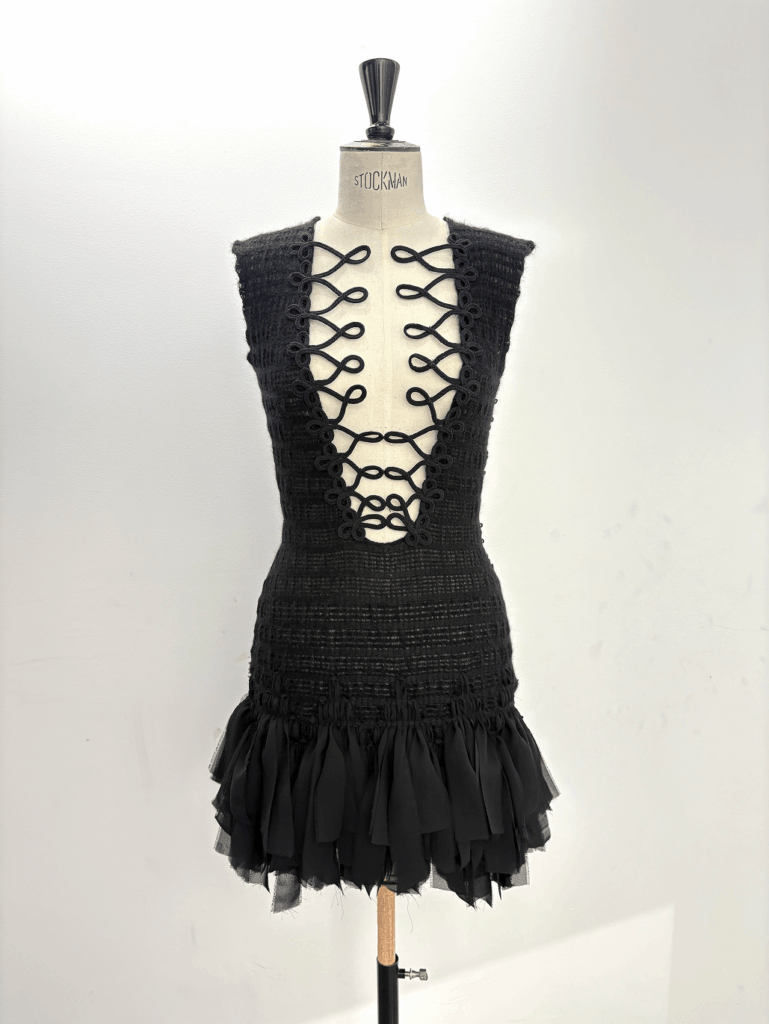
FCR: Over the course of this project, I became particularly fascinated by tassels. I first encountered them through eighteenth-century references, specifically during my visit to Versailles—they feature heavily throughout the decorative language of that period. This same motif reappears throughout Dior’s history, from Galliano to Jonathan Anderson.

What makes this symbol especially meaningful to me is that it also exists within my own personal history. Growing up, my mother had an upholstery store where she worked with decorative elements. It’s the same object, but a completely different context.

Fashion is constantly in dialogue with the past. A motif is never just decorative; it evolves over time and acquires different meanings depending on the context, shifting memories and ideas about craftsmanship and luxury. Translating these elements into knitwear allows me to explore how historical codes can be transformed into something contemporary while still retaining their cultural significance.

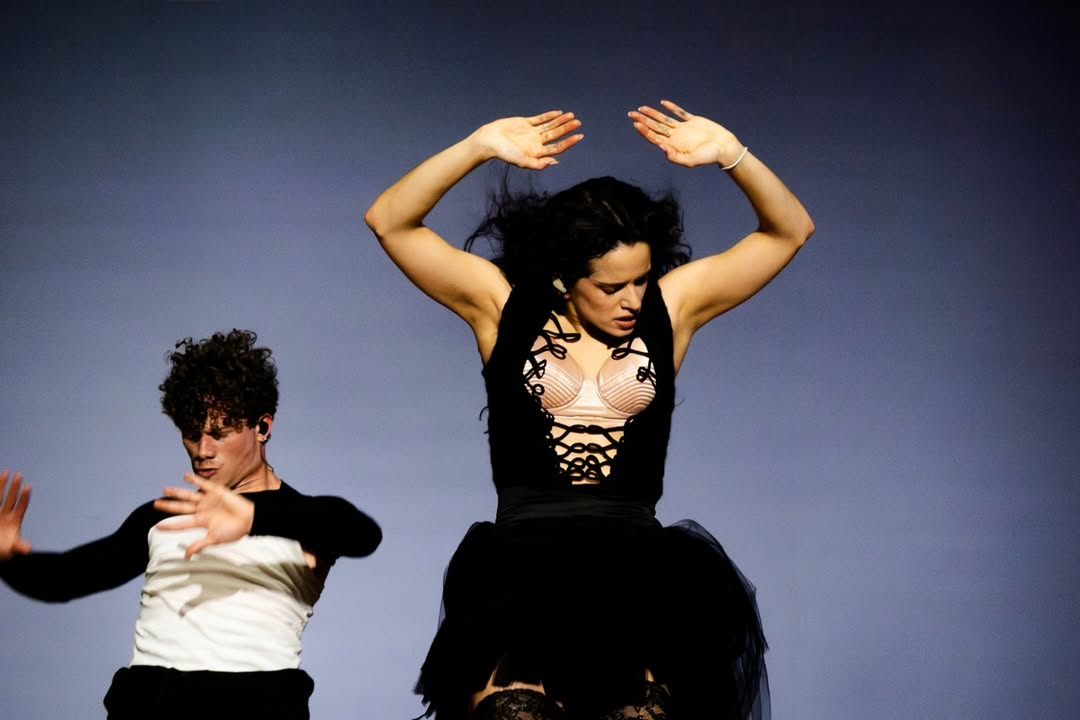
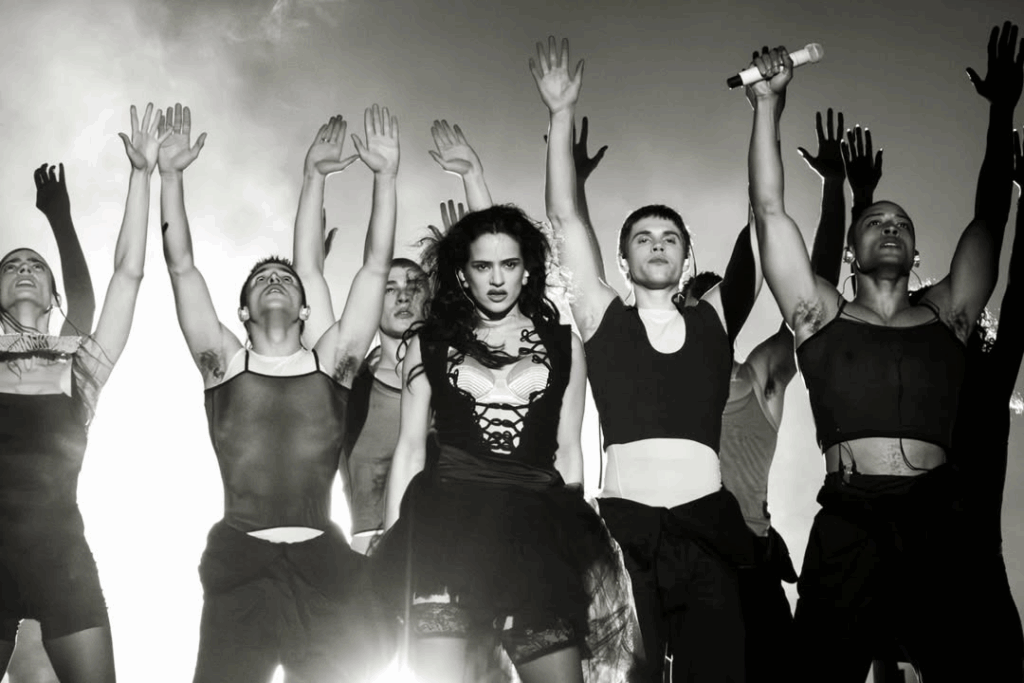
h: Your garments have been worn by the likes of Ravyn Lenae, Charli XCX, Ashnikko and, more recently, Rosalía for her critically lauded Lux tour. What unique considerations come into play when designing for the stage? Would you say fashion in itself is a performance?

FCR: You have to think about movement, visibility, and how the garment reads from far away. It needs to be impactful. Fashion is always a form of performance. Even in everyday life, clothes shape how we present ourselves. When working with artists, that becomes even more apparent. The garment communicates their identity.

h: In addition to this, your work has been featured in numerous editorials and print publications, photographed by Gabriel Moses, worn by Devon Lee Carlson, and featured in Vogue Scandinavia and Exhibition Magazine, among others. In these contexts, your garments become part of a much larger visual world. What have these collaborations taught you about world-building? What is it like to see your work through another creative’s gaze? Can that shift in perspective change the way you see your own work?

FCR: A garment changes once it becomes part of a bigger image. Seeing my work through someone else’s perspective is often surprising. Sometimes they highlight things I didn’t notice, or it’s styled in a way I would’ve never thought of. It keeps the work open and stops it from becoming too closed. This way, design feels more like a conversation.

fernanda castro
emerging fashion designer
knitwear designer
Maison Christian Dior
Art direction and photography by SINÉAD ÁOIFE NÍ TOMÁS
Model NIKOL
Makeup by ASBEL
fernanda castro
emerging fashion designer
knitwear designer
Maison Christian Dior
Courtesy of FERNANDA CASTRO
fernanda castro
emerging fashion designer
knitwear designer
Maison Christian Dior
Art direction and photography by SINÉAD ÁOIFE NÍ TOMÁS
Model NIKOL
Makeup by ASBEL

h: You are of Peruvian heritage, but have studied in Firenze and now Paris. How has this international perspective influenced your practice? In what ways has it shaped your understanding of the global fashion industry?

FCR: Being from Peru, I grew up outside the European fashion capitals; I experienced fashion from a distance. I was always observing and imagining what these places would be like. Studying in Italy and France has completely changed my perspective. I have gained a better understanding of how everything works, the people involved, the conversations… Despite this, I think that distance is still an important part of my practice. Sometimes I remain a witness, but I no longer simply accept what I see. I interact with it, question it, and contribute my own perspective to the conversation.

h: You frequently collaborate with friends when documenting your work, bringing together stylists, photographers and set designers. In an age where remote working is so common and many of our working hours are spent in front of a screen, what is the value of studio culture, community and collaboration? In what ways do fellow students support and lift each other up?

FCR: Throughout both my bachelor’s and master’s degrees, I have met completely different groups of people, all of whom have shaped the way I work. When I started my BA, I was far from the designer I am today. I truly believe that the people around me have played a huge role in helping me grow. Now, I see the same thing happening during my MA. Being surrounded by people who are constantly pushing themselves motivates you to do the same.

Sometimes it’s through critiques and collaboration, and sometimes it’s simply through being present, together in the studio, even when there is nothing specific to work on. There is something about knowing you are not alone in the process. We support each other during moments of uncertainty, when someone needs to rethink their direction, or even in practical situations when deadlines become overwhelming.

Communities and relationships continue beyond education; it has been inspiring to see my classmates enter the industry and continue to pursue their ambitions.

h: As your time in education draws to a close, what has the process of refining and crafting your voice taught you? Looking back, what challenges have defined these years, and what learnings will you carry with you into the industry?

FCR: I have learnt to trust my instincts and to be independent in my creative decisions. When you start university, there is always a desire for external validation, for someone to confirm the value in your work. The biggest challenge has been reaching a point where that confidence comes from within.

I have had to navigate moments where I didn’t always feel like I belonged, but making work that I genuinely believe in has transformed that feeling. The most powerful form of validation comes from creating something that feels true to who you are. I’d like to take that confidence with me into the industry, while always being open to learning new things. Developing your voice is about trusting your perspective enough to keep evolving.

h: And finally, having spent these past few years refining your voice as a designer, where do you feel it is leading you next? What ambitions and aspirations do you hope to realise?

FCR: It has always been a dream of mine to be part of a creative team and contribute to an overarching vision. My goal is to keep working hard, make good clothes and seek stability. Many people have encouraged me to work independently, and I would never say never, but so far, working independently has felt a little lonely. I would like to continue growing in an environment where there is exchange and collaboration.

fernanda castro
emerging fashion designer
knitwear designer
Maison Christian Dior
Courtesy of FERNANDA CASTRO
fernanda castro
emerging fashion designer
knitwear designer
Maison Christian Dior
Courtesy of FERNANDA CASTRO
fernanda castro
emerging fashion designer
knitwear designer
Maison Christian Dior
fernanda castro
emerging fashion designer
knitwear designer
Maison Christian Dior
Courtesy of FERNANDA CASTRO
fernanda castro
emerging fashion designer
knitwear designer
Maison Christian Dior
Courtesy of FERNANDA CASTRO
fernanda castro
emerging fashion designer
knitwear designer
Maison Christian Dior
Model ALISA DANISH
Styled by SHAOUL AVITAL
fernanda castro
emerging fashion designer
knitwear designer
Maison Christian Dior
Courtesy of FERNANDA CASTRO

Words: MARTA TERESA

ISSUE 8

issue no8

Discover the new issue — available now