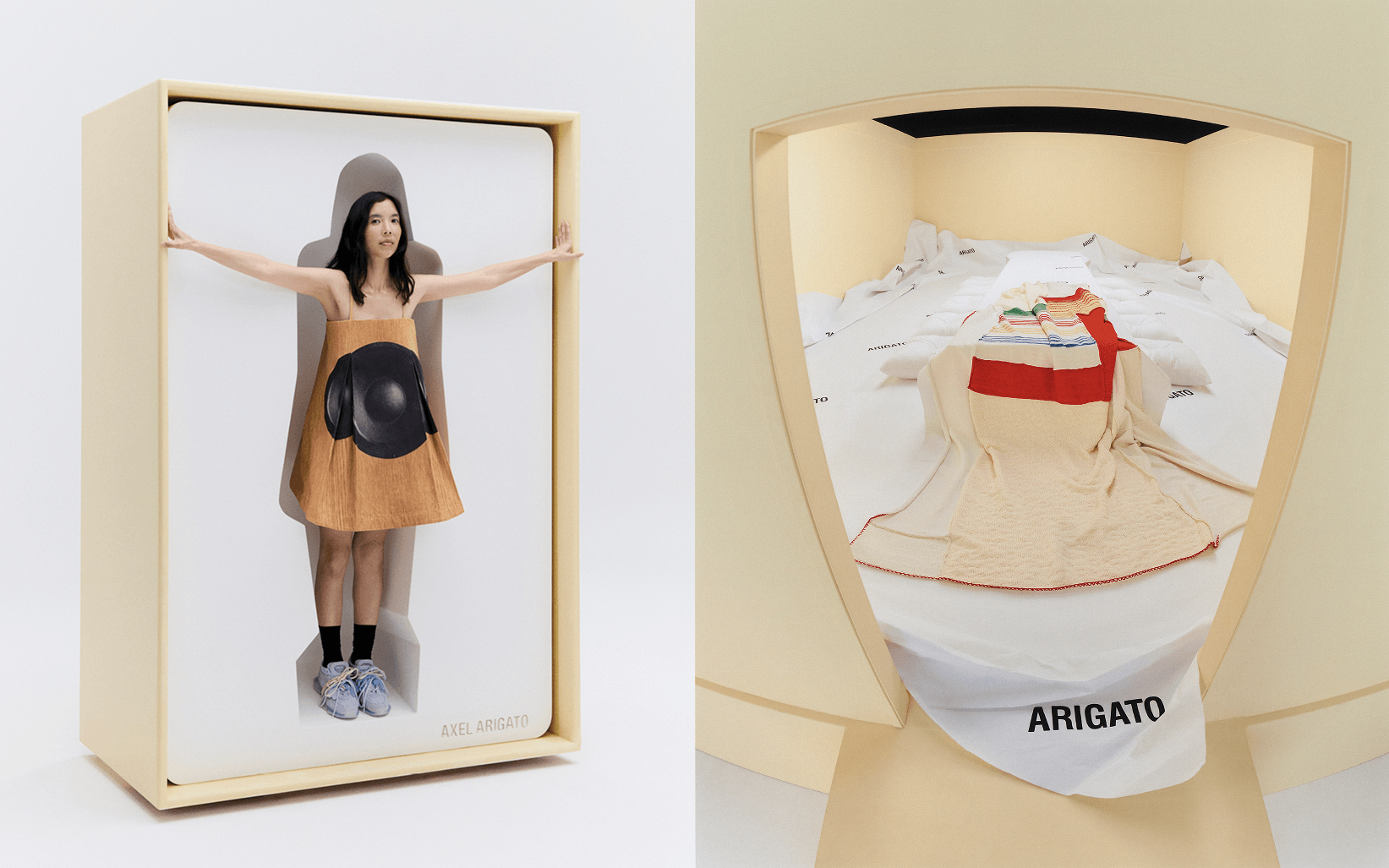
Jens Werner, creative director of the Swedish footwear brand Axel Arigato, has helped push streetwear forward within the fashion industry for over a decade, having held positions at Adidas, where he contributed to the Y-3 collaboration, and as design director of Tory Burch Sport, as well as formerly serving as design director and creative director of J.Lindeberg. In 2023, he assumed the role of creative director at Axel Arigato, guiding the young brand into its next phase as it entered the realm of ready-to-wear. His refined expertise in contemporary fashion, footwear design, as well as product and spatial design, has brought a sense of curiosity to what comes next for the brand. In its Spring/Summer 2026 collection, Green Space, Werner brings these interests together through an exploration of man within the spaces he creates: the tension within our own constructions of urban greenery.
hube: You’ve described ‘the shoe’ as something closer to interior design—an object that connects people and space. What do you mean by that? And how has that philosophy shaped your work at Axel Arigato?
Jens Werner: There are parallels between sneaker and object/interior design, especially its longevity and non-seasonality, which is quite different to how you approach RTW design. A sneaker might never change. A good design is timeless, and can carry lots of different colours and materials that put the design in different lights and target various audiences over time. You create with versions in mind, while in RTW you create for a moment, knowing you need the next idea 6 months later. With shoes, you consider every angle when you design. It’s more 3D, it’s many components, moulds are involved, it feels more industrial than how you approach a garment design. And since we are predominantly a sneaker brand, everything starts with the shoe; an outfit is built around it. It’s like your favourite furniture piece, your first purchase for a new home, and you decorate around that one item. With our new direction, the attitude and shape of our new silhouettes was a key focus: minimal, but expressive, things that visually talk.
h: Your recent collection, Green Space, explores the quiet tension within constructed natural environments. What sparked this idea—and why did it feel like now was the right moment to examine that friction?
JW: We found inspiration in urban and man-made nature when we started designing SS26 back at the end of 2024. I saw more efforts for green spaces in cities, parks being crowded in the summer, people caring more about planting their own herbs, being food independent, learning about old traditions, and being more aware and interested in organic things as a general trend. Another angle to the theme was the ambition to create spaces for our community, and the urge to spend time outdoors. The closest idea to that was an AXEL ARIGATO community garden, a park offering hangout space, playgrounds, skateparks and festivals. The friction of nature and something man-made was an interesting contrast to this. With every ambition and idea of how this park would shape up, it became obvious that even if we like to call it nature and green space, most urban green spaces are entirely made up, controlled, maintained and designed, but over time nature starts taking over and things become more organic. I like to play with opposites: the geometric and organic, the controlled and perfect, and over-time natural evolution. There was a subtle aim to inspire more time spent outdoors, in nature, in the real world, maybe off screens.

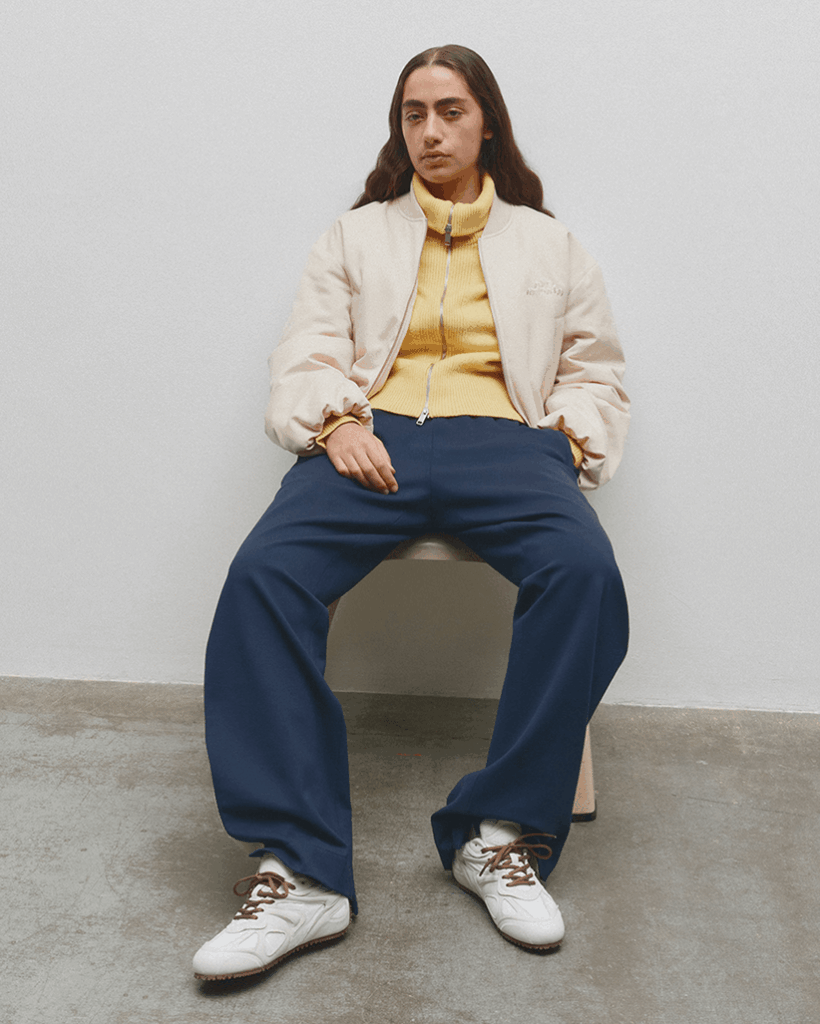
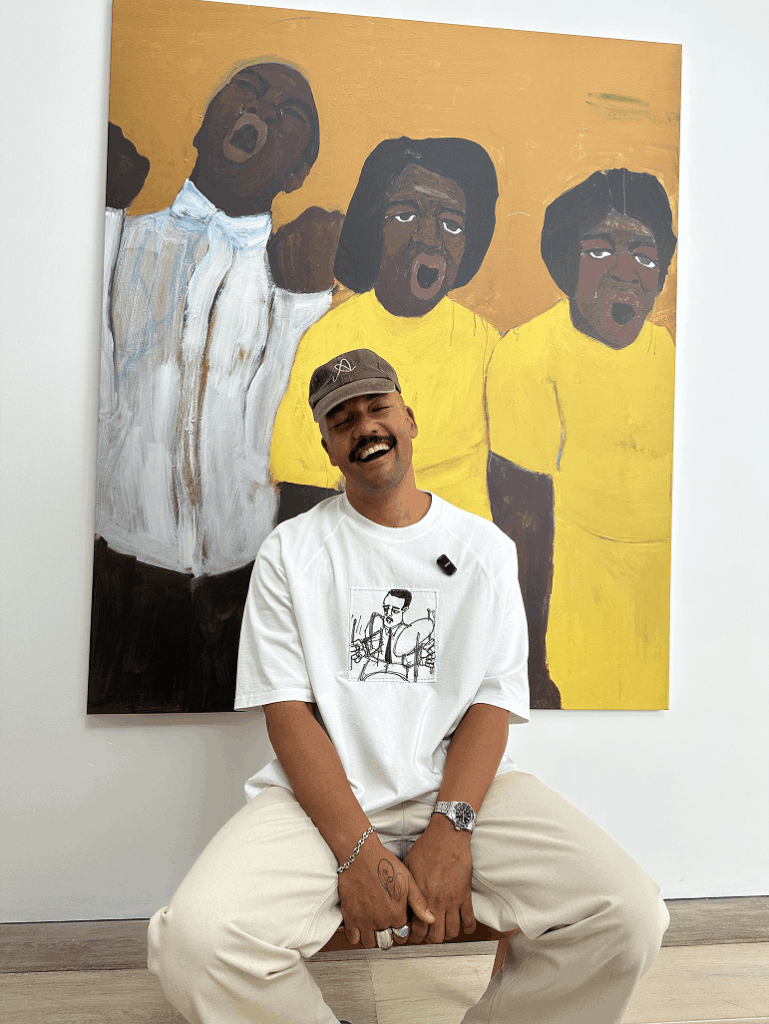
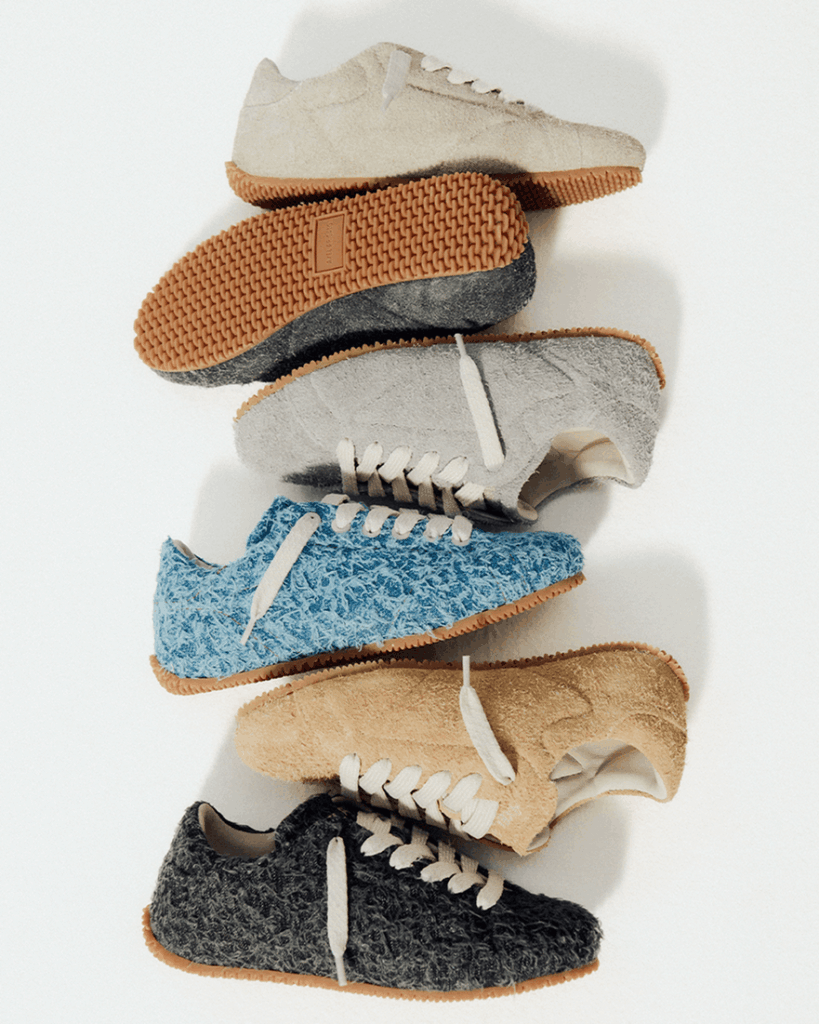


h: How, if at all, has growing up in Germany informed your aesthetic sensibility? Have you noticed that its influence has shifted depending on where you are in your career?
JW: Growing up in a small town in Germany influenced my career in many ways. After high school I had an urge to create things that were different to everything else. It all seemed uniform. At that time, I was so inspired by the extravagance of John Galliano, Alexander McQueen, Yohji Yamamoto and Comme des Garçons, the dreamy world they built through their shows, and the conceptual approach to something wearable. I guess growing up in Germany made me rather look outside of Germany for inspiration and an aesthetic that I found interesting. Once I moved out of Germany and did my time in NYC, Stockholm and now London, I think some of my German-ness comes through increasingly, with a passion for timeless simplicity, minimalism and longevity, but paired with personality, expression and warmth. Practicality and pragmatism are more and more valued in fashion, but shouldn’t mean things need to get boring.
h: Designing footwear comes with its own particular calculus: comfort and engineering must coexist with aesthetics. How do you negotiate that balance and the technical demands of production?
JW: We have incredibly talented designers and developers, and factories and engineers that so far always found solutions to even the most technical or aesthetically challenging requests. Designing a sneaker is a pretty long journey, and from the very initial concept sketch, development and design go hand-in-hand to achieve the best balance of comfort and aesthetics. We are lucky to have a brand following that appreciates our design and innovation, and our premium segment allows the use of high-quality materials and compounds.
h: When moving between Adidas and a brand like Axel Arigato, how do you recalibrate your vision? To what extent do you adapt to the house—and how much do you bend it toward your own ambitions?
JW: You always adapt to the brand; you have to respect the history and product that has built the brand, as it’s the base that allows and enables any future directional shifts. I believe any creative brings new personality and iteration into the mix, which pushes a brand forward. The role comes with ambitions that form a future vision.
h: Was there a pivotal moment in your career that shifted your perspective—creatively or personally?
JW: Since I am self-taught, I think the moment I got my first internship based on my own collection I had made is the moment that shifted my perspective the most. Realizing that my designs and ideas resonated and got me into my career. Working for 15 years in the industry and in various brands and roles taught me that you never stop evolving your creative perspective, and with every year I feel I learn more about how to express ideas and thoughts, and how to make them into something relevant for the brand, the teams and, at the end, the consumer. Most recently, becoming Creative Director at Axel Arigato, and being able to tell visual stories, not only create products, has been pivotal in my career. Adding an abstract, intellectual layer, and contextualize product, design and the inspiration behind them.
h: In an era of relentless content and accelerated trend cycles, your work seems to operate above the noise. How do you decide which cultural currents to engage with—and which to let pass? Is that discernment intentional, or instinctive?
JW: We have pretty long lead times from concept to shelf, which leads to us starting a project with only a hint of what future trends might be. It forces us to choose rather macro trends and cycles, and bet on our own ideas and our core styles. In our creative marketing we are closer to the current and establish our timeless products in what’s popular today. I like to see it as parallel story telling: you entertain and communicate on a daily with your community on socials, pick up on trending topics, and at the same time build a long-term artistic brand narrative that tells a unique story of who we are in the mix of all brands.


h: Whose work—or which brands—are most exciting to you right now?
JW: I find inspiration mainly in art and daily objects. Artists that influence my work, and that I luckily got to work with recently, are Charlotte Kingsnorth, with her beautiful and unique approach to upcycling, restoring and hand crafting art/design objects. Illya Goldman Gubin, with his cardboard and foam series, manipulating, and shifting perception of simple, daily objects and materials. And Alvin Armstrong, who we just recently launched a collaboration with. I am excited to see where the London-based start-up brand ‘A Letter’, by Freddy Coomes and Matt Empringham, is headed, and find it very inspiring how conceptual, yet seemingly naive and simple, the two approach ready-to-wear.
h: If you could completely ignore practicality and budget, what kind of shoe—or project—would you create tomorrow?
JW: If absolutely no boundaries? I think I like the idea of treating a shoe as something very personal, tailoring a shoe to the exact needs and desires of individual customers. Designing every single piece unique and representing the person’s aesthetics, energy and personality, through the lens of our brand codes and design language. The reality of shoe-making complexity and costs involved makes this a fairly unrealistic vision!
h: How do you feel about collaborations that blur categories—footwear with architecture, music, or technology? Have you ever considered treating a shoe more like an installation than a product?
JW: I love when different industries come together, different creatives merge to work on something hybrid. While we always design a shoe to be on someone’s feet, there is something nostalgic for me in treating a new sneaker like an object, an installation at home. I remember the feeling of unboxing your long-fought for sneakers, having them sit on top of the box, in your room, for a few days before you dare to wear them. When I stepped into the Creative Director role, one of my first projects with the team was called ‘Maybe’, and it examined the brands 6 most iconic sneaker silhouettes, and how they maybe evolve to something new. That capsule started first from an installation/ art object POV, to not limit the team in creativity over practicality, but the end result was wearable, something hand crafted and in limited runs of 50 pairs.
h: Sustainability is an unavoidable conversation today. Do you think it’s possible to make ‘desirable’ shoes without compromise—or is tension always part of the equation?
JW: For us, it really starts with awareness, having honest conversations early on about what’s possible and where compromises might need to be made when designing a new product. Our OUR:TOMORROW Sustainability Strategy gives us clear standards to guide those decisions. Sustainability in footwear is complex, and sometimes trade-offs are unavoidable, but we try to minimize them by making informed, data-driven choices through life-cycle assessments. Whether it’s selecting better materials at the design stage or thinking about end-of-life solutions like recycling or bring-back schemes, it’s all part of a continuous effort to keep improving and reducing our impact.
h: How would you describe the future in three words?
JW: Artisanal. Curious. Individual.


Words: ISABELLA MICELI
