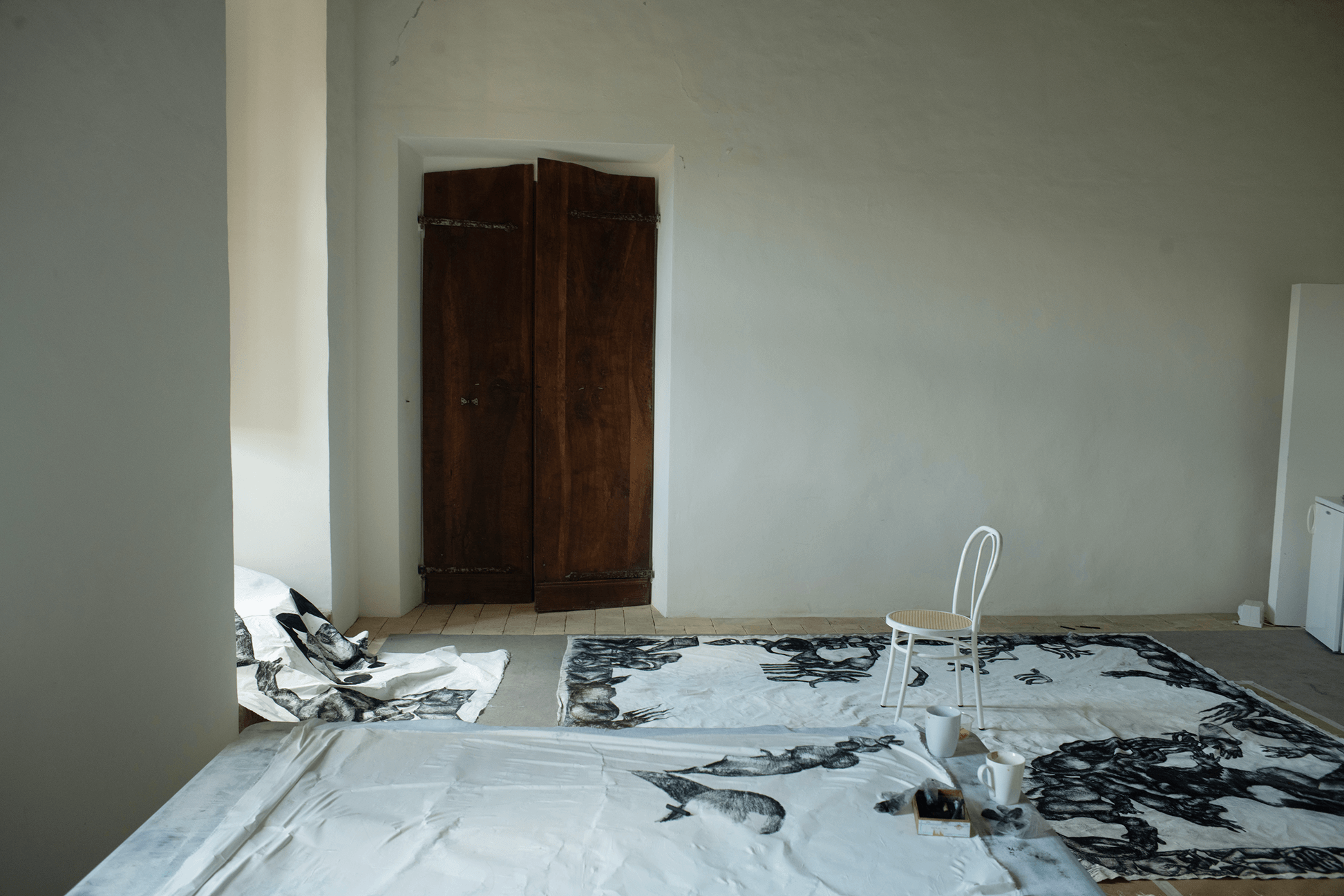
This summer, Sendb00ks launched its first artist residency in Rocca Sinibalda, Italy, gathering six artists — Tali Lennox, Elsa Rouy, Jan Melka, Inès di Folco Jemni, Okiki Akinfe and Mathilde Albouy — for two weeks at the Renaissance Castle of Metamorphoses. Revisiting Ovid’s Metamorphoses, they developed new responses to the poem’s first three books through painting, sculpture and conversations around mythology.
Perched 552 metres above the Turano Valley and shaped like an eagle with folded wings, the 16th-century castle became both setting and source of the residency. Evening readings and discussions informed a limited edition of 600 books, each featuring a detachable sleeve designed by one of the artists. The project launches Sendb00ks’ five-year ambition to publish all 15 books of Ovid’s poem.
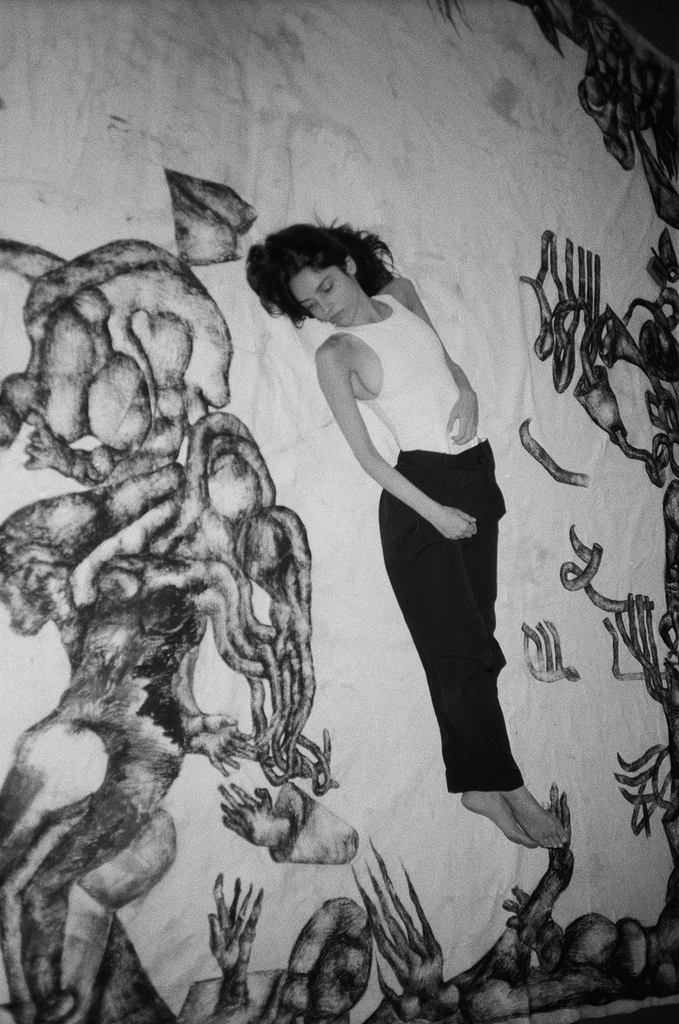
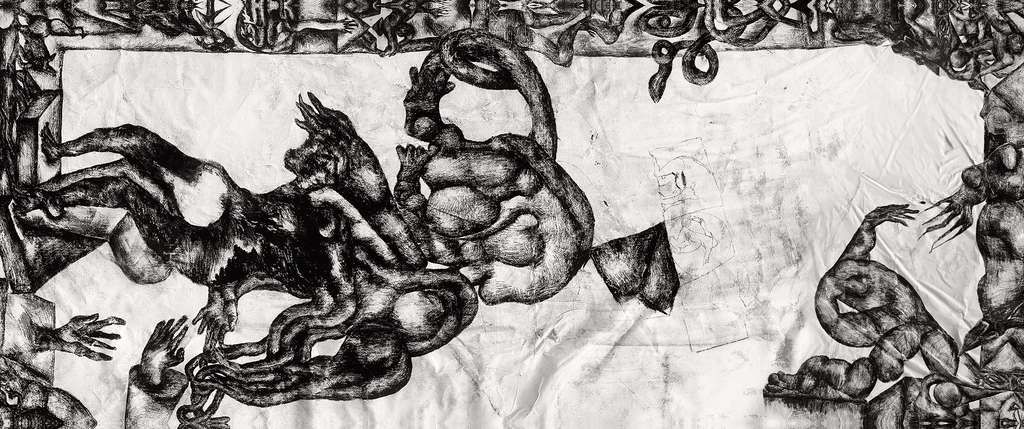
Jan Melka’s contribution, Daphne’s Ribcage, reflects on Daphne’s metamorphosis into a tree through questions of bodily limits, mortality and the radically different temporality of trees, balancing confinement with expansion, movement with stillness. Don’t miss our interview with Jan Melka and Sonny Hall on the relationship between painting and poetry, and why art remains essential to their practices.
The residency reflects Sendb00ks’ publishing model, pairing contemporary artists with texts that continue to shape the cultural imagination. Read Elspeth Mair’s essay below for a closer look at how the residency connects ancient mythology with contemporary art and shifting ideas of transformation, identity and memory.
A castle under metamorphosis: Sendb00ks on revisiting Ovidian myth in the digital age
“Omnia mutantur, nihil interit.” All things change, nothing is extinguished. The line from Book 15 of Ovid’s Metamorphoses ran through the heart of Sendb00ks’ first artist residency, which across two weeks asked six artists to revisit one of the greatest bodies of mythology. The location, a distant Italian fortress replete with Ovidian symbolism, was less a fortuitous happening than a considered collaboration between Sendb00ks founder Gemma Janes and Bianca Pozzi, who currently runs the castle’s cultural programme. Ovid’s poem has long been an abundant source for artists and one that shows no sign of drying up, from Constantin Brâncuși’s sculptures to Ana Mendieta’s Silueta Series – both part of the Galleria Borghese’s Metamorphoses exhibition. Mythology’s tales of transformation, desire, and deceit remain evergreen, and yet are undergoing a metamorphosis of their own, circulating now, as all things are, through primarily digital streams. Rather than lament this shift, Sendb00ks has used it to sustain a network of readers and artists intent on maintaining the vitality of myth.
The residency could not have been more secluded, hidden among the valleys of the Sabine Hills, and yet a digital thread persisted throughout. Hosting a livestream from within the thick stone walls of the castle meant opening it to a wider community of readers, and epitomises Sendb00ks: a publishing project born on social media that for eight years has commissioned artists to respond to bodies of literature, then sent the two out together to its subscribers as a custom reprinted edition.
The project’s digital roots are, after all, the reason it came to inhabit a remote fortress miles away from the online world. It was Pozzi who first reached out to Janes, although, “in a way, Sendb00ks found me first,” she explains, “I am a bookworm, and by 2021 the Instagram algorithm had worked that out.” The account appeared in her feed soon after. The invitation, when it came, was instinctive: Pozzi was drawn to Sendb00ks’s page, eclectic and non-canonical. “It worked against the kind of performative reading the internet can encourage,” says Pozzi, “where books become flat images and status symbols.”
The theme of metamorphosis arose from the fortress itself. Zoomorphic in nature, the Castle of Rocca Sinibalda keeps its true form a mystery: some see an eagle with outstretched wings; others, a sword-tailed scorpion. Over centuries it has metamorphosed through the hands of architects – a medieval fortress until 1530, when the Sienese architect Baldassare Peruzzi carved it into a mannerist palace, renovated most recently by Claudio Silvestrin. Inside, 16th-century frescoes paint the walls with Ovidian symbolism: Narcissus, Europa and the bull, the head of Medusa on Athena’s shield, Perseus and the dragon, the abduction of Proserpina.
Space is never neutral in a residency. As the artists slept beneath the frescos in this small mountain town, absorbing its mythology, elements of the space around them soon seeped into their work. The marine parade fresco decorating Tali Lennox’s studio re-emerged in the form of water – a single tear – in her interpretation of Apollo and Daphne. Her Daphne lies down rather than running, a body come to rest and disintegrating into the undergrowth. Her metamorphosis is one of release rather than entrapment. “It is so extraordinary really to immerse ourselves so entirely,” says Lennox, of a fortnight in the castle she purposefully never left, “to absorb the intricacies and minutiae of the space.” The thread between myth and space ran both ways: the castle marked the artwork, and the myth began to take over the castle soon after. While Elsa Rouy and Okiki Akinfe were both recreating the myth of Coronis and Phoebus (The Raven and the Crow), a crow was suddenly found stuck in the South Wing.
The imagery circulating throughout the castle had an almost Warbugian effect that Pozzi explains as intentional: its libraries favour idiosyncrasy and serendipity over rigid systems of organisation, and sit in close proximity to the frescoes. “Two adjacent ways of telling stories, one through text and the other through image, is a dialogue Sendb00ks beautifully takes part in,” Pozzi says. Theorist Aby Warburg rejected the idea that images were fixed to their original moments, seeing them instead as accumulating new meaning as they moved through time. There is both wonder and risk in this process: the image is free to acquire infinitely new meaning, but risks becoming entirely untethered from any spatiotemporal context altogether. The residency restored those points of reference – physical, visual, and textual – for the artists, which was then transmitted to a wider digital community.
Mythology’s digital circulation feels somewhat inevitable given its fundamental malleability. Its willingness to accommodate flux and change is what has kept it alive in the human imagination. Each generation discovers it anew, finding relevance even in a text thousands of years old. Mathilde Albouy says she finds comfort in knowing that myth is always open to transformation. She knotted and wove silk threads in a way that invokes the first book’s overarching theme of a universe born from chaos, but explains the work has not reached its final form. “That’s what metamorphosis is,” she says. “It doesn’t end and nothing is completed.”
To read mythology is to accept this flux and relinquish the idea of absolute accuracy. Pozzi reminds that “there is no single, authoritative original to return to.” These stories, born from an oral tradition, have since antiquity existed in a multitude of contradictory forms. Helen of Troy was once Helen of Sparta, and in some versions as old as Homer, she is Helen of Egypt, and goes nowhere near Troy. For Jan Melka, who reimagined Daphne as returning to her true form as a tree rather than being trapped in it, reading myth “feels like you can see yourself in every story” – its fluidity of interpretation makes it hard not to identify with its characters. Inès di Folco Jemni chose to focus on the ambiguity of the myth of Tiresias in her artwork, for which she used paper with a metallic, reflective sheen that made it difficult to tell “if this drawing [was made] 200 years or just today.” No two characters were alike across the six artworks, nor were they confined to a definitive reading of Ovid’s text. The female characters, such as Daphne and Coronis, were transformed through the paintings into symbols of empowerment, far from their status as victims in other interpretations. The poem has lasted partly in the hands of its translators, artists and writers, each remaking it over and over again.
The trickling of mythology into digital realms will ensure its continuity for years to come. Sendb00ks knows how to strike a sweet spot between the digital and the physical modes of sharing art, so that the two may be complementary to one another, rather than corrosive. Importantly, it signals the transition of classical mythology from the hierarchies of high academia, where it has remained beyond reach, to more accessible platforms. What came out of the fortnight at the Castle of Rocca Sinibalda was, in Sendb00ks tradition, a pocket-sized publication of the text featuring the artists’ work as a detachable sleeve – soon available as part of a subscription re-launching in late September. These publications, Janes hopes, “will allow the stories to travel more widely” and inspire a “surge of creativity” for others to respond to and transform the myth in a manner that feels, in itself, truly Ovidian.
Just as myth has survived by mutating through fresco, sculpture, and vase painting, it will continue to adapt to new mediums. Sendb00ks, nurturing this metamorphosis, will welcome the six artists back annually, inviting them to remake the following four books of Ovid’s poem. In the years to come, artists will once again gather at sunset to read a section of the poem aloud, and drift to sleep with the myth of Ovid firmly in their minds.
Daphne’s Ribcage