Photography by BENEDICT CAMPBELL
Courtesy of WHITAKER MALEM
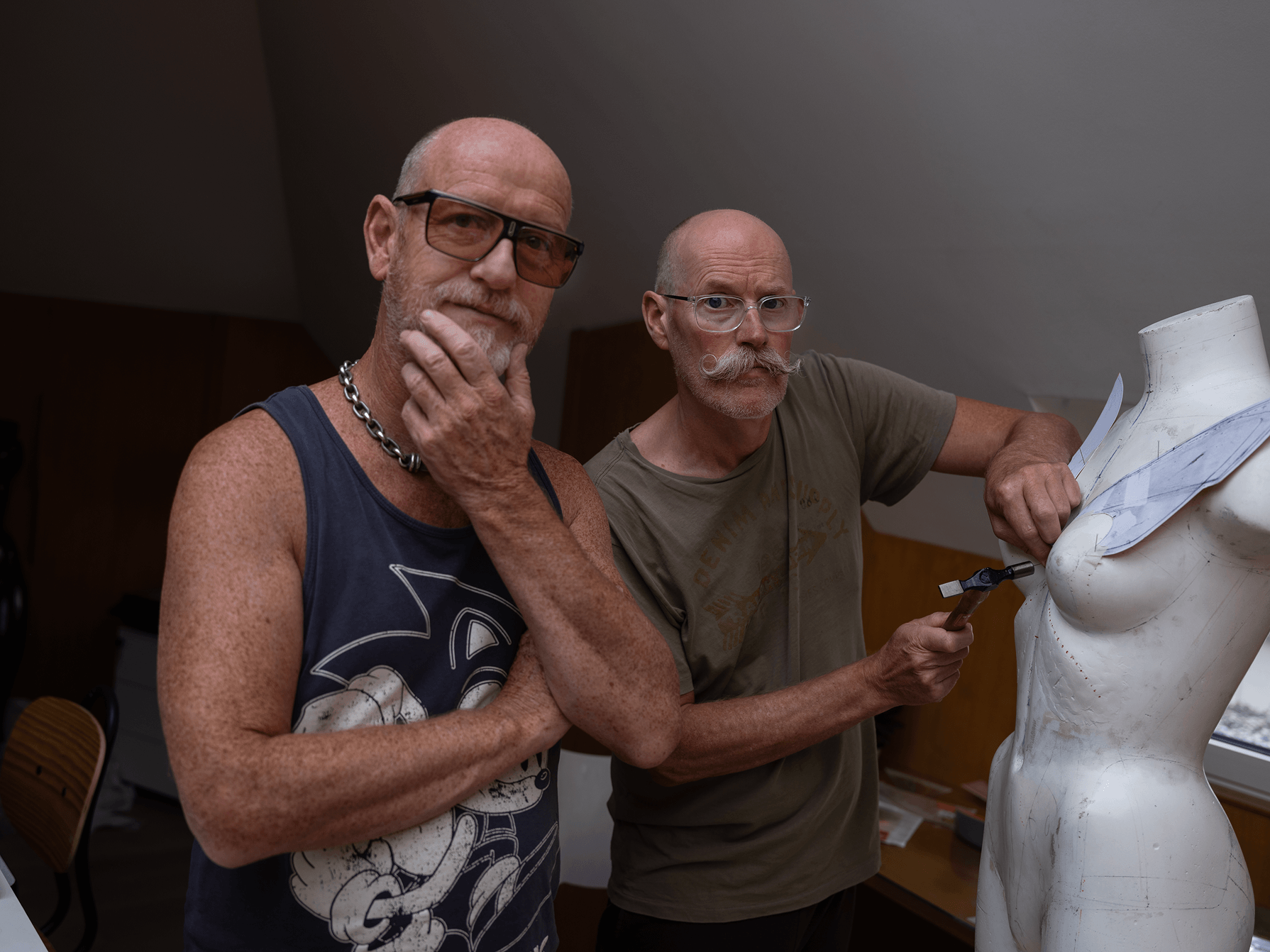
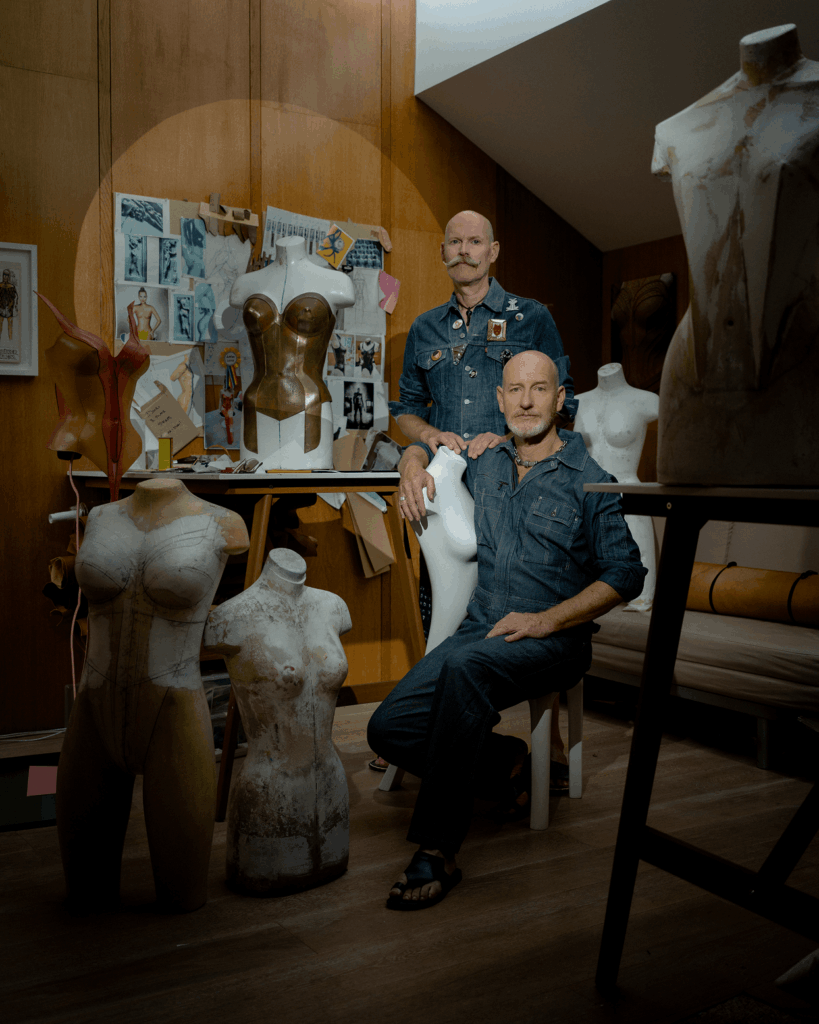
Patrick Whitaker and Keir Malem have spent four decades tracing the intimate contours of the physical self. Few collaborations have shaped the language of the human form in contemporary art and fashion as distinctively as theirs. As partners in life and art, the duo has built a singular practice rooted in the act of bodycasting—capturing living bodies in leather, fiberglass, and sculptural forms that hover between armor and second skin. Their work has evolved through years of craft, intuition, and selective technology into a substantial oeuvre. Their pieces have appeared on runways, in blockbuster films, at the Met Gala, and in gallery contexts, yet they retain the quiet charge of something made by hand, close to the body, and close to each other.
A Whitaker Malem object is never merely a garment or a sculpture; it is a translation—sometimes tender, sometimes assertive—of flesh into form. Over years of working with actors, pop stars, and fellow artists, they have navigated the tension between private vulnerability and public spectacle, always returning to the body as both material and meaning. In this conversation with hube, the duo opens up about symmetry and imperfection, the evolving politics of visibility, time, and the long, negotiated harmony of their shared creative life.
hube: The body in your practice is not represented but directly captured, almost “taken” from reality. How has your understanding of the body changed through this act of direct translation—from living presence into physical trace?
Keir Malem: When you capture a body, you get a static thing. But the body is always moving, it’s impossible to keep it still, even if you try. So it’s a kind of transitional act. Sometimes we use body scans of people—more often for movies—but most of the time, the body image comes out of our imaginations.
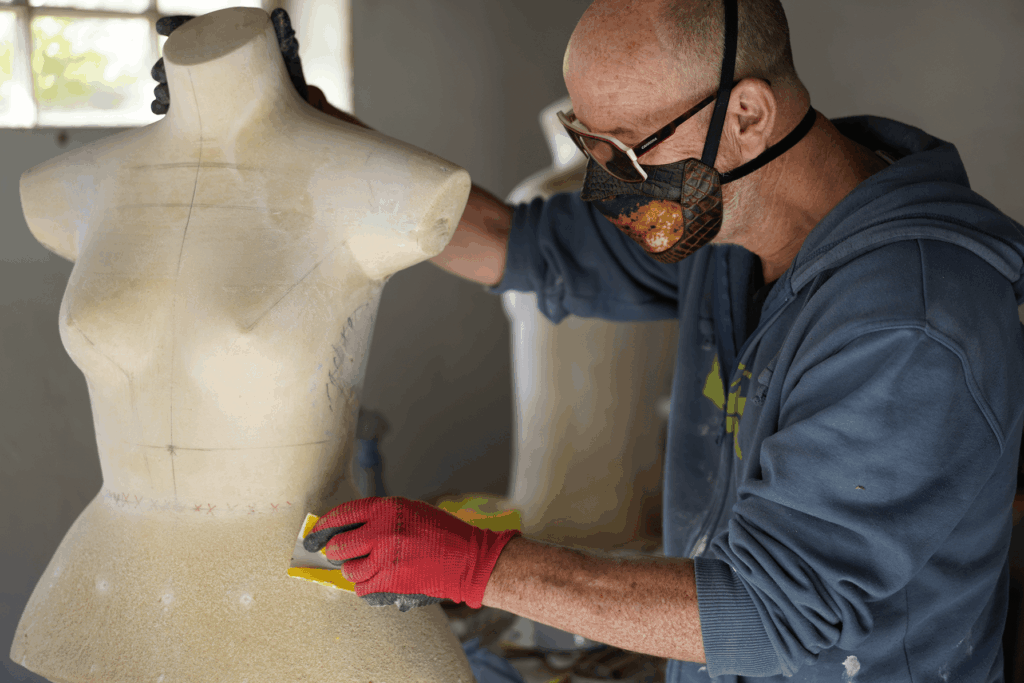
Patrick Whitaker: It comes back to the fact that we’ve been doing this a long time. Originally, we started using a vintage tailor dummy, a really beautiful one. Then, when it eventually collapsed—because it was made from papier-mâché, and we were wet-molding leather over it—we were forced to create our own version by making a mold from it. This was around forty years ago, well before body scanning or other technologies.
In a photo, the body is static, and you can imagine the movement—though good photos of people in action or doing sports capture it. When you’re making something that’s going to be worn or that represents the body, you’re looking for an idealised moment. But then it becomes animated once it’s on a living body, and it’s hard to predict in what way. When we make something, it really gets an additional life when it goes to the next stage—when it’s worn or photographed. That’s always fascinating to us, especially when we are working with body scans. They capture a moment, like a photo—but even with that technique, we always refine the result quite a lot, literally by hand. We’ve done some digital editing, but it’s never entirely satisfactory. All of these things look quite different when you see them in reality, in 3D.
h: Your work often sits at the intersection of ritual, craft, and technological precision. Do you think your practice is ultimately about preserving the body, transforming it, or interrupting the way we normally perceive it?
KM: Preserving the body—yes, transforming the body—yes, and interrupting the body—yes. All the way, we are preserving and holding the body, but we’re also transforming it into a more stylised version of the captured moment.
PW: Our experience over the years has taught us, when we are presented with somebody, to see whether it would be nice to push them out a little bit. If it’s a client commission, or it’s to make an actor or a pop star look cool or sexy, then you’re always looking to optimize what the person has about them, the most interesting aspect of their body. Not everything we make is idealised, or even intended to be that way, but generally it is—that’s what people usually want.
KM: In a way, that’s the interruption—this idealisation. An important aspect of the process is that we work on body forms we create. They’re not symmetrical, and therefore we don’t make symmetrical patterns as it usually happens with garments.
PW: Most times, the pattern is made for one half of the body—left or right—and then simply flipped for the other half. But our patterns are 360 degrees around the body. I think one of the reasons our work looks interesting is that it’s not completely symmetrical. There’s a project that we’ve been working on just recently, and what we’ve been provided to work with is symmetrical because it’s a computer-generated 3D file. It’s interesting, but also has an unreality about it, which we’re not used to. We use a lot of new technology to enable what we do, but ultimately our techniques are quite primitive. We use remarkably few tools and machines, so we’re quite old-school.
There’s a famous story worth relating in this discussion about the making of one of the latest Star Wars movies. As we all know, human minds are conditioned to look for symmetry, and people are often disturbed by asymmetry in faces. It’s generally considered unattractive to be asymmetrical—or less than perfectly symmetrical—which is just a result of our conditioning society. I don’t think it’s necessarily true, but that’s apparently how we generally respond.
So, for the first two or three Star Wars films, the original Darth Vader helmet had been sculpted by hand, by eye, using traditional sculpting techniques: building one half, measuring it, using dividers, and working in clay. But whenever they did the later films—I think, in the early 2000s—they had the ability to scan one half of the helmet, and then flipped it. They made the first symmetrical Darth Vader helmet, and nobody liked it as much as the previous one. It lost something—some character, something that makes things look interesting without perfect symmetry. We’re so used to seeing these utterly perfected, symmetrical 3D computer-generated objects that the more that we identify the hand of man in these processes, the more people like it.
h: Many of your works emerge within highly visible cultural moments—from fashion to global events like the Met Gala. How do you navigate the tension between intimacy of the body and the spectacle of mass visibility?
KM: Very early on in our careers, we made a molded leather garment for Patrick’s degree show, even before we started the business. The first armor piece we made was probably for our second or third collection. The feedback from people wearing it was that they felt protected and, as a result, stronger. So in a way, if you’re wearing one of our pieces it’s like armor against mass visibility. Your body is controlled and kind of idealised. You’re presenting something that is not going to change very much, and you have to worry less about things going wrong or moving.
PW: Of course, we were far from the first people to present this sort of thing. The original instigation of this in mass visibility was probably Jane Fonda’s costumes in Barbarella. She wore very body-conscious breastplate pieces made from combinations of plastics and leather. Even before that, she actually had worn leather in another Roger Vadim film called Powers of Evil—a portmanteau film that goes under many names. When we were working on our recent project with Allen Jones for the Met Gala for Kim Kardashian, Allen was heavily inspired by all of that.
There’s a lot of similar work—Allen’s plastic breastplates for women, a lot of Mugler and Issey Miyake. It goes in and out of fashion, but lately there has been almost a peak moment for it. I think people feel very insecure at the moment, understandably. Everybody has an enormous amount of anxiety about the modern world that surrounds us. It’s not just women—it’s everybody. It’s been very nice over the years when people said they felt like a warrior woman, or empowered, wearing a breastplate or a bustier that has form.
It’s also worth noting that the leather we use is quite substantial—it’s a few millimeters thick— but it’s still quite flexible and isn’t totally rigid. Though the piece Kim wore was completely rigid, because it was made of fiberglass.
As Keir says, it’s very telling that more and more people feel a natural need to be protected. About thirty years ago, we did a project with the British Council at the Design Museum London called Personal Space. It was a dialogue about how the first space we inhabit is our own body and skin, the second is what we put on to cover ourselves, and the third is the structures and architecture around us. That’s really the essence of the symbiosis between architecture and fashion: these things are for humans to be in and to exist in. We created a piece called the Human Shell. It was like a tortoise shell in molded leather that went over the head.
The conversation starts with nudity and the confidence that it takes to be naked. We technically regard ourselves as naturists to some degree, because we socialise naked in certain situations—not just queer contexts, but beaches and so on. My parents were naturists, and I had naturist holidays in France in the 1970s. So it is interesting to go from that as your first layer to making an extreme version of your skin—something like what Kim Kardashian wore, but covering all of you, layered and defensive.
When times are more relaxed and less fraught, then people may gravitate toward more floaty, thin, sheer things. As Keir pointed out, it’s about having armor against mass visibility and a certain degree of control over what you’re presenting your body as. If you’re a young, toned CrossFit woman, your body is very set, of course; but the bodies of the vast majority of women are actually quite malleable in terms of what you can shape or exaggerate. That’s what designers, stylists, and couturiers have been playing with for centuries, and continue to do so. It’s extraordinary how people still seem to want to do that.
h: When you collaborate with artists, fashion houses, or filmmakers, do you feel you are working within a shared visual language—or constantly translating between fundamentally different ways of thinking about the body?
KM: The usual starting point is a conversation. Then somebody has to bring forth some visualisation—which is usually a drawing or a sketch—and that becomes something to talk about. Then you move on, think about that, present something else, and colours come in, and so on. Especially if it’s for a film—then it’s for a certain scene; and it’s about what that scene needs to convey, so that’s quite an important thing. But we think it’s all about negotiation and compromise.
PW: The kind of films that we get involved with are big studio projects. If it’s a superhero movie, there’s a lot to consider: what the character looked like when it was originally drawn in the 1930s or 50s, what are the other expectations, what the actor wants, what the director wants, what the costume designer wants, and so on. That can be incredibly tedious.
There’s other times when people come along and say, “We love what you do, just make something for us.” That’s really nice, but it can feel quite weird because sometimes you feel a bit like a fish out of water. You’re thinking, “Hang on, we’re used to constraints—will you please give us some more constraints? Do you know what you want?” When it’s going well, we’re all thinking in the same direction, the visual language is shared, and you feel a common ground. We work in many different disciplines and are essentially freelance guns for hire. We make our own creations and show people what we can do, and people say, “I love that, and I want something like it.” That happens a lot.
One of the nicest examples was a costume we made for the Apple TV show Foundation. There was an android character, a very lifelike female humanoid robot. It was the second season, and they wanted her to be sexy because she gets involved with one of the leads. They have seen a photo of one of our pieces, taken here in our house in a situation entirely of our own making and control, and they literally said, “We want a version of that—but purple and a bit different on the hem.” So there are occasions when we’re literally given “We want Whitaker Malem on a plate.” Then there are other times when it’s not like that—like with the Captain America suit or the Dark Knight Batsuit.
KM: It also depends who you work with. Some people are very controlling, and they will not compromise much. They have a set vision, and that’s what you have to produce. This is especially true with superhero projects, where everything is usually drawn before you even get asked. There’s not much room for negotiation. Other times, they act what I call creatively generous, meaning they’re happy to have as much of your input as you’d like.
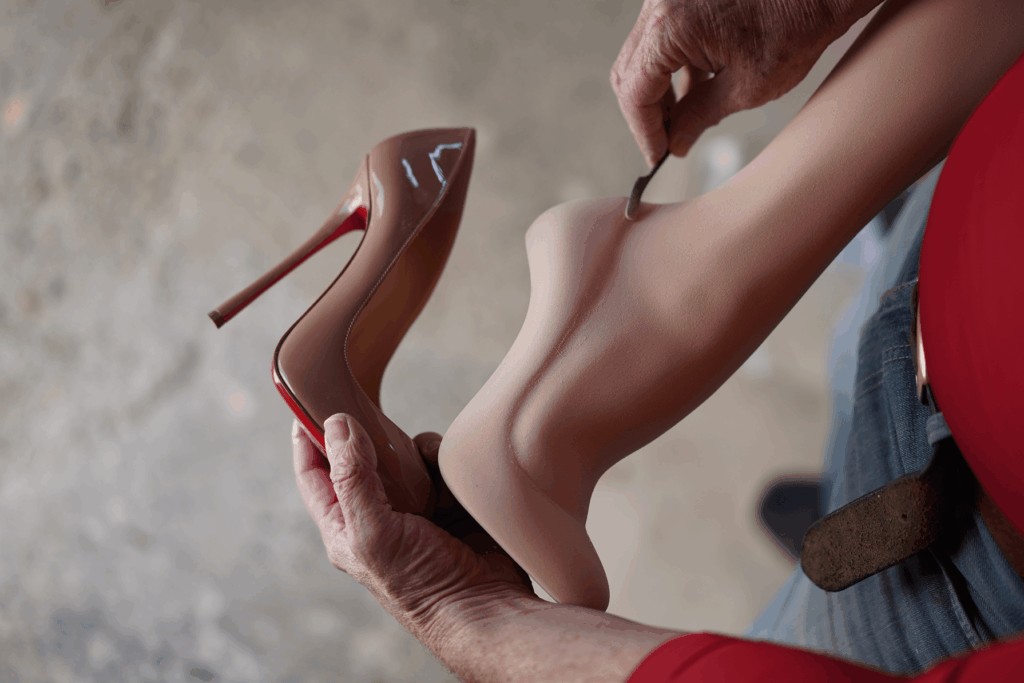
PW: But there is a point of translation when someone comes to you with a design and says, “We want you to make it your way.” We generally know when something is going to work within our range of techniques, and when it’s not. There have been a few times when people requested something and we knew it wasn’t going to work. For example, the pieces we make with Allen Jones and for Christian Louboutin are made of much thinner sheep leather on the surface of a sculpture, and that’s what gives it its effect. But sometimes, fashion editors or designers want the “bodysuits”—which are actually fiberglass or freestanding plastic constructions. You couldn’t move in them.
KM: You know you cannot pause or buy time, and people come to you with ridiculous expectations of what you can achieve in very short spaces of time. We are able to accommodate sometimes, and certain things are quite simple; but when it’s something that you’re trying to experiment with or change the boundaries of, you need more time.


Photography by DAVID LACHAPELLE

Photography by ALLEN JONES

Photography by AARON IDELSON

Photography by KILIAN O’SULLIVAN

Director PATTY JENKINS
Courtesy of WARNER BROS

Foundation, 2021

Director PATTY JENKINS
Courtesy of WARNER BROS

Photography by JOHNATHAN GLYNN SMITH

Courtesy of WHITAKER MALEM

Courtesy of WHITAKER MALEM


h: To what extent do you think technology (such as scanning, digital modeling, and replication tools) has changed the “truthfulness” of the body in your practice — and do you still believe in the idea of physical truth?
KM: Well, has there ever been physical truth?
PW: This is the thing with the worlds that we’re involved with. There’s generally a lot of trying to avoid physical truth, or make it hyperreal, or change it. That’s more of what we’re aligned with. A good example was when we did the body scan of Arielle Dombasle, an amazing French actress and chanteuse. She’s a character, an older woman; she has amazing legs, and Christian [Louboutin] suggested we use her as a subject for the sculptures we made for him. She was a great choice, but naturally there were things on her scan that we wouldn’t have wanted to represent, and they were effectively erased—so that’s not particularly truthful.
KM: We are sometimes accused of not doing garments for larger people or people who don’t conform to beauty norms. The simple truth is that we’re just rarely asked to, though we have done them in the past. I think there is an aesthetic about the human body that is very hard to erase. If you go back to Greek or Roman statues, these are sort of idealised bodies, and Western society has held them up as ideals, and they’ve been celebrated for a very long time. That really permeates the society that we live in.
When people are confronted with a body scan of themselves, or even a facial scan, they’re actually shocked because they’re used to looking into a mirror, which gives you a false view of your body. So when they actually see it in reality, they’re so unused to it. That’s what everyone else sees, and it’s kind of a weird experience when people first see that themselves.
PW: What’s very important to our practice is a degree of stylisation—trying to find planes and surfaces within the body that present well. Our technique relies heavily on seaming, and we like seams because they enable storytelling; they are the language of couture. We’re also very interested in letting people understand the process that went into making something, so when you see it, you can actually get some idea of how it was made. I think people get vicarious pleasure from that. A lot of what’s to be celebrated about artisanal handmade pieces is that you can actually see how they were made. People like that a lot, and that’s why stitching and seams are important to us.
We’re working on a male sculpture at the moment, which has been scanned from an incredibly built, toned, muscular guy. Yet when it came to actually working on his body scan and making the sculpture, we still were looking for the planes, angles, and surfaces that would please the eye. In fact, it involved erasing quite a lot of the detail from the musculature and making it plainer rather than bumpy. A muscular man is an incredibly complex object, and we want to represent and stylise things. We are, as Keir says, inspired by classical sculpture, but probably even more we both like that futurist, deco-esque 1930s notion of the body, which comes through in sci-fi a lot. It makes an interesting fusion—when you take this and combine it with our quite organic, handmade, and crafty process. That’s probably at the heart of what we do.
h: Working as a duo requires a continuous negotiation of vision and authorship. At what point does a shared practice stop being collaboration and become a single unified artistic intelligence?
PW: In about a month, we’ll have been together for forty years. We met at a post-Gay Pride party. Gay Pride was a hugely different thing then—largely political and very small, about six or seven hundred people each time. Keir and I were very different people as individuals, but we’ve always liked a lot of the same things.
KM: Obviously, we differ a lot, like people do—but there is a lot of common ground just about things we like: books, films, art. We have a similar aesthetic. That’s our starting point. We did some bas-relief sculpting a few years ago, and there was a man and a woman. We would spend an hour sculpting—I’d sculpt the woman, and Patrick would sculpt the man—then we’d swap over and work into each other’s pieces. We thought there was going to be a lot of argument about that, but it actually worked really well.
PW: Sometimes we have disagreements, but not so much about what we’re going to do or what it’s going to look like, but more about how we’re going to achieve it—the steps or the process. Our work is entirely presented as a unified artistic intelligence, as you put it—that’s how we’d like it to be seen. There are pieces that we’ve made that I can point to and say, “That one was much more Keir’s idea, that one more mine,” and we try to challenge each other with it quite a lot.
I think it’s also because we only actually make about twelve pieces a year, and that’s probably even an exaggeration. When we’re working on a movie or another big project, we do have assistants—like it was with Wonder Woman, where we spent a year making 150-odd costumes in total. But generally it’s not like that in our practice.
KM: Making our pieces is a big investment in time, and we have to be really sure that we want to make that thing. We’d like to have a reason for that thing existing, so it’s not just something to put into a cupboard.
PW: That’s why we keep going so much with commission work. In terms of sustainability, our thing has always been to only use the materials that we need to make a piece. We don’t buy batches; that’s why we buy all our leather in its natural colour. All the colours you see on the surface of our pieces—we’ve dyed them ourselves. We’re ultraslow fashion. If you try to buy that exact leather, you’re not going to get it right away; you’re going to have to put up with whatever colors people have made, and then buy a whole skin of it, and then have to wait for your order. It allows us to be much more flexible and respond more quickly. When you see metallic finishes on what we do, that’s where Keir gold-leafs the leather using a size and glues down the little pieces of gold leaf on the surface of the leather.
I’m not sure that it would be the same if we weren’t a relationship. It’s impossible to know, because we don’t know anything other than this now. But we do know other people that work together but aren’t in relationships—and it’s generally more of a nine-to-five kind of thing. It’s tricky; in some ways it’s become our life, but in other ways we don’t want it to be entirely our life. We like to think that we have some sort of life outside our work.
As you get older, you realise it’s actually not just about making money to survive. We’ve not made ourselves by modern standards rich by doing this. I’m happy to say that we have survived and prospered. But we’re very keen on doing our thing—and I’d encourage other people to do it. We’re also quite keen on the fact that we’re not a brand. We don’t just put our name on something and say, “Here’s a credit card holder, here’s a phone case.” It would be fun in some ways, but it would have to be a bit more than that for us.
KM: I think you can definitely regard our output now as a singular output from both of us. That’s important, because we collaborate with other people so often—like with Allen Jones on the Kim Kardashian piece, and with many others—with costume designers on their films or with fashion designers on their collections. Often there can be quite a lot of chefs in the kitchen, and we generally try to present a united front. And we do, because we know what we’re capable of and what we can offer.
h: In contemporary visual culture, the body is constantly read through frameworks of meaning—gender, identity, story, desire, status. Do you think there is still a way of seeing the body that resists this immediate interpretation, and simply allows it to exist as form, presence, or material?
KM: I think everyone immediately imposes a stereotype on what they see because of their cultural and personal identity. They immediately pigeonhole things into the boxes they like. It’s impossible to escape it, but it’s good to challenge those stereotypes if you can and try to present things in a new or different way—or come up with something new that people haven’t seen, which is increasingly rare in this world.
PW: But it is possible, and it does happen. In this century, people have embraced, to some extent, gender fluidity and inclusivity, and we really appreciate the fact that people are more accepting now of different body types and different ideas about the body and sexuality, and are prepared to be proud of that difference. We’re aging—we’re both 61 now—and our bodies aren’t what they were. As you get older, things change in uncontrollable ways that are completely unforeseen. Some are serious and unpleasant, but others are quite mild, like baldness or skin issues. I know people that are beautiful at 14 and people who are beautiful at 80. I’m really glad that people are looking much more at bigger bodies and other sizes.
KM: Now we have more choice over clothing. There is a lot more available in a wider range of styles and materials. People can find garments, makeup, hair colors, tattoos, other things they like and that say a lot about them. They can present themselves as fully rounded people. I think it’s great that different people have been graced on television and in fashion shows—because that’s what humanity is, and it’s a representation of humanity in all its diversity.
PW: It is the differences between us that make us interesting as humans. What’s so depressing about a lot of what we’re getting presented with by the internet or the media is how homogenised and similar everything is becoming, lacking diversity.On the other hand, one of the best things about social media and the internet is that it has enabled people to find their tribes—from wanting to do lindy hop or a 1950s revival, or go right through to extreme and bizarre things. Hopefully people feel less isolated, having found their tribe.
KM: But then the negativity of that is the kind of ghettoization where people just feed into their own tribe, so they’re not challenged by people who think or act differently. They become less broad-minded or less able to deal with things outside their own feelings or thoughts.
PW: This experience of people being in their own bubbles has definitely increased since Covid, and I think we’re all aware of it. Even us—an older generation with friends that grew up through only social contact that was only physical or on the telephone. Everybody used to phone all the time, which has more or less disappeared now. These are the profound changes that we’re only just beginning to assimilate. Still, the most important thing for people is to actually get together and relate one-on-one as much as possible. We certainly think that humans do better when they’re around other humans.
h: If you could invite three people—living or dead—to a dinner, and you knew they would definitely come, who would they be?
KM: Patrick’s parents, who died twenty-odd years ago, and my grandmother, who died about thirty years ago. I would love to spend an evening with those three people. We’d have a lot of laughs, maybe a few tears, and it would be a great evening.
PW: It’s very sweet. I didn’t know that Keir thought of that. It is quite upsetting, as you start realising how much influence these people had on you. My mother was a sculptor, and she had a huge influence on our work. She was not just an amazing sculptor; she taught Keir how to do fiberglassing and lots of practical things, she helped with my degree show, and she always had a hand in these things.
These people would definitely be the ultimate choice. I immediately started thinking about which famous people we would like to talk with. There’s lots of historical figures I would love to ask to dinner, but I think it’s really sweet that Keir chose people that we actually did know and who are now gone. You realise that it is what really matters.
KM: Because we’ve had this fortunate career that allowed us to work with famous people right from the beginning, we realise that some sort of celebrity shine is often false. I think a lot of celebrities, although they enjoy their lifestyle, don’t actually like being famous. Their most valuable time is being with their loved ones and not having to pretend to be anything special.
We always say, “Don’t meet your heroes.” People are famous for their achievements, but that’s often a lifetime achievement, which we can’t distill into one evening. Someone’s accomplishments can be amazing, but they may not be so nice as a person. So really, do you want to spend an evening with them?


Courtesy of WHITAKER MALEM


Courtesy of WHITAKER MALEM

Photography by JOHNATHAN GLYNN SMITH
