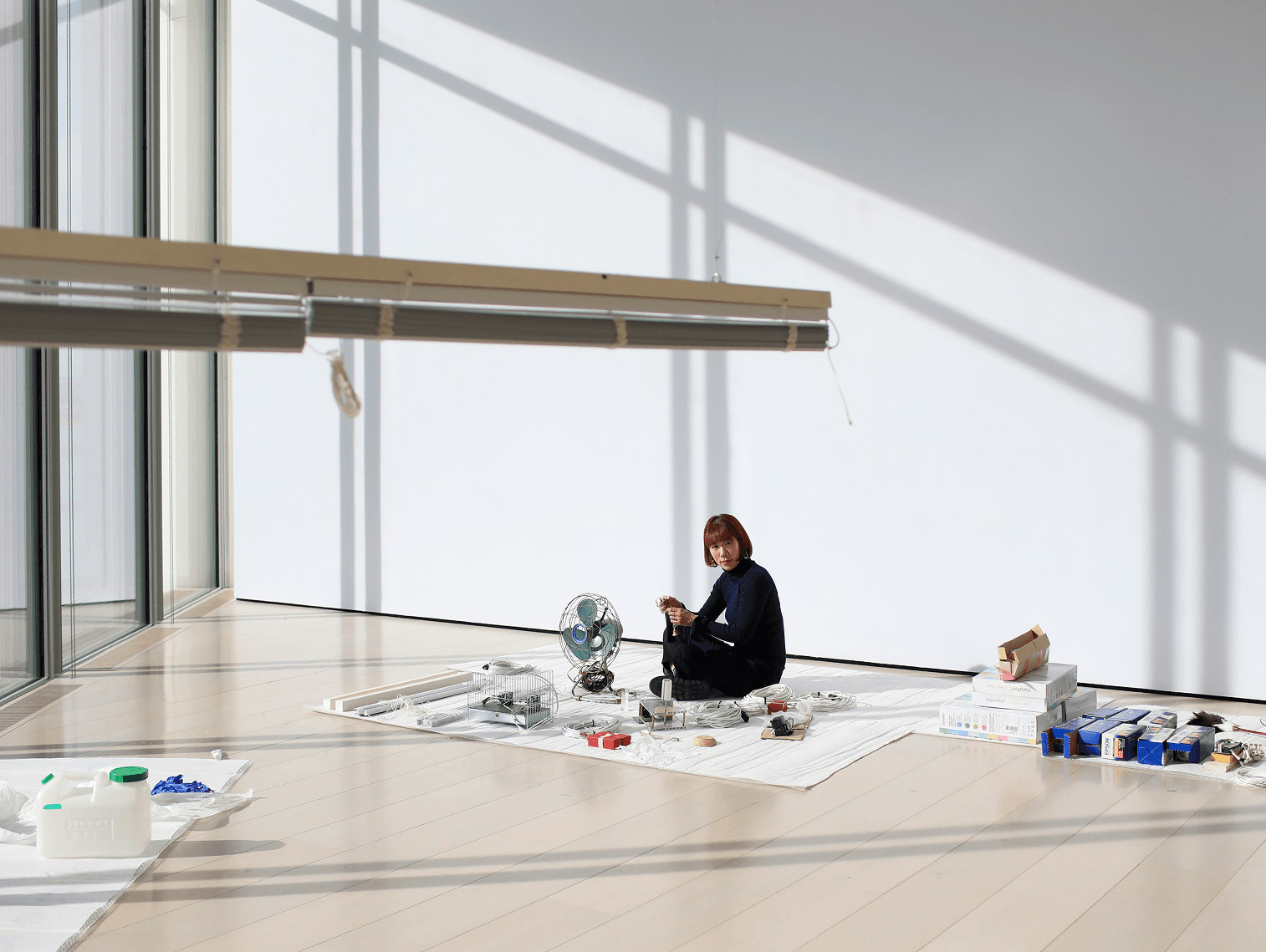
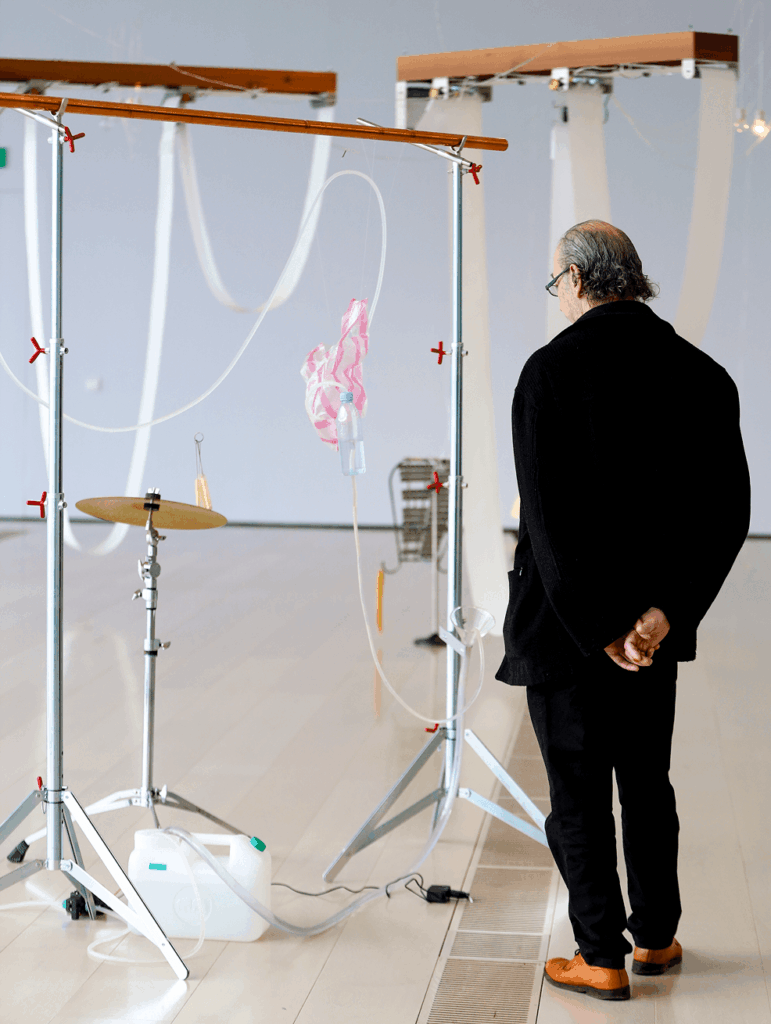
Yuko Mohri sets up environments, places objects within them, and observes what happens. Air currents, humidity, electrical charges, and the slow accumulation of dust—forces that normally escape notice—become the active ingredients of her installations, which remain in a constant state of becoming.
Opening 28 March and running until 6 September 2026, Entanglements is Yuko’s most extensive solo exhibition in Europe to date. The title captures precisely how her practice works: everything is connected to everything else, though these connections are rarely visible. Incorporating found objects in art, reworking musical instruments, and wiring them into electronic circuits, Mohri creates fascinating kinetic sculptures that respond to changes in air and temperature. Visitors’ presence and movement become part of the system, altering what they came to observe. Sound runs through it all.
Following her celebrated presentation at the Japan Pavilion at the 60th Venice Biennale in 2024, Entanglements marks a significant moment in Mohri’s ongoing investigation into the sensory environment and invisible forces that shape the world around us. In this conversation, she talks about leaks and breakdown, resistance and authorship, and why she still chases the spectral energy of a needle on a record.
hube: Do you think of your installations as systems you design, or as situations you enter into and negotiate with?
Yuko Mohri: I definitely lean toward the latter. I don’t really draft blueprints in advance; instead, I go to the site and build the installation by responding to the space and placing objects within it. It’s a process of gradually coming to understand the space through my interaction with those objects.
h: Imperceptible forces like air, dust, humidity, or electricity become noticeable in your work. What draws you to things that usually escape attention?
YM: Our daily lives are so hyper-scheduled—we’re constantly checking our phones, rushing to catch trains, and trying to keep up with social rhythms. But when we momentarily step back and shift our gaze, we catch glimpses of things that usually stay hidden. You might find yourself staring blankly and suddenly notice how fast the clouds are moving, or see a plastic grocery bag caught in an updraft, drifting gracefully. Even in New York, where I was staying until recently, I would occasionally come across scenes like that.
The complexity of these landscapes—revealed when I briefly step out of society’s dictated flow of time—brings unexpectedly rich moments. The social timeline is, after all, an anthropocentric rhythm, and we inevitably get locked into its schedules. But there must be many other temporal layers. When a door to one of those alternative timelines opens, a wonderfully rich atmosphere flows into my everyday life. That’s exactly the kind of gap I want to create in my own work.
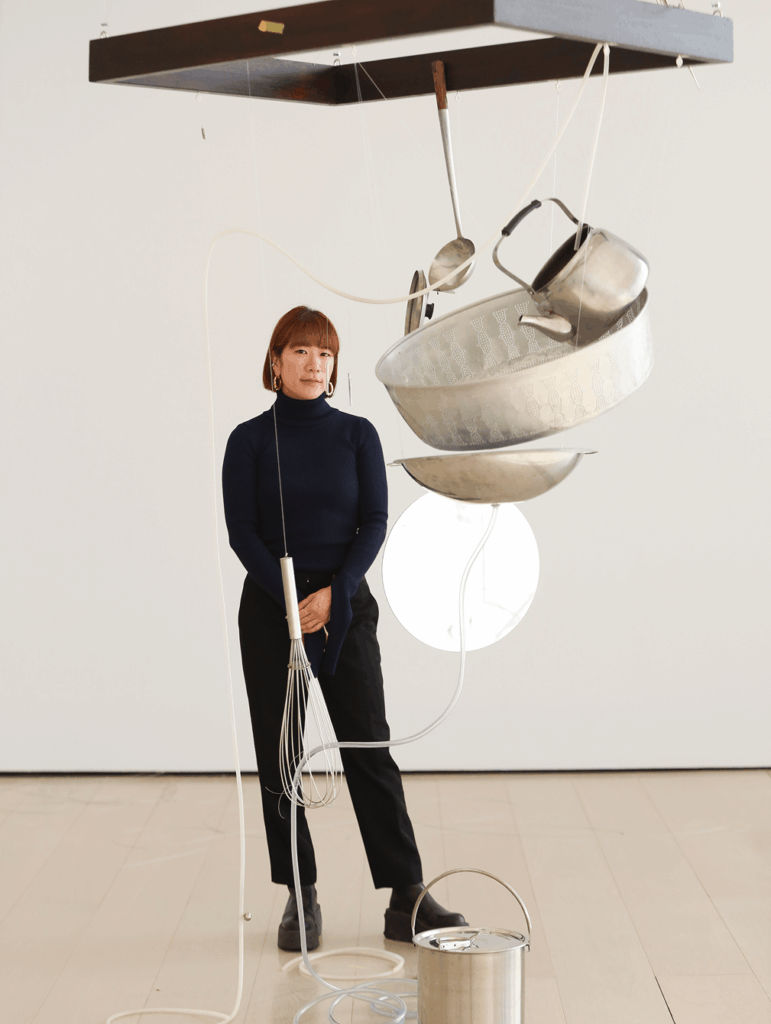
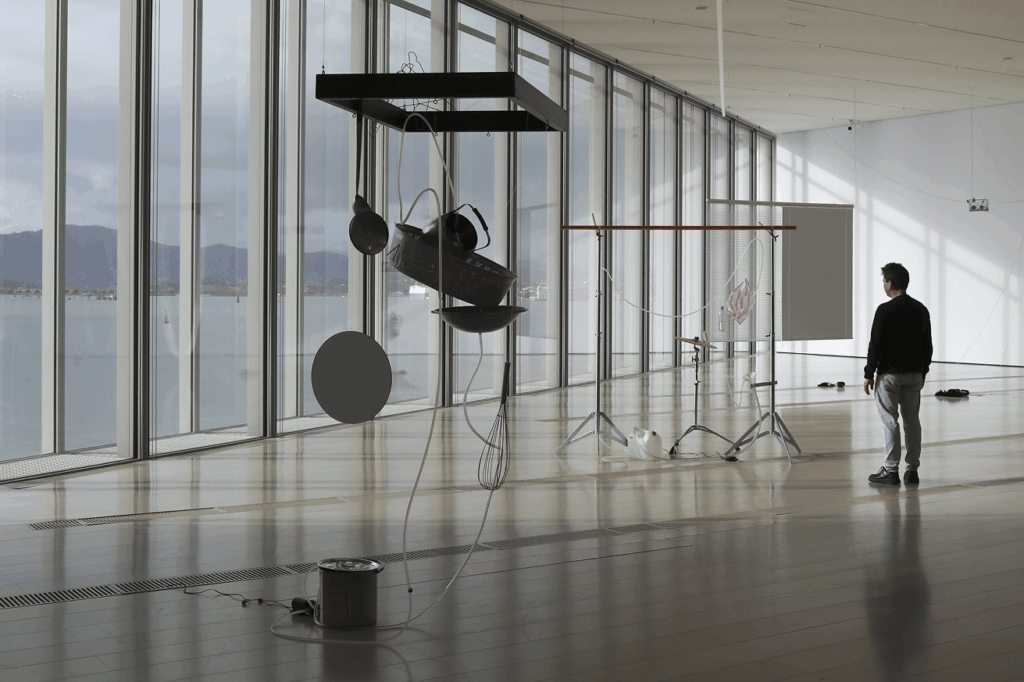
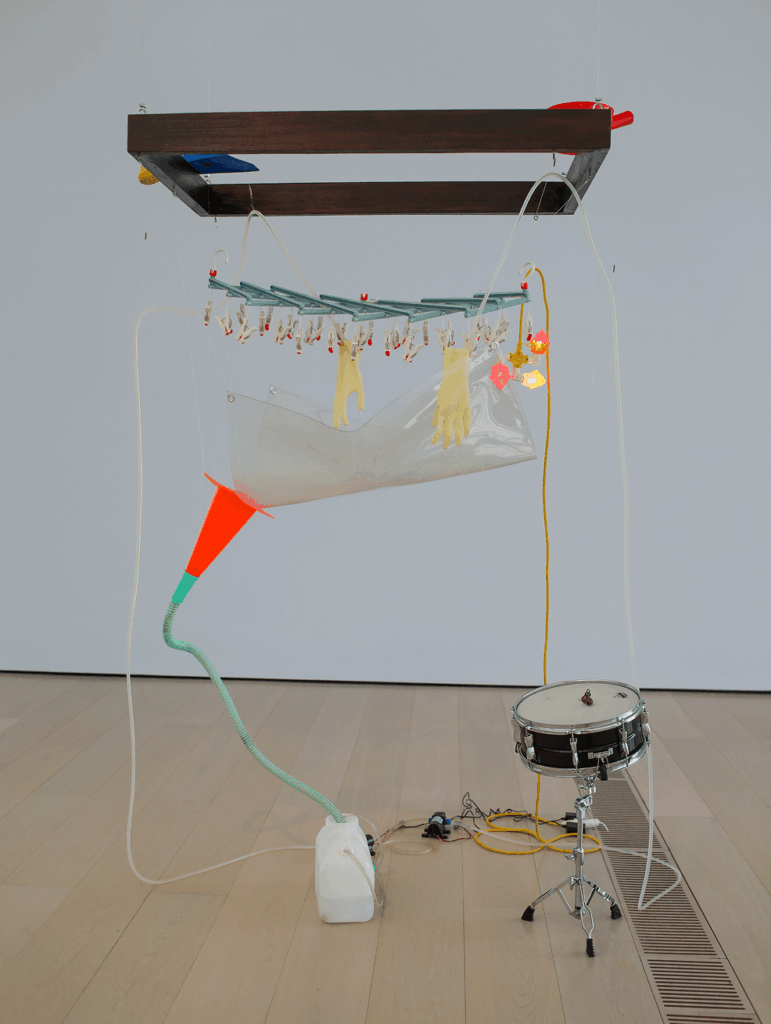


h: You’ve spoken about “noise” as something productive rather than disruptive. What kinds of noise feel most alive to you right now?
YM: Noise isn’t inherently good or bad. It’s simply what exists outside us. To me, a state that is neither good nor bad is noise.
h: Many of your works rely on chance and environmental instability. How do you decide when to intervene and when to let things unfold on their own?
YM: To be honest, I think it would be fascinating to reach a state of mind where I truly wouldn’t mind if a piece broke down. That doesn’t mean creating works intentionally designed to self-destruct, like Jean Tinguely’s Homage to New York. It means not intervening at all—even letting a motor stay dead if it stops working.
However, since museums and galleries are public spaces where people come to experience the art, I feel a responsibility to intervene just enough to keep things running during the show. It’s a real dilemma, though. Deep down, I’d love to let things follow their natural course.
h: You’ve said, “I do not compose.” When materials, environments, and machines shape the outcome, what does authorship mean to you?
YM: If anything, the sense of “testing” is stronger to me than the sense of “making.” My artistic practice consists of repeatedly asking and building on the question, “What will happen if I place this object in this environment?” I’m not seeking a specific result. Rather, I believe the result will be unpredictable, and that unpredictability is what holds meaning. It’s not an expression that aims for the summit of a mountain, but one that repeatedly experiments with the environment itself. That is how I, as an artist, engage with the world. But in that case, what exactly is authorship?
h: Is there a moment when a work surprises you—when it behaves in a way you couldn’t have planned?
YM: Quite often. Those are actually the most joyful moments for me. Take the Japan Pavilion at the 2024 Venice Biennale, for example. The building has very distinctive architecture, with square openings in both the ceiling and the floor. Since I was showing Moré Moré (Leaky)—sculptures dealing with water leaks—I thought it would be good to invite actual rainwater into the installation. So we decided to leave both the ceiling and floor openings completely exposed for the duration of the show. During the preview days, a sudden evening storm hit, and visitors rushed into the pavilion to take shelter. Watching the rain pour in through the ceiling, I was smiling to myself, thinking my plan had worked out perfectly. But the very next second, a massive gust of wind blew in from the pilotis, catching the plastic sheet hanging there. It whipped the sheet right up onto the exhibition floor, billowing like Hans Haacke’s Blue Sail. I was completely caught off guard—I never anticipated the piece taking on that kind of form—but it was an absolutely sublime sight.
h: Your work often begins with moments of breakdown: leaks, decay, malfunction. What do these situations allow you to notice that stability doesn’t?
YM: Since 2009, I have been doing fieldwork, observing how Tokyo subway staff use everyday items to patch up water leaks. At first, I was just fascinated by the quirky, improvised setups they created, so I enthusiastically documented them.
Then, in March 2011, the Great East Japan Earthquake struck. Miraculously, the subway was already running again the day after the disaster. But what I witnessed wasn’t the usual whimsical scene of a minor leak—it was a real-life disaster response. At Yurakucho Station, water was pouring from the ceiling like a waterfall. It was beyond fixing with everyday items; the staff were completely blocking the exits with sandbags. Overnight, the reality of this situation had completely shifted. When I got home, I watched the news reporting the meltdowns at the Fukushima Daiichi Nuclear Power Plant, with massive amounts of radioactive material leaking out as gas and contaminated water.
That was the exact moment the meaning of “leakage” shifted profoundly for me. How should we respond to these kinds of unprecedented situations? How can we act flexibly while still honouring history? I started a daily practice of experimenting with how to improvise solutions to unexpected problems—not just in my art, but in daily life. I realised then that a crisis can also serve as a catalyst for unleashing creativity.

h: Do you see your work as a form of quiet resistance, or more as an act of careful attention?
YM: This ties back to what we discussed about authorship, but generally, I set up environments where something emerges passively, based on that “careful attention” you mentioned. There is one exception, though: the installation You Locked Me Up in a Grave, You Owe Me at Least the Peace of a Grave, which combines a rotating spiral staircase with a rotating speaker.
In that piece, I actively embraced the theme of “resistance.” Many of my works are kinetic sculptures driven by motors, but fundamentally, anything that moves on this planet inevitably encounters physical friction and resistance. Because of this, the works often don’t move as I intend, creating struggle—but that is why they evolve in complex ways. Friction and resistance are also sources of noise. And, naturally, resistance is the starting point for a spirit of rebellion against the mainstream of the times.
I wanted to treat all these elements positively in my work. Even small friction, like scratching a record, can accumulate into significant resistance and eventually evolve into a revolution. This is the concept behind You Locked Me Up in a Grave, You Owe Me at Least the Peace of a Grave, which I conceived by drawing on the cosmology written by the nineteenth-century revolutionary Louis-Auguste Blanqui while he was in prison. In other words, friction and resistance are also among the “moments of breakdown” you mentioned in your previous question.
h: Entanglements is your most extensive solo exhibition in Europe to date. How does working in a new geographic and cultural context shift your thinking?
YM: Regardless of the scale of the show, I feel that various shifts in my thinking naturally emerge through my daily practice. So the very act of constantly moving and immersing myself in new geographic and cultural contexts as part of my nomadic practice is always shifting my perspective.
Moreover, one of the rules of my Moré Moré (Leaky) series is that the pieces must be created using only found objects I encounter during my travels. In that sense, the work itself is a direct manifestation of these new environments and encounters with the unknown.
h: Many of your installations seem to exist in a delicate balance between control and letting go. How do you relate to uncertainty in your own life?
YM: When I was younger, I was convinced that forcing unexpected results was the key to making interesting work. But as I kept creating, I realised I was far more moved by the unseen landscapes that emerged naturally—simply by steadily cultivating something—rather than imposing a focus on unexpected expression upon myself. Eventually, I fully shifted toward that latter approach.
In my personal life, I generally prefer stability. But I also recognise that uncertainty is more prevalent today than ever, so I try to stay mentally flexible. When something truly troubling happens, or a problem seems impossible to solve in the moment, I think it’s fine to just step away from it. If I leave it alone, go do something else, and come back to it later, the issue sometimes resolves itself surprisingly easily. Or a problem that felt massive suddenly breaks down into smaller, manageable pieces. I believe it’s important to say, “Well, let it be” sometimes.
h: What are you curious about now, something unresolved that hasn’t yet taken form, but keeps returning to your thoughts?
YM: I often use audio equipment as a material. Even with something as basic as a speaker, I’m constantly amazed by how rapidly the technology evolves. At the same time, I often feel that the highly engineered latest models are strangely lacking something.
As technology has advanced, the act of “listening” has been abstracted and simplified. It’s been reduced to streaming compressed music files and listening through Bluetooth earbuds. For most people, a speaker just needs to emit sound, and today’s listening habits are undeniably convenient. After all, capitalism thrives on the narrative that “technological progress always pushes humanity forward.”
But I believe that in this process of abstraction, we’ve overlooked a kind of spectral energy surrounding sound. I sometimes daydream about how playing a record—putting a needle on a turntable, running it through an amplifier and out of a speaker—wasn’t just about perceiving sound. It was about feeling the various energies attached to it: magnetism, electricity, signals, or physical waves. I think I’ll keep using old, clunky equipment in my practice because I want to keep chasing the spectres of that energy.


Yuko Mohri: Entanglements, 28 March – 6 September 2026, CENTRO BOTÍN. BELÉN DE BENITO
Image courtesy of CENTRO BOTÍN
Words: ARINA V
