New York-based artist Rachel Rossin joined our call from her studio, a pocket of paint and canvas suspended above the chaos of Times Square. Inside, the space hums with its own kind of disorder, with works and technologies feeding off the restless energy that seems to radiate from the artist herself. A self-taught programmer and researcher as much as she is a painter, Rossin operates at the intersection of art and technology, collapsing the boundaries between code and canvas in search of beauty in the sublime and the rare. In this conversation, she speaks about teaching herself AlphaFold, the technology used to predict protein structures, the lingering influence of Ghost in the Shell, and making art with her twelve-year-old self.
hube: Hi Rachel, can you hear me?
Rachel Rossin: Oh hi, yes, I can hear you now. Sorry, I have a new phone and had to set permissions.
h: No worries. Thanks for making the time.
RR: Of course. I’m on deadline, so it’s that kind of fun chaos. I have lots of ideas flying around.
h: When you’re on deadline, are you locking yourself in or following some kind of routine?
RR: It’s pretty quarantined. I’m not very social during that time. I don’t take in much outside input, maybe just some music without lyrics, or strange electronic stuff like dubstep. Mostly, I’m surrounded by my own notes and sketches. I draw every day, make small preparatory paintings, and just live inside the work.
h: Much of your work deals with virtual and augmented realities. How does the physical labor of painting coexist with that digital sphere?
RR: Painting uses the whole body, and that feels like a reflection of how we live now, constantly oscillating between physical and digital realities. Sometimes I’m very literal, painting “en plein air” inside game engines or VR mockups. But I’m also interested in the vapor between the two, exploring what’s lost or gained in that exchange. When I make physical work, I’m the reporter from that space, translating what that experience feels like.
h: How do you maintain a sense of embodiment when so much of your process happens online?
RR: I definitely lose it sometimes. When I’m building large-scale or virtual installations, I can lose the tether to my body completely. It’s similar to that feeling when you’ve been scrolling too long, that disembodied drift. I have to actively practice mindfulness to stay sober in that process.
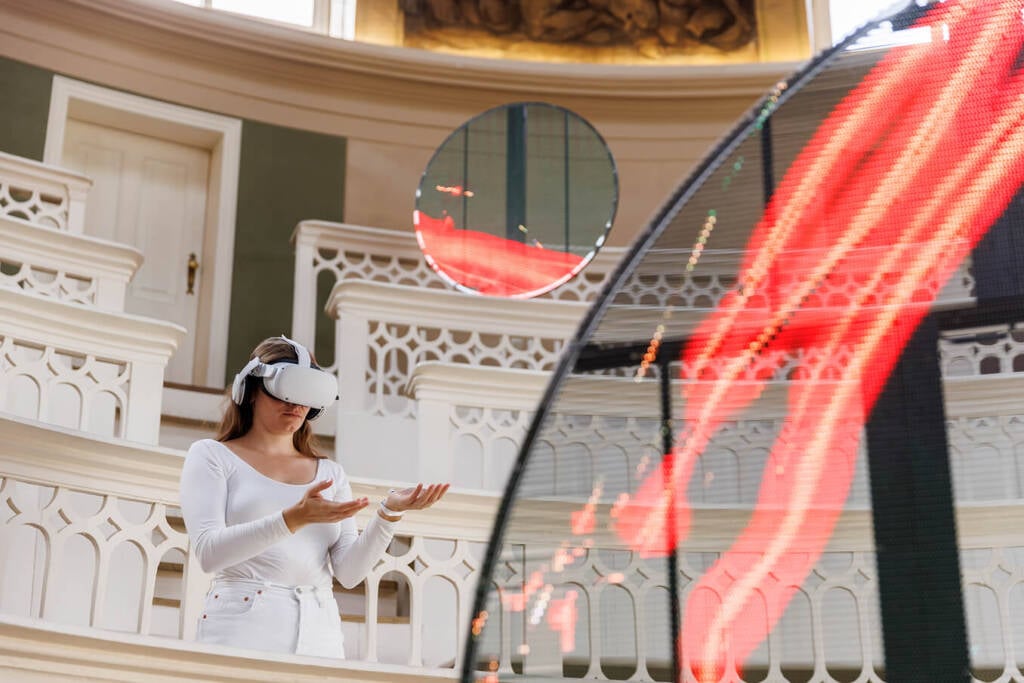
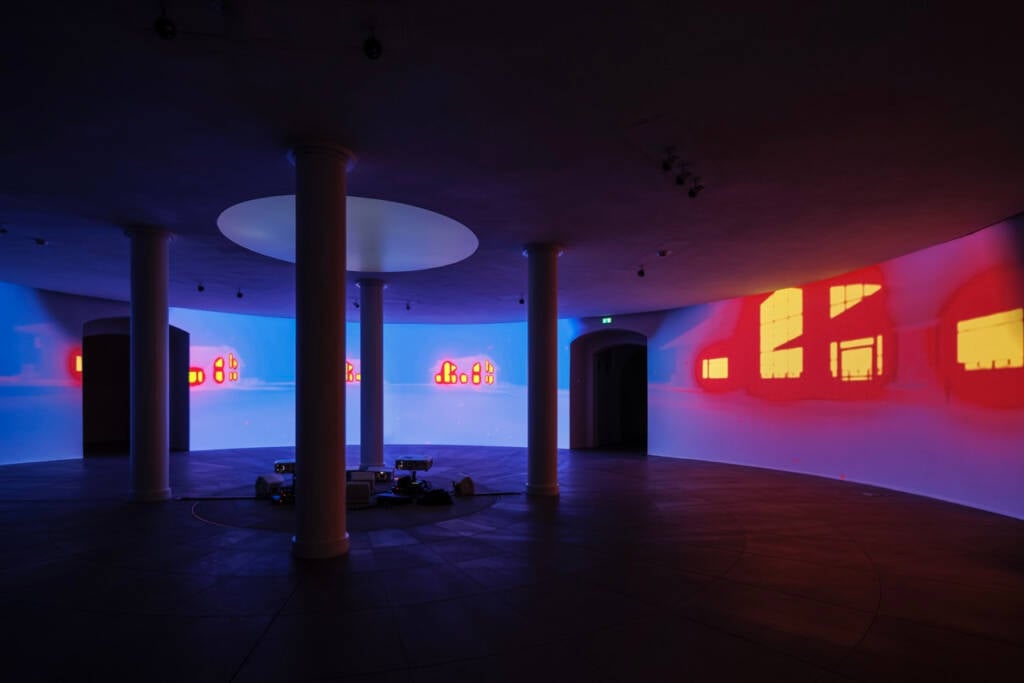

Monolith, 2025
Courtesy of ALBION JEUNE and RACHEL ROSSIN

Monolith, 2025
Courtesy of ALBION JEUNE and RACHEL ROSSIN
h: That makes sense. I’ve been thinking a lot about Ghost in the Shell and the idea of “second-layer realities.” How do you think artists should participate in shaping how people interpret these technologies?
RR: First, we have to ask what art is for. Art is one of the few spaces that doesn’t ask you to buy something. Its only real demand is: how do you feel about this? That’s why it’s so threatening in places like America. It resists instruction. In a world that tells you what to think, art just asks you to feel.
James Joyce said bad art is either pornographic or didactic, meaning it’s trying to sell you something or teach you something. Good art, by contrast, just holds space for you to be with it.
So, when it comes to technology, I think artists should protect that autonomy and consent, the right to experience without being manipulated. My work often circles that question of autonomy: where does the body end and the network begin?
h: How do you stop your work from becoming too didactic or political?
RR: By being honest. You do your best to translate what you mean, then you release it and it’s no longer yours. The translation happens after. My work feels soft because I don’t want to tell anyone what to think. Art is one of the only languages for experience, for emotion, things that exist outside of words.
h: What draws you to that tension between softness and chaos?
RR: The digital is a constantly shifting texture. Painting, by contrast, speaks in the slower language of the body. I think of paint as hormones or pheromones; it’s the closest thing I have to a record of my nervous system in time.
I’ve been researching neurobiological states of awe, trying to understand how beauty or the sublime register in the brain. I love the idea of using technology to study those things, not to strip them down, but to see what awe looks like structurally.
h: And how do you balance the weight of painting’s history with the future-oriented nature of your practice?
RR: Painting, to me, is the body. It’s the antidote to the constant evolution of technology. I approach it like a record, a trace of my nervous system, a counterpoint to the digital.
When you think about it, our devices are psychological peripherals. They extend the mind outward but also atrophy certain abilities, like handwriting, or navigating a city. McLuhan said every technology amputates the faculty it extends. Painting resists that. It’s a way of keeping the body present.
h: You also train your own AI models. What matters most to you in that process?
RR: I love the technical side. I’ve been working with systems like AlphaFold, the AI used for protein modeling and programming simulations in DNA. It sounds wild, but it’s about understanding computation at the biological level.
I’ve trained personal AI models for fun, like one that can draw with me as my 12-year-old self. It lets me collapse time, collaborate with a younger version of me who wasn’t thinking about being “good” or “cool.” Then there are more complex models exploring neurobiological states of awe. It’s about translating those cognitive and emotional structures into visual language.
h: Would you describe yourself more as an artist, a researcher, or an engineer?
RR: Definitely an artist. I do a lot of research and some engineering too. Right now, I’m working with a quantum computing lab, but it’s always in service of the art. That’s what I care about most, and what I think the world lacks the most.
h: Which thinkers or artists have been orbiting your mind lately?
RR: Richard Feynman, the physicist. Fun fact—Jeff Koons actually consulted him for his floating basketball pieces. Feynman’s writing on AI and quantum systems feels incredibly relevant now. There are so many more—I could send you a whole list.


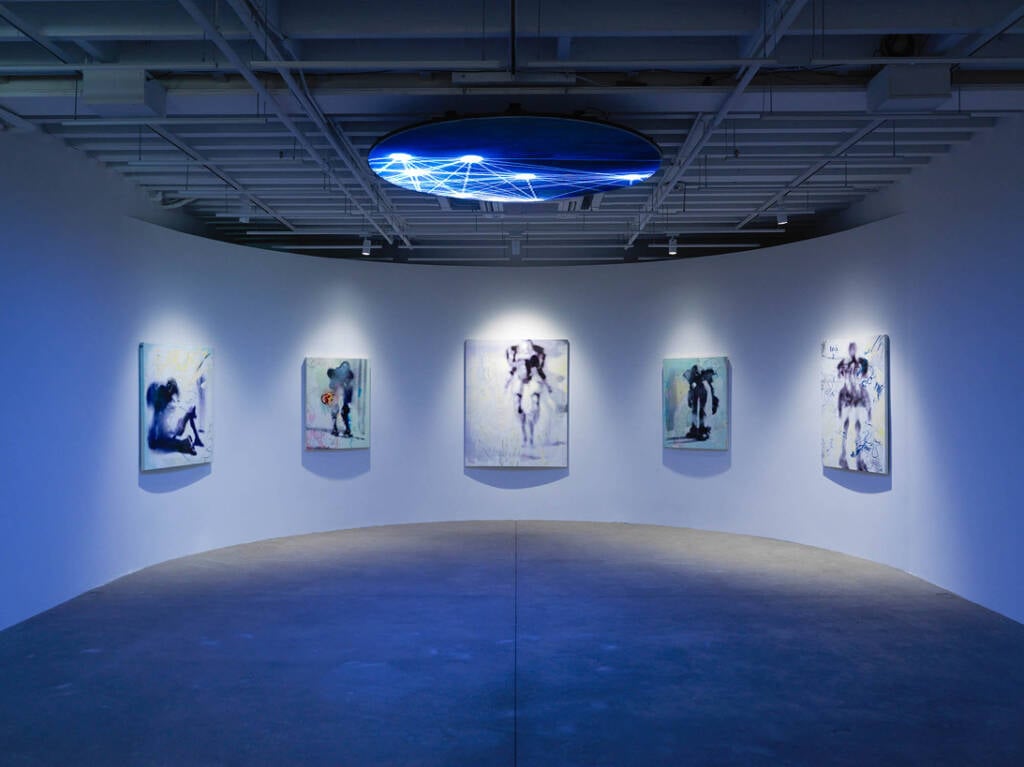
Siblings, 2025
Courtesy of ALBION JEUNE

Words: JULIA SILVERBERG
