From April 15th to August 16th, 2026, Paris will host one of the most highly anticipated cultural events of the season: the major Alexander Calder retrospective, Calder: Rêver en Équilibre. Organised in close collaboration with the Calder Foundation, this exhibition celebrates the centenary of Calder’s arrival in France and the 50th anniversary of his death. It offers visitors a comprehensive journey through over half a century of radical artistic innovation.
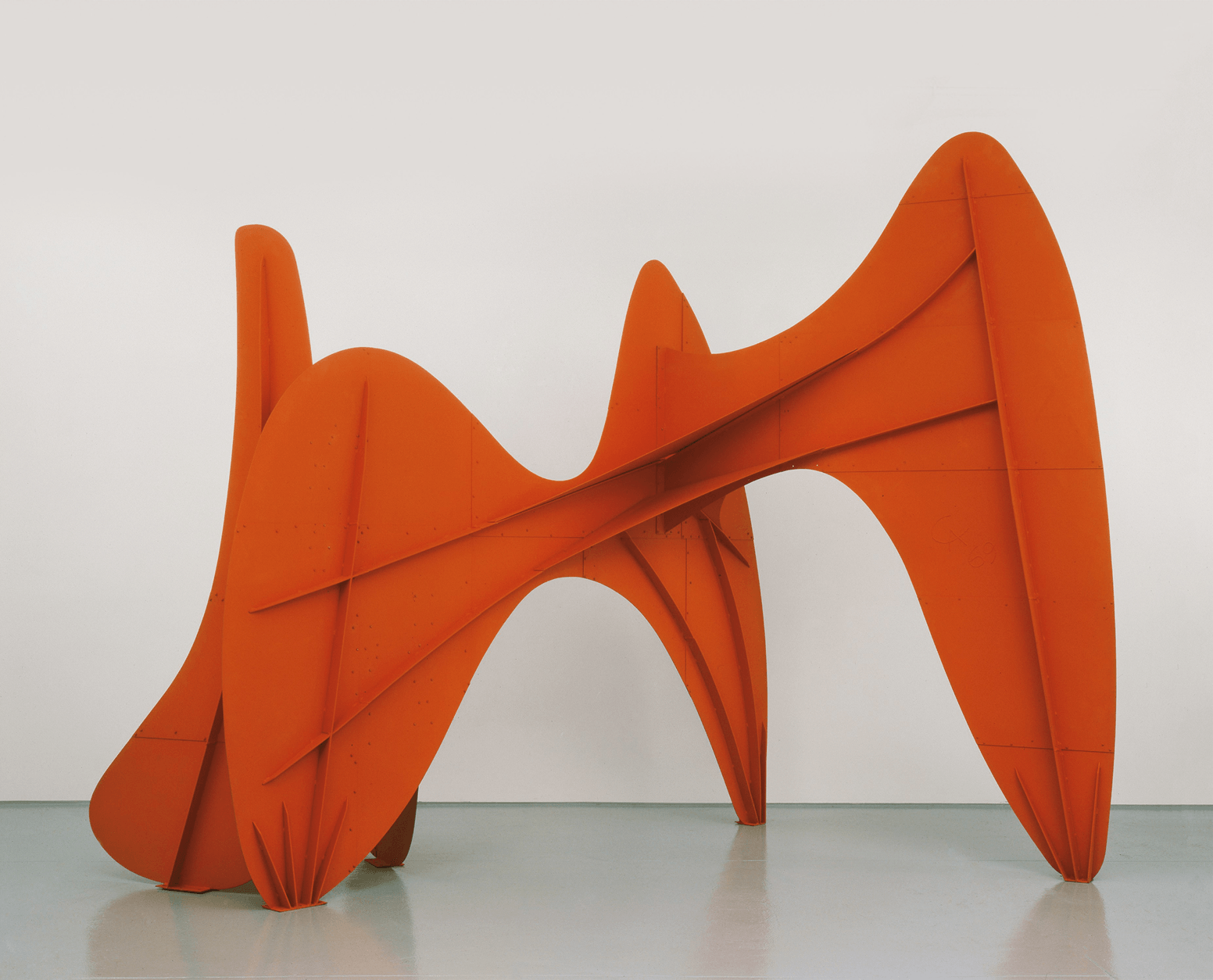
Unfolding as a total environment, the project brings together nearly 300 works, including wire sculptures, paintings, monumental stabiles, delicate jewellery and the legendary Cirque Calder. Spanning over 3,000 square metres, Calder’s universe expands into a living system of balance, where movement, light, gravity and emptiness become active materials. A particular highlight will be the return of Cirque Calder to Paris—a rare loan from the Whitney Museum of American Art—which will reconnect the city with the artist’s early performative imagination.
Calder’s mobiles: a choreography in Frank Gehry’s space
Set within the exhibition, the mobiles unfold as suspended constellations within Gehry’s architectural landscape. Hanging in motion, they subtly shift with air currents, transforming each gallery into a field of changing relations rather than a fixed display. Rather than being treated as inert objects, the works are continually reactivated by their surroundings, where sculpture, space and atmosphere remain in constant exchange.
In this setting, movement and structure are brought into direct contact. Gehry’s flowing architecture finds an unexpected counterpart in Calder’s kinetic forms, producing an environment defined by instability and adjustment rather than resolution. Nothing settles into permanence: forms adjust, distances change, and the works register even the slightest variations in air and light as part of their ongoing presence.
One of the must-see exhibitions in Paris
Positioned among the most significant cultural events in the city’s calendar, this presentation firmly establishes itself within the landscape of unmissable Parisian exhibitions. Alongside Calder’s own works, the exhibition features key figures of modernism, including Piet Mondrian, Jean Arp, Barbara Hepworth and Pablo Picasso. This contextualises Calder within a broader avant-garde movement.
Photographic works by Henri Cartier-Bresson, Man Ray, Irving Penn and others extend the narrative further, capturing Calder as both artist and performer—someone who was perpetually balancing art and life.