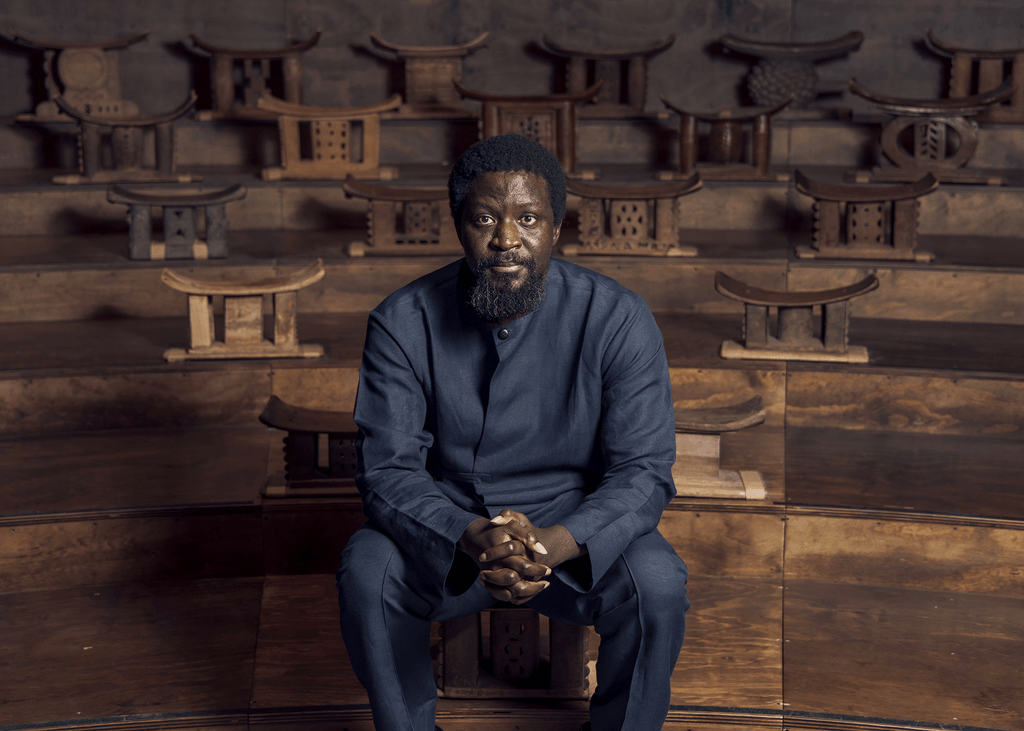
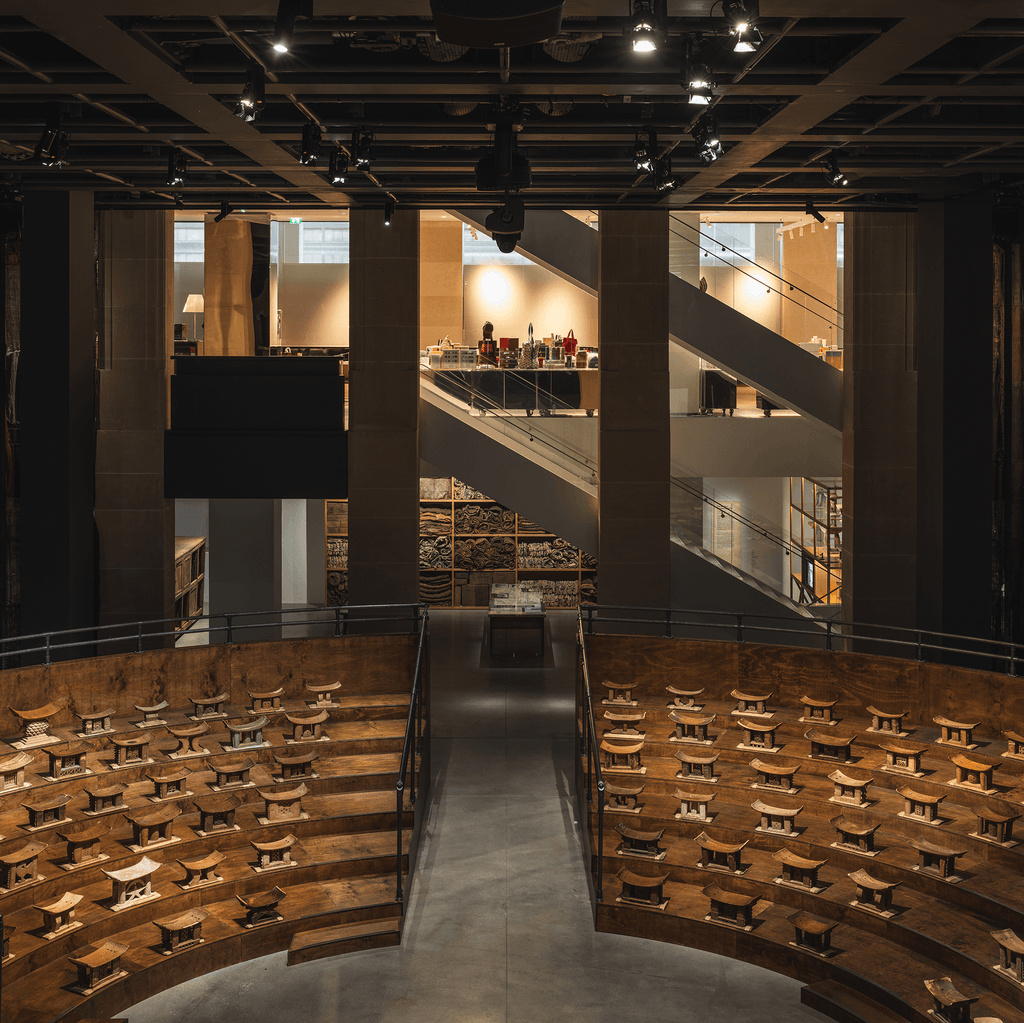
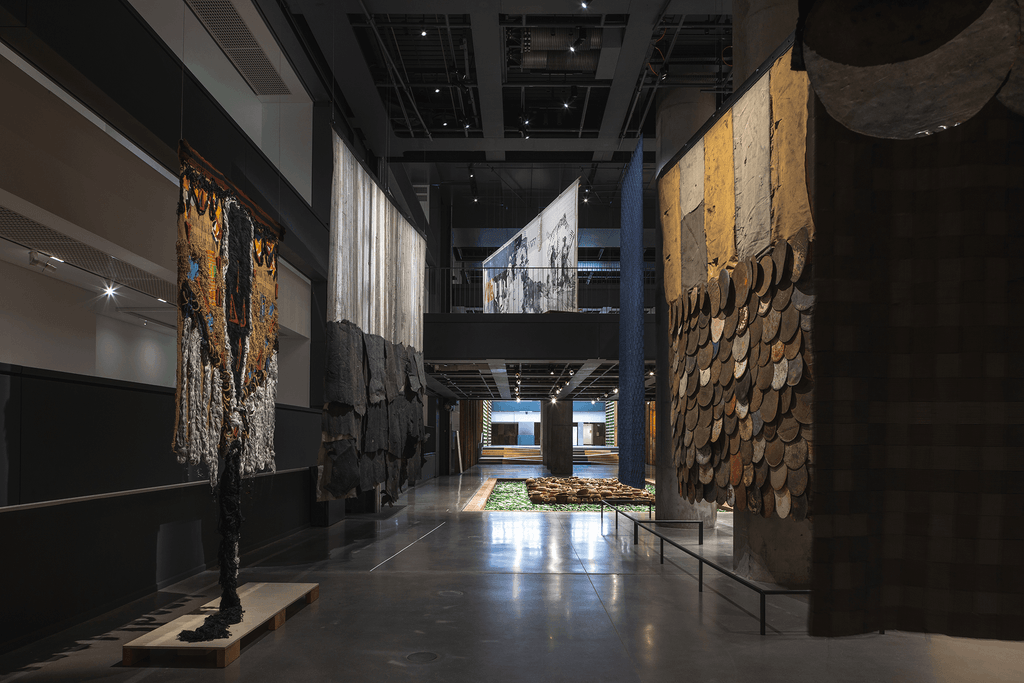
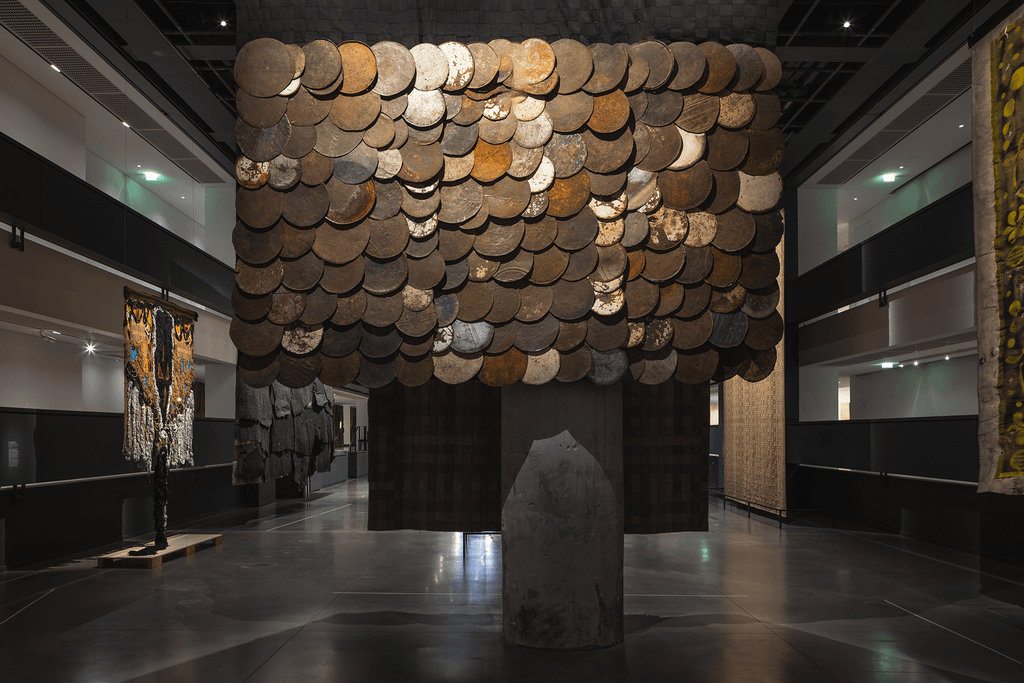
IBRAHIM MAHAMA, Parliament of Ghosts, 2026 © IBRAHIM MAHAMA
Photography © THIBAUT VOISIN
IBRAHIM MAHAMA
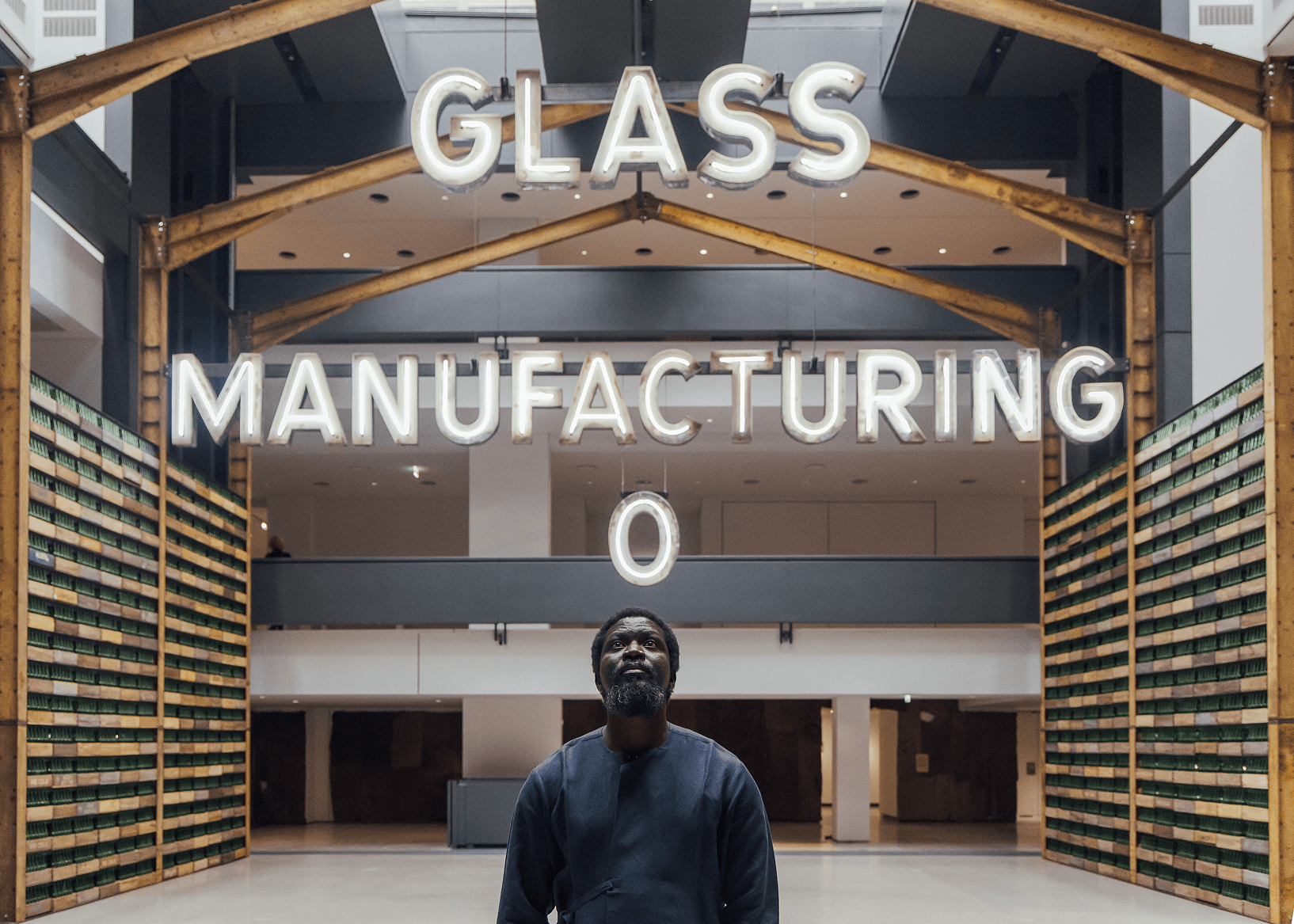
Things Fall Apart, 2026 © IBRAHIM MAHAMA
Photography © BENOÎT FOUGEIROL
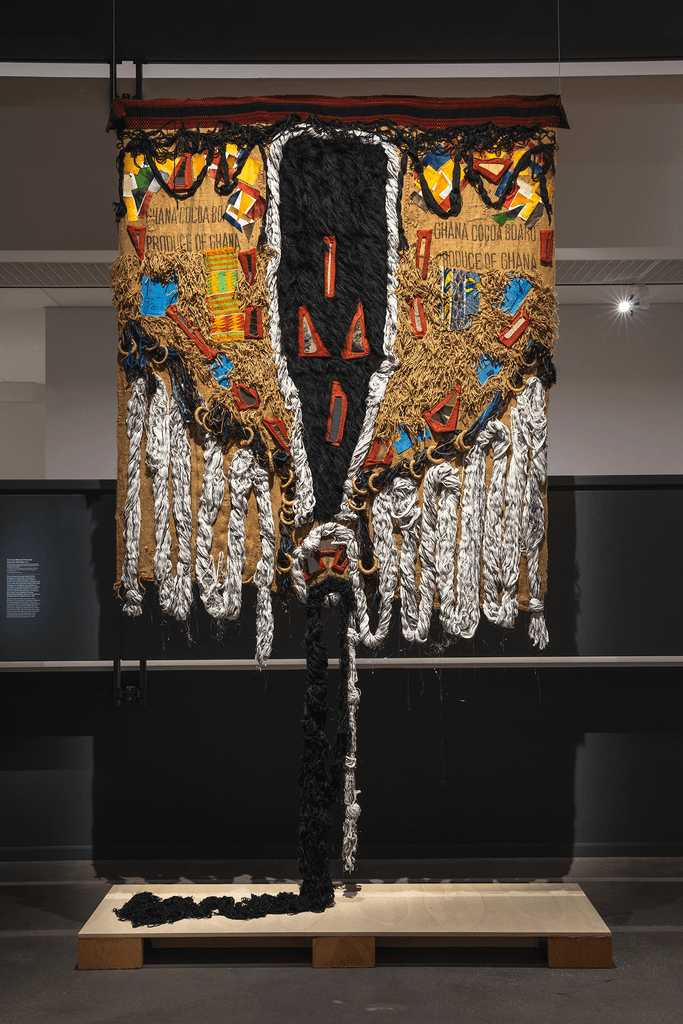
Ibrahim Mahama works with materials that carry the marks of human labour and history: jute sacks once used to transport cocoa and charcoal, decommissioned trains, archival paper and fragments of buildings constructed in the years following Ghana’s independence. This autumn, his exhibition takes over the entire building of the Fondation Cartier at the Place du Palais-Royal. The Harvest Season, Mahama’s first major exhibition in Paris, brings his own installations into conversation with works by artists and collectives whose practices have intersected with his through years of research, collaboration and exchange.
Mahama studied painting and sculpture at the Kwame Nkrumah University of Science and Technology in Kumasi, where studio practice and critical theory were taught side by side, and where several of the artists featured in the exhibition also studied. Working collectively has remained central to his practice ever since. In recent years, this commitment has extended beyond his own artistic production into institution-building: in his hometown of Tamale, northern Ghana, he has established a network of art centres that bring together creative practice, education and independent cultural exchange.
Curated by Aby Gaye-Duparc, who oversaw Mahama’s installations, and Jeanne Barral, who worked with the artists he invited, The Harvest Season draws on a shared interest in the histories and cultural landscapes of West Africa. Gaye-Duparc’s research, including her ongoing doctoral work on women artists in post-independence Senegal, offers another perspective on the period in which national art scenes were taking shape alongside Pan-African and feminist movements. The exhibition brings these histories into dialogue through different generations, artistic practices and geographical contexts.
Ahead of the opening, hube spoke with Mahama about the exhibition’s title, the industrial ambitions of Ghana’s independence years and the cultural spaces he has built in Tamale. Gaye-Duparc, meanwhile, offered insight into the exhibition’s early beginnings, the curatorial choices that shaped its journey through the building and the broader artistic context in which it takes its place.
hube: The exhibition title The Harvest Season points to the cycles of sowing, transmission, and gathering. How does this metaphor reflect your approach to art-making and the work of your centers in Tamale? And who, in your view, is the harvest ultimately for: those who planted, those who tend it now, or those who come later?
Ibrahim Mahama: A harvest is never the achievement of one person. You can plant something, but you depend on many other people, on the land, on time, and on conditions that you cannot always control. Art is similar. A work might begin with an idea, but what it becomes depends on the people who work on it, the materials it passes through, and the people who encounter it later. The spaces we have built in Tamale come from this understanding. They are not only places to produce or exhibit art. They are places where people can learn, experiment, exchange ideas, and develop ways of thinking that might not otherwise be available to them. Some of the results are visible immediately; others may take many years to emerge.
I don’t think the harvest belongs exclusively to those who planted it. The people who tend to something now are just as important, and those who come later should also have the possibility of benefiting from it. In fact, perhaps the real measure of what we do is whether it allows somebody else to begin something we could not have imagined ourselves. This is particularly important when you work with younger generations. You cannot determine what they will do with the things you leave behind. You can only try to create the conditions in which they have the freedom to do something with them.
h: You describe the future as something that “also lives in our past memories, in the form of unrealized futures.” How do the works in this exhibition excavate those unrealized futures, particularly around Ghana’s independence era and its industrial heritage? What does it mean to work with a future that was imagined but never built?
IM: When Ghana became independent in 1957, there was a strong desire to imagine a different future for the country. Independence was not supposed to mean simply changing the people who governed. It was also about changing the economic conditions inherited from colonial rule: how resources were used, where industries were built, and whether the country could produce value for itself rather than continue supplying raw materials to others. Some of those ambitions became buildings, factories, railways, and other infrastructures. Others remained unfinished, or were abandoned before they could fulfil their original purpose. But I don’t think we should look at these places only as evidence of failure. They also contain ideas about what Ghana could have become.
Working with these materials means asking what happened to those possibilities, and whether they have completely disappeared. A building can stop functioning as a factory, but the questions it raises do not stop there. Who was it meant to serve? Why did it become redundant? What knowledge, labour, and resources were invested in it? And what could it produce today? I am interested in bringing these questions back into the present. I don’t want to reconstruct the past as though we could return to a moment when everything was still possible. That moment has passed. But we can examine what was left behind and decide what to do with it now. An unrealized future is not necessarily a dead future. Sometimes it is a responsibility that has been transferred to another generation. The question is whether we have the imagination and the resources to take it somewhere else.
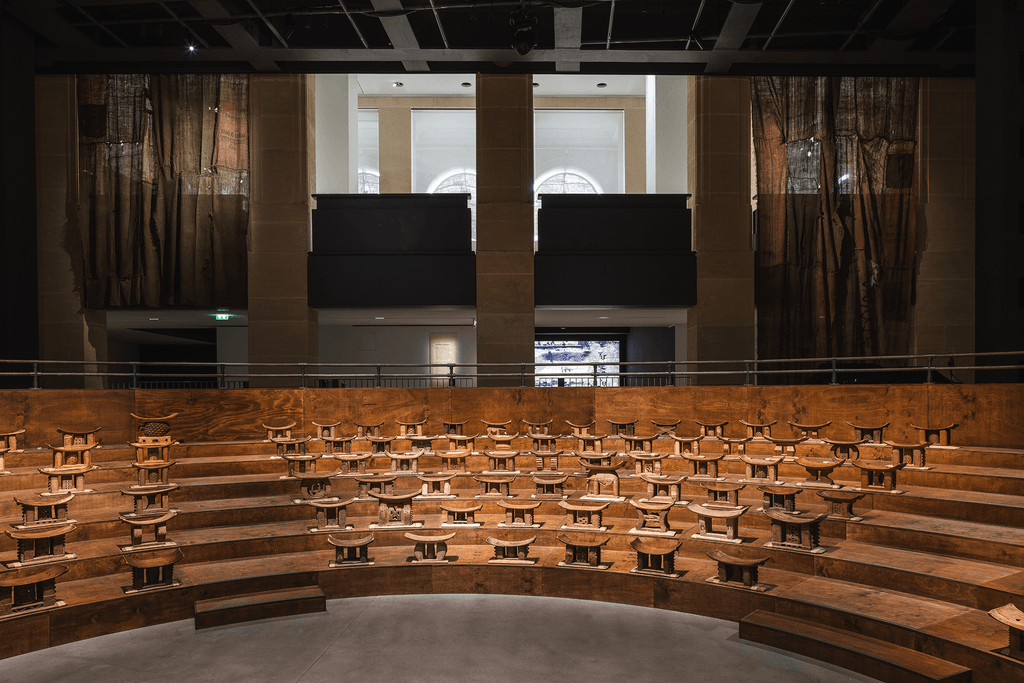
h: Parliament of Ghosts is a chamber of Asante stools that will also host concerts, talks, and classes during the exhibition. A parliament full of empty seats could be read as a place of absence or of silent authority. What happens to the meaning of the Asante stools when living people sit among them, speak, and argue? Who, or what, do you think should have a voice in this chamber?
IM: The Asante stools carry histories of authority, social organization, and political life. But when they enter an exhibition, they can easily become objects that people look at from a distance, without asking what kinds of relationships and systems of knowledge they embody. With Parliament of Ghosts, I wanted to create a situation in which the stools are not simply displayed. They become part of a space that people can occupy, where conversations, performances, and disagreements can take place.
The idea of ghosts is also important because history is never entirely absent. People may no longer be physically present, but their labour, decisions, and experiences continue to shape the conditions in which we live. Sometimes these histories are acknowledged; sometimes they are deliberately excluded from the conversation. A parliament shouldn’t give a voice only to those who already have authority. The people who built things, those whose labour has been forgotten, younger generations, and communities that are usually spoken about rather than listened to should all have a place in these conversations. And perhaps we should also think beyond the human. The materials, the stools themselves, and the histories embedded in them have something to tell us, if we are prepared to pay attention. I am not suggesting that an object speaks literally. I mean that we need to learn how to listen to the evidence it carries. The chamber becomes meaningful when it is used, questioned, and shared. The presence of living people does not erase the ghosts. It allows us to enter into a relationship with them.
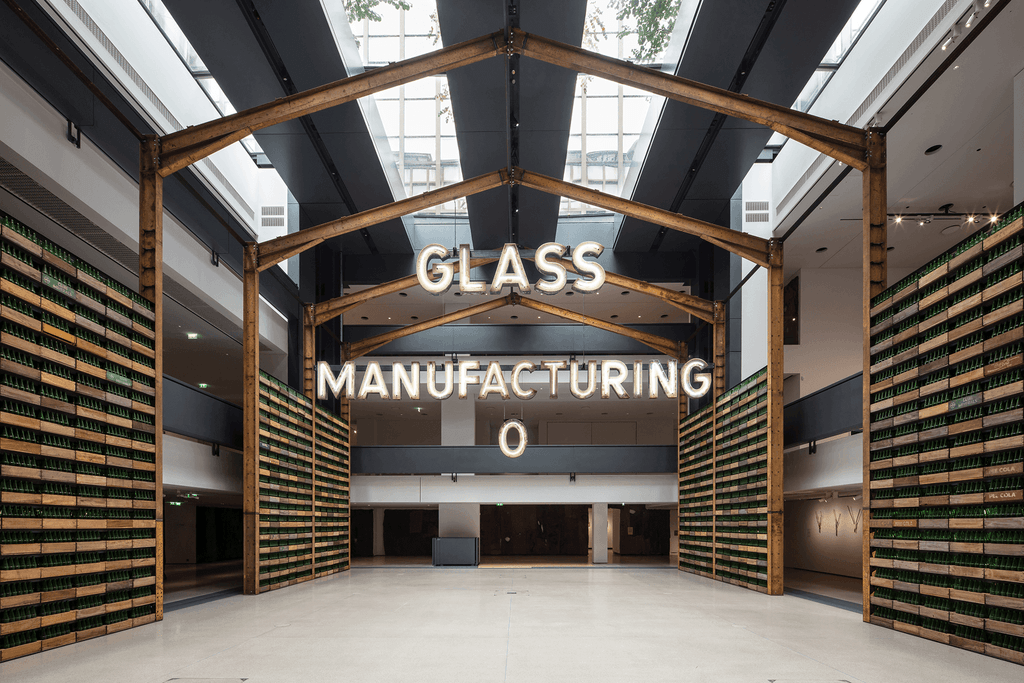
h: Things Fall Apart rebuilds a glass-bottle factory in southwestern Ghana that opened in 1966, during Kwame Nkrumah’s push to decentralize industry. Why was it important to buy it, take it apart, and move it? What new narrative does its presence at the Fondation Cartier create, and how do you avoid it being read only as a monument to loss?
IM: The factory opened in 1966, just after independence, at a time when there was a serious attempt to build an industrial economy in Ghana. The intention was to process materials locally and create value within the country, rather than remain dependent on the export of raw materials. But the factory eventually became abandoned, and its original purpose was lost. When I encountered it, I was interested in the distance between the ambition that produced the building and the condition in which it had been left. What does it mean for something that was built to create value to become regarded as worthless? And who has the authority to decide that it no longer matters?
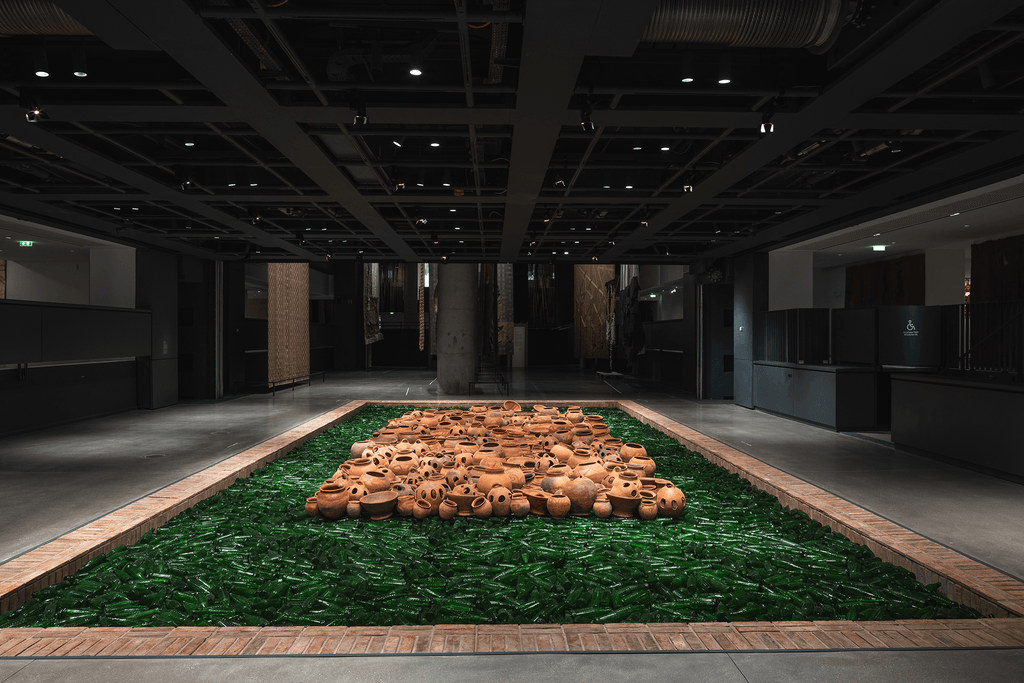
Buying the factory, dismantling it, and moving it was not an attempt to restore it to its original state. It was a way of taking responsibility for its history and allowing that history to enter a different context. The materials have travelled from a place where they were once part of an industrial project to a space in Paris that is associated with contemporary art and cultural production. That movement raises questions about how value is created, where it is recognized, and whose histories are allowed to circulate internationally. But I don’t want the factory to be read simply as a monument to something Ghana lost. That would be too easy. The building also represents an ambition, a belief that the future could be organized differently. By bringing it into the exhibition, I want to reopen that question rather than close it. The factory cannot return to the future imagined in 1966. But it can become part of a new conversation about production, education, and the ways we use the resources already around us.
IBRAHIM MAHAMA
Season of Migration to the North, 2026 © IBRAHIM MAHAMA
Photography © THIBAUT VOISIN
IBRAHIM MAHAMA, Parliament of Ghosts, 2026 © IBRAHIM MAHAMA
Photography © THIBAUT VOISIN
DOROTHY AKPENE AMENUKE
How Far How Near, 2012 © DOROTHY AKPENE AMENUKE
Photography © THIBAUT VOISIN
DOROTHY AKPENE AMENUKE, How Far How Near, 2012
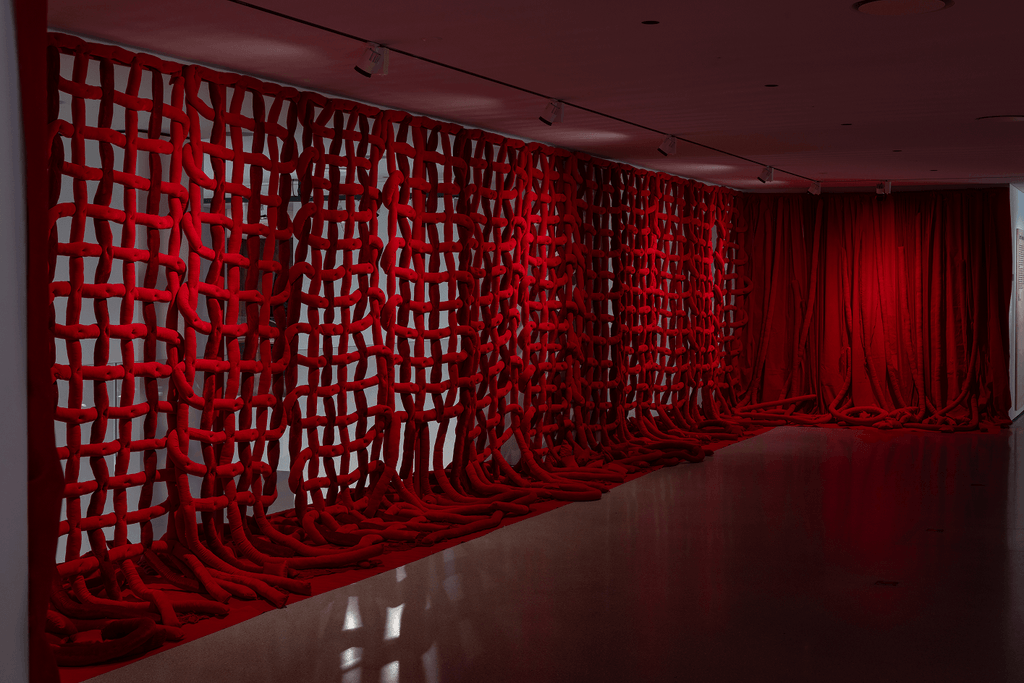
IBRAHIM MAHAMA, Mbeugël is All II, 2026, Season of Migration to the North, 2026, Be careful, 2026
© DOROTHY AKPENE AMENUKE © IBRAHIM MAHAMA
Photography © THIBAUT VOISIN
DOROTHY AKPENE AMENUKE, How Far How Near, 2012
IBRAHIM MAHAMA, Seeni Valeurs, 2026
© DOROTHY AKPENE AMENUKE © IBRAHIM MAHAMA
Photography © THIBAUT VOISIN
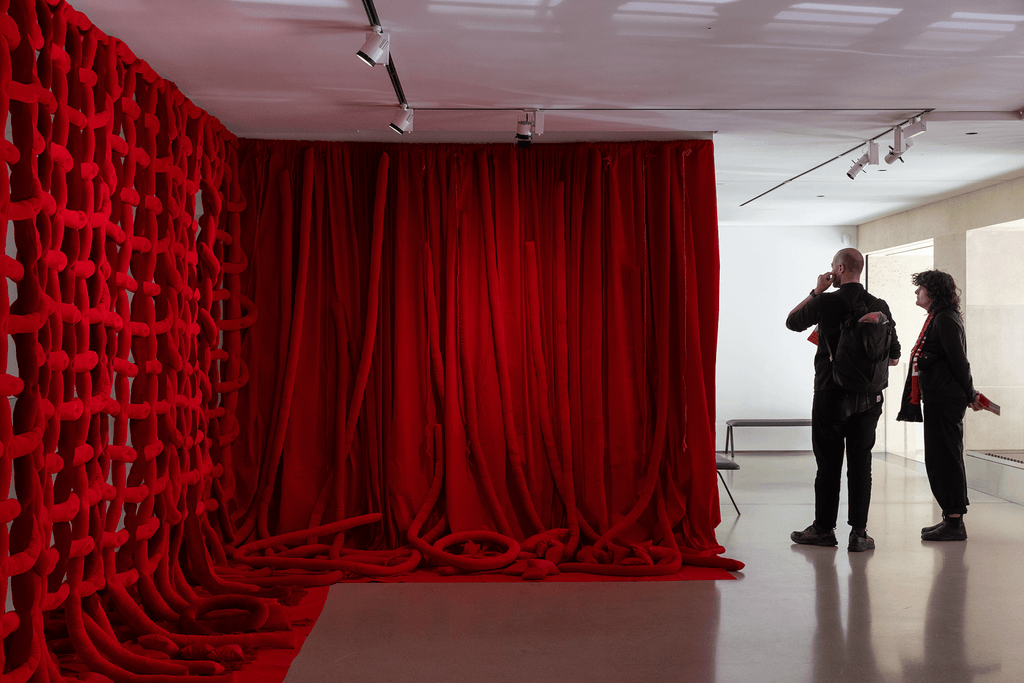
Photography © THIBAUT VOISIN
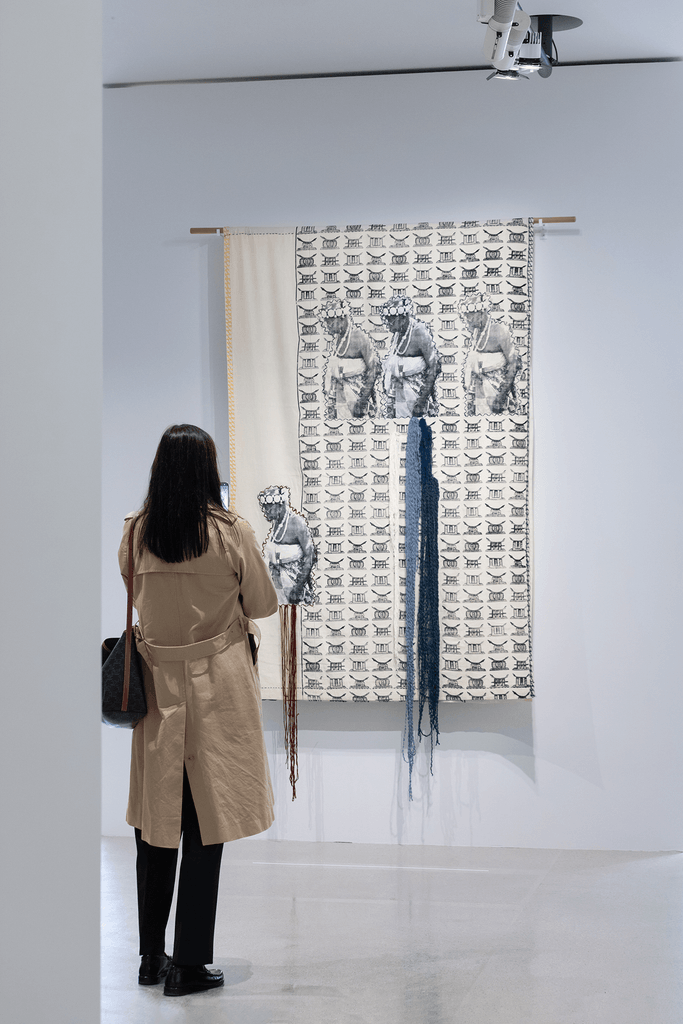
Photography © THIBAUT VOISIN
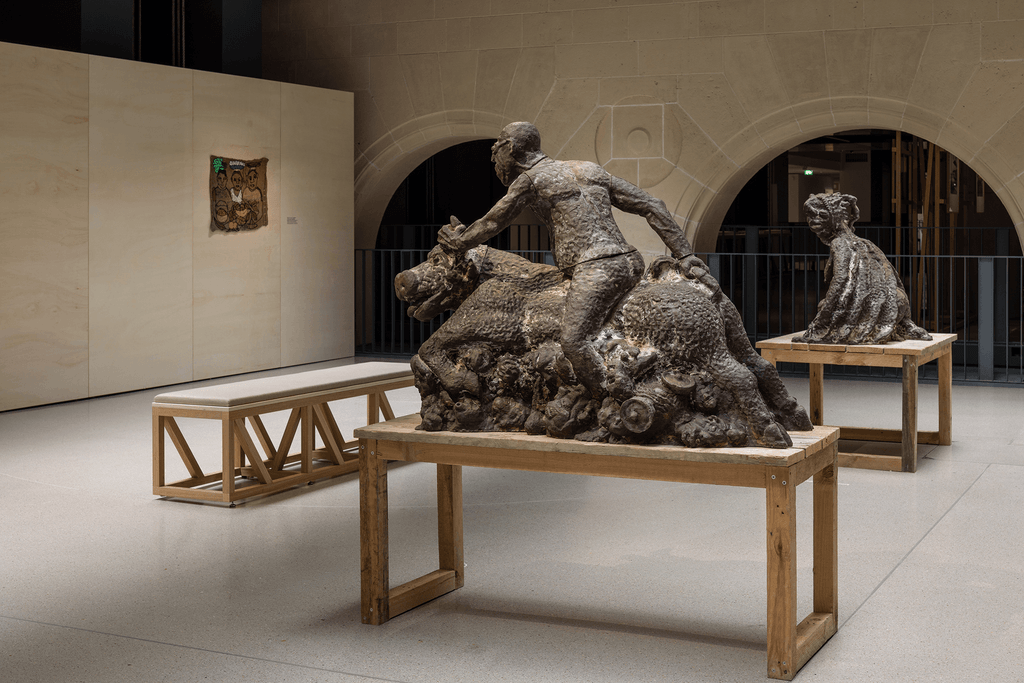
CATPC, Femmes de la post plantation, 2024, Bailleur des Fonds Fou, 2023,
Couple de l’égalité, 2023
© CATPC
Photography © THIBAUT VOISIN
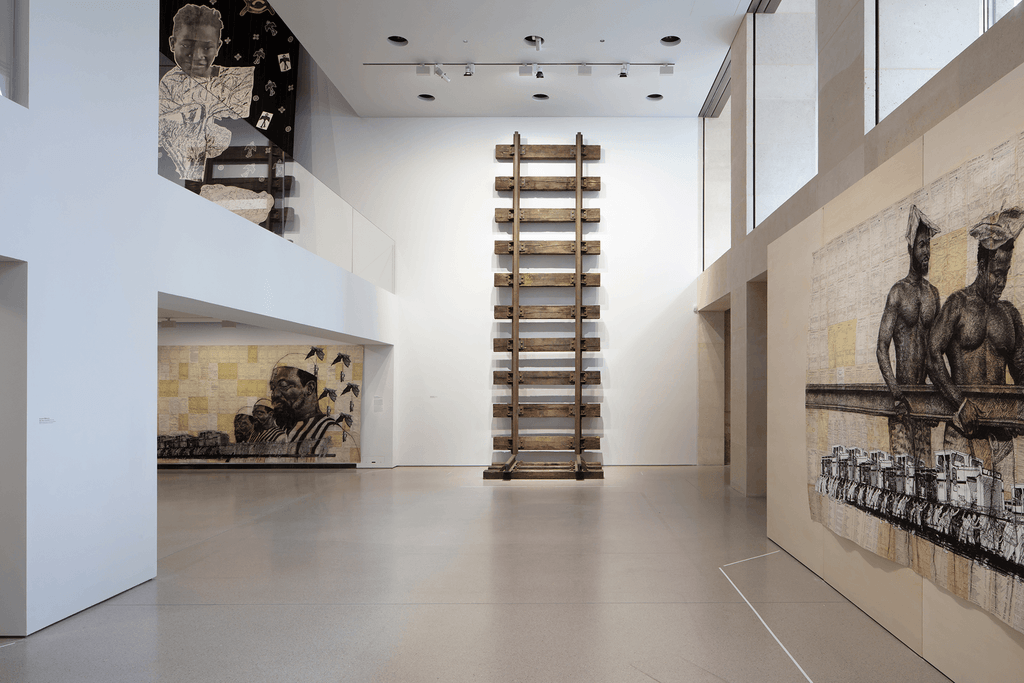
From left to right: IBRAHIM MAHAMA, Ghana Mann Papapaaaa, 2023-2024, Between heaven and earth, 2026, Ghana Mann, 2023-2024 © IBRAHIM MAHAMA
Photography © BENOÎT FOUGEIROL
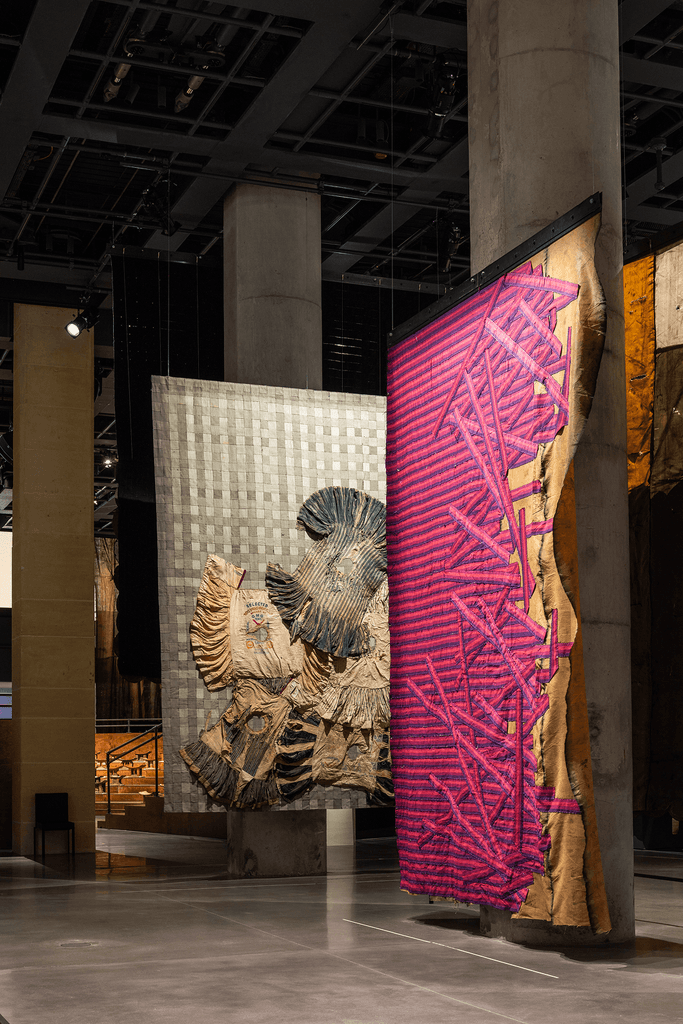
Photography © THIBAUT VOISIN
h: You have opened three art centers in Tamale since 2019. In what ways does The Harvest Season carry the teaching and community work of those centers into the Fondation Cartier’s new building?
IM: These spaces were not conceived only for an art audience. They came from a need to create conditions for learning, especially in a part of Ghana where access to cultural resources and institutions has historically been limited. In Tamale, children can enter spaces that might otherwise be considered unsuitable for them. They can explore, ask questions, encounter unfamiliar materials, and develop their own relationships with art. I don’t think every experience has to begin with an explanation. Sometimes a child needs to spend time inside a space, to be curious about something, or simply to enjoy being there. Those experiences can remain with them for a long time. The exhibition in Paris is different in scale and context, but I wanted to carry that principle into the building. Knowledge does not move in only one direction. The work we do in Ghana is not simply something to be presented to an audience in Europe. The exchange should allow people in Paris to encounter different histories and ways of thinking, while also making visible the knowledge and labour that have shaped the works. I hope visitors leave with questions they can carry beyond the exhibition. That is one of the most useful things an institution can offer.
h: You invited nine artists and collectives with whom you share long-standing ties. How did you choose these collaborators, and what kinds of dialogue or friction do you hope their presence will generate within the exhibition?
IM: These relationships were not formed for this exhibition. They have developed over time through conversations, shared experiences, and different forms of work. I am interested in people whose practices I respect, but also in the ways our approaches might differ. I didn’t want the exhibition to become a situation in which all the works simply illustrate one idea or follow a single artistic language. The artists and collectives bring their own histories, questions, and ways of working. Their presence creates relationships that I cannot entirely control, and I think that is important. Collaboration is not about producing a unified voice. It is about creating the conditions for different voices to exist alongside one another. Sometimes this produces an unexpected connection; sometimes it reveals a disagreement or a difference in perspective. Both can be productive. This also reflects the way I understand the work we do in Ghana. An institution cannot be built around one individual alone. It depends on a wider network of people who contribute knowledge, labour, criticism, and ideas. The same is true of an exhibition, even when the artist’s name is the one that appears most prominently.
h: Your materials carry the traces of labour, use, and time, and the arcades of the Fondation Cartier are a very different kind of surface. What happens when worn, collected, “used” material meets a polished, transparent architecture? Who adapts to whom?
IM: I don’t think the materials need to become something else in order to enter the building. Their histories are already there. A piece of metal, a wooden component, or an industrial object carries traces of the people who handled it, the conditions in which it was used, and the economic systems it was part of. These things are not always visible at first, but they are present. The architecture of the Fondation Cartier brings a different set of conditions. It is transparent, carefully constructed, and designed to shape how people move through the space. I don’t want to treat the architecture as something that must simply be filled with artworks. The works have to negotiate with it, but the building must also be understood in relation to what enters it. There is a kind of tension between the polished surface and the material that has been worn down through use. That tension can reveal things about how we assign value.
We often associate refinement with something that has been cleaned, repaired, or made to appear new. But I am interested in what happens when we allow the marks of use to remain. Those marks are evidence. They tell us that something has passed through the world and has been part of other people’s lives. The question is not simply who adapts to whom. The encounter should change our understanding of both. The architecture provides a particular setting, but the materials bring histories that the architecture cannot absorb or erase. I want visitors to become aware of that relationship, rather than see the building and the works as separate things.
h: The exhibition places your work in conversation with earlier African institutional experiments such as doual’art, CCA Lagos, RAW Material Company, and the Nairobi Contemporary Art Institute. What lessons from these initiatives feel most urgent to you right now?
IM: One of the most important lessons is that cultural institutions do not have to follow a single model. The history of museums and art institutions in Africa is complex, particularly because many of the systems through which culture is collected, classified, and displayed were shaped by colonial power. We have inherited structures that do not always respond to the needs or realities of the communities around them. Initiatives such as doual’art, CCA Lagos, RAW Material Company, and NCAI have developed different ways of working within their own contexts. I would not say that they all share the same approach, but they demonstrate that cultural production can be organised through forms of research, exchange, public engagement, and experimentation that do not simply reproduce the conventional museum model. The urgent question is how these spaces can remain meaningful to the people around them. It is easy to speak about building an institution. It is much harder to ensure that it creates opportunities for people who might otherwise have no access to the resources, networks, or conversations it makes possible.
There is also the question of sustainability. How do we build spaces that can continue to operate without becoming entirely dependent on the expectations of the international art market or on short-term funding cycles? How do we make sure that knowledge and resources circulate, rather than accumulating in one place or remaining accessible only to a small group? I don’t think there is one answer. Each institution has to respond to its own circumstances, and there are things we can learn from one another without simply copying each other’s structures.
What feels most urgent is to recognise that building a cultural institution is not only about creating a physical space. It is about deciding what kinds of relationships that space will support, what knowledge it will make available, and what possibilities it will leave open for the next generation.
h: Many of the works and programs deal with passing things on—between generations, between Ghana and Paris, between earlier hopes and present possibilities. How do you see the visitor’s role in that exchange?
IM: I don’t see the visitor as someone who simply receives information that the artist has prepared for them. Every person comes with their own history, experiences, and understanding of the world. What they encounter in the exhibition will be shaped by those things, and that is part of what gives the work its life beyond the studio. Visitors therefore have a responsibility, but also an opportunity. They can question what they see, share their own interpretations, and carry those questions into other situations. They do not have to agree with the work or arrive at the same conclusions as me. I am particularly interested in what younger visitors might take away. We cannot know what an encounter with a work of art will mean to a child years later. Perhaps they will remember a material, a space, or a question that stayed with them. That possibility is important to me.
h: Looking beyond the exhibition dates, what do you hope remains once the show closes—both for the public in Paris and for the network of independent cultural spaces you are helping to build?
IM: For the public in Paris, I hope the exhibition creates a connection to histories that are not always visible within the spaces where contemporary art is presented. These are not only histories of loss or colonial exploitation. They are also histories of ambition, knowledge, labour, and people trying to build different futures. I would like visitors to leave thinking about how those histories continue to shape the present. For the independent cultural spaces we are building, the question is more practical. How do we continue creating places where people can learn, work, meet, and develop ideas? How do we make resources available to younger generations and support forms of cultural production that are not determined entirely by the market? These questions cannot be answered by an exhibition alone. They require long-term commitment, collaboration, and the redistribution of resources.
hube: The Fondation Cartier has a long history of presenting artists from the African continent, from Seydou Keïta and Malick Sidibé to Bodys Isek Kingelez. Where does The Harvest Season sit within this history? Does it extend an existing curatorial approach, or does it challenge the way the institution has traditionally presented African art?
Aby Gaye-Duparc: It’s an extension of our deep interest in the African scene in general, and the West African scene in particular. We started working with West African artists, mainly photographers, in the 1990s, so it continues that work. The Fondation is now led by Chris Dercon, who has a long-standing interest in the African scene and has known Ibrahim Mahama for more than ten years—thirteen, I would say—since they met in London. So I think it’s a convergence of his and the Fondation’s existing interest. Our earlier exhibitions were mainly curated by André Magnin, a French specialist in the scene, so we worked mostly with French-speaking countries in Africa: Congo, Mali, and Burkina Faso. Now it’s a bit different. Ghana is also a context the French audience doesn’t know much about. And the project really started within the Fondation Cartier team—we didn’t bring in an independent curator.
h: Mahama is taking over the Fondation’s entire new space. What did your first conversations about that look like, and what did he bring to them—drawings, models, a list of works?
AGD: We started working on this project three and a half years ago. At that point, I think we even had the idea of inviting Ibrahim to our previous building in the south of Paris, which was five or six times smaller than the one we have now. Initially, we had spotted several artists on the African continent who ran art centres and personal initiatives. When I travelled to Ghana in January 2024, I saw the extent of everything Ibrahim has done in Tamale, and when I came back, I proposed a solo show instead of inviting different initiatives. There was already so much within his work that we didn’t want to extend it to other artists building institutions. So we started working with him around the question of which work conveyed the spirit of the art centres in Tamale, and we soon realised it was Parliament of Ghosts, the installation he has been developing since 2019 in different configurations and with different materials. We wanted a fairly imposing version—it has 200 seats—and that became the starting point of the exhibition.
Because we have so much space, we also wanted new works and, for a French audience that doesn’t necessarily know Ibrahim, some of the fundamental parts of his practice: the collecting of railway materials, the textiles in terms of both form and medium, the rebuilding of factories, and also more classical works—charcoal drawings, photographs, and collages. He makes a lot of drawings and collages with photographs, juxtaposed with text. Ibrahim would send us many of his drawings, and we would discuss them. We had time for those conversations, and we had time to visit the space while it was still under construction. It was really easy to work with him, and we never had to rush. I would say the main issue was the production, because it was so massive and required so many people.
h: Mahama was born in Tamale, where he has founded three art centres that connect artistic production with education and local communities. How did you bring this context into the exhibition without reducing it to a biographical starting point? In what ways does Tamale shape the space, the works, or the relationships between them, even from a distance?
AGD: The idea was always to give a sense of what Tamale looks like. But Tamale and the three art centres make the most sense locally, where they were created, so the idea was not simply to transport them into a private foundation in the middle of Paris, which would feel very disconnected. It was also to show that Ibrahim is an international artist, able to engage with people in Tamale and with audiences in France. I think the starting point was the question of how to convey, aesthetically, what he is building in Tamale. We commissioned a very immersive three-channel video work from him, in which you can see the daily life of the art centres: the workers, the studio assistants, and women selling fruit and vegetables on the land he has acquired. Then there are the elements of Parliament of Ghosts, whose materials look very much like what he has in Tamale. All around the exhibition there are also the stitched jute sacks, the material he first became known for. The exhibition designers also worked with bricks. There are elements like these to make you think of Tamale.
We also worked with our audience department on how to bring in schoolchildren, as Ibrahim does in Tamale, but in a different context—taking inspiration from his way of working and using the installation as a site to teach, to invite people to give speeches, or to discuss things that may have nothing directly to do with the exhibition. Parliament of Ghosts will host a large programme of discussions, as well as performances and live music—a lot of what you can see in Tamale, transferred into a different context.
h: As Mahama’s first major exhibition in Paris, The Harvest Season also offers an introduction to his practice for many visitors. How did you think about the journey through the exhibition? What did you want people to encounter first, and how might their understanding of the work change as they move through the space?
AGD: You’re right, it will be Ibrahim Mahama’s first exhibition in Paris, although he is very well known elsewhere in Europe. I would say the first challenge for us was to bring in a history—that of Ghana after independence from the British colonial empire—which is less known in France, because we know more about the French colonial empire and the French-speaking countries of West Africa. So first we had to find a balance in how to convey this history, and then to work out how it and Ibrahim Mahama’s work would be in dialogue.
It’s centred on Ibrahim, but it’s also a group show. When you enter the Fondation Cartier, you arrive on level zero, where the exhibition text talks about Mahama’s practice, the art centres, and why we also invited nine other artists and collectives. Then, as you walk in, you see Parliament of Ghosts as a statement—a parliament that will sometimes be empty, sometimes very busy, and sometimes hosting a performance. You might buy a ticket one day and arrive to find a talk taking place there. You will also see the jute sacks, a material that greets you even before you enter the building: on the Place du Palais-Royal, Ibrahim was commissioned to make a site-specific work, a set of awnings made of jute sacks on the facades. It’s inspired by the history of the building. We found archives from the end of the nineteenth century, when it was a luxury department store with very beautiful awnings in the style of the period, and he is reproducing them in sacking. That also sets the tone for how closely his work is in dialogue with the building.
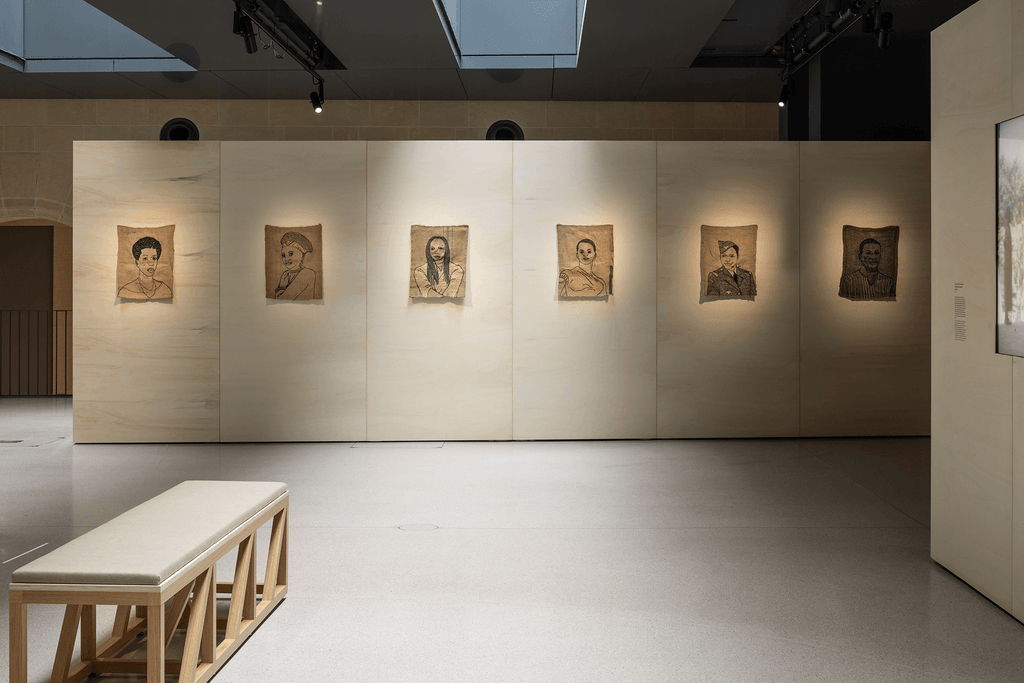
You encounter Parliament of Ghosts, and then you make your way through the rest of the exhibition. There’s the video work I mentioned, which shows how the art centres in Tamale function. There’s a commission of ten new textiles, very much in dialogue with Ghana’s industrial past and the way he collects materials, and also with the craftsmanship of the north that interests him—two dimensions central to his practice. And then there’s a big project premiering at the Fondation Cartier: the reconstruction of a factory that produced glass bottles in Ghana in the 1960s, which he bought three years ago and dismantled. It was a very long, enormous process, and it has been rebuilt as an architectural form within the space.
Around this constellation of Ibrahim’s work, you will find Gideon Appah, Zohra Opoku, and the other artists—some of them have something close to a solo presentation, and others show smaller pieces. It’s also a very open building, with no walls separating things, so you can see almost everything from the entrance. That’s a bit challenging for us in terms of how it all works together, but it’s also how things work in Tamale: you enter a space and see a work by Ibrahim, a work by another artist, and schoolchildren climbing on trains and holding very old archives in their hands. It’s another way of experiencing an exhibition, and we wanted to try it.
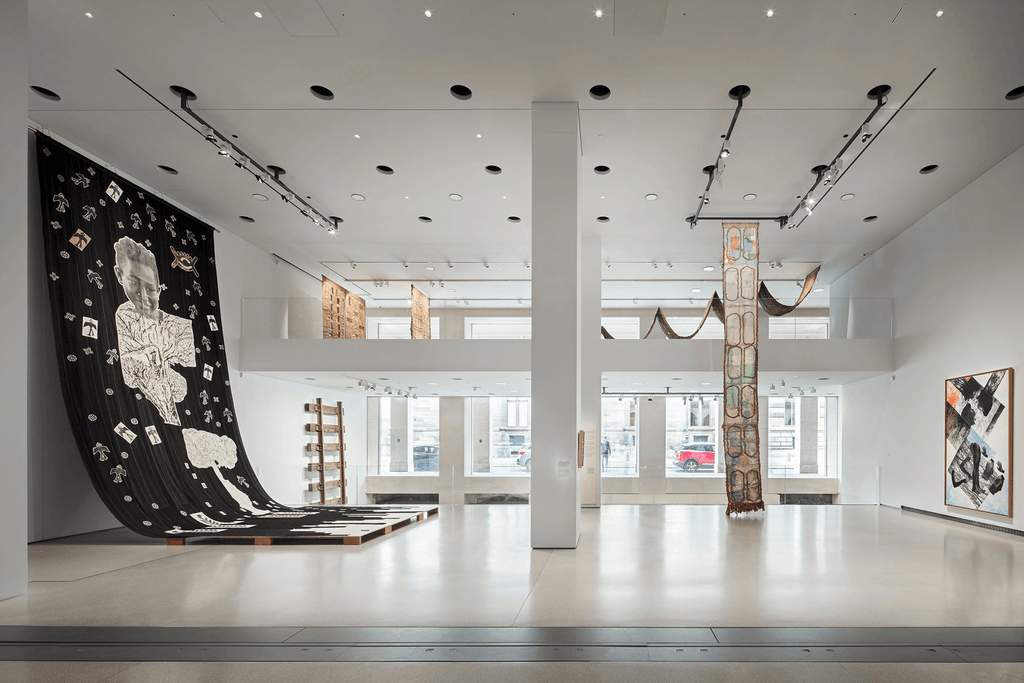
From left to right: ZOHRA OPOKU, Sunsum, 2026; IBRAHIM MAHAMA, Between heaven and earth, 2026; DOROTHY AKPENE AMENUKE, The Scroll, 2016,; ZOHRA OPOKU, série The Myths of Eternal Life, 2020
© ZOHRA OPOKU © IBRAHIM MAHAMA © DOROTHY AKPENE AMENUKE
Photography © BENOÎT FOUGEIROL
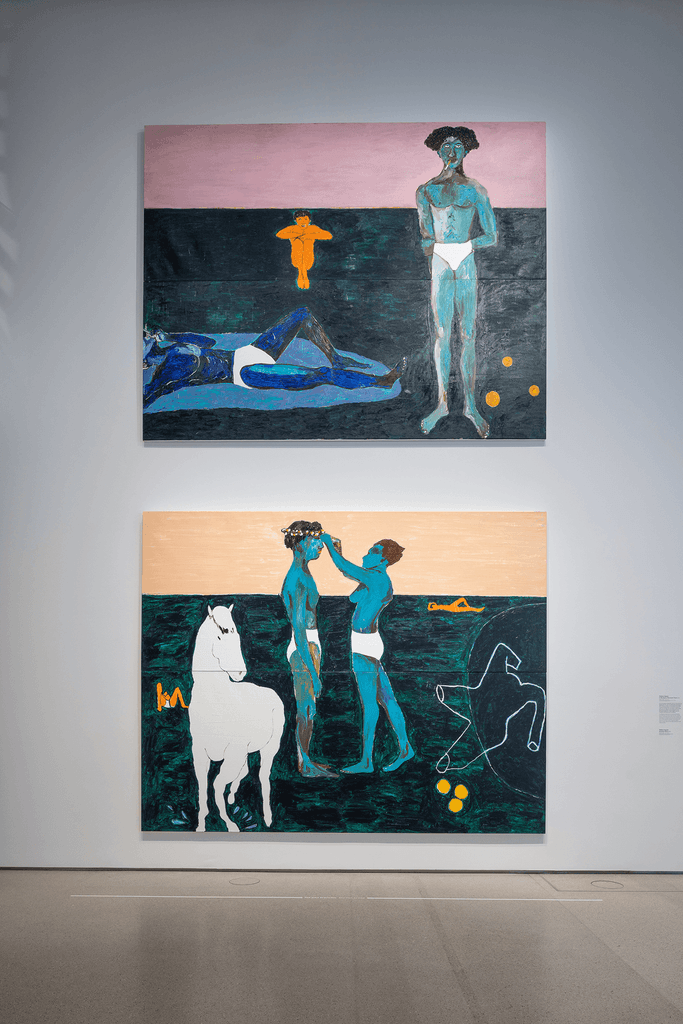
GIDEON APPAH, Another place, 2020, If We Had a Thousand Years, 2020 © GIDEON APPAH
Photography © THIBAUT VOISIN
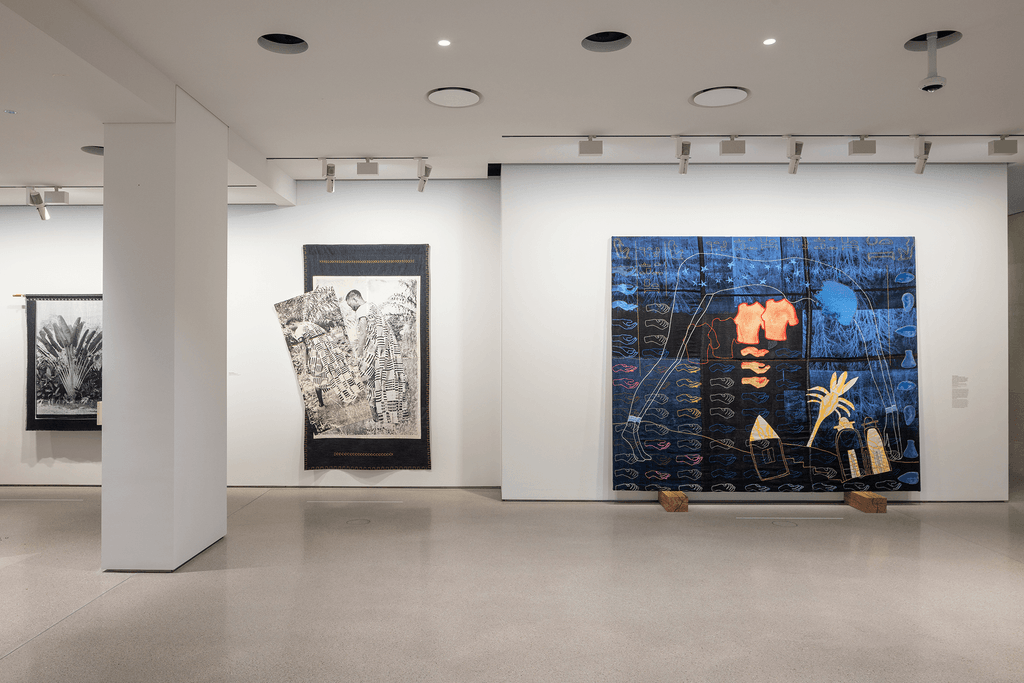
Photography © THIBAUT VOISIN
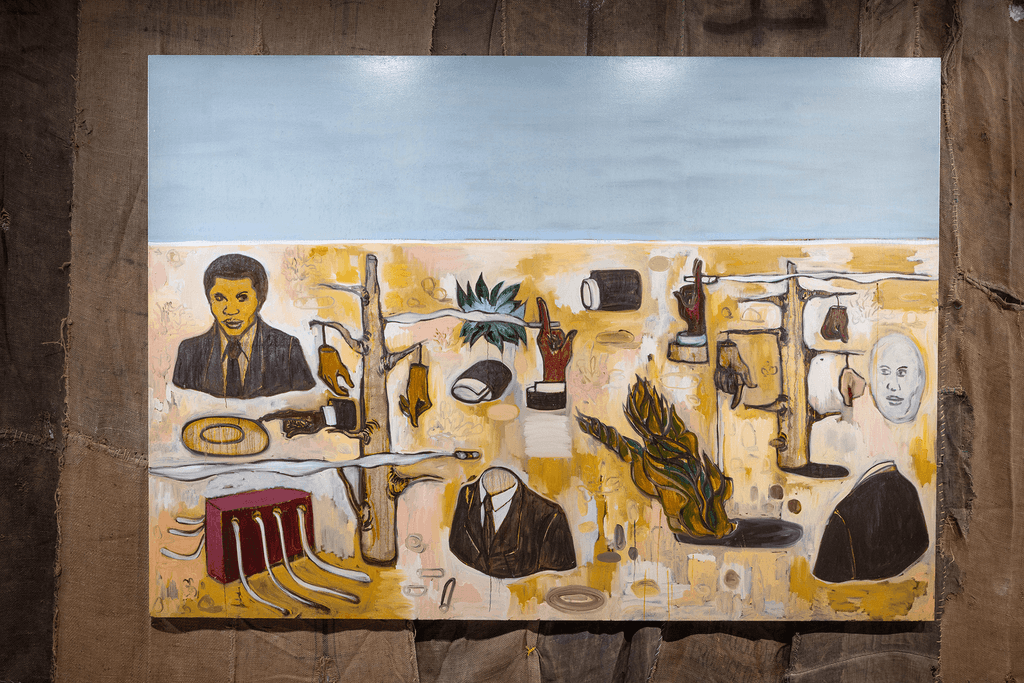
GIDEON APPAH, The Sensitivity of Everyday Things – Relatable Species, 2023 © GIDEON APPAH
Photography © THIBAUT VOISIN
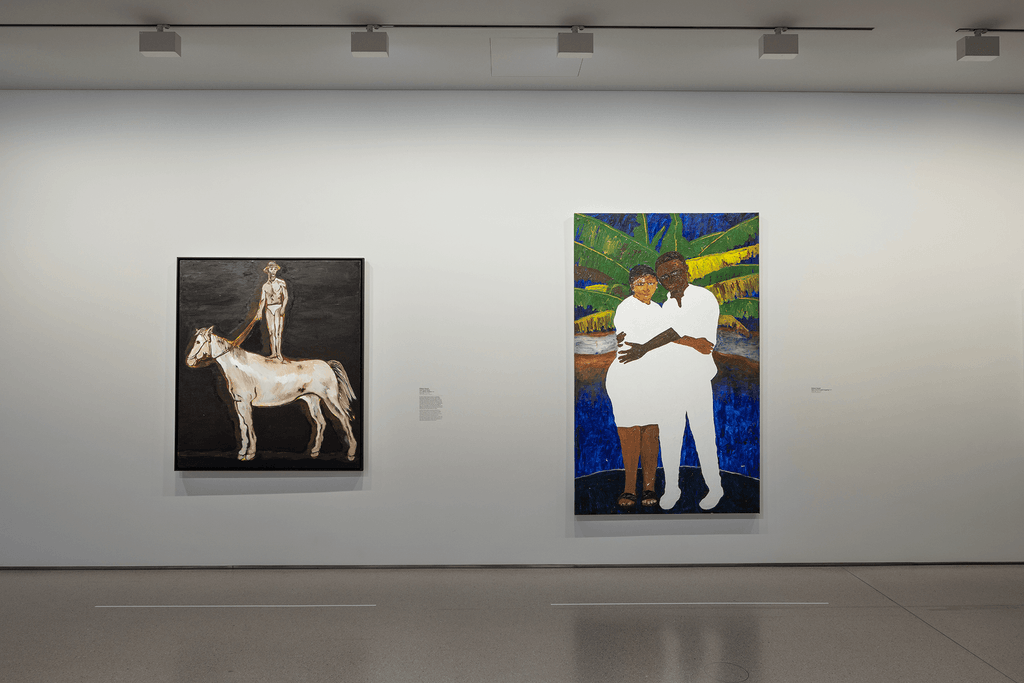
GIDEON APPAH, Half Nude Rider on a White Stallion, 2025, Untitled, 2020 © GIDEON APPAH
Photography © THIBAUT VOISIN
DOROTHY AKPENE AMENUKE
Gli, 2023 © DOROTHY AKPENE AMENUKE
Photography © THIBAUT VOISIN
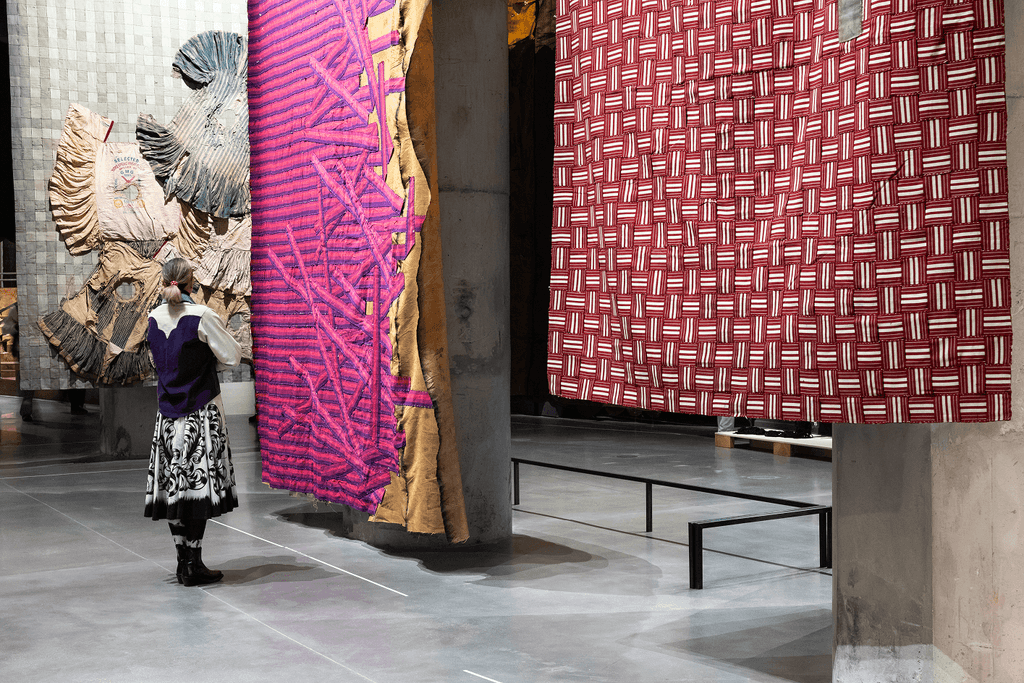
IBRAHIM MAHAMA, Dawal, 2026, Yittè, 2026, Mbeugël is All III, 2026
Photography © THIBAUT VOISIN
JAMES BARNOR
Calendrier AGIP de 1974, 1973 © JAMES BARNOR
Photography © THIBAUT VOISIN
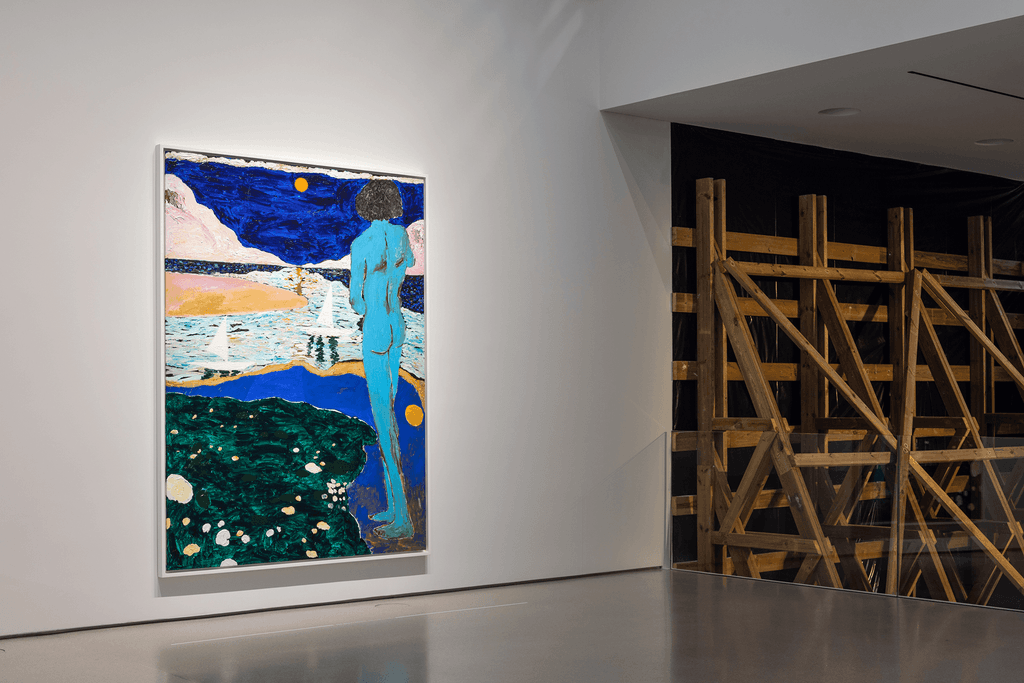
GIDEON APPAH, Night Watcher, 2020 © GIDEON APPAH
Photography © THIBAUT VOISIN
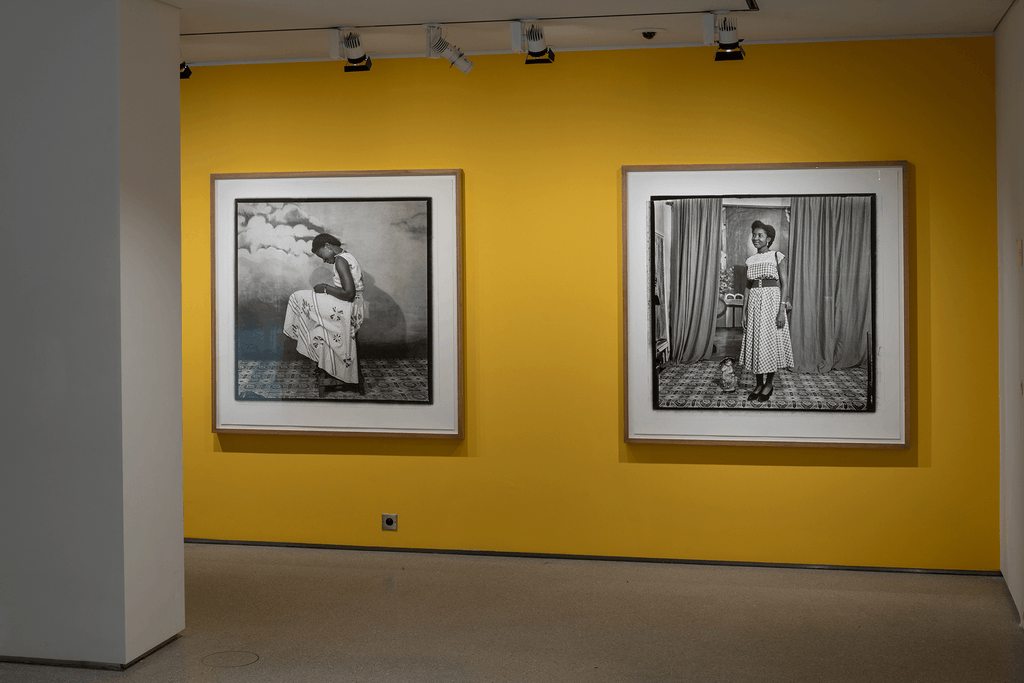
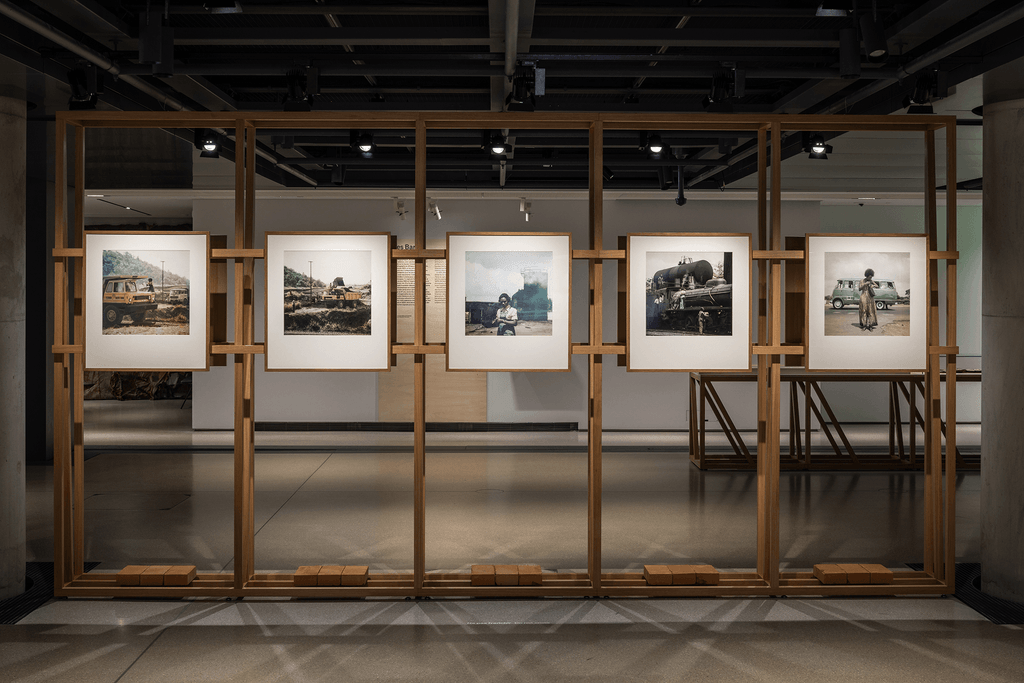
JAMES BARNOR
Evelyn Abbew, Ever Young studio, Accra, 1955-1956, The first client of the Ever Young Studio after its installation in Jamestown (an undergraduate student at the University of Ghana, Legon), Accra, 1953 © JAMES BARNOR
Photography © THIBAUT VOISIN
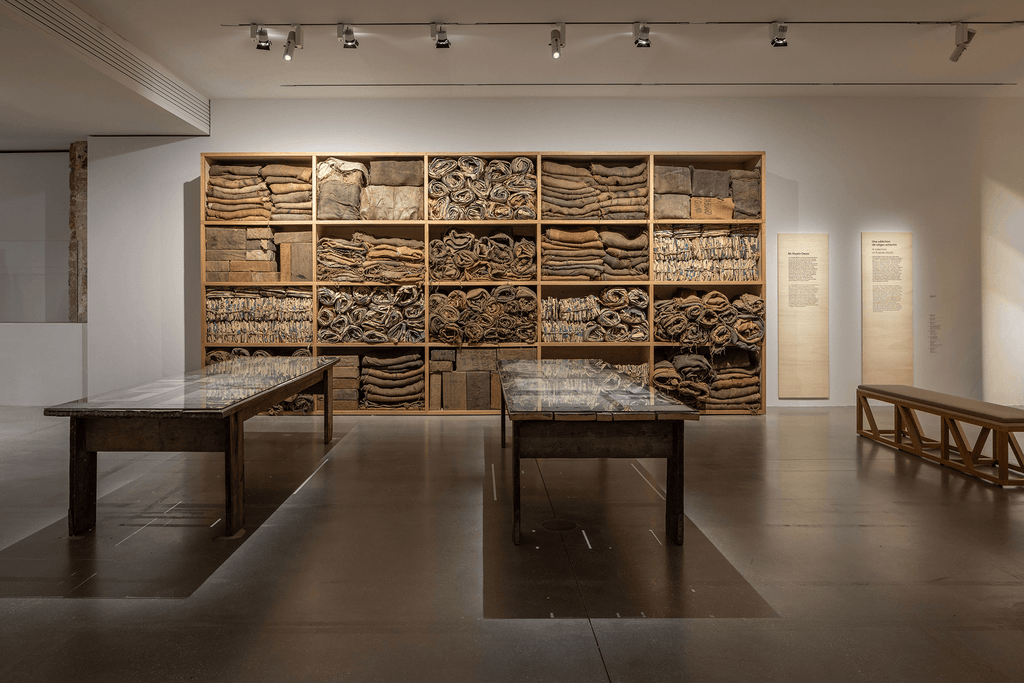
IBRAHIM MAHAMA, Parliament’s archive, 2026 © IBRAHIM MAHAMA
Photography © THIBAUT VOISIN
Photography © THIBAUT VOISIN
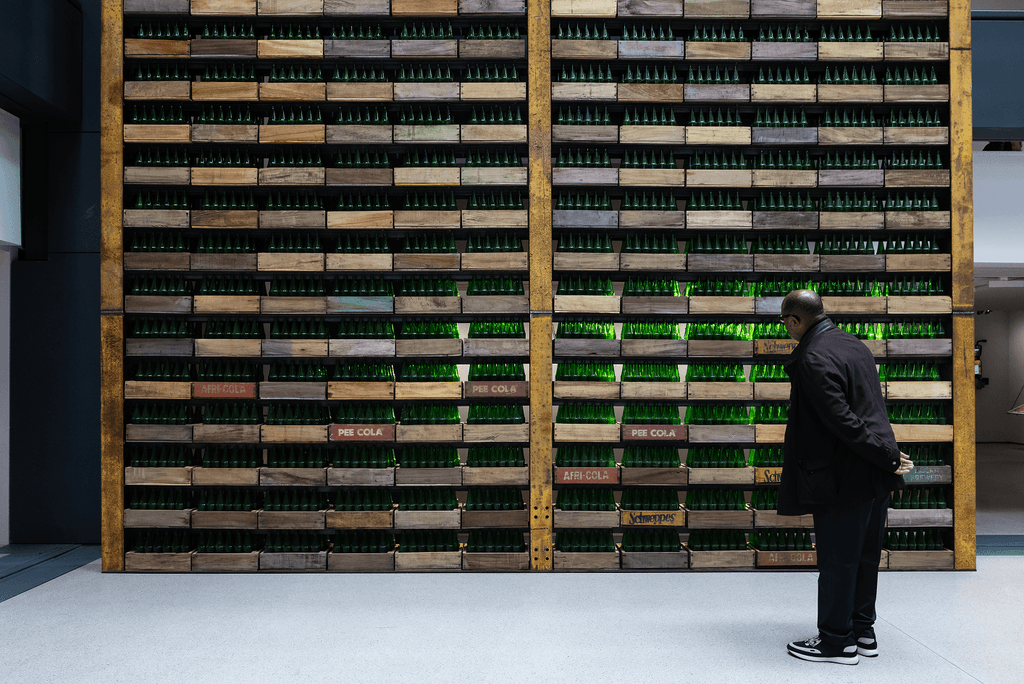
IBRAHIM MAHAMA, Things Fall Apart, 2026 © IBRAHIM MAHAMA
Photography © THIBAUT VOISIN
h: You curated Mahama’s work, while Jeanne Barral curated the works by associated artists. How did you define the relationship between these two parts of the exhibition? Was the aim to create a dialogue between distinct practices, or to reveal a wider network of ideas, histories, and relationships around Mahama’s work?
h: You curated Mahama’s work, while Jeanne Barral curated the works by associated artists. How did you define the relationship between these two parts of the exhibition? Was the aim to create a dialogue between distinct practices, or to reveal a wider network of ideas, histories, and relationships around Mahama’s work?
AGD: I think it’s both, and it came about very naturally. I went to Ghana for the first time in January 2024 and came back about six months later for a huge festival around the photographer James Barnor, who was celebrating his 95th birthday. So many exhibitions had been organised in Ghana with his gallerist, Clémentine de la Féronnière, and I had the opportunity to curate a James Barnor exhibition in Tamale with one of my colleagues. Even then, given the way things work there and the space we have in Paris, we were thinking—and it was a conversation with Ibrahim—that it would be very natural to bring in other artists who work on the same period and have different views of this moment in Ghana’s history.
Ibrahim, for example, is not very critical of Nkrumah; he sees the post-independence moment as something very inspiring. But some of the artists don’t share that view of the period. James Barnor, for instance, had to leave Ghana because of the economic crisis. He refused to become one of the government photographers—he always remained independent—and he left Ghana for thirty years before coming back. So we wanted to tell a broader history, not just Ibrahim’s point of view, also because he is always surrounded by many other artists: his teachers at the Kwame Nkrumah University of Science and Technology, and his colleagues. When we went to Ghana, we visited so many studios, and I think it was important for us to give this art scene the opportunity to really shine beyond Ibrahim’s practice.
h: The exhibition revisits the political and cultural ambitions of the 1950s and 1960s, including connections between Ghana and Tito’s Yugoslavia explored through Tjaša Rener’s research. Why was this particular history important to the exhibition? How do the works make it accessible to visitors?
AGD: When I started working with Ibrahim, he was also the curator of the Biennial of Graphic Arts in Ljubljana. I went to Ljubljana and saw the biennial, with all those links between Nkrumah and Tito and Nasser, the Non-Aligned Movement, and the USSR and the Soviet bloc. The history of Ghana’s industry that Ibrahim tells is always linked to those transnational friendships between Nkrumah and his peers outside Africa, so it was always important for us to highlight this.
It became very natural when we met the artist Tjaša Rener, whose work I saw in Ljubljana. She is a Slovenian artist who has been based in Ghana for almost fifteen years—and, as you can imagine, the Slovenian diaspora in Ghana is not that big. She had reconstructed the living room of a Slovenian woman from Yugoslavia who lives in Ghana. I met her after seeing the work, and she told me the story of this woman, who is now in her eighties. They were in contact, both living in Accra, and Tjaša went to see her almost as a family member. When she entered her house, she saw that it was decorated in a 1970s Yugoslav style, but with some African elements and pictures of her family. We all learn about the history of non-alignment, but beyond the treaties and the politics, we don’t really know what came out of it on a personal level. This image of a living room, with all its different elements, made that tangible. When I saw it in Ljubljana, I was struck by it, so we decided to invite her.
She will present this work, which is called Place We Call Home and includes recordings of the woman telling her story in Slovenian. Since then, Tjaša has also done a lot of research in museums in Belgrade, looking for images and archives of young African students who came to Yugoslavia at that time: what the links were, what they learned there, and how it all ended. The connection with Ibrahim was always very clear, but his work is less about personal and human links—he is more interested in buildings, industry, and materials. We wanted another practice that looks more at relationships, feelings, and personal histories.
h: The exhibition includes new versions of a selection of his earlier installations, each first made for a particular site. For the reinstalled works, on what basis did you decide what carries over and what is rebuilt?
AGD: Parliament of Ghosts started in 2019 at the Whitworth in Manchester, built with materials from Ghanaian trains dating from the 1950s to the 1980s. Then Ibrahim built a Parliament of Ghosts in Red Clay, and since then he has made many different versions—one last year in London, at Ibraaz. For this exhibition, we wanted a new one, and he proposed a very different version: a circle, not a parliament as it is in Great Britain, but more as it is in Ghana or France, for example.
At that time Ibrahim was also collecting wooden stools from the Ashanti region. Those are very beautiful stools carved from a single piece of wood. For him, it was also research into the Anglo-Ashanti wars of the colonial period, because that’s when the British were able to take these stools back to Great Britain and to Europe in general, where they ended up in ethnographic museums. So the question was how this form circulated. Ibrahim decided to build this parliament with those stools, and it’s the first time he has used them. The 200 stools were collected by Ibrahim, repaired in Ghana, and then sent to us.
I’m really looking forward to the audience seeing it, because we’ve been working on it for many years, and it has taken Ibrahim so many years to collect all these objects and materials. It’s fascinating to see how they take shape in an exhibition.
h: The exhibition is meant to keep changing after the opening. Which elements were designed to evolve, and how do you balance the need for a coherent exhibition with the possibility of change, uncertainty, and new encounters?
AGD: To be honest, the changes will mostly depend on the audience. As I said, we are organising a whole programme of talks, music, and live art in the parliament, so it’s built to change: sometimes there will be a screening, sometimes a concert—we have an evening concert in November. We will also use the glass factory, the architectural reconstruction I mentioned, as a site for workshops. So the changes lie mainly in the way we inhabit the exhibition. Rather than having something completely fixed, Ibrahim imagined that we could take some of the materials out of the archive section, and that artists running workshops could use an installation to draw on with the children—perhaps even moving the workshop space into the exhibition instead of keeping it separate.
That isn’t easy, as our institutions are quite strict, partly for security reasons, and it was a bit difficult for some of the artists to imagine, because in Ghana—and this isn’t a cliché, it’s real—people who have built art centres have so much flexibility to do whatever they want with workshops and with how the audience lives in a space. We will also organise screenings. The idea was that for every event we hold, we use the exhibition space. The programme has to live with the exhibition, and it has to be a collaboration, even if the link isn’t always a natural one.
Words: VERONIQUE ZACH