Angel Otero memory in art layered painting
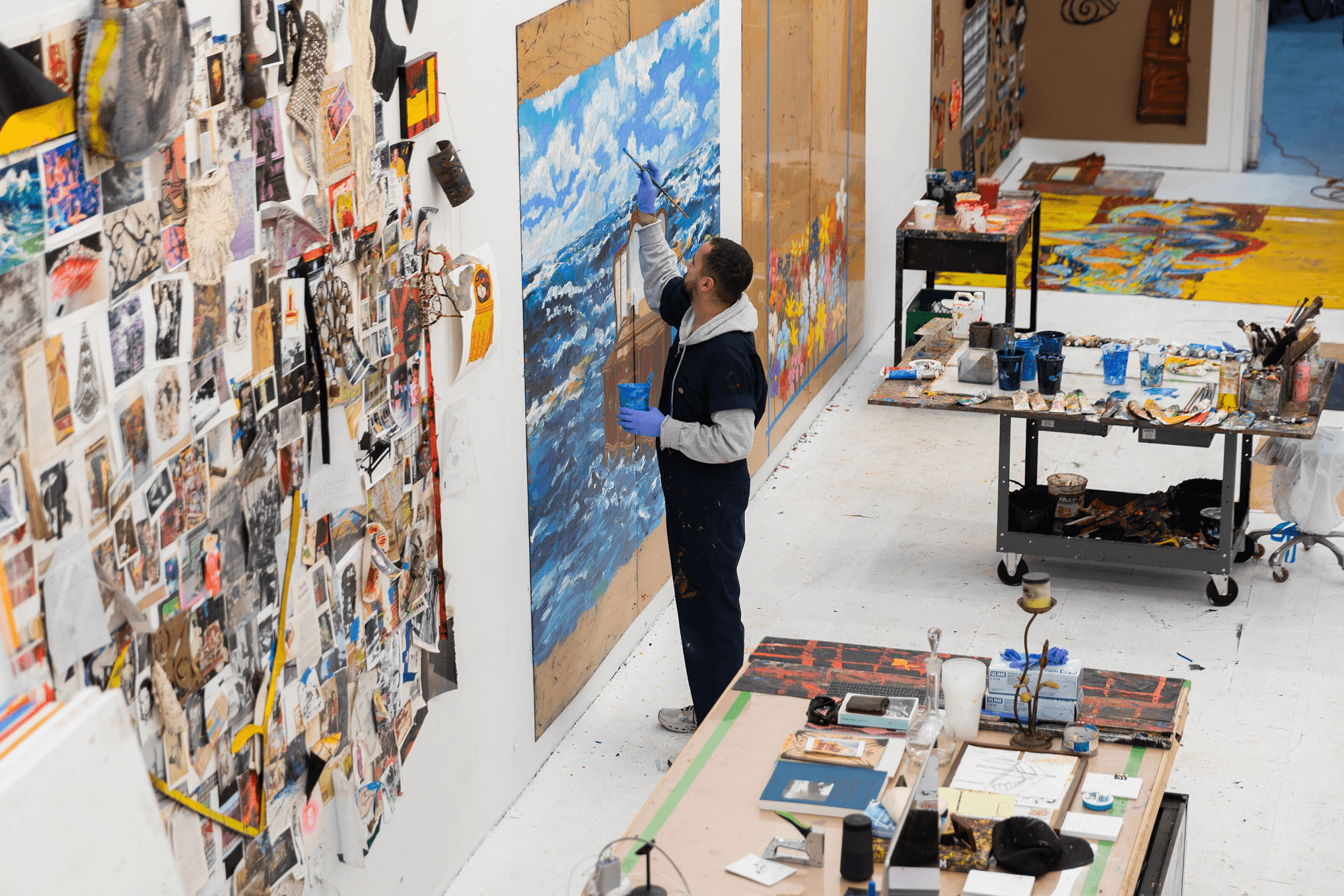
ANGEL OTERO at his Brooklyn Studio, 2026. Photography by JAVIER ROMERO. Courtesy of ANGEL OTERO and HAUSER & WIRTH

Angel Otero: a homecoming

Angel Otero builds surfaces and then destroys them. He pours oil paint onto glass, lets it dry, peels it away in fragile sheets, and repositions it onto canvas—a process that is at once controlled and uncertain. What emerges from that tension is work between abstraction and figuration, between the intimate and the historical, between remembered and reconstructed. The Puerto Rican artist, based between San Juan and New York, has spent his career developing a practice that centres on personal memory in art—crabs escaping across his grandfather’s floor, the texture of a childhood home, the weight of distance—while remaining in dialogue with the history of painting, from Spanish Baroque tradition to Abstract Expressionism. His first solo exhibition in the UK, Agua Salada, presented at Hauser & Wirth Somerset, marks a significant expansion of that practice into sculpture and film, and a homecoming of an entirely different kind.

‘Angel Otero. Agua Salada’ will be on display at Hauser & Wirth Somerset from 2 May to 18 October 2026. 

Hauser & Wirth Publishers will publish a new dedicated title, ‘Angel Otero’ in September 2026. An exclusive pre-release will be available from July 2026 at Hauser & Wirth Somerset.

hube: You’ve lived in New York for many years, but Puerto Rico remains deeply present in your work. How does that distance, both physical and emotional, shape how memory appears in your works?

Angel Otero: Although I’ve lived in New York for many years, I recently moved back to Puerto Rico and established a studio practice there, while keeping my New York space. These days I’m constantly moving between the two. But before that return, the distance was a powerful shaping force. It changed how I confronted the feeling of missing a place and, more specifically, missing the community that defines it. That distance creates space for other elements to enter the conversation—things that I might not have noticed in proximity. For me, memory functions as a tool of exploration, a lens through which I can confront the self. 

h: Memory seems to sit at the centre of your practice, but not as something stable or nostalgic; it’s layered, sometimes incomplete. Do you think of your work as recovering the past, or more as reconstructing it? 

AO: Within the instability of recollection—in its gaps and slippages—that’s where the reconstruction happens. I’m not trying to retrieve something intact. What interests me is the collapse between certain memories, whether they are crystal clear or blurry, and things that are happening to me in the present day. That incompleteness is generative. That’s where the work lives. 
Angel Otero
memory in art
layered painting
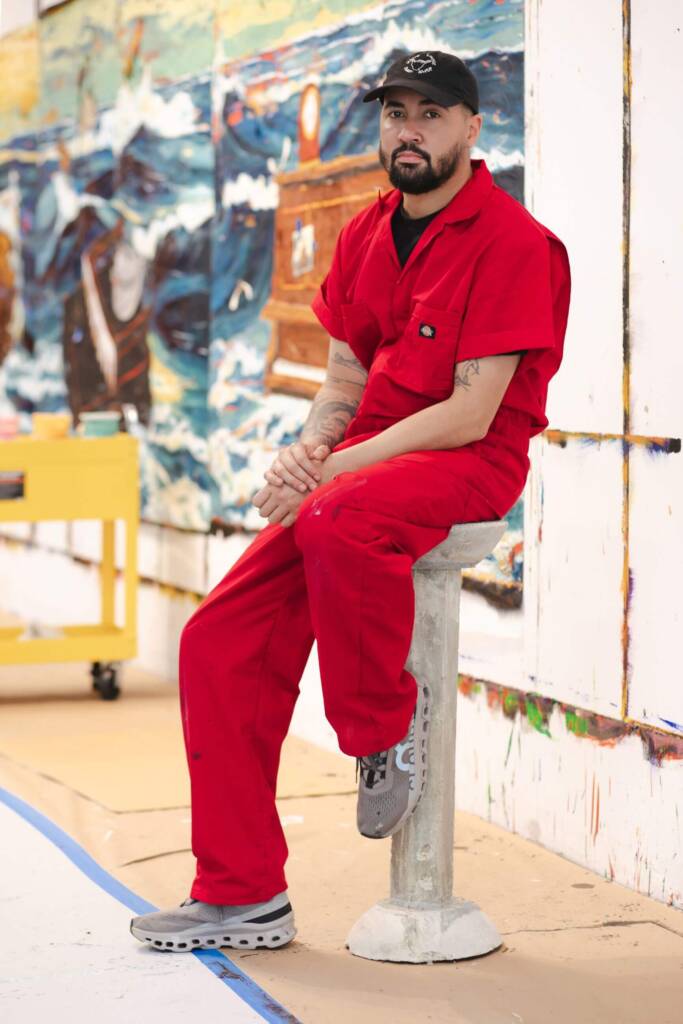
ANGEL OTERO at his Puerto Rico Studio, 2026
Photography by JAVIER ROMERO
Courtesy of ANGEL OTERO and HAUSER & WIRTH
Angel Otero
memory in art
layered painting
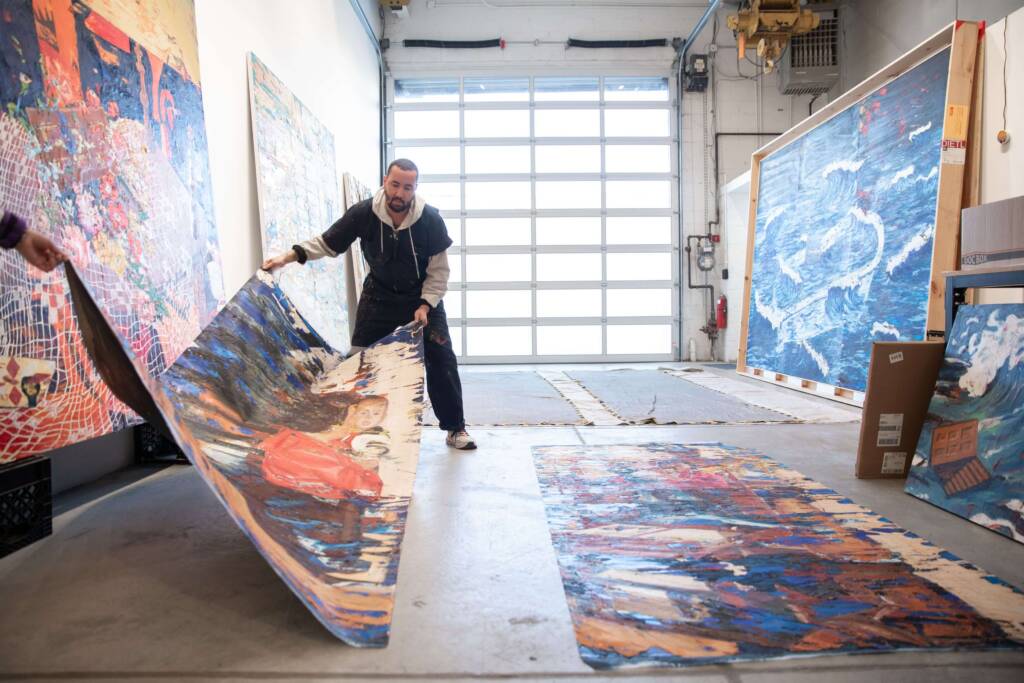
ANGEL OTERO at his Brooklyn Studio, 2026
Photography by JAVIER ROMERO
Courtesy of ANGEL OTERO and HAUSER & WIRTH
Angel Otero
memory in art
layered painting
ANGEL OTERO at his Puerto Rico Studio, 2026
Photography by JAVIER ROMERO
Courtesy of ANGEL OTERO and HAUSER & WIRTH
Angel Otero
memory in art
layered painting
ANGEL OTERO
Prayer Piano, 2026
Oil paint and fabric collaged on canvas
183.5 x 242.5 x 4 cm / 72 1/4 x 95 1/2 x 1 5/8 in
Angel Otero
memory in art
layered painting
ANGEL OTERO at his Puerto Rico Studio, 2026
Photography by JAVIER ROMERO
Courtesy of ANGEL OTERO and HAUSER & WIRTH
Angel Otero
memory in art
layered painting
ANGEL OTERO
A Two Man Island, 2026
Oil paint and fabric collaged on canvas
182.5 x 242 x 4 cm / 71 7/8 x 95 1/4 x 1 5/8 in

h: Everyday objects in your paintings were described by you as stand-ins for family members or moments from your life. Can you share an example of an object that found its way into a work, and what it carried with it?

AO: One object that comes to mind is the land crab. It’s a very common sight on the island of Puerto Rico, and the motif grew out of an actual memory involving my grandfather. Land crabs need to be cleaned and looked after for about a week before you cook them. My grandfather brought some home at the same time my father returned from the hospital. At some point the crabs escaped and started roaming around the house. My grandfather and father, broom in hand, had to round them up. There’s something slapstick about that image, but beneath the humour, it became a metaphor for my father returning to life with my grandfather. These two men, each living alone, suddenly mirroring each other. The whole situation holds something very delicate. I started painting the crabs without knowing exactly where they would land in the work, and I think that unknowing was important. 

h: Your work holds a tension between control and unpredictability. You build painted surfaces, yet the moment you peel the oil skin, anything can happen. How do you manage that uncertainty?

AO: I think that tension is one of the most interesting parts of the work. Anything can happen in that moment of scraping the built-up layers of oil paint, and that is both thrilling and challenging. There are real moments of frustration. But there’s also a constant dialogue between my intuition and the physical layering—between the decisions I’m making and what the material is doing on its own. The distortion that emerges engages both control and chance at once. That’s where the imagery transforms into something I couldn’t have planned. 

h: Is that openness to unpredictability something that exists only in the studio, or does it reflect a broader way you approach life?

AO: It does reflect the way I approach life. I don’t think I could separate the two, honestly.

h: Work of yours seems to be in conversation with painting’s history: from Spanish Baroque traditions to Abstract Expressionism, from Poussin to de Kooning. How do you hold those different worlds together in your practice?

AO: I hold it as a personal relationship between myself, art history, and the history of painting. I feel a genuine need to continue those conversations, whether that manifests as formal decision-making or as something closer to inspiration. I’m borrowing from the masters to build my own visual language. From early on, what intrigued me most about painters I admired—both historical and contemporary—was their tendency to reinterpret or rewrite subjects that had already been explored. Picasso with Velázquez, for example. That impulse to be in dialogue with what came before, rather than simply moving away from it, has always felt natural to me. 

h: The Hauser & Wirth Somerset show marks your first solo exhibition in the UK. What feels particularly significant about this body of work for you at this moment?

AO: This body of work began over two years ago. It was a very specific moment and a very specific feeling—thoughts and images that I knew would evolve but didn’t yet know where they were going. Moving back to Puerto Rico, setting up a studio there, being back with family again all opened a lot of doors for me emotionally. It became something of a homecoming in the deepest sense: about place, about self, about being a son, about being a father, about being an artist. Those experiences fed directly into the work. And then there was the experience of resolving the paintings at a distance during the residency, in a completely different environment. That geographical shift created a new mindset, which informed how I would complete what I had begun. There’s something meaningful about beginning the work in one place and finishing it in another. 

h: This exhibition grew out of a residency in Somerset, where you temporarily relocated your practice from New York and Puerto Rico to the English countryside. Did that shift in environment change the way you approached the work?

AO: The change in scenery was significant in ways I didn’t fully anticipate. Being in Somerset offered me a different pace, a change of weather, the intimacy of a tight-knit creative community. All this found its way into my practice, indirectly and symbolically. There’s also something happening when you are physically far from home yet still think about things back there. I feel like I gained a kind of stillness that allowed me to resolve things, albeit from afar. The residency in Somerset gave me that. 

h: In this exhibition, you move beyond painting into sculpture and moving image. What prompted that? What possibilities did these new mediums open up for you?

AO: Both sculpture and film are things I think about constantly. I’ve worked in sculpture before, but this is the first time the work has been in earnest conversation with the outdoors and an exterior context, which felt like new territory for me. Film is something I grew up loving, particularly French New Wave cinema. I always wanted to explore making film, and, in a way, leaning into my inexperience with the medium became its own kind of layer in the work. There was a lot of collaboration involved, and the ideas that emerged turned out to be deeply personal—which also made them difficult. That discomfort was intentional, and I think it added meaning to the piece.

h: Your work touches on themes like memory, loss, and time through deeply personal imagery. Do you feel artists have a responsibility to speak about the wider world, or can the personal itself be enough?

AO: At different times during my years as a practising artist, I’ve asked myself whether I have an obligation to respond to what’s happening in the world—politically and socially. In those moments of questioning, I often find it hard to create anything at all. My work comes from an immensely personal place, and I believe that stance is itself a position in relation to the world we live in. The personal is not a retreat from the broader conversation but my way of entering it. 

Angel Otero
memory in art
layered painting
ANGEL OTERO during his artist residency at HAUSER & WIRTH SOMERSET, 2026
Photography by CLARE WALSH
Courtesy of ANGEL OTERO and HAUSER & WIRTH
Angel Otero
memory in art
layered painting
ANGEL OTERO at his Brooklyn Studio, 2026
Photography by JAVIER ROMERO
Courtesy of ANGEL OTERO and HAUSER & WIRTH
Angel Otero
memory in art
layered painting
ANGEL OTERO during his artist residency at HAUSER & WIRTH SOMERSET, 2026
Photography by CLARE WALSH
Courtesy of ANGEL OTERO and HAUSER & WIRTH
Angel Otero
memory in art
layered painting
Installation view, Angel Otero. Agua Salada, HAUSER & WIRTH SOMERSET, 2026
© ANGEL OTERO
Photography by KEN ADLARD
Courtesy of ANGEL OTERO and HAUSER & WIRTH
Angel Otero
memory in art
layered painting
Installation view, Angel Otero. Agua Salada, HAUSER & WIRTH SOMERSET, 2026
© ANGEL OTERO
Photography by KEN ADLARD
Courtesy of ANGEL OTERO and HAUSER & WIRTH
Angel Otero
memory in art
layered painting
Installation view, Angel Otero. Agua Salada, HAUSER & WIRTH SOMERSET, 2026
© ANGEL OTERO
Photography by KEN ADLARD
Courtesy of ANGEL OTERO and HAUSER & WIRTH
Angel Otero
memory in art
layered painting
Installation view, Angel Otero. Agua Salada, HAUSER & WIRTH SOMERSET, 2026
© ANGEL OTERO
Photography by KEN ADLARD
Courtesy of ANGEL OTERO and HAUSER & WIRTH
Angel Otero
memory in art
layered painting
Installation view, Angel Otero. Agua Salada, HAUSER & WIRTH SOMERSET, 2026
© ANGEL OTERO
Photography by KEN ADLARD
Courtesy of ANGEL OTERO and HAUSER & WIRTH

Special thanks to SUTTON COMMUNICATIONS

Words: ARINA V

ISSUE 8

issue no8

Discover the new issue — available now