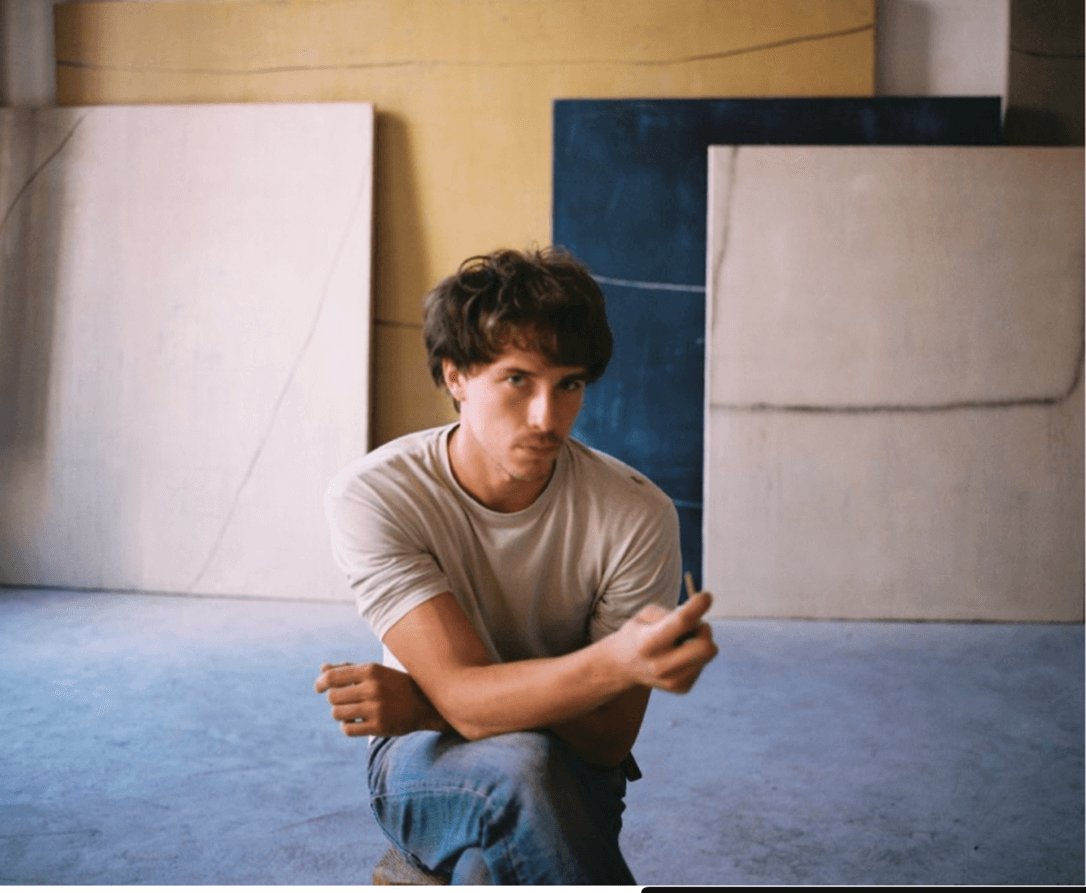
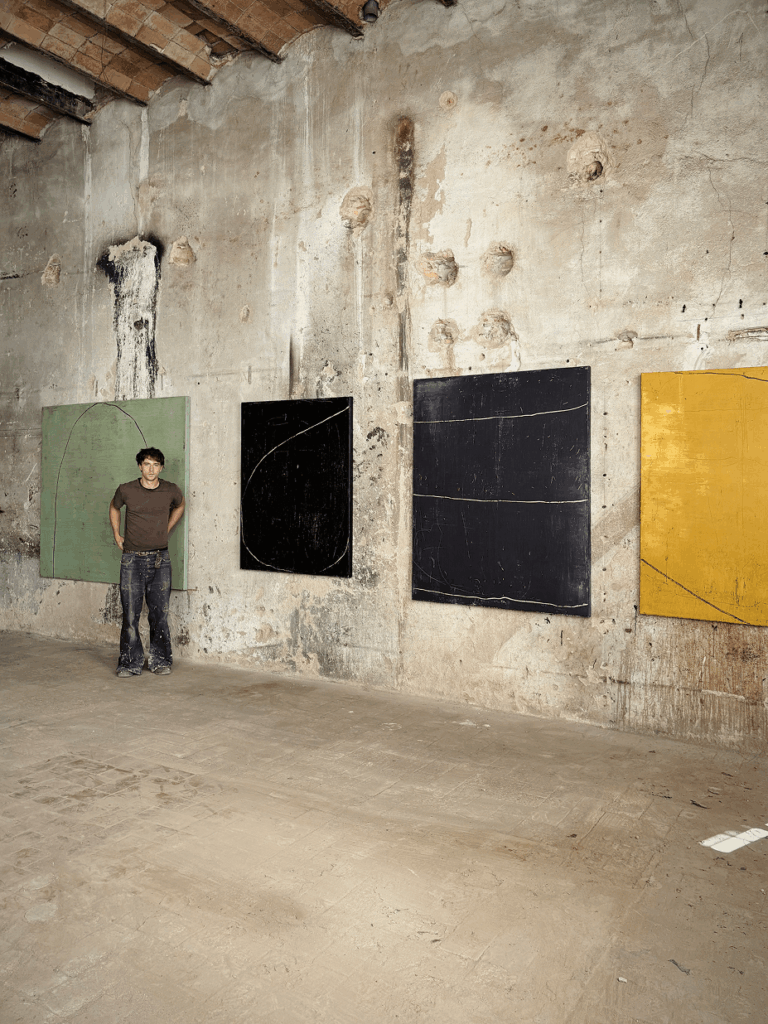
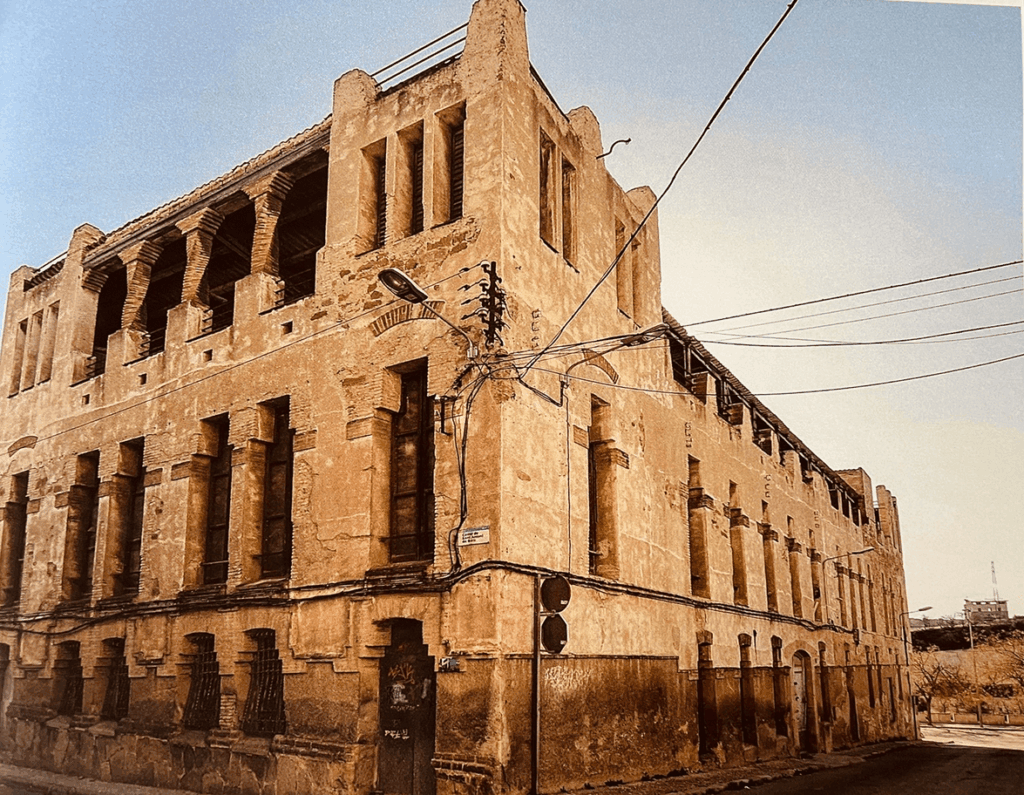

Quiet, melancholic reflection—this is how one might briefly describe the paintings of Enrich. R, whose canvases emerge less from the stroke of a brush than from layered paint, cracks, and traces of patina. Raised between the industrial architecture of Igualada and the open landscapes of the Catalan countryside, the artist developed a visual language shaped by the tension between solidity and expansiveness. For Enrich, painting is a way of constructing space: a canvas should create depth and openness, much like a window.
In our interview, Enrich reflects on the role of space and silence in painting, the importance of doubt and time in his practice, and the invisible forces that shape the material presence of his works.
hube: Growing up between the industrial architecture of Igualada and the open, breathing landscape of the Catalan countryside, how did this continuous dialogue between solidity and vastness shape the foundations of your visual language?
Enrich. R: Space has a lot to do with my painting. A painting must give breadth and depth to space, in the same way a window does.
I clearly remember going out into the countryside to paint landscapes, spending hours searching for a motif to interpret, which was usually a hill, a field, a cart path… Later, when I began working in the studio, I realized that the exercise was essentially the same, but instead of looking outward, I was searching with an inward gaze at reality.
h: In your practice, a layer is never simply a backdrop but a trace: a memory of a gesture, a decision, or an erasure. By what internal metric do you sense that a layer must be buried beneath new matter, and when do you feel compelled to let it persist as a fragile, visible truth?
ER: I try to remain very attentive while working, because sometimes a single gesture can radically change the perception of an image. Usually, I know when something is worth letting dry, but sometimes it takes many attempts to arrive at that gesture, color, or surface. These sessions accumulate one over another, transforming the canvas into a new surface. That’s why I believe every painting has its own secret, hiding a story within it.
h: You have said that doubt is important to your work. In what ways does hesitation leave a mark on the canvas?
ER: Doubt or uncertainty is what creates stimulation. I’m very restless and need my day to be physical. I always try to have a new motif or outline on the table so that I never stop and can continue working with my hands.
h: You refer to your works as “paths of silence.” Visually speaking, what is silence to you: a restraint of gesture, a void charged with tension, or an active space where meaning gathers without asserting itself?
ER: I’m not entirely sure what creates silence or even what it is, but a good painting can never be fully resolved. By that, I mean the viewer must bring their own perspective and reality rather than simply contemplate it. I like to think of paintings as strong messages, yet each person sees something different.
h: Many of your compositions feel suspended in a slowed present, neither anchored in memory nor reaching toward the future. How do you conceptualize time when constructing the internal structure of a painting?
ER: I try to capture the moment when the painting is still alive, and then I let it dry—somehow immortalizing a gesture over a color. Intuition has a lot to do with it; nothing is entirely random. Usually, the painting itself tells you how it needs to end. A painting ends up being the result of the time we live in, but it is also loaded with a past full of paint, which is sometimes hard for me to let go of. I don’t believe art is an evolution; it is more an accumulative human act.
h: You have mentioned physics, memory, and invisible forces as underlying concepts in your work. How does your imagery negotiate the boundary between the tangible material world and the invisible energies that shape it?
ER: There are many things to discover when you look at a painting, and the most interesting ones are often the inexplicable. Objects have always kept me company, beyond their logical utility. Some things retain a symbolic energy that makes them more special than others. Sometimes, the simple passage of time gives beauty and personality to things.


h: What emotions do you hope viewers experience when encountering your work?
ER: I don’t expect any particular emotion. I can’t control what someone else might see or think. But I do hope that within a few seconds, one has a clear sense of what they are looking at. Perhaps there’s no need to put it into words—just looking is enough.
h: You have exhibited in Girona, Brooklyn, Paris, London, Berlin, Bali, Copenhagen… What have these encounters taught you about how abstraction is interpreted or emotionally received across different cultures?
ER: Perhaps in more Eastern countries I share a certain reflection, a warm emotional. By contrast, I see americans as very brave in the way they work, as if they’re in a hurry to make the next painting before finishing the last one—and in that immediacy, I also see myself reflected. Still, I’ve always had my roots in Spain, and I don’t think that’s something one can hide from.
h: Minimalism is often described as a universal visual language. In your experience, does its meaning remain stable across contexts, or does it mutate in response to cultural expectations, spatial environments, or local sensitivities?
ER: I’m not sure what minimalism really means, especially since the term is so overused today. Perhaps Judd is the clearest answer for me. It’s a universal philosophy that has little to do with culture—it’s more a sensibility to space.
h: How would you describe the future in three words?
ER: A forgotten memory.

Courtesy of ENRICH R.
