Swiss artist Ugo Rondinone, whose practice continues to oscillate between the monumental, intended for antlike audiences, and art that enlightens the existence of the individual, with works that move beyond the purely formal, probing material, colour and weight, and the emotional as experiential. His exhibition more light, 9 June – 22 August 2026, at Sadie Coles HQ, London, offers a fresh opportunity to revisit recurring concerns that have animated his work for decades, of the body, nature, time, melancholy, ritual, and the capacity of the sculptural form to alter our experience of space. Rondinone, as much as he is a sculptor is at the same time an unashamed colourist, claiming that “colour reaches the body before thought”, that “you don’t translate blue, you experience it”, and that sense of the urgency and impact of colour was as eloquently evoked in the writings of German polymath Johann Wolfgang von Goethe, who coined the phrase “colours are the deeds and sufferings of light”, that once understood, enflames Rondinone’s ambitions for illuminating his work in infinite and intimate spaces”. Light being the least tangible of materials but the most immediate. Before recognising form, colour or distance, as Rondinone would argue, we encounter illumination itself. And for all his intellectual sympathies, Goethe recognised that colour was not merely an attribute of objects but the visible consequence of light entering the world, and few contemporary artists have pursued that proposition with greater consistency or poetic conviction than Rondinone. Swiss-born German artist Paul Klee was convinced “art doesn’t reproduce the visible; rather, it makes visible,” and for Rondinone, what becomes visible is often what is ephemeral; light, time, silence, solitude, atmosphere, the passing of one state into another.
For more than three decades, Ugo Rondinone has returned obsessively to a remarkably concise vocabulary of archetypes, the rainbow, the sun, the moon, mountains, trees, horizons, windows, clouds, waterfalls and the solitary human figure. Never applying them as motifs in the conventional sense, nor symbols requiring interpretation. Instead, they formulate and function as recurring states of being, elemental forms through which the artist repeatedly examines perception, memory, solitude, and the passing of time. Rather than continually inventing new subjects, Rondinone has spent his career deepening the expressive possibilities of the few that have accompanied him from the beginning. As he later reflects in this conversation, each new work becomes “another sentence written with the same alphabet.”
And in his hands such consistency shouldn’t be mistaken for repetition. As Rondinone’s practice resembles a long philosophical enquiry conducted through matter itself.
Whether working with watercolour absorbed into raw cotton, fluorescent pigments, cast bronze, monumental stone, wax, earth, trees or neon, his concern has remained remarkably constant, how might material alter consciousness? Sculpture, in such a context, ceases to function simply as an object occupying space, but becomes a condition through which space itself is experienced. As modern French philosopher Maurice Merleau-Ponty observed, “the body is our general medium for having a world.” Rondinone’s works continually remind us that perception is never detached or purely optical; it is bodily, emotional and profoundly spatial. We do not simply look at his sculptures, we move around them, slow before them, measure ourselves against their scale and, perhaps most importantly, discover ourselves differently in their presence.
The London constellation, the song is you at the Royal Academy, light across Bond Street, and more light at Sadie Coles HQ, extends this enquiry in an unexpectedly distilled form. Although realised across three very different sites, Rondinone conceives them not as separate exhibitions but as “three movements of the same composition.” Together they trace a quiet migration from language to public space. The rainbow poem welcoming visitors to Burlington House, the fifty-four flags animated by London’s wind, and the delicate watercolours dissolving into unprimed cotton all ask variations of the same question, how can something as immaterial as light become an experience that is physically and emotionally felt?
It is tempting to understand these new paintings as a departure from the major sculptures that have come to define Rondinone internationally. In truth, they reveal the underlying continuity of his practice. The watercolour doesn’t in any way replace sculpture, and neither should it; it simply reaches the same destination by different means. Throughout the interview, Rondinone repeatedly returns to an idea that unites every medium he employs transformation. Rainbows appear only to disappear, as much as sunrise exists is a prelude to the day becoming a day. Trees pass through seasons of growth and decay, and even stone, the historical emblem of permanence, carries within it the evidence of geological time. His works therefore resist the traditional ambition of sculpture to overcome time through permanence. Rather, they dwell within change itself, asking us to recognise impermanence not as loss but as the very condition of existence. Colour occupies a similarly singular position within this enquiry. Yet Rondinone’s chromatic intensity is never decorative. His fluorescent mountains, rainbow figures and vividly saturated installations refuse to describe the visible world; instead, they construct emotional climates in which viewers become physically immersed. If colour, as German-American artist Josef Albers argued, is “the most relative medium in art,” Rondinone demonstrates that it is also among its most immediate. Before language, before interpretation, colour reaches the body. It alters atmosphere, rhythm and feeling with a directness that thought can only subsequently explain. His colours do not simply illuminate sculpture; they become its emotional architecture.
Perhaps this explains why silence emerges repeatedly throughout the following conversation. Rondinone describes silence and slowness as his “favourite materials,” a statement that at first appears paradoxical. Yet silence, in his work, is neither absence nor emptiness. It is an active condition of attention. The monumental stone figures, isolated trees and contemplative landscapes never demand contemplation through spectacle. Instead, they cultivate a rare stillness in which perception itself begins to expand. Which draws on turn-of-the century Austrian poet and Rainer Maria Rilke’s conviction that works of art do not simply represent the world but quietly transform the conditions through which it is encountered. Rondinone’s sculptures ask remarkably little of us beyond our presence, in return, they offer the possibility of inhabiting the world, if only briefly, with greater awareness.
If this latest constellation begins with light, it ultimately arrives elsewhere. It moves towards colour, matter, weight, demonstrating that these are not separate concerns but different manifestations of the same enduring investigation. Rondinone’s achievement lies not simply in producing memorable objects or environments, but in revealing that sculpture, painting, poetry and public space can all become instruments for recalibrating perception. In an age increasingly defined by acceleration, distraction and spectacle, his work proposes something quietly radical, that the deepest transformations often occur not through movement, but through stillness; not through accumulation, but through reduction; less through certainty, but through sustained attention to the elemental conditions of being. Works by Ugo Rondinone are currently on show at Sadie Coles HQ at Art Basel Paris, 22 – 25 October 2026, with his forthcoming exhibition shaping silence, at Jōju-in, Kiyomizu-dera Temple, Kyoto, 27 October – 12 November 2026.
Rajesh Punj: I see it explained that your three current London presentations, ‘the song is you’ at the Royal Academy, ‘light’ across Bond Street and ‘more light’ at Sadie Coles HQ, as a constellation rather than three independent exhibitions. Why was it important for you to think of these projects as one work unfolding across different sites, and how does each location complete the others?
Ugo Rondinone: I never thought of them as three exhibitions. For me they are three movements of the same composition. It’s an organism. At the Royal Academy, language becomes light. A short poem appears as a rainbow in front of the entrance and welcomes every visitor. On Bond Street, light becomes movement. Fifty-four flags carrying sunrise and sunset paintings are activated by wind, weather and the rhythm of the city. At Sadie Coles, light becomes stillness. The same sunrise and sunset dissolve into intimate watercolours. The three projects move from language to public space, to contemplation. Together they ask how something as immaterial as light can shape our emotional experience of the world.
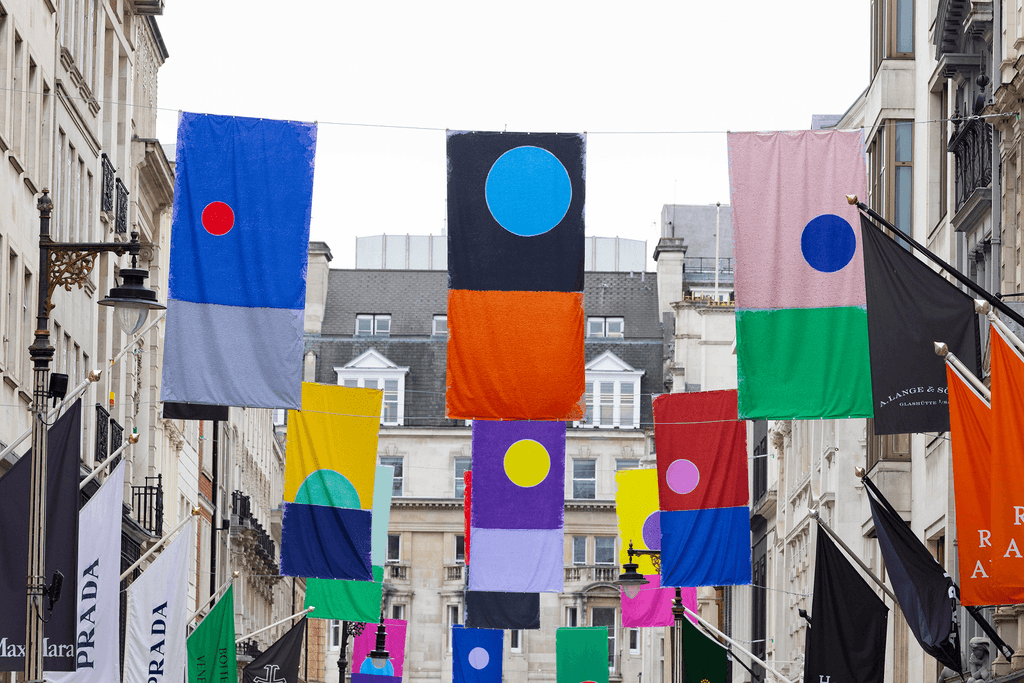
Installation view, Ugo Rondinone, light, Art in Mayfair, Curated by the
New West End Company in partnership with the Royal Academy of Arts
© UGO RONDINONE. Courtesy the Artist and ART IN MAYFAIR, Curated by the NEW WEST END COMPANY in partnership with the ROYAL ACADEMY OF ARTS
Photography by DAVID PARRY/PA MEDIA ASSIGNMENTS
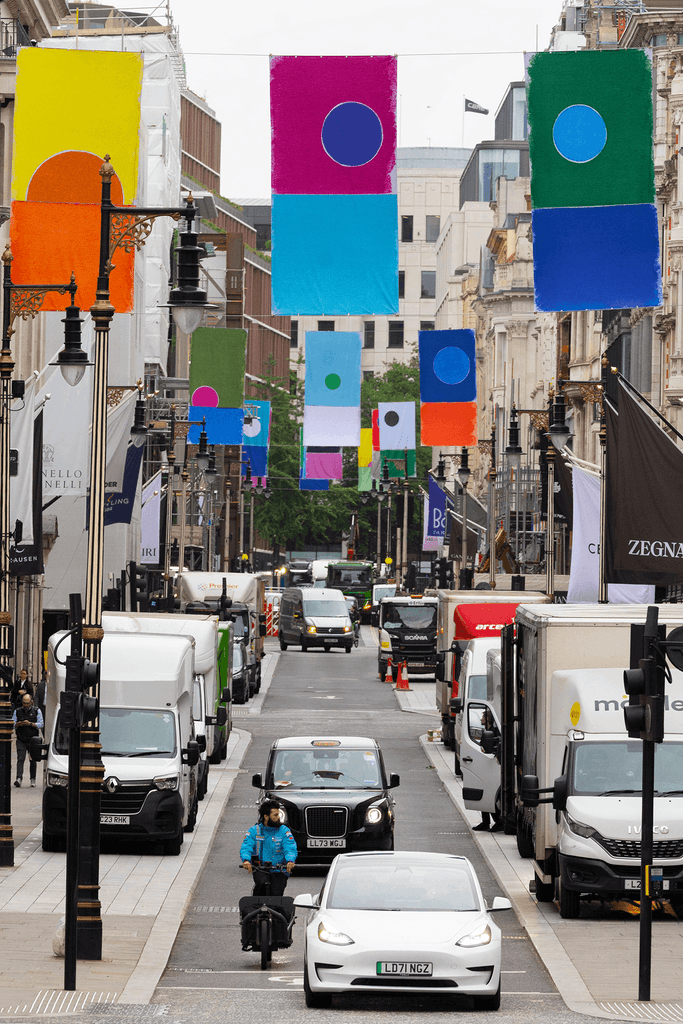
Installation view, Ugo Rondinone, light, Art in Mayfair, Curated by the
New West End Company in partnership with the Royal Academy of Arts
© UGO RONDINONE. Courtesy the Artist and ART IN MAYFAIR, Curated by the NEW WEST END COMPANY in partnership with the ROYAL ACADEMY OF ARTS
Photography by DAVID PARRY/PA MEDIA ASSIGNMENTS
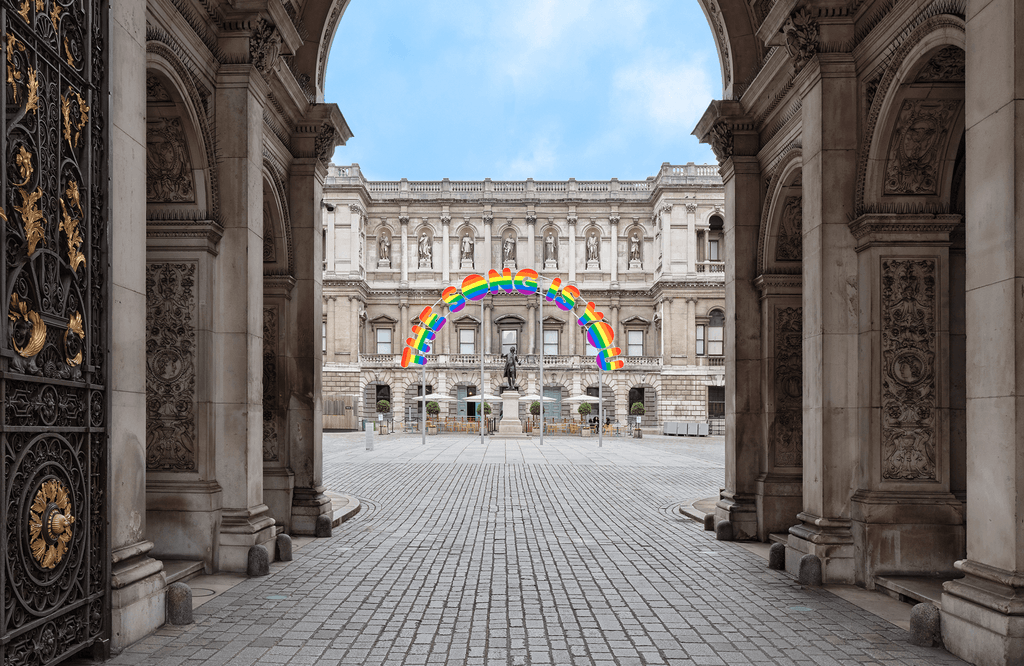
Installation view, the song is you, Royal Academy of Arts, London, 16 June – 23 August 2026
© UGO RONDINONE. Courtesy the Artist and ART IN MAYFAIR, Curated by the NEW WEST END COMPANY in partnership with the ROYAL ACADEMY OF ARTS
Photography by DAVID PARRY/PA MEDIA ASSIGNMENTS