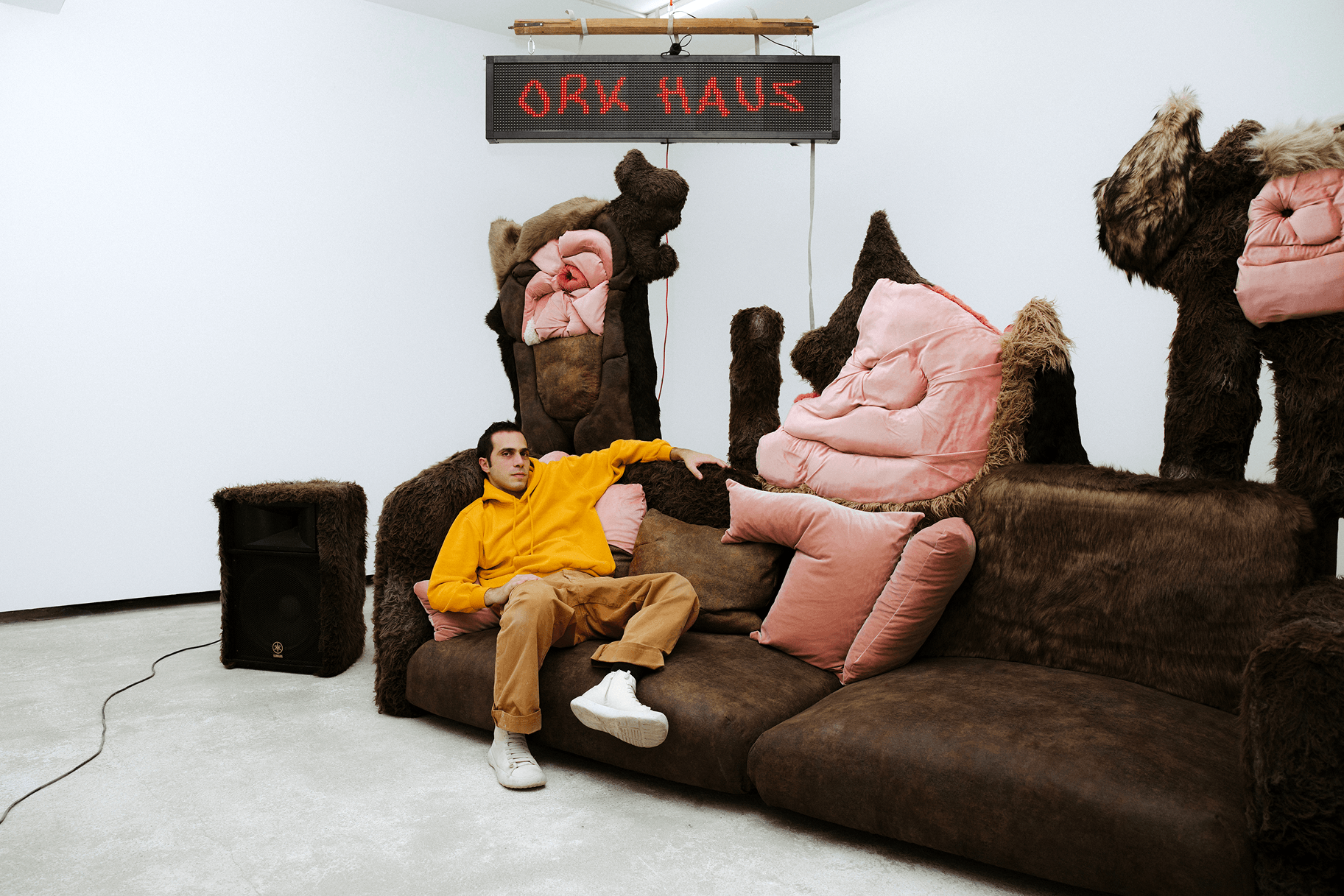
Theo Triantafyllidis works with game engines, and what comes out of them is usually a system rather than an object. He trained as an architect in Athens before moving into media arts, and the habit shows: he builds an environment, writes its rules, drops in bodies that are human, animal, monster, and machine by turns, and then lets the rules do the work. Ecological collapse, social entanglement, and networked desire are the recurring subjects, handled with enough comedy that the dread arrives sideways.
Feral Metaverse, the multiplayer game he has been developing since 2023, is the clearest case of that method. Players are assigned a body they did not choose, stripped of the usual ways of talking to one another, and left to work out how to cooperate anyway; getting anywhere means piling into temporary group forms with strangers. It has already existed as a performance with Onassis ONX in New York, as an installation at Ujazdowski Castle in Warsaw, and as a download on Steam, each version less a finished work than a test of what players do with the rules. His simulations have also run at the Whitney, Centre Pompidou-Metz, and the Athens Biennale.
On 14 October, a game took on a new form at Frieze London. Feral Metaverse (Spider), the 2026 Frieze London Artist Award commission by Triantafyllidis, turns the fair’s Focus section into a space of collective play. Co-commissioned and co-produced by Forma and Frieze, and developed in collaboration with Google Arts & Culture for the first time in the award’s history, the work takes the form of a large, soft, spider-like sculpture built in Athens by a team assembled for the project.
But this is no sculpture to simply stand before. To enter the game, visitors must climb, hold on, and rely on one another. Speaking to hube ahead of the fair’s opening, Triantafyllidis reflects on rules, assigned bodies, and the forms of cooperation that emerge when a system cannot be solved alone.
hube: You’ve described your work as building performative systems where natural and synthetic intelligences coexist. How did that framing first take shape for you, and what continues to draw you to the unstable threshold between the two?
Theo Triantafyllidis: I think it developed gradually through working with game engines. At first, I was interested in games because of their expansiveness, the worlds, systems, relationships, and the amount of time someone can spend inside them. But eventually I became more interested in the game engine itself as a medium for building systems.
With the simulations, I became interested in what happens when you create a very simple set of rules and then allow different agents to interact within them. It made me think a lot more about natural systems and how difficult they are to replicate. I don’t necessarily see the natural and synthetic as opposites. I’m interested in the space where you try to construct something that behaves like a living system, while knowing that you can never completely control what will emerge from it.
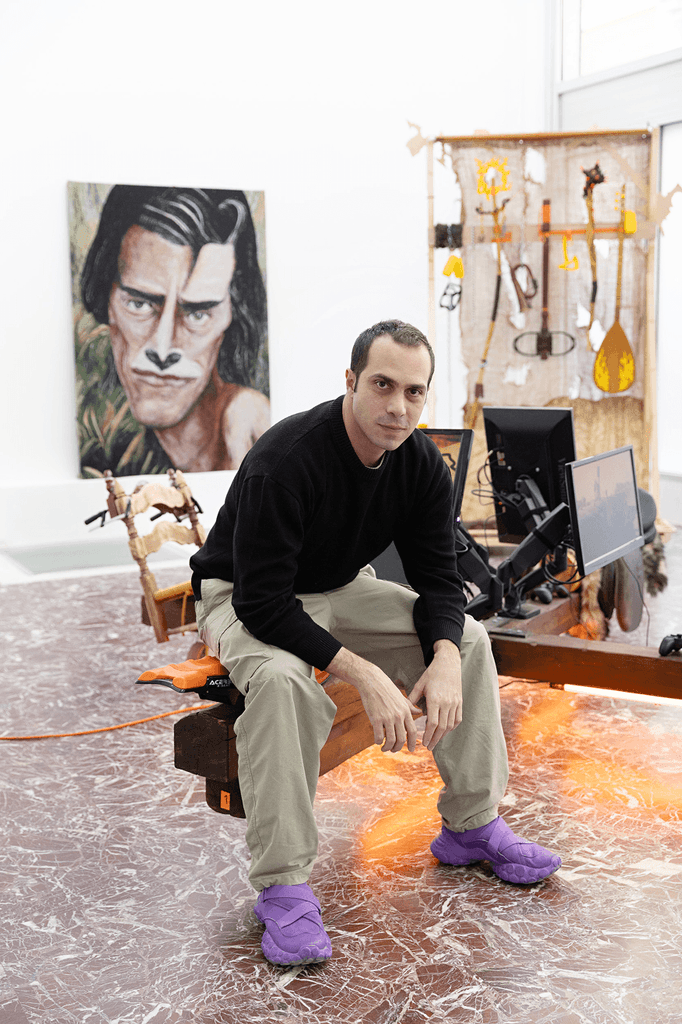
Photography by PARIS TAVITIAN LIFO
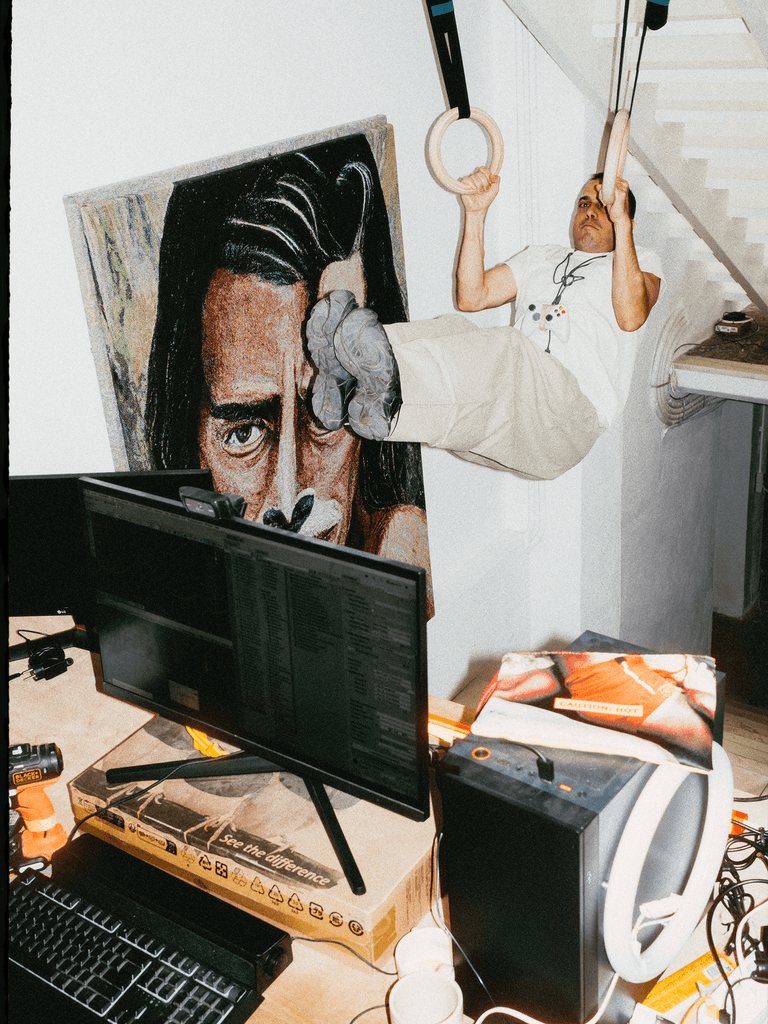
Photography by DOUGLAS MARTIN EVELEIGH. © DOUGLAS MARTIN EVELEIGH
Courtesy the Artist and THE BREEDER, Athens