Photography by CHAZ GUEST

Larry Ossei-Mensah: mapping new frontiers in African art

Internationally recognized for his distinctive curatorial vision, Larry Ossei-Mensah has organized exhibitions and public programs across major cultural hubs worldwide. His tenure as Susanne Feld Hilberry Senior Curator at the Museum of Contemporary Art Detroit, as well as Curator-at-Large at the Brooklyn Academy of Music, resulted in such projects including Parallels and Peripheries, Let Freedom Ring. Beyond his institutional roles, he has organized such shows like The Poetics of Dimensions at Art Basel Miami Beach (with ARTNOIR & UBS) and an expanded version at the ICA San Francisco—exhibitions that navigate identity, diaspora, and social transformation with clarity and intent.

In 2013, he co-founded ARTNOIR, a collective dedicated to amplifying the voices of artists of color and expanding representation within the fine arts. During the 2019 Venice Biennale, the Ghanaian-American Ossei-Mensah contributed an essay highlighting the work of Lynette Yiadom-Boakye for the first-ever Ghana Pavilion. In 2023, he co-curated the 7th Athens Biennale with OMSK Social Club and further advanced global discourse on contemporary art.

Most recently, following his role as a judge for the Paul Smith’s Foundation x Winsor & Newton International Art Prize, Ossei-Mensah has taken on the mentorship of Cecelia Lamptey Botchway—the Prize’s New York winner and a Ghanaian mixed-media artist whose tactile works explore womanhood, community, and material memory through textiles. Across his exhibitions and writing, he remains a powerful advocate for equity, imagination, and access within the art world—helping to ensure that the next generation enters a field ready to sustain and elevate their voices.

hube: What initially compelled you to take on a mentorship role, and what have you discovered about yourself through teaching and guiding others? Can you recall someone who once played that role for you—a figure who shaped your own trajectory?

Larry Ossei-Mensah: I was recommended by Ekow Eshun, a great friend and colleague who previously participated. He shared the value, and it encouraged me to look into it. As a curator, much of what I’ve learnt has come from doing and experiencing IRL. I’ve also benefited from mentorship in my own career. In 2016, participated in the ICI Curatorial Intensive in New Orleans, and that was a game-changer for me—next year will mark a decade.

It’s been a constellation of individuals who’ve supported me throughout this journey—pushing me when I need that push but also being the sounding board when I needed that, through this constellation of individuals—not just one person—who’ve been supportive in the practice but a pleathra of folks such as: Thelma Golden, Franklin Sermons, Hans Ulrich Obrist, Klaus, Deborah Willis, Mickalene Thomas, Klaus Biesenbach, and Derrick Adams.

I feel blessed to have people show up exactly when they’re needed. I’ve been lucky to be part of a network of mentors, peers, and friends I can speak with, learn from, and reach out to whenever necessary. It’s something important in personal growth—not just in the art world but in life. I understand the value of mentorship and an opportunity like this for an emerging artist or an artist in general, because we often have the misconception that mentorship is only between older and younger artists. I don’t think that’s necessarily accurate.

It’s more of an exchange of ideas and helping an individual understand and expand their lens of possibility. You have your own personal experiences—you’re thinking through how to manifest them through your work as an artist, curator, or writer. Sometimes life brings individuals into your world who may say, ‘That’s great, but have you thought about this?’

We get absorbed in our day-to-day—in our bodies, minds, and spirits—so it’s powerful to meet someone who recognizes your potential, who sees possibilities you haven’t yet imagined, or sees them clearly and simply offers tools or insight to adjust your approach.

h: What stood out to you about Cecilia Lamptey Botchway’s practice that made her a compelling choice for the Paul Smith’s Foundation & Winsor & Newton International Art Prize?

LOM: She was someone I have been watching because she’s of Ghanaian descent, and I try to watch all the artists in the ecosystem. Moreover, my review process was a practical and intuitive choice, and then it’s a curatorial one. Her training in textiles, as part of the skills that encompass her practice, made her a compelling choice.

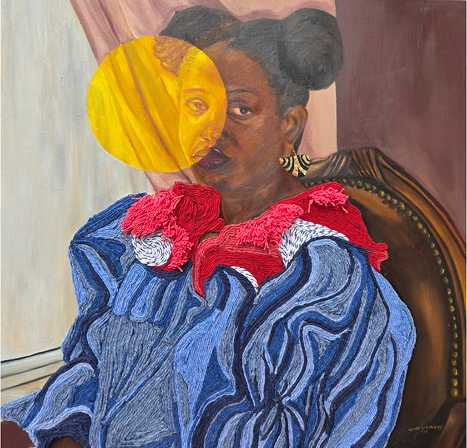
Thinking about an artist who has an understanding of textiles, fabric, and material—she’s been able to move in and out of it—making textile-driven works but also paintings that incorporate mixed media. I liked this oscillation, which gestures towards fluidity. This work, particularly the one on view, is profoundly personal. It’s a self-portrait. She just became a mother; she’s trying to re-examine her role in this world as a mother, woman, artist, and creative.

If you look at the painting, it’s almost like sunlight over the eye, which could also be a magnifying glass—this moment of reflection, both for the viewer and for her as an artist. I’ve always been drawn to work that incorporates mixed media, and she’s been able to do that seamlessly, in an interesting way.

A prize like this can be an incredible catalyst for an artist’s practice. Even being at the opening last week, it was great to see all the artists in dialogue and exchange—you have artists from Shanghai and Antwerp. I hope that this becomes a group that stays in contact and continues to dialogue beyond this project.
Larry Ossei-Mensah
African art
diaspora art
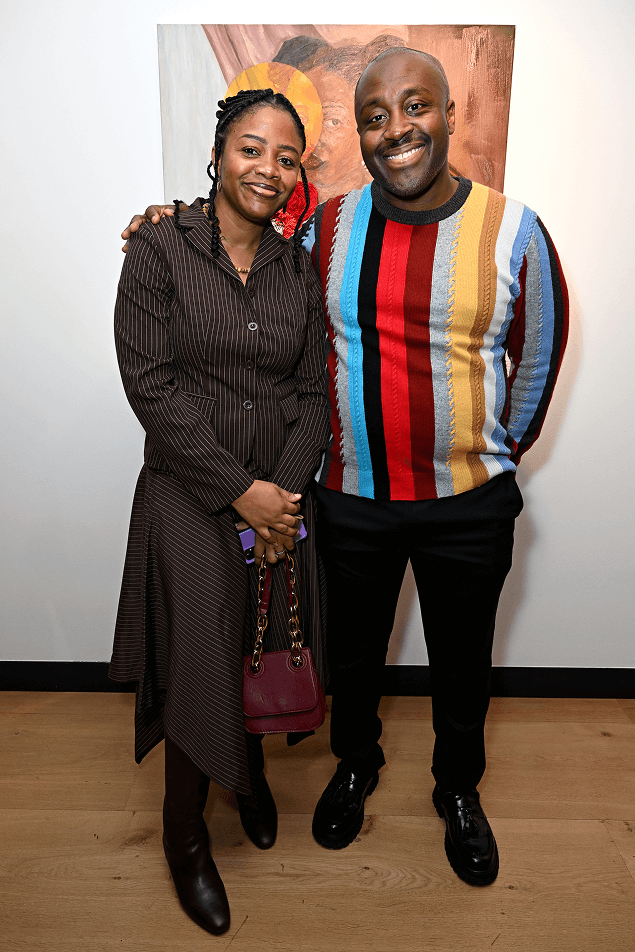
LARRY OSSEI-MENSAH with CECILIA LAMPTEY-BOTCHWAY
Larry Ossei-Mensah
African art
diaspora art
CECILIA LAMPTEY-BOTCHWAY
Resiliance, 2026
Larry Ossei-Mensah
African art
diaspora art
CECILIA LAMPTEY-BOTCHWAY
Courtesy of LARRY OSSEI-MENSAH
Larry Ossei-Mensah
African art
diaspora art
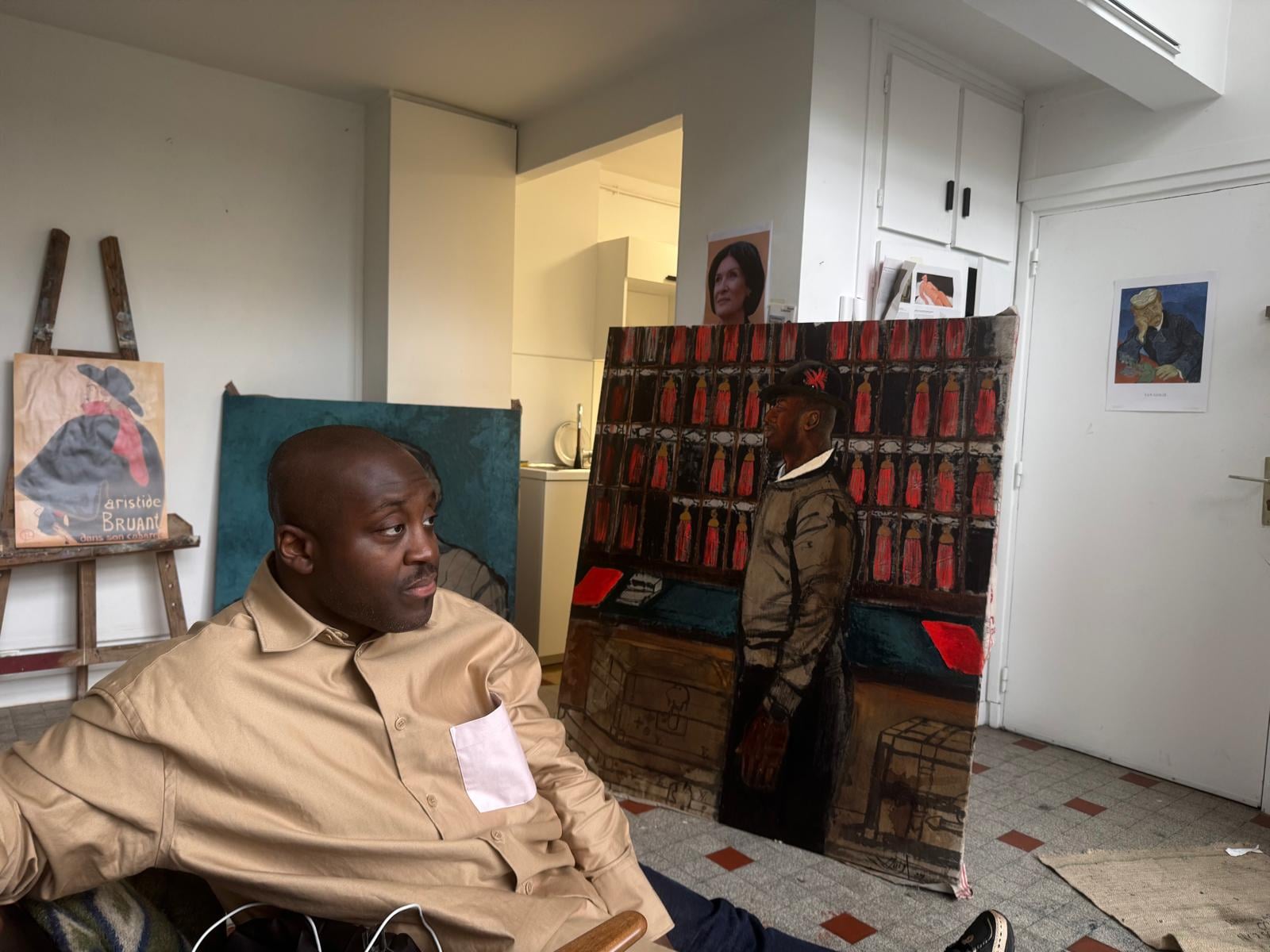
LARRY OSSEI-MENSAH with ZEH PALITO at his studio in Brazil
Larry Ossei-Mensah
African art
diaspora art
LARRY OSSEI-MENSAH with JULIANA DOS SANTOS

h: In your view, how does Cecilia’s work embody the spirit or vision of the prize—both in terms of innovation in contemporary art and the broader dialogue it seeks to create among emerging international artists?

LOM: Particularly coming from Ghana, I have a different context and more nuanced understanding. There’s been a lot of attention on artists from Ghana and West Africa in the last decade in terms of emerging contemporary art, but there’s always been the question, ‘Where are the female artists?’ Because if there’s a list, the majority of them are male, and if they are female, it’s someone like Lynette Yiadom-Boakye, who’s been doing this for over 20 years and is more in the diaspora. I’m happy to see so many more female artists from Ghana now getting some shine. For someone who was based in Ghana and is now based in the States, Cecilia offers a compelling perspective that people may not necessarily be used to seeing.

There’s an opportunity to connect with a broader audience and tell the stories of what it is to be a woman, an African woman, a Ghanaian woman—now a Ghanaian woman living in America. You have all these layers that further complicate her identity but also her approach to practice, because much of the work was about being situated in space. Now, how does that work evolve when you’re not necessarily in Ghana? Ghana doesn’t leave you; your identity doesn’t leave you, but you have to adjust to a new variable.

There are particular idiosyncrasies and ways things are done that you have to adapt to. How do you do that as an artist, but also as a parent and a wife? Those layers now offer source material. The source material becomes even more interesting when you have a country with a history of immigrants coming here, bringing their stories, rituals, food, and creativity, and weaving them into the country’s fabric. Even though we’re now in a climate where that’s continually being questioned, the reality is that’s the construction of the United States. People can say what they want—that’s the reality. How do you navigate a reality and a climate where there’s an attempt to erase or negate that history?

It’s an interesting opportunity for her as an artist to use this platform to articulate how she’s seeing, feeling, understanding, and maybe not understanding it. Art is such a great platform to instigate those conversations. At this point in her career, even after observing what Paul’s been able to do on the design side, it’s about identifying the right person at the right time in their career and giving them the tools and platform to take things to the next level. That was very clear to me, looking at all the applicants and concluding that she would be the best to represent New York for the art prize.

h: Your mentee, artist Cecilia Lamptey Botchway, like you, is Ghanaian and now based in New York. Much of her practice centers on narrating the lived experiences of African women through mixed media, performance, and textile-making. How, if at all, does your shared heritage shape your understanding of one another? Has her exploration of gender in Ghana prompted you to reconsider your own place within that cultural fabric, or your understanding of the women around you?

LOM: It definitely heightens my awareness, but it’s something that I’ve been thinking about because I was born here and go back to Ghana to visit. This is something I was thinking about over a decade ago, as a collective action, what we can do to catalyse the voices of more female artists. I’m not going to pretend it was just me. There are many organisations, such as Dot Ateliers by Amoako Boafo, Dikan, Wold Faze Art + Practice by Kwesi Botchwey, KNUST, Red Clay Studio by Ibrahim Mahama, Gallery 1957, and the Nubuke Foundation. There’s a constellation of organisations and individuals committed to making sure that stories are told across the board.

There’s always a sensitivity and awareness to ensuring parity—not just privileging male or female voices. It gives me a bit of understanding of the nuance, but there’s also trust. When an artist and a curator engage in dialogue—whatever that may look like, whether it’s an exhibition, mentorship, or writing a text—there must be trust to talk honestly, exchange ideas, and interrogate them. It’s been a fruitful exercise to go through that experience together.

h: The prize emphasizes mentorship and cross-cultural exchange—how have you approached supporting Cecilia’s artistic development?

LOM: Really, through dialogue. She’ll share with me what she’s working on. She’ll show me paintings that she’s working on, and it’s about being a sounding board. She’s a competent artist, so when it comes to a complicated idea, how do you make that idea more nuanced?

With this prize, for example, there’s going to be a lot more attention, and people are going to be reaching out with opportunities. Now, how do you evaluate opportunities that will serve as building blocks? I’m a believer that it’s a marathon, and you don’t want to jump into any opportunity just because it’s offered to you. It’s about asking, ‘How is this a building block towards the goals that I want to establish for myself as an artist, as an individual, as a woman?’

It’s really about being a sounding board, offering guidance when she has questions or doubts, and trying to be there to help her navigate and figure out how she wants to move the practice forward.

h: Your work as a curator and cultural critic has influenced institutions worldwide, earning recognition for its clarity of vision and conviction. How did you cultivate your curatorial eye—both professionally and personally—and in what ways has your international perspective refined or complicated it?

LOM: You refine it by looking—that was the first thing I learned. One of my first mentors in the arts was Bob Buck, who served as the Brooklyn Museum’s director for about 13 or 14 years. He always impressed upon me: look at everything, but make the distinction between what you like and what’s important. Not everything I show I may personally want to live with in my home, but if it’s crucial within the context of now, or the time in which the project is being developed, ideated, or executed, you have to be attuned to that and how including that work into a project will help with engaging your curatorial thesis.

It’s about developing an intuition, but also a cognitive facility to understand what is contemporary. It’s not just about looking at artists—it’s about looking at what’s happening in fashion, music, cinema, the streets, and the community. What’s the dialogue? Through those conversations, listening, and exploration, you pinpoint consistent themes. Thinking about now—living in America—it’s about the current administrative climate, affordable living, immigration, and women’s rights. Then you try to see if that triangulates whatever might be your focus via exhibition making.

Another key aspect is building great relationships with artists. I started curating in 2008, and since then, I’ve worked with many artists I’ve known, both formally and informally. I discover artists through other artists. It’s about establishing a network of exchange.

In terms of the international piece, that’s been the most significant thing I’ve learned. I had the honour of meeting Quincy Jones in 2004 when I was 24 years old. I asked him, ‘What’s the secret to success?’—a typical 24-year-old question—and his advice was: ‘See the world. See how other people live. Try to understand that nuance, and through observation and immersion, you’ll gain a better understanding of how humanity operates, how other creatives operate.’

Every place, every country has its codes, rituals, and nuances beyond just language. Then you immerse yourself in those spaces, understand the codes, and see if there’s alignment. Sometimes there is, and then you assume that code into your way of being and living.

I’ve been spending a lot of time in Brazil, Greece, and Italy over the past several years—it creates a new challenge because you can’t just cut and paste. Information that registers in São Paulo will register differently in London. It’s not about hierarchies—you have to factor in cultural differences. The quality is there, but how I write a text for a Brazilian audience, because it must be translated into Portuguese, is going to be different from how I write for an Italian audience.

I enjoy that because it challenges me to question my ideas and assumptions. I did my graduate studies at Les Roches in Switzerland, and my classmates were from all over the world. We’d do group projects, and they would always say, ‘Stop thinking like an American. There’s not only one way to approach things.’

I have my lived experience and identity as a Ghanaian-American, but I also have to be cognisant of the environment. How do you bring your point of view to a project or a space, but then unlock something that may have been in front of someone’s face that they took for granted? It’s about maintaining a beginner’s mind.

If I’m doing a project in Brazil, maybe there’s an elder statesman or stateswoman that everyone knows. A great example is Fabric of Being, a show I just did with Almeida & Dale, putting Esther Mahlangu, who’s from South Africa, in conversation with Rubem Valentim. It was interesting for people to see a correlation, even though they had probably never met or seen each other’s work in dialogue before, and to think about indigeneity—what it means to use codes, symbols, and rituals from your own identity and to manifest them through artistic gesture and practice.

I relish the opportunity to enter a new environment, learn, and understand how artists, curators, and institutions work. What’s the delta where I can create an opportunity and maybe offer a new conversation or point of view? Concurrently, how do I take what I’ve learned in those places and bring it back to the States when I’m doing projects? Then, when I do a group show in New York, I think about how I can include a Brazilian, Filipino, Japanese, and South African artist, for example, and offer a new perspective to my audience. It’s a nice back-and-forth that I try to stimulate through the practice, and it creates this ongoing exchange.

h: Can you recall the first work of art that truly stopped you in your tracks—something that changed the way you see the world?

LOM: I remember that Campari used to do these exhibitions called House of Campari. They featured emerging artists and were curated by Simon Watson. I remember seeing Nina Chanel Abney’s work for the first time, Mickalene Thomas’s work for the first time, and Rashid Johnson’s work for the first time. There was a painting by Titus Kaphar that knocked my socks off.

If you know Titus’s work, sometimes he cuts out the figure and leaves a void within his canvas. It was a painting in which he made that gesture, and the cut-out was on the floor while the painting was on the wall. I was just like, ‘Wait, what’s going on?’ Because before that, much of my relationship with art was more modern or post-war—someone like John Biggers or a Romare Bearden—more traditional forms, I suppose. Titus’s work totally fractured that. I was just like, ‘Wait, you can do that?’ To see an artist take such liberty, but also through that gesture of cutting out—whether you look at it as removal or as a historical correction, centring a brown body in the painting—I was utterly confused, mesmerised, and excited.

It’s a story I tell often—Titus and I are friends now. His work was like an ‘aha’ moment. That’s when I said, ‘Okay, I want to be part of this,’ because my journey started in photography, and I realised that photography wasn’t going to be the best way for me to participate. Then I started writing about art, and then curating. It was about creating that moment for other people—the catalyst that made me want to be part of the art world.

It was transformative. You often hear people say art can be transformative, exhibitions can be transformative—and sometimes we repeat that to the point where it becomes a cliché—but when you have those moments, and it’s not necessarily something you knew you needed, it’s an awakening. That moment with Titus’s work back in 2008 was the spark plug that I needed. I’ve been chasing that moment ever since.

h: Has there been a particular project or exhibition that profoundly shifted your worldview? What changed for you in that process?

LOM: I would say Souls of Black Folk, featuring the work of Amoako Boafo. The exhibition presented me with the opportunity to collaborate with Amoako Boafo on his first US institutional exhibition, and we toured it to four museums—CAMH in Houston, MOAD, the Seattle Art Museum, and the Denver Art Museum. To ideate with a fantastic artist and share his story with the constellation of these communities was remarkable.

Seeing the reaction, particularly when we did it in Houston, you had people who drove from other parts of Texas just to be there for the opening. If someone said, ‘Oh, I drove from San Antonio,’ or ‘I came from Dallas,’ you’d look at them like they were crazy—driving several hours, just to see and experience this moment.

Another project was an exhibition I co-curated with Susan Cross featuring the work of Allison Janae Hamilton at MASS MoCA. It was special because it was my first museum show, and MASS MoCA exhibitions are often up for 10 months to a year. It’s a different exercise from something that’s three to four months—you have to make it feel fresh every time. Allison was someone I’d been following for a long time, and collaborating with her to present her first institutional solo exhibition—showcasing her photography, sculpture, and video, which have become an essential part of her practice—was incredible.

Most recently, Sonia Gomes: Ó Abre Alas!, an exhibition I co-curated with Nora R. Lawrence, Executive Director at Storm King Art Center, and Adela Goldsmith, Assistant Curator. This was Sonia Gomes’s first institutional solo in the United States. Sonia is a master of her craft. She’s in the MoMA collection and shows all over Europe. To collaborate with Sonia to present her work in a museum setting—something we worked on for three years—was extraordinary. Through that process, she participated in other exhibitions that I curated, and I gained a deeper understanding of her practice and what it means to be a sculptor working with textiles and other materials. We commissioned her to do an outdoor installation, which was an interesting challenge and exercise for all of us.

It was exciting because it was my second outdoor installation, and the first in which you had to submit to nature—a very different exercise from working in a white cube, where you control the conditions and lighting. Here you have this incredible installation and a tree on Museum Hill, and if it rains, you can’t make it stop. If it’s windy, you can’t control that. So nature becomes a collaborator in the work’s presentation. The landscape becomes your collaborator. It’s almost like a conceptual painting that keeps changing every couple of months, which was super exciting.

Each project is an opportunity to learn and refine the approach—to sharpen something. Someone will come to see the show and say something you hadn’t even considered, and it may change your whole perspective on the endeavour. I try to stay in a beginner’s mind and always in a space of learning. As much as I know, there’s still a lot to learn, and that’s what makes going on this journey as a curator so much fun.

h: In 2013, you co-founded ARTNOIR, a platform devoted to amplifying the voices of creators of color. When did you first sense that this was something you needed to build, and what catalyzed its formal inception?

LOM: It was organic. At the time, I had joined several museum groups and saw how they operated and ran programming, but I wasn’t satisfied with those experiences. So I began to sense there was a need for something different. So we started organizing art trips and field trips—going to see shows and saying to friends, ‘Hey, I’m going to Storm King,’ or ‘Dia Beacon,’ or ‘the Barnes—who wants to come?’ People were responsive, and the groups were getting bigger. Many friends weren’t necessarily in the art world but were interested in it or worked in adjacent fields, such as advertising and marketing.

Through that, my co-founders and I realised we might have something, because we were consistently gathering strong groups. My co-founders and I realised there was something here—something that could serve our community.

I’ve always believed that if you don’t see it, create it. It was interesting to organise talks or exhibition tours while concurrently building relationships through my curatorial practice. Friends were getting hired at museums, curating shows, and artists were getting opportunities. It became this organic ecosystem—I began to wonder how to create a Venn diagram that supports the next generation of artists, cultural workers, and curators while also cultivating the next generation of patrons.

Things have changed significantly in recent years regarding institutions, inclusion, and participation compared to then. There was an effort to create a place where we felt welcome, where we felt seen—and where artists felt seen—a space for exchange. Through these exercises, we realised we needed to formalise it as an organisation.

It’s been an incredible journey. We’re a 501(c)(3) now, and all the money that comes in goes back into the community to support opportunities. I don’t think people realise that none of us take a salary for this. We try to make all of our events and experiences free when possible.

We have our Jar of Love grant, which we started in 2020 in response to COVID. Many colleagues were being furloughed or laid off and were in a tight squeeze, so we asked, ‘How do we help?’ We held an online art auction with Artsy, raised funds, and reinvested those funds into our community. Since 2020, we’ve been able to reinvest over $350,000 into more than 150 artists, cultural producers, and curators—to help them buy materials, pay rent, or fund travel, research projects, and exhibitions. Seeing that impact has been incredible.

In the last few years, we’ve partnered with Sotheby’s, and several weeks ago, we partnered with Live Culture to see a play called Practice by playwright Nazareth Hassan. Some of our Jar of Love alumni attended, and one told me it was the first time they’d ever been to a play. That was beautiful—to be able to say we offered that experience—gratis. Even most recently, we partnered with UBS to give away over 400 tickets to our community to attend Art Basel Miami Beach, 2025. Moments like that make you understand the value, because sometimes these experiences are expensive, or you don’t know they’re for you. Our goal has been to continue collaborating with different organisations, artists, cultural critics, dancers, writers, and visual artists. Art is the foundation. How does art intersect with life? For example, we recently had a conversation with Arthur Jafa and Ebony L. Haynes, who runs 52 Walker, to celebrate his book Live Evil, which feels like an extension of his—an ever-evolving exercise. What my co-founders and I are building with ARTNOIR has been fruitful because we’ve been able to invite people into spaces they may not have previously felt were for them and let them know they belong.

h: The United States is often mythologized as a ‘melting pot.’ How accurate do you find this metaphor—particularly in terms of art, identity, and cultural production? And how did growing up in the Bronx on the periphery of one of the world’s wealthiest and most culturally saturated cities shape your perception of access, privilege, and opportunity within the arts?

LOM: Growing up in the Bronx, growing up in New York, you learn how to be a hustler. You know how to make the most of the opportunities presented to you. In terms of institutions, it’s about recalibrating that relationship, because when I was young, you might have had a school trip to a museum, but it didn’t create a feeling of belonging. It wasn’t until adulthood that I realised the potential within these spaces and that I did truly belong, but moreover, we can create our own institutions that make folks feel welcome.

I’ve always believed that if I’m there, I’m there—I’m never going to allow myself to feel excluded. Sometimes there are direct or indirect attempts to do that, but I think art is for the public—it’s for the public good and public inspiration. It’s been a fascinating journey creating those experiences for others.

New York is an interesting place; it really is a melting pot. It’s strange because if you’re on the metro, you’ll have someone from one background and economic status sitting next to someone completely different—we’re all in this together. Being a New Yorker is distinct. It’s different from living in other cities.

The varying pockets of different communities allow you to see cross-sections of people living in various spaces—that’s just what it is. Some areas are more posh than others, but once you get into the city—Columbus Circle, SoHo, Washington Square Park, Union Square—it becomes this confluence of people. It’s not “you stand here, I stand there.” What makes New York enjoyable is that, even though it’s a challenge now, the creative community has always found ways to come here, find home, find their tribe, and find space to create.

Growing up in the Bronx in the 1980s and 1990s—if you think about graffiti culture—it emerged as a form of resistance, frustration, and a desire to be seen. Out of that, you also have hip-hop culture. Growing up in New York, you learn how to make a way out of no way. You learn how to take lemons and turn them into lemonade. You learn how to take a DJ, an MC, and a breakdancer and turn that into a multi-billion-dollar business. You learn how to be crafty, creative, and industrious.

Those things are ingrained in my DNA and inform how I navigate the art world. I never felt it was inaccessible because I didn’t consciously think about it growing up. In retrospect, maybe it was—but New York is great in that there are always things to do. You just figure out what’s accessible to your budget and what’s interesting to you. As you mature, those things shift and change.

When a price tag is attached, accessibility becomes more salient. That shapes the work we do at ARTNOIR. For example, Carrie Mae Weems is doing a project at Lincoln Center in January. I admire her; we’re acquainted. So I think, ‘How do we support Carrie, but also introduce new audiences to her work?’ We’ll get a group of tickets and bring people. Some may not know they need or want to go, or it may not be in their budget. It’s about instigating those moments because, having worked at a museum, I understand that audience attention, attraction, and retention are always challenges. It raises questions like: Who is your audience? How are you promoting these things? I use my museum experience to identify opportunities. For example, Rashid Johnson has a show at the Guggenheim—how do we get our network to know it’s there and see it—without prescribing the experience—but knowing it could be transformative?

Larry Ossei-Mensah
African art
diaspora art
LARRY OSSEI-MENSAH with CECILIA LAMPTEY-BOTCHWAY
Larry Ossei-Mensah
African art
diaspora art
LARRY OSSEI-MENSAH with ZEH PALITO at his studio in Brazil
Larry Ossei-Mensah
African art
diaspora art
LARRY OSSEI-MENSAH with ZEH PALITO at his studio in Brazil
Larry Ossei-Mensah
African art
diaspora art
Exhibition view Sonia Gomes: Ó Abre Alas!
The exhibition was organised by NORA LAWRENCE, Executive Director of STORM KING ART CENTER, and LARRY OSSEI-MENSAH, independent curator, with assistance from ADELA GOLDSMITH, Assistant Curator at STORM KING ART CENTER
Photography by ANTHONY ARTIS
Larry Ossei-Mensah
African art
diaspora art
Exhibition view The Poetics of Dimensions at the ICA San Francisco, curated by LARRY OSSEI-MENSAH ( October 2024–March 2025)
Photography by NICHOLAS LEA BRUNO 
Artist in the foreground: ESTEBAN RAMÓN PÉREZ and ANTHONY AKINBOLA
Larry Ossei-Mensah
African art
diaspora art
Installation view. POV – Defining Your Point of View. PAUL SMITH SPACE, November 2026

h: You’ve spoken about the need for institutions to confront their complicity in sustaining systemic oppression and racism. How do you navigate the tension between working within these very structures and challenging them to evolve?

LOM: It’s this idea of kaizen—a Japanese philosophy rooted in manufacturing that focuses on continuous improvement. This is not something we’re going to solve tomorrow, and we may not solve it in my lifetime. It’s a constant effort, unfortunately, but that’s reality.

It’s something that has to come from both sides: people working within institutions, people working with institutions, and people working to hold them accountable. Having worked in an institution, you identify some of the challenges—a lot of them are attached to funding, human resources, and structure.

It’s about ensuring that institutions have a workforce that’s a cornucopia of perspectives and not monolithic or homogeneous. And not just in terms of race or gender, but also psychographic diversity—you want people who think differently. When you bring that together, it may create friction, but out of that friction a diamond may emerge, enabling you to address the needs and interests of a multiplicity of people.

That’s always the north star: when I’m doing a project with an institution, I assess how the place works. What are the challenges? What are the opportunities? What can I do as an outsider—as a guest—to point out areas for continuous improvement? It’s different if you work there; it’s more complicated. There’s always space for growth—structurally, organisationally, and in the artists you bring in. The artists you collaborate with will often have specific requirements for how they want to work, operate, and have their work shared with the public. It’s a constant negotiation.

It also comes down to human respect—respecting me as a person, as a colleague, and respecting the artist. Communication is key. Often, challenges arise because people don’t communicate clearly—they’re passive-aggressive instead of addressing issues directly. That’s interesting when thinking about international contexts.

h: Paris and Venice have long served as enduring pillars of the fine arts world, while the United States—perhaps due to its relative youth—continues to define its artistic voice. Where do you see the U.S. positioned in the global arts conversation today? Do the nation’s internal tensions inevitably manifest on the international stage?

LOM: It’s evident when you look at places like Argentina. The Netherlands was on the brink, but they figured it out, where you see more conservative administrations coming to the fore.

I was talking to someone recently who said that what America has done best is brand itself. We’re great at branding this American identity, this ideal, this point of view. I can offer other artists a perspective on how to deal with the messiness and challenges—from an economic standpoint. Much of what we do here drives the international art world, but there’s still room for growth and exchange. You might have an artist like Kerry James Marshall, whose incredible show at the Royal Academy in London, yet you have some audience members who aren’t too familiar. I look at these as moments of learning and discovery.

We each do our part in this global ecosystem. There are figures like Warhol and Jean-Michel Basquiat who are internationally known, but at the moment, there’s still much more opportunity for exchange and mutual learning. You have artists who may be household names here or in parts of Europe, but if you take them to Southeast Asia, no one knows who they are.

That’s the beauty of this international exercise—there’s still so much to learn, exchange, and discuss. This climate heightens awareness, because when I travel, people often ask, ‘What’s going on in your country?’ That opens a space for dialogue.

When you talk about Venice and Paris, many of these patterns have occurred before. The key is learning from history to avoid repeating the same mistakes. In our pursuit of democracy and freedom, how do we use art as a catalyst to call out these issues?

We’ve still got a lot of work to do, but it’s an ever-evolving process. There’s no endpoint—it’s continual growth and exchange. In a climate where books are being banned and history is being rewritten, it will be artists who call those things out, question them, and challenge them. It’s a moment—a wait-and-see situation.

h: As U.S. cultural institutions face heightened scrutiny and strain under the current administration, how has your capacity to do this work—and the responsibilities tied to it—evolved? With your global presence, do you ever feel the impulse to re-center yourself elsewhere, where there might be greater creative freedom?

LOM: There’s no endpoint in this work. You continue to learn how to be crafty and creative. Personally, thinking more deeply about how we double down on cultural solidarity—Black, Brown, Asian, Indigenous, and queer communities, all of which have been pushed to the margins, or at least there have been attempts to do so. When you do the math, we are the majority, but there’s still an effort to keep us apart. It’s about identifying collaborators and how I can work with them in solidarity, where there’s like-mindedness or at least a shared goal.

Institutions have been financially challenged. There’s also been censorship, so how do we recalibrate our relationship with these institutions? It’s been interesting to see how many artists are creating their own spaces—project spaces, residencies, communes, and collective spaces.

The question becomes: how do we support those spaces that are working to fill the gaps created by a lack of fiscal support or by changes in institutional mandates? Some institutions can’t apply for specific funding because of the terminology they use, and that may require a shift in mission. How do you negotiate that? Sometimes you adjust the language to secure funding while continuing the same work under different terms. For others, it means creating a new set of terms and conditions to ensure the multiplicity of voices is heard. It’s a constant negotiation.

Because I move in that way, I’m not as frustrated as some colleagues who have a very fixed perspective on how things should operate. I see it as: the institution serves an important function, but at the end of the day, there’s no institution without people. There’s no art world without artists.
I prioritise foregrounding artists, cultural workers, and curators—ensuring they feel supported in mind, body, spirit, and finances. Artists are amazing; they’ll always find a way. They’ll take an abandoned building, squat in it, and make it work until it no longer can. That’s inherent to creative people and creative communities. It’s now about shape-shifting and using inventive tactics to keep pushing forward.

h: What do you think is most vital for the public to understand about the state of the fine arts today—and about the institutions that hold space for it? What would you like to see more of, both from audiences and the next generation of artists?

LOM: Understanding that it’s an exchange—there’s no institution without an audience—and recognising that these institutions exist for them. How do you hold them accountable while also supporting them when they take risks and try new, interesting things? How will institutions reach communities that don’t feel these spaces are for them? I’ve seen some institutions begin bringing art into communities through mobile projects—initiatives that extend their work beyond the walls of the museum or gallery and bring it directly to people.

The museum isn’t just an arbitrary structure that holds art—it has the potential to be a thriving beacon, a hub. I love what the Serpentine does in London, where it has a pavilion and hosts public convenings. How do you, as an institution, create these moments of accessibility where people can bring their families? Some institutions are already doing this, but how do we do more? And how do we go into communities and say, ‘Hey, this is for you. We want you to be part of this’? There is no institution without public support.

We need more exchange, and I’m beginning to see that, which is encouraging. I also hope to see more artists decentralising and creating their own spaces. Many are already doing it—Derrick Adams has The Last Resort in Baltimore, for example—and we’re seeing the continued emergence of cities like Baltimore, Philadelphia, and Atlanta. These places aren’t necessarily New York or L.A., but they’re developing their own ecosystems. It will be exciting to see how these cities evolve and cultivate their artistic networks in the years ahead.

Words: ISABELLA MICELI

ISSUE 7

The new edition is here