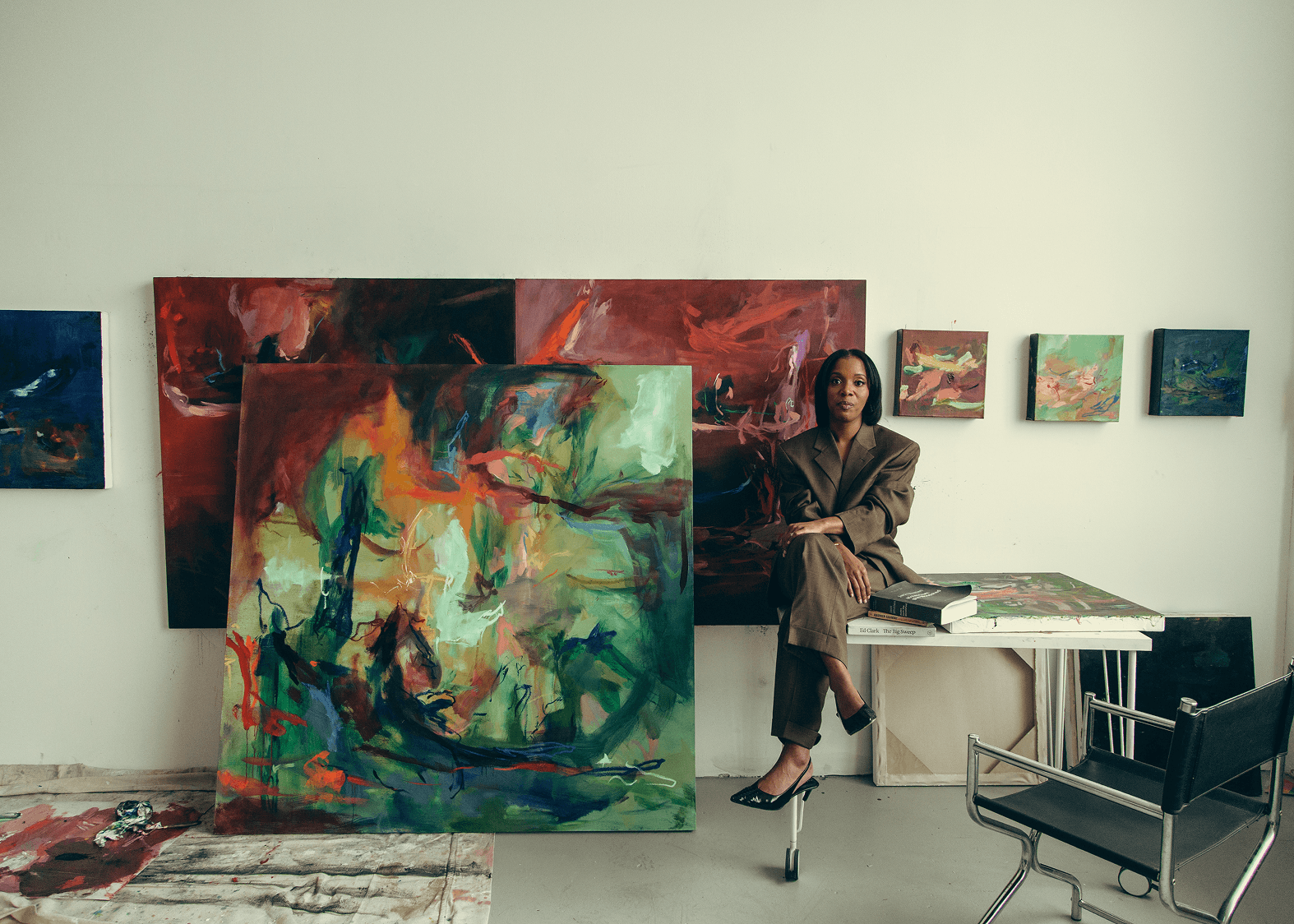
In the span of just a few years, Lindsay Adams has established herself as a promising emerging artist. With an interdisciplinary background in social sciences, she graduated from the School of the Art Institute of Chicago in 2025, soon afterwards experiencing a remarkably swift ascent: a solo exhibition at Sean Kelly Gallery in New York, a residency at Silver Art Projects, and a prestigious commission for the forthcoming Obama Presidential Center. As the youngest artist selected for this project, Adams joins a roster that includes Theaster Gates, Carrie Mae Weems, and Jenny Holzer. Her work, draws from her background in social sciences and is informed by a keen awareness of history, place, and belonging, opens new emotional and conceptual horizons in abstract painting.
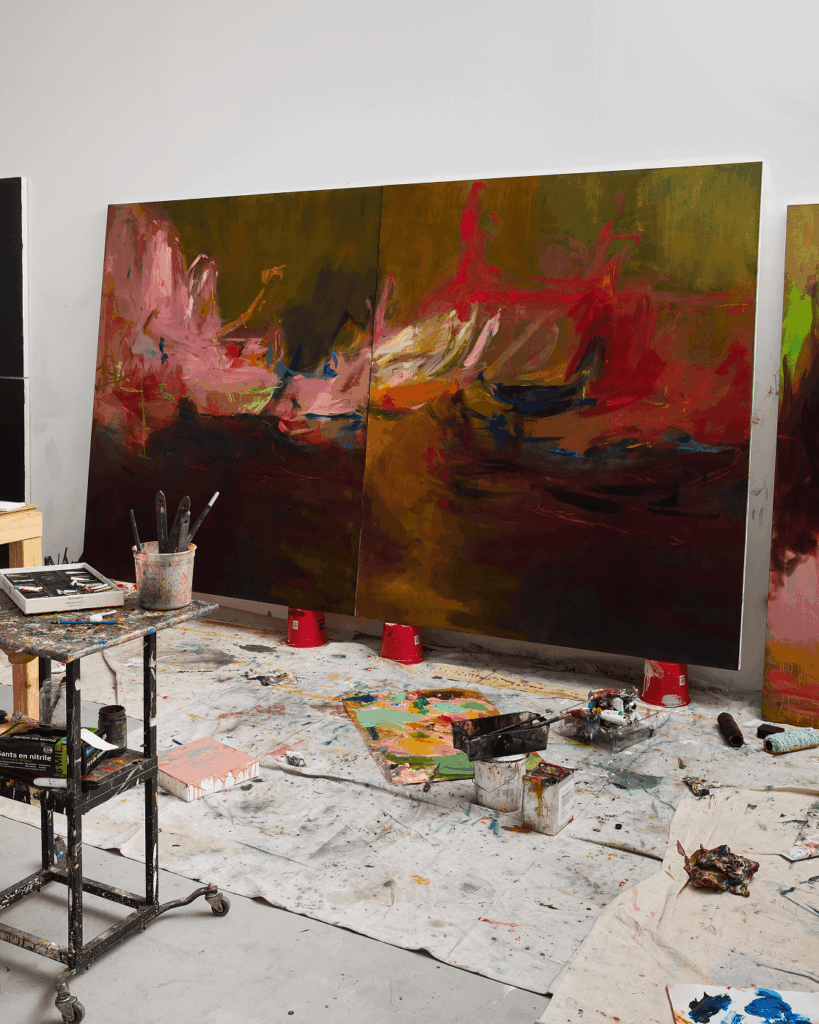
Her current exhibition, titled SOIL, is on view at Sean Kelly Gallery through June 6th, 2026. There, Adams pulls luminous, expansive worlds from a profoundly dark ground. She shows color as a dynamic material rather than something stagnant or still, exploring its influence on space and surroundings. The works hover between the familiar and the distant, inviting viewers to slow down amid a fragmented, image-saturated culture and engage with painting as a space for contemplation, wonder, and imaginative refusal.
hube: You’ve had an incredibly fast rise since graduating from SAIC in 2025—you opened a solo exhibition at Sean Kelly Gallery, received an Obama Presidential Center commission, and more. What has this moment felt like?
Lindsay Adams: I’ve had a wonderful year since graduating and am deeply grateful for the support and space I’ve found for my work. I have been working hard in the studio and in my research and am excited to continue building out various projects. This moment has felt encouraging and enchanting, and I am grateful to be a steward of my practice and to grow alongside it. I feel very grounded in the present and look forward to the future.
h: You came to painting after studying social sciences. How does that analytical lens shape your studio process, especially in thinking about abstraction, space, fugitivity, or psychological landscapes?
LA: Ive been painting for over half of my life at this point. I’ve had a chance to live, explore, and study subjects alongside art, which has made my appreciation and understanding for my practice much clearer. Coming to painting through the social sciences fundamentally shaped the way I think, observe, and move through my practice. I am constantly aware of interconnectedness and am discovering how things are related. I studied International Studies and Spanish at University of Richmond while minoring in Studio Art, and even then I was driven by a desire to understand worlds beyond what was directly in front of me. I’ve always been deeply interested in history, travel, cultural exchange, and the ways people construct meaning, belonging, and identity across space. My degree was interdisciplinary and I took classes across departments, so much of my studies spanned history, anthropology, political science, and sociology.
Embracing the social sciences and having a liberal arts background has given me the latitude to create a practice rooted in observation, research, and an empathetic attention to my immediate environment and the larger world. This layered way of thinking and problem-solving has allowed me a diversity in thought and making. I push and pull from different parts of myself and the world and bring that into the studio. My paintings are pensive and emotional, and I build them both intently and intuitively. I build colors and gestures, creating worlds that expand and hold. Fugitivity and this understanding of refusal, offers a way of thinking about movement, possibility, and refusal beyond fixed categories. It informs how I think about belonging, not as permanence but as something continually made and remade.
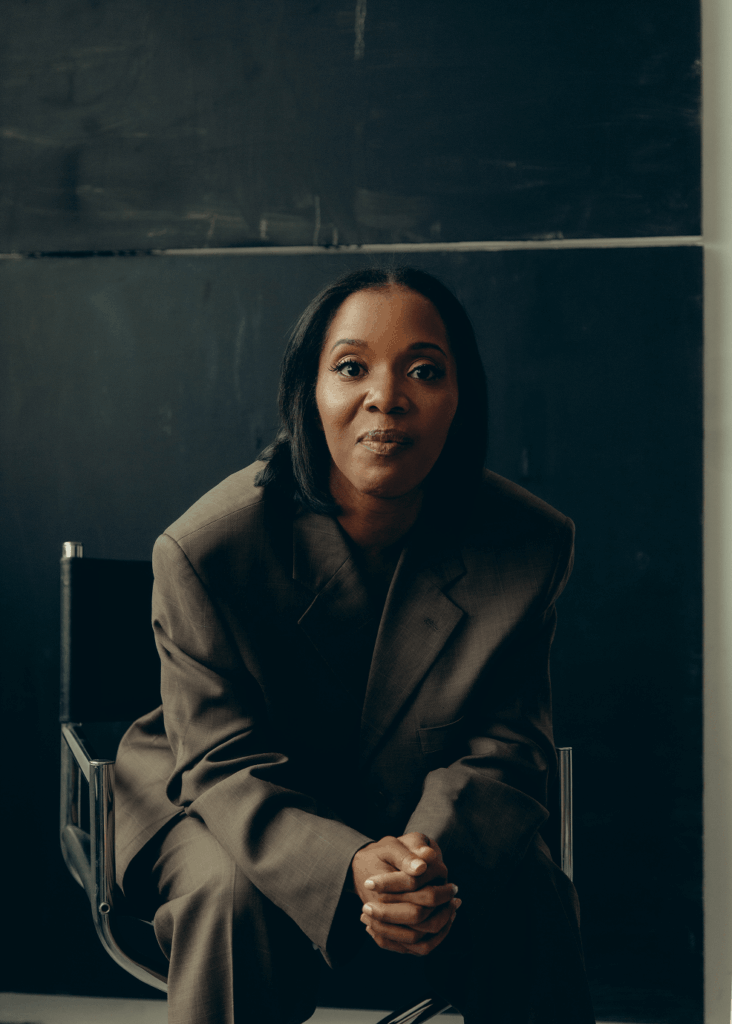
Photography by ERIN MORGAN TAYLOR